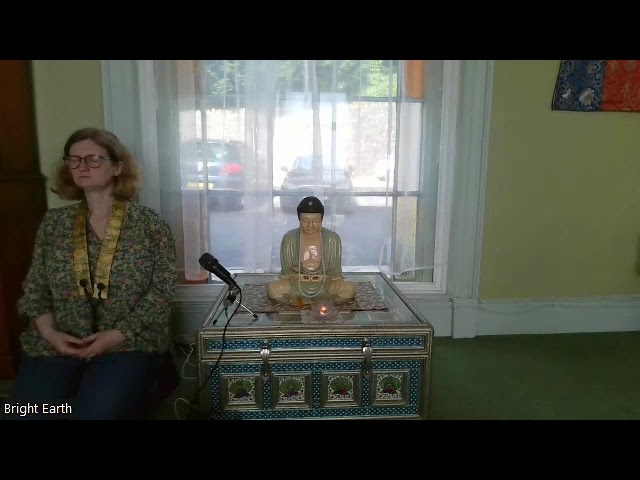
A dharma service led by a teacher featuring readings from the Larger Pure Land Sutra about Amida's radiant light, devotional chanting, and a meditation on taking in light. The service includes a reflective story about a cemetery gravestone inscribed with Psalm 36: "In thy light shall we see light."
Chapters
Good morning to everyone in the shrine room, and good morning to Satya Robyn, Robyn, and Chris. Really lovely to have you all here to practice with you. It's always a pleasure to to practice together. So this morning I'm going to begin with— it's all about light today. I'm going to begin with a reading from one of the Pure Land sutras, the, the larger Pure Land Sutra. And in this section, the Buddha is describing to Ananda, who he's telling this story to. He's describing Amida, he's describing Amida Buddha who has made his vows, and his vows have come to fruition. And this is, this is what the Buddha wants Ananda to know about Amida. The Buddha said to Ananda, The majestic light of the Buddha Amitāyaṣ is the most exalted. No other Buddha's light can match his. The light of some Buddhas illuminates 100 Buddha lands, and that of others 1,000 Buddha lands. Briefly, that of Amitāyaṣ illuminates the Eastern Buddhist lands, as numerous as the sands of the River Ganges. In the same way, it illuminates the Buddha lands in the south, west, and north, in each of the four intermediate directions, above and below. Further, the light of some Buddhas extends 7 feet, that of others 1 yojana, of 2, 3, 4, or 5 yojanas, and the distance covered increases in this way until the light of some Buddhas illuminates one Buddha land. For this reason, Amitāyaṣṭha is called by the following names: the Buddha of infinite light, the Buddha of boundless light, the Buddha of unhindered light, the Buddha of incomparable light, the Buddha of the light of the king of flame, the Buddha of pure light, The Buddha of the Light of Joy, the Buddha of the Light of Wisdom, the Buddha of Unceasing Light, the Buddha of Inconceivable Light, the Buddha of Ineffable Light, and the Buddha of the Light Outshining the Sun and the Moon. If sentient beings encounter his light, their three defilements are removed. They feel tenderness, joy, and pleasure, and good thoughts arise. If sentient beings in the three realms of suffering see his light, they will all be relieved and freed from afflictions. At the end of their lives, they all reach emancipation. The Buddha continued, the majestic glory of the light of Amitābha could not be exhaustively described even if I praised it continually, day and night, for the period of one kalpa. So a kalpa is a very, very, very, very long time. So we will take light into our meditation this morning. You might just want to be aware of the actual light as it softly shines through your eyelids, or you might want to sit yourself in a quiet place within, uh, reaching distance of the Buddha's light and just allow it to Permeate, allow it to sink into your being. And of course, you can sit wherever you like because the Buddha's light is infinite. You can sit in a forest gl— a glo— uh, grove, or by the sea, or wherever you'd like to sit. Nam-myoho-renge-kyo.
Omami Devari. Om Ami Deva Shree. Om Ami Deva Shree. Mami te wari. Oh, Mami te wari. Oh, Mami te wari. Oh, ma mi de wa ri. Oh, ma mi de wa ri. Oh, ma mi de wa ri. Om Ami Te Wari. Om Ami Te Wari. Om Amitabhari. Om Amitabhari. Om Ami Dei Wari. Om Ami Dei Wari. Om Ami Te Wari. Om Ami Te Wari. Om Ami Te Wari. Omami te warri. Omami te warri. Om Namite Wahree. Om Namite Wahree. Om Namite Wahree. Om Amidevare. Om Amidevare. Om Amidevare. Om Namite Wah Re Om Namite Wah Re Om Namite Wah Re For refuge I go to Amida.
For refuge I go to Amida.
The one who is awake and full of love.
The one who is awake and full of love.
Namo Buddhaia! For refuge I go to the Dharma— all that guides us to wisdom and compassion. Namo Dharmaya! A refuge I go to the Sangha— those who live in the Buddha's light. Nammo sanghaya! For refuge I go to the Earth.
For refuge I go to the Earth.
The holy ground of awakening.
The holy ground of awakening.
Namobhumyay.
Namobhumyay.
With faith in the Four Refuges.
With faith in the Four Refuges.
And in light of our human tendencies.
And in light of our human tendencies.
I pray that I may become aware.
I pray that I may become aware.
Of when I take life.
Of when I take life— —I pray that I may become aware of this time they've come away from it.
When I take what is not freely given up, or my taking which has not really been done, I pray that I may become aware— —when I fall into sexual misconduct— —I pray that I may become aware— When I fall into wrong speech, I pray that I may become aware. I pray that I may become aware of when I become intoxicated. Of when I become intoxicated. No blame. Be kind. Be kind. Love everything. Love everything.
In the name of all sentient beings, we bow.
To save that one.
Inexhaustible are deluded passions.
We vow to transform that one.
Immeasurable are the Dharma teachings.
We vow to master that Infinites, the Buddha's way. We vow to fulfill completely.
So if we go out through our garden, out the back gate, there's a little road, and just over the road is Morven Wells Cemetery. There's a little gate just very close to where our back gate is. Sometimes I feel like it's an extension of our garden. It's really beautiful. The primroses were stunning, and then there's blossom on the trees. And the moment— there's a whole section of tall daisies. Um, and every time I go there, I find something new. I find someone new. There's a grave at the back which has a big palette carved into it, which is an artist's grave. There's under a tree, there's a lesbian couple who died about 30 years ago who were together for all of their lives. There's a woman at the front who's buried with her first husband, and her second husband is sprinkled nearby, which I really like. And, um, about a month ago now, I think I've shared this Before, in practice, I found on Edith McDowell's grave, and she died in the 1930s, it said, it says, 'In thy light shall we see light.' 'In thy light shall we see light.' I posted that quote on Substack the other day, and somebody responded and said, 'Oh, just to let you know, it's from the Psalms. It's from Psalm 36.' So I looked it up and I thought I would read you a little section of it. Thy mercy, O Lord, is in the heavens, and thy faithfulness reacheth unto the clouds. Thy righteousness is like the great mountains, thy judgments are a great deep. O Lord, thou preservest man and beast. How excellent is thy lovingkindness, O God! Therefore the children of men put their trust under the shadow of thy wings. They shall be abundantly satisfied with the fatness of thy house, and thou shalt make them drink of the river of thy pleasures. For with thee is the fountain of life. In thy light shall we see light. I love that it's got loving kindness in there, just for us Buddhists. And I was kind of— I was struck first of all by the similarity of those two readings, that, that, um, that the Buddha told a story about Amida, the light of Amida, and how bountiful and infinite that light is. And we're also— we're told the same story in this psalm and in, in in other, um, religious texts, in other spiritual texts, that there is something, there is something so generative, something so generous and beyond our knowing about this light. And I think that the quote on the grave caught me so much because I was kind of a little bit confused by it. I was interested in it, that kind of hook that you get from a good poem or a good something that, that, um, that pulls you in to think about it. In thy light shall we see light. It doesn't say in thy light shall we see your light. Um, it— I don't think it's talking about just the light that shines forth from the Buddha or from any great being. I mean, who knows? But I think that it's pointing to a function of a Buddha. A function of a Buddha is that in the Buddha's light, the Buddha is is just glowing, not trying to glow, they just are. In that glow, we can see that that light is everywhere. We can see in a— in it, when we see a great kind person being kind to somebody maybe who's not easy to be kind to, we maybe feel our own kindness for that person. When we see a great person enjoying a garden, we maybe look at the garden ourselves and we're like, wow, that's actually really beautiful. When we are in the light of a Buddha, we might look at ourselves reflected in that light of the Buddha and see our own light, see the light that is already in us. That we're mostly disconnected from, the light that, um, that can also shine forth just like Amida's light. So it's like a kind of, uh, it's like we borrow God's light, Amida's light, to wake us up to all light. And I'm hoping that sometimes when you come to practice with us online in this room, you might get little glimpses of that light in the world, in the natural world. It's sometimes easy— it's easy for us living in this beautiful space to see, to see the light in the natural world, but also the light in the pavements in the front of the temple or the, the rubbish, or the, the light in ourselves, the light in, uh, the kind of, uh, the darker corners of ourselves, the tangled, the tangled self-protection, that the light is always there underneath, behind, just waiting for us to connect with it.
Now, Moe, need to be In gratitude, we offer this incense to Buddhas and bodhisattvas throughout space and time. May it be as fragrant as the air itself, reflecting our careful efforts, our wholehearted awareness, and the fruits of understanding slowly ripening. May we and all beings be companions of Buddhas and Bodhisattvas. May we awaken from forgetfulness and realize our true nature.
So this morning, after a quick cup of tea, we have a Sangha meeting for anyone interested in helping us to share our Dharma and keep us funded. You don't have to have come before, just come along. Next Saturday at this time, Kasper's talk on no blame. Chamei's book group online is starting in June. And everything else is on the calendar on the website. I will come back in a minute. We'll just say a closing blessing. Blessed by Amitabha's light, may we care for all living things. You're on it.









