Buddhist Practice: Falling off the path, and treating all things as living beings
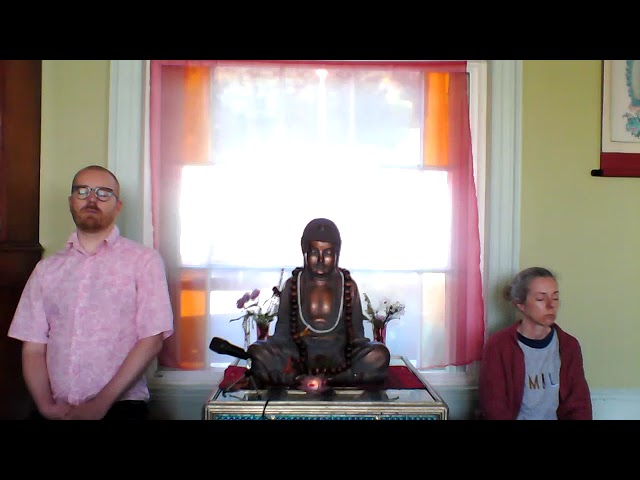
Katie shares her recovery from alcoholism and return to Buddhist practice. The group chants Om Amitabha, takes refuge vows, and hears a talk on treating all beings as living, drawing on Dongshan and indigenous ways of listening to the nonhuman world.
Chapters
Good morning, everybody. Special welcome to Philip, who's joining us on Zoom this morning. We'll start practice by listening to a Dharma glimpse. By Katie.
I take a deep changing breath as I put the words together to write this. I've been promising Satya to take up the challenge but have been avoiding actually completing the task. I find myself with some very unusual time off and this has now felt the right time. My path was always tight, long, and went straight ahead towards the horizon. But slowly, very slowly, I began to fall. I noticed myself slipping over the edge and I could no longer see the horizon, but instead I felt fear as if, as if I was at a cliff edge hanging by one finger. Gravel and stones were falling beside me. I was panicking, hot and sweaty, and this was only making my slip further. My legs swung underneath me and my breathing was tight and shallow. I was falling from my path, and quickly. What was beneath me, I had no idea, but it frightened me. What made me fall, I suppose you're wondering? I didn't fall, I was pushed, quickly and hard, by the force that alcoholism had grasped me and taken a hold of who I was. I had become a functioning alcoholic. I was trapped. I was lost, and I had fallen. I was left hanging like this for 5 long years, and I didn't know how to lift my foot on the path and get back up. And one terrible weekend in the midst of the COVID pandemic, I nearly fell completely. I needed to get back up, and I did. Someone took hold of my hand, and very slowly, over a period of nearly 2 years, I was up and walking back towards the bright, powerful horizon ahead of me. The person reaching a hand out was me, and I pulled the shame, the guilt, anguish, and fear from myself. I looked up, and there I was looking down at me smiling with a hand held out. I grasped my hand tightly, and as the tears fell, I managed a small frightened smile back, and I knew I was going to be okay. I found myself on the route back, guided by spirituality and faith. My mornings became bright and powerful, and my evenings became relaxed and calm. I practiced yoga, meditation, and I even began to run 5K regularly. I listened to Buddhist music as a way to escape temptations, And then I came across the Bright Earth Temple. I very quickly learned that with the love and care from Buddha, we can live the life of forgiveness, be calm, and embrace a healthy lifestyle. The words each week I speak with others, with faith in the Three Jewels I pray that I may avoid intoxication, remind me of the importance to stay on my path and keep walking with my head held high. I sometimes kick the bottle of wine in front of me straight off the side of my path listening to the crash of broken glass below me. And sometimes it might rain on my journey as temptation arises, but I would just open my umbrella and carry on towards the warm welcoming sunshine. We all have our own journeys and our own pathways, and I truly believe that with the glimpse of the Buddhist way, I am fairly back on track. And I sit amongst these wonderful people on Saturday mornings, and I feel love and gratitude. I pray that our paths keep bright, warm, and strong, The love we honor ourselves is so important. Namaste.
Thank you.
So we'll move into a period of quiet sitting together.
Om Amitabha, Om.
Om Amitabha Om. Om Amitabha Om.
Amitabha Om. Om Amitabha.
Om Amitabha. Om Amitabha.
Omami tabahum. Omami tabahum.
Omami tabahum. Om Amitabham.
Om Amitabham. Om Ami. Om Amitabha.
Om Amitabha. Om Amitabha.
Om Ami.
Tabam Omami tabam Omami tabam Omami sabahum.
Om Ami Tabahum. Om Ami Tabahum.
Om Ami Tabahum. Omami tabaho.
Omami tabaho. Omami. Om Amitabham.
Om Amitabham. Om Amitabham.
Om Ami. Om Amitabham. Om Amitabham.
Om Amitabham. Om Amitabham.
Omami tabahum. Omami tabahum.
Omami tabahum. Omami tabahum.
Omami tabahum. Omami tabahum.
Om Amitabham. Om Amitabham.
Om Amitabham. Om Mani Tabahum.
Om Mani Tabahum. Om Mani Tabahum.
Om Ami Tabavum. Om Ami Tabavum.
Om Ami Tabavum. Omami tapam.
Omami tapam. Omami. Tah ba om.
Om ah mi tah ba om. Om ah mi tah ba om.
Om ah mi Om Amitabha. Om Amitabha.
Om Amitabha.
For refuge I go to the Buddha.
For refuge I go to the Buddha.
Namo Buddhaya. For refuge I go to Dharma.
For refuge I go to Dharma.
Namo Dharmaya.
Namo Dharmaya.
For refuge I go to Sangha.
For refuge I go to Sangha.
Namu Sangha.
Namu Sangha.
With faith in the Three Jewels—
with faith in the Three Jewels—
I pray that I may not take life.
I pray that I may not take life.
With faith in the Three Jewels—
With faith in the three jewels I pray that I may not steal. —I pray that I may not steal.
"With faith in the 3 jewels—" " "...I " pray that I may not fall into sexual misconduct." "I pray that time they're not falling to sectionless conduct..." "With faith in the Three Jewels"— "with faith in the Three Jewels" "I pray that I may not fall into wrong speech." "I prayed so you might not follow me on stage," With faith in the Three Jewels, with faith in the Three Jewels, I pray that I may avoid intoxication.
I pray that I may avoid intoxication. No blame.
No blame. Be kind. Be kind. Love everything.
Love everything. Innumerable are sentient beings.
We vow to save them all.
Inexhaustible are deluded passions. We vow to transform them all.
Immeasurable are the Dharma teachings. We vow to master them all.
Infinite is the Buddha's way.
We vow to fulfill it completely.
The reason we bow to our cushions, the reason we puff up our cushions meditation cushions, plump them up and bow to them is because they are living beings. That's what I heard in a Norman Fisher talk that I was listening to a few days ago. It was a series of talks about the Zen, the Chinese Zen teacher or Chan teacher Dongshan. And one of the important encounters that Dongshan had important conversations, or at least let's say one of the conversations that's got handed down to us. So it's important to somebody because they remembered it enough to tell somebody else and tell somebody else and tell somebody else. Who knows what it meant to Dongshan? Was about a koan where the national teacher, the sort of head Buddhist teacher, says to another monk that this tile is speaking the Dharma. And they go on to talk about, well, what's it saying? It's like, well, you know, only the Buddhas can hear it. Can you hear it? No. The teacher's, no, I can't hear it. And the implication is like, I can't really hear it because I've been incarnated in a human body, so I have to use ordinary— I use ordinary human speech to communicate to you. And there's a value in that because those are the words that you listen in. So that's the way that you and I meet in this human realm. But partly as a consequence of that, I can't really understand what the tile is saying to me. But I trust that there are holy ones who can hear the Dharma being spoken by this tile. Or meditation cushion, or tree, or mountain, or river, or chandelier. There's lots of indigenous communities around the world who are deeply embedded in that way of being. And there's lots of indigenous communities whose sort of wisdom was fractured by Western colonialists, and there are still a few elders around passing on that intention and that way of being around listening to deeply listening to the world. There's the Future Psychology podcast. One of the episodes is about invasive species. In— it's, it's recorded on— in Western Canada, and they're one of the— are they looking at some islands where various species were taken that became prolific in ways that caused harm or were perceived to cause harm. Partly, some of the islanders were upset that the deer were eating all their flowers, and that is a cause of harm, but maybe it just needs a change of mindset. Anyway, they're exploring all the different kinds of responses to invasive species. And one of the, um, one of the people I spoke to was from the indigenous community of that area. And like, I didn't know I was going to talk about this, so I haven't looked up the name of that community. Apologies. And he was teaching people to really listen to the plant. He was both— I think he was trained as an ecologist in, in sort of, um, Western science, and also had received this initiation, I guess, in, into the mysteries of his own community. And it was, how do we really pay attention to what this living being is offering to us? What is the teaching that this living being is offering to us? And if we can really tune into that, including this kind of ecologist, more scientific ecologist view. So what, what are the sort of measurable facts of the case here? And a more, a more relational spiritual view of, can I really get down to this other living being's level and get a sense of what the meaning of this is? That different kind of solutions tend tended to appear to the issue of these invasive species. They were able to honor them as messengers almost, and enter into this reciprocal relationship where they discovered some value in what had been thought of as weeds and invaders and harmful beings. And, you know, most of us in this culture have been trained out of that way of thinking. Our, our society, capitalism, teaches us that other living beings and what we normally think of as objects, which some other cultures might think of as living beings, are there to be used, to be consumed, to prop up our sense of identity. And yet this causes a great harm to the Earth. It's one of the root causes of the climate crisis and the ecological emergency. It causes a great harm to us as we become isolated from these communities of other beings. It's a kind of existential loneliness it leaves us with. And in the Dharma Hall, in the shrine room, there's an invitation to begin training in this way of seeing the world. In those moments when we bow to our cushion and tidy our place Can we trust that we are taking care of a living being? Just a moment of experimenting with that way of thinking. And maybe every now and again we're able to take that into our daily life and slowly weave ourselves back into this sense of really Knowing how interconnected we are and how alive the world is around us.
Namaste. In gratitude, we offer this incense to all Buddhas and Bodhisattvas throughout space and time. May it be fragrant as Earth herself, reflecting our careful efforts our whole heart of awareness, and the fruits of understanding slowly ripening. May we and all Buddhas be companions of Buddhas and Bodhisattvas. May we awaken from forgetfulness and realize our true home. Nam-myoho-renge-kyo.
Blessed by Amitabha's light, may we care for all living things and the Holy Earth.
Namami Tobey. Namami Tobey. You made me cry again.









