Buddhist Practice: What's the point of ritual and ceremony?
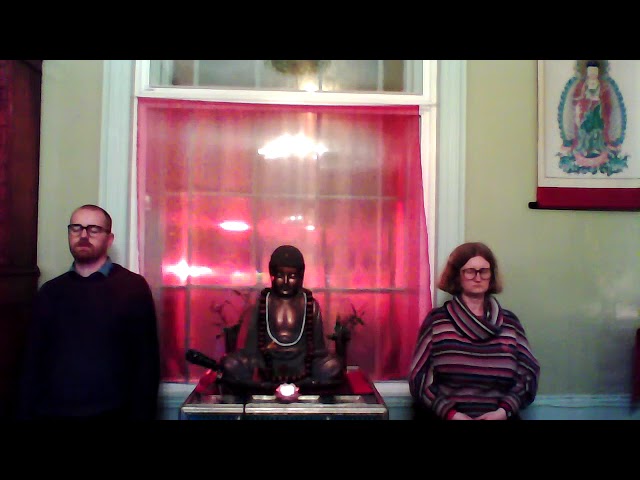
Satya Robyn leads a Buddhist service with guided meditation, chanting of Amitābha, and recitation of the refuges and Five Precepts. A Dharma talk explores why ritual and ceremony matter in practice, using a reading called Perfection to ground the discussion in lived experience.
Chapters
Welcome everybody, welcome if it's your first time, uh, welcome to Chris, Philip, and Kate, who are joining us on Zoom this evening. We'll begin as we always do by a Dharma glimpse, which is a piece of writing created usually by one of our community who's sharing some insight or a little bit of wisdom they've received, and occasionally from the Bright Dawn Dharma Glimpse book, a community over in the States who have a similar practice.
So this evening, it's called— this is called Perfection, and it's by Kyle— Kayo Williamson. This last weekend, I was babysitting my nephews and we decided to work on an art project. The older one wanted a gloved hand like his favorite superhero, Iron Man. The younger one just wanted to be part of the fun, so I traced the older one's hand and began cutting out the tracing. I then handed the cutout over to him and he coloured it in red and gold crayon. When we tried tapping the cutouts around— taping the cutouts around his hand, we found they did not fit exactly. He became distraught. Unfortunately, he threw a tantrum and was sent to timeout. When I checked in with him to see why he was so upset, he stated that the hand was not perfect. I tried to explain to him that it doesn't have to be perfect to be fun because our imagination is what makes it fun. His comment made me think about the disappointment I feel when things aren't perfect, be it a meal that turns out subpar or a dinner party running late. I'm easily discouraged when things don't turn out perfect, that is, the way I want them to be. I find it amazing as early as 5 years old we find ourselves frustrated with a lack of perfection. Buddhism believes that the source of this frustration stems from our own assumptions and attachments. If we think something should be a certain way, there is no room for flexibility when the reality does not meet our mental assumptions. Perfection is an idea in my mind, it is not reality. I need to reflect on this idea and try to free myself from my assumptions about how things are and my attachments to how things should be. The frustration and disappointment that I experienced are all self-imposed. This suffering is avoidable if I follow the Four Noble Truths. In Ocean, Kenneth Tanaka says people expect life to be one smooth 2, mine; 3, always the same; and 4, lousy, have unwholesome views. They are going against the Four Marks of Existence. To help us remember this, I say, think big but don't think small. Smooth, mine, always, and lousy. I gotta keep going and think big, not small. Namami Devi.
Namami Devi. Thank you. So we'll now have a period of quiet sitting together, or meditation. Just take a moment to notice your posture. We're Aiming for an upright but easy position. It helps me sometimes to move a little bit left, a little bit right, a little bit forwards and backwards, and just find that center point. It's very common to say meditation helps calm the mind, and that is one of the things that it can do. But actually, our experience can be all sorts of different things— sometimes calming, sometimes learning that we're not calm, getting to know ourselves more deeply. Sometimes insights appearing, and it's helpful to trust that regardless of what, regardless of any benefits that we might feel in the moment, whether they're large or small, we trust that it is still good to do, that it is still meaningful activity. So beginning by noticing the breath, the cooler air entering at the tip of the nose, the warmer air leaving. Not trying to change the breath or breathe in any particular way, just noticing how it is. Moment to moment. When other thoughts or feelings appear, noticing them without adding to them or without pushing them away, and gently bringing awareness back to the breath. And we'll sit together in this way for around, uh, 10 or 15 minutes. And if the mind and body become particularly quiet and peaceful You can let go of awareness of the breath and just dwell in the peace. If other things come to distract you, returning to the breath as the focus. Continually returning awareness. To the breath. Thank you. It's an unusually busy temple building this evening with lots of different noises. It reminds me of meditating on the rooftop in India where all the flats around had their TVs and radios on, because this is— seems like the way they create a little bit of privacy for themselves. I'm going to put my program on, then I won't have to hear your program and the traffic noises and the kids playing cricket and the chaiwalas shouting. And occasionally it was possible just to light a candle and go, well, I can be quiet here even if everything is noisy. And strangely, that's still very peaceful. So we'll move into a period of chanting now. We're going to recite the word Amitabha, which means infinite light, and the light is compassion. It is the wisest form of love, love for all beings. So we're invoking and evoking that quality. But sometimes when we're chanting, you may get a sense of that in your heart, of being held by compassion or by compassion appearing. And sometimes you might not notice it. So the practice is as much about trusting as it is about feeling these qualities. Like even today when it's really miserable and rainy, we trust that the sun is still in the sky somewhere. And so with this particular practice of chanting, the Nembutsu it's called, we're trusting that that compassion is there, it's around somewhere. That loving kindness is around somewhere, even if we can't quite get hold of it ourselves today. So the, um, the word is Amitābha. We recite it in sets of 4, and do join in when you get the gist, is the the way to really— yeah, you have to taste the practice to really see whether it's for you or not.
Amitabha. Amitabha. Amitabha. Amitabha. Amitabha. Amitabha. Amitabha. Amitabha. Amitabha. Amitabha. Amitabha. Amitabha. Amitabha. Amitabha. Amitabha. Amitabha. Amitabha. Amitabha. Amitabh. Amitabh. Amitabh. Amitabha. Amitabha. Amitabha. Amitabha. Amitabha. Amitabha. Amitabha. Amitabha. Amitabha. Amitabha. Amitabha. Amitabha. Amitabha. Amitabha. Amitabha. Amitabha. Amitabha. Amitabha. Amitabha. Amitabha. Amitabha. Amitabha. Amitabha. Amitabha. Amitabha. Amitabha. Amitabha.
In a moment, we'll recite the refuges and precepts together. The refuges are the things that we are entrusting ourselves to when we engage in Buddhist practice. Or maybe we experiment with entrusting ourselves to, or put one tentative foot onto the path of entrustment while keeping our other foot on familiar ground. And there's three things that Buddhists entrust themselves to: the Buddha, who founded the Buddhist tradition 2,500 years ago in northern India, and in all other awake teachers and living beings, in the Dharma, which is both the words that the Buddha spoke that have been passed down to us and the truth of things as they are, that we live in a world of suffering and that there is also love here, that it is always possible to find love in the midst of any darkness. And the third jewel, as it's called, the sangha, the community of those people who are practicing the Buddhist teachings. So please repeat after me. For refuge I go to the Buddha.
For refuge I go to the Buddha.
Namo Buddhaya.
Namo Buddhaya.
For refuge I go to the Dharma.
For refuge I go to the Dharma.
Namo Dharmaya.
Namo Dharmaya.
For refuge I go to the Sangha.
For refuge I go to the Sangha.
Namo Sangha.
Namo Sangha.
And now we recite the 5 precepts that the Buddha gave to lay people. You can either say these with the intention of keeping them, or simply in saying them, voicing your support. For other people who are choosing to keep them. And they're sort of— they're a description of an ethical life. They are a description of how an awakened one behaves. There's something to aim ourselves towards. We're not expected to be perfectly ethical beings. With faith in the Three Jewels, I pray that I may not take life. With faith in the Three Jewels, I pray that I may not steal. With faith in the Three Jewels— I pray that I may not fall into sexual misconduct. With faith in the Three Jewels— I pray that I may not fall into wrong speech. With faith in the Three Jewels— I pray that I may avoid intoxication.
I pray that I may avoid intoxication.
And finally, in call and response, we chant the Bodhisattva vows, which are a sort of very, uh, they're very grand in scope, but they're simply saying that whatever dose of love we receive, we intend to pass along to others. Innumerable are sentient beings. We vow to save them all.
Inexhaustible are deluded passions.
We vow to transform them all.
Immeasurable are the Dharma teachings.
We vow to master them all.
Infinite is the Buddha's way.
We vow to fulfill it completely.
I've been thinking a little bit about ritual and ceremony this week, partly because I was at a talk by Osho Zenjin Earthlyn Manuel, who was talking about those things. Partly it'd been on my mind already, although I think a lot of the reason it was on my mind is because I'd already read her book, so she probably should take quite a lot of the credit for this talk. She describes ritual and ceremony as including all the things that different Buddhist groups do when they come into rooms like this, whether they are groups that have a lot of complicated ritual and ceremony, or a kind of medium amount like we do here, or hardly any at all, and they just sit in silence for 40 minutes. And then walk in silence and sit in silence. Even that is a form of ritual from the way that in Zen temples people are instructed to hold their hands or to use their left foot as they step in through the door, which really is a way of saying pause for a moment and collect yourself and take a breath before coming into the shrine room. A slightly more playful and creative way of saying that. And what she's suggesting is that the real teaching is in all of these things. The job of the bit where I'm talking is to get you to try something out. Is to get you to sit quietly or to bow, to do something wholeheartedly. In the middle of the talk, she has to sort of pause and make this motion with her hands, which I've never seen any Buddhists do before. But as I did that, my mind became completely quiet because all I was doing was moving my hand. And there's something about when we wholeheartedly engage in doing something, there's the possibility of dropping out of thought and into just experiencing what's happening in the present moment. And when you do this over and over and over again, what you discover is there's layers and layers of meaning to it. So at the very end of practice, I will invite us to tidy our seats and bow to our seats. And of course, one of the functions of this is that it keeps the room tidy., and it means that somebody doesn't have to come in and do that afterwards. That's one very prosaic layer of meaning. Another is that we are bowing to the seat that we sat on, and then we can express our gratitude for that chain of cause and effect that led that seat to exist. The many hands involved in the weaving and sewing and stuffing, if we're sitting on a cushion, or the welding and riveting and upholstering, if you want, a chair which is on a carpet that was made by somebody else, which is on floorboards that were put into this building 200 years ago. Uncountable things to be grateful for. And we're also bowing to the whole earth. In that moment. And we can know that in our minds. I can tell you that now, and you might think, oh yeah, back to the whole Earth. And maybe occasionally, as you do that, a sense of vastness appears, which might come with some clarity. Oh, I feel deeply connected to other living beings, to the whole earth. I'm feeling really grateful and moved that my seat is here. Or it might come with some confusion. Oh, I just feel open-hearted and my mind's open and I'm bowing and I'm feeling things and I don't know what to make of that, but wow, isn't the universe a big place. And everything we do in the shrine room has all of these multiple meanings to it. When I offered the little bowl of water to the Buddha, this is one of the traditional things that would have been offered to guests in ancient India— flowers, water, candles, incense. When somebody's traveled a long way and is hot and sweaty and dusty, you offer them water to drink, water to bathe in. So we offer water today to remember that spirit of welcoming, welcoming a stranger. We're welcoming in something new when we sit down, we're inviting change. We're inviting the spirit of the Buddha through the practices and the teachings into our life. And our bodies are 70% water, and when we're offering water, I can think, oh, I'm offering myself, I'm offering my life. I know that I am made of the same thing as the world. It's very tempting, particularly when there's beginners here, to say this means this, this means that, this is what you'll get out of it, do these three things. You'll be more peaceful, you'll be more loving. And that is sort of true, but it's not the whole truth. I guess that's what I wanted to hint at this evening, that, that we can trust the forms that have been handed down to us to illuminate in time all these different layers of meaning. And perhaps me having spoken about it, uh, we'll practice engaging in them in a more wholehearted way, once or twice anyway, and then it will become routine again, and then I'll have to give another talk about it. Anyway, namo amida butsu. So in a moment, Phi will ring the inkin bell, which will invite us to stand, and we'll make 3 full bows to the main shrine chanting namo amida butsu, which is a different version of the same thing that we said earlier. So we're invoking that same spirit of loving kindness and compassion I could tell you something about what bowing means, but actually, I just try it and see what it feels like, and you'll find out. And I can't tell you what that's like. Namaste. We dedicate the merits of this incense offering to all Buddhas, bodhisattvas throughout space and time. May it be fragrant as Earth herself, reflecting our careful efforts, our wholehearted awareness, and the fruit of understanding slowly ripening. May we all— may we and all beings be companions of Buddhas and bodhisattvas. May we awaken from forgetfulness and realize our true birth. Namamitabhu. Namamitabhu. So on the first bell, we will bow to each other, first one side and then the other. To the main shrine on the two bells. Now we tie our seats and bow to our seats. Thank you for joining us this evening. You're very welcome to stay for a cup of tea and even a brownie, I believe. Satya Robyn is nodding. If you'd like to, a donation bowl is in the hallway. And on Saturday we've got a mindful day which includes a practice like this in the morning, a longer talk, some outside sitting, and a meditation walk in the hills. So you're very welcome to join us for that as well. I think that's all the announcements, so we'll finish by reading the closing verse, which is on the top of the piece of paper under your seats. Do unmute if you're on Zoom and want to join in with the closing verse. Blessed by Amitābha's light, may we care for all living things and the holy earth. Namami Teva. Thank you.









