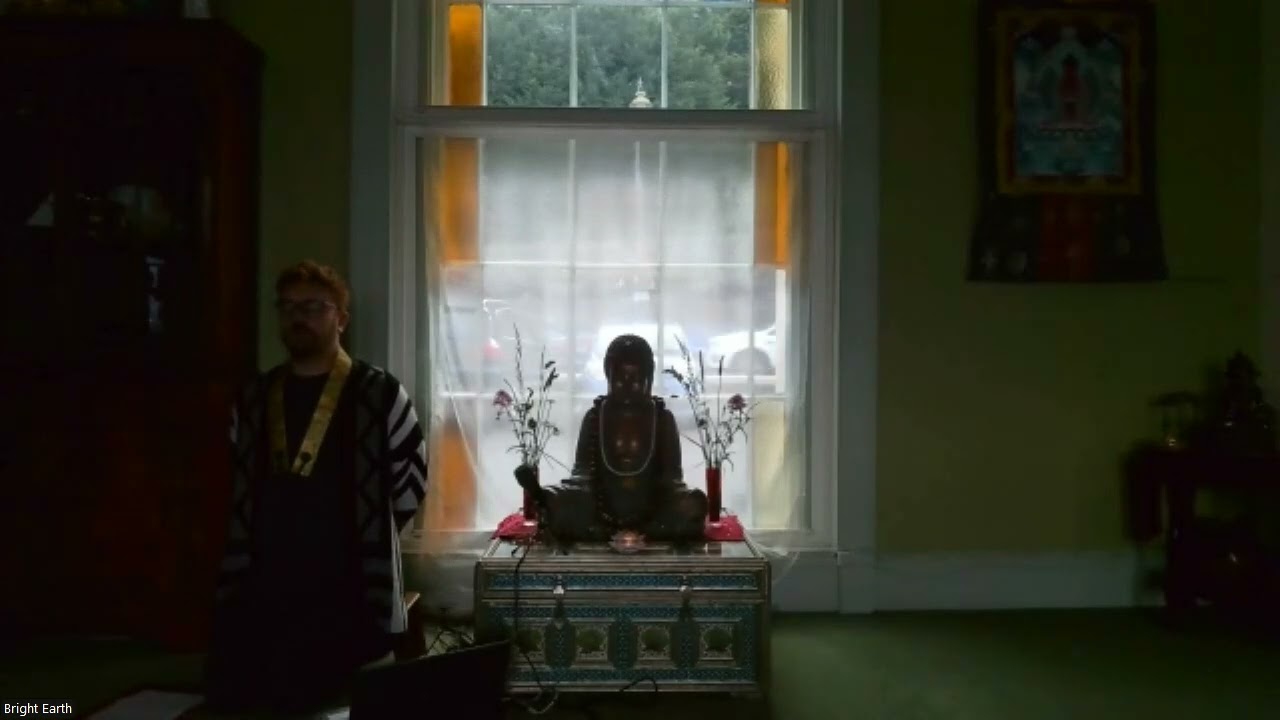
This content was created by Satya Robyn. This content was uploaded by Satya Robyn. This is a YouTube recording (title: "Can awakening brings ignore cause and effect?", created 2024-07-13) of an English-language Buddhist dharma talk and group practice led by a main teacher (SPEAKER A) with accompanying participants (SPEAKER B, SPEAKER C and an assembled sangha). The teacher recounts a koan-like story about Master Bai Zhang and a fox spirit that probes whether awakening frees one from cause and effect (karma), explores competing interpretations (freedom vs. continued moral responsibility), and reflects on spontaneous awakening versus ongoing ethical practice. The excerpt also includes guided meditation instructions, chanting of Amitābha, recitation of refuges, precepts and bodhisattva vows, prostrations, ritual lines, brief commentary, and closing announcements and verse.
Chapters
Welcome everybody, welcome Matt on Zoom. Bit quieter this evening, but I know a couple of people are working, someone's on holiday. I want to start with a story from China a long time ago, part of a collection of stories called koans, or public cases, that are used for study and practice in Chinese Buddhism and in the Zen schools of Japanese Buddhism. In Rinzai Zen, you are given these stories to take into your meditation practice and, and sort of turn over in your mind and keep with you through your daily life until some insight spontaneously appears that you then take to your teacher, who tells you whether you've passed or failed. And if you pass, you're given the next story to work on. In Soto Zen, they're just used as little teach— like, uh, springboards for teaching, which is what I'm doing this evening. And this is about a fox spirit, and it takes place on a mountain that is called Fox Mountain. And in China, the abbots of temples that were on mountains were named after the mountains. So the abbot Master Bai Zhang is Master Fox, and the mountain is called Fox, and there's a fox spirit. And in Chinese mythology, it's not like a cute fox, it's a little bit— the foxes are a little bit looked down upon, they're a bit sometimes a bit trickster quality, you know, they slink and about, and they scavenge things. And later on this evening, I will, I will point out some of the meanings of it, but for now, just sort of let it wash over you. So on Fox Mountain, Master Bai Zhang gave a series of talks Among the gathering, there was always an old man. He always left when the gathering dispersed. Finally, one day he remained. The master said to him, 'Who are you?' The old man replied, 'I'm not a human. Ages ago, I was the abbot here. One day, a follower of mine asked me 'Does someone who is awakened fall under the laws of cause and effect?' I replied, 'Such a person is free of cause and effect.' Ever since, I've been reincarnating as a fox spirit, 500 lives now. Please, I beg you, free me. He then made bows and stood again before the master and asked, 'Does someone who is awakened fall under the laws of cause effect or not?' The master replied, 'Such a person is one with cause and effect.' Upon hearing this, the old man awoke. Making more bows, he said, 'I'm now free of that fox body. The corpse of the fox is on the other side of this mountain. Please give me a monastic funeral.' Master Bai Zhang had his head monk announce to the assembly that after midday there would be a funeral. The monastics were confused. 'Well, we're all here. Who's died?' After the meal, the master led his company around the mountain, and they found the body of a fox. Carried it back and gave it the monk's funeral. And in the evening, the master told the monastics the whole story. Huangbo stood up and said, you, you say the old man missed the turning word. He got the answer wrong, and because of that, he was reborn as a fox 100 times. But what if he gave the right answer? What then? Bai Zheng smiled and said, 'Come closer to me and I'll tell you.' Huang Bo walked up to his teacher and quickly gave him a slap. The master laughed and said, 'Here I thought the old barbarian had a red beard, but right here is the red-bearded barbarian.' And if you, if you are practicing in tradition, you, you'd know some of what those allusions meant, and I will, I'll shed some light on them later on. But for now, just letting it sink in as we go into the meditation. Perhaps noticing your breath entering, leaving your body at the tip of your nose. Warmer air entering— sorry, cooler air entering, although it is warmer than it because it's the summer. And the warmer air heated by your body leaving And when thoughts or feelings or sensations arise, just noticing what they are. Oh, now I'm thinking about dinner. Now I'm thinking about going into work tomorrow. Then coming back to paying attention to the breath. We'll sit like this for 10, 11, 12 minutes before moving into a period of chanting. So in a moment, we will chant the Sanskrit word Amitabha together. Amitabha is the name of a cosmic Buddha, a mythological Buddha, not a real figure, but the the embodiment, this sort of archetypal mythological embodiment, symbolic, partly symbolic, partly real, for enlightenment that is available right now in every moment. We know that 2,500 years ago there was someone in Northern India that became enlightened and started the tradition, but we also know that the, the spirit of enlightenment, what they woke up to— unconditional love, kindness, compassion, seeing things clearly, understanding the interconnected nature of things— that that's available right now, swimming all around us. And that we as limited beings can call out to it and trust in it. Amitābha means limitless light. The light is a symbol for this unconditional love that permeates the whole universe. So as we chant We're entrusting ourselves to this loving kindness that is in us and around us, this spirit of enlightenment.
Amitabha. Amitabha. Amitabha. Amitabh. Amitabh. Amitabh. Amitabh. Amitabh. Amitabh. Amitabh. Amitabh. Amitabh. Amitabh.
We'll now recite the refuges and precepts and bodhisattva vows, which you can find on the A5 liturgy sheet near your chair. And, um, versions of these things have been said by Buddhists since the Buddha lived 2,500 years ago. They connect us to Buddhists around the world and back through time. They are the things we place our trust in They are the things that signpost us to what a good Buddhist life looks like. And the Bodhisattva vows speak to the longing that arises in our heart as we become more loving, more kind, to spread that to others. So Please repeat after me. For refuge I go to the Buddha.
For refuge I go to the Buddha.
The one who is awake and full of love.
The one who is awake and full of love.
Namo Buddhaya.
Namo Buddhaya.
For refuge I go to the Dharma.
For refuge I go to the Dharma.
All that guides us to wisdom and compassion.
All that guides us to wisdom and compassion.
Namo Damaya. For refuge I go to the Sangha, those who live in the Buddha's light. Namo Sangaya. With faith in the Three Jewels, and in light of my human tendencies, and delight at my human tendencies.' I pray that I may become aware— 'I pray that I may become aware' —of when I take life; of when I take life; I pray that I may become aware— 'I pray that I may become aware' —of when I take what is not freely given; of when I take what is not really given; I pray that I may become aware—I praise him everywhere— Of when I fall into sexual misconduct— of one eye falling to sexual misconduct—I pray that I may become aware— I'm afraid it's time they come away—of when I fall into wrong speech—when I call this your own speech—I pray that I may become aware—pray for somebody coming over—of when I become intoxicated—no blame! No shame! No blame. Be kind. Be kind.
Love everything. Love everything.
Innumerable sentient beings, we vow to save them all.
Inexhaustible ardor and passion We vow to transform them all.
Immeasurable are the Dharma teachings. We vow to master them all. Infinite is the Buddha's way. We vow to fulfill it completely.
So back to the story. It doesn't help that the two main characters are both called Fox, right? Because they're both named after the mountain, one living in the time of the story and one from— who was abbot generations ago, also named after the mountain. But we'll call the one in the present Master Bai Zhang, and we'll call the one who was incarnated as a fox, we'll just call him Fox. So the question that stumped Fox, that he answered incorrectly and got him reincarnated, was this one about cause and effect. When you're enlightened, do you become free of cause and effect? So in the early Buddhist teachings, the Buddha talks about cause and effect a lot, karma. And this is the idea that if you have negative thoughts and feelings and let those become negative actions, negative words, then you will tend— that, that sows the seed for more negative feelings and actions and words, and it leads you on a path that creates suffering for yourself and suffering for others. Simple cause and effect. If I'm angry today, I'm more like— if I give way to my anger today, I'm more likely to give way to it tomorrow. If I'm angry, other people are more likely to be upset with me, or I'm more likely to hurt them. Like a ping-pong ball bouncing around. And the same is true of positive thoughts and feelings. If I'm feeling kind, loving, compassionate, and those— I let those transform into kind words or actions, helpful deeds, I'm more likely to be kind the next day. I'm reducing suffering for myself and others. That's the law of cause and effect. And the idea was in early Buddhist practice that you practice restraint, sila in Pāli, sometimes translated as discipline, that you don't do the bad things. You notice, I'm feeling angry, I'm not going to shout, I'm practicing restraint. And you do lots of the good things, and you do enough of the good things eventually you become enlightened. So there's this path laid out in front of you, a bit like Snakes and Ladders, right? If you— the good things you do, you get closer to the finish line. The bad things you do, you come back to the start. And the question is But when you're enlightened, do you stop— do you still have to worry about those things once you've got off the game board? And this fox says, once you've got off the game board, you don't have to worry about them. Speaking to this truth that enlightened beings don't have to try to be kind, they're just naturally kind, and they don't have to try to be— to restrain themselves because there aren't any negative thoughts or feelings coming up. They're just in this state of easy loving kindness. They don't even notice they're being kind. It's not coming from a kind of place of calculation or thinking about what other people need. They're just living their lives and everything they do is good, is— they're free. They're free from that cause and effect. But apparently that isn't the right answer because he gets reborn as this fox for 500 lifetimes. And he eventually, he figures out, oh, if I can ask the current— if I can talk to the current abbot and get a different— and give the other answer to this question, I'll be free. So he gets this It's a bit like, uh, a bit like in therapy where you might, you know, imaginatively reenact something, or in psychodrama you might reenact something but get a different result. You behave differently and you get a different result. So the question comes, when you're enlightened, are you free from cause and effect? You still have to worry about this stuff. And he says, yes, you do. And this time he's chosen the right answer, and he gets freed from— he doesn't have to be reborn as a fox anymore. And this time what he's saying is, oh, even if you're enlightened, actually, as a human being, you still have to think about this stuff. The thoughts and feelings are still rising in you, and you still have to notice whether you're being skillful or unskillful. You don't get free from that. Maybe it's helpful to say that in later forms of Buddhism they didn't just think of, of like starting at the beginning of the path and then trying to get to the end of it. There was this idea that like off the sides of the path, off either— all around the game board, if you like, not on the squares— is enlightenment. You don't have to do a load of practice, you don't have to behave well all the time. You can have this enlightenment experience wherever you are on the path, whether you're behaving well, whether you're behaving badly. You can suddenly be moved to spontaneous loving kindness, even if you were feeling awful a moment before. Occasionally that happens. You can suddenly spontaneously understand that all beings are connected. A teacher says the right words to you, or you happen to be in a beautiful setting in nature, and suddenly the penny drops. And those experiences of seeing through ordinary mind to something else, to a world full of loving kindness and connection are not dependent on having worked really hard. Sometimes they just arrive as gifts. And you can have that deep kind of experience and come away from it and actually still be a really foolish human being and have to watch how you speak to your partner and how you behave at work and whether you lose your rag or not. Maybe you really have a deep understanding of impermanence and interconnectedness and all the Buddha's teachings, and yet you're still an asshole sometimes. And when the monk realized, oh, 'You still have to watch yourself because you can still be an asshole sometimes.' That's when he became enlightened and didn't have to be reborn as a fox anymore. And then there's this later addition to the story, which I think maybe actually is something that was added to the story later on, where another monk comes up and says, 'Well, what if he was right the first time?' And this— and I won't go into all the symbology of like the red-headed barbarian and the slap and everything, but basically the teacher saying, oh well, you know what, he was right the first time as well. Both answers are correct. In the moment of feeling deeply connected to the earth, to the sky, to the Buddha, of noticing interconnectedness, you are free of cause and effect. And it is true that Buddhas are free of cause and effect. They do live from that place of spontaneity and loving kindness. They don't have to worry about hurting others because it just doesn't come up for them. And we are limited foolish beings who get a taste— maybe we get a taste of that sometimes, but we still have to keep an eye on, on whether we're being an asshole or not. And perhaps what the final answer is pointing towards is that you can have a deep faith in the Buddhist teachings and be deeply moved to compassion and a deep trust that you are held by the loving kindness that is swimming all around us. And sometimes be moved to give beautiful Dharma talks or to help out people without even thinking about it. And sometimes you can still be an asshole. And that it's good to take care of those tendencies, it's good to think I should be less of an asshole, but that doesn't mean that the other things aren't also true. That you aren't still held by loving kindness, that interconnectedness still isn't true. It's all true. Namaste. So maybe now when you see a fox, you can think of, uh, this story. Maybe, just maybe, it's a Buddhist abbot trying to figure out something they got wrong in a previous life. So in a moment, we'll stand and make prostrations to the main shrine, which is our way with our whole bodies of connecting with that spirit of loving kindness that the Buddha represents. And as we do, we say Namu Amida Butsu, which is another, a different language, another form of the word Amitābha that we were saying earlier, which is the same spirit. Everything we do is recognizing our own limited nature, connecting with the unlimited nature of loving kindness. There is the Buddha.
Nam-myoho-renge-kyo.
We'll make 3 bows as we chant.
Down to the ground if your body allows.
Namaste.
Namaste.
Gratitude. We offer this incense to all Buddhas and Bodhisattvas throughout space and time. May it be fragrant as Earth herself. This is reflecting our careful efforts, our wholehearted awareness, and the fruits of understanding slowly ripen. May we and all beings be companions of Buddhas and Bodhisattvas. May we awaken from forgetfulness and realize our true nature.
So we'll bow to each other, the main shrine at the front. Hide our faces and bow to our seats. Before we close with the final verse, couple of announcements. You're welcome to join us on Saturday after morning practice for an hour or so of work in the garden. You're welcome to join us now for a cup of tea after practice. The donation bowl is in the hallway, or you can use the QR code or the website to make a donation online. It's a 200-year-old building, so there's always something that needs paying for, unfortunately. Nam-myoho-renge-kyo. We'll finish with the closing verse, which, if you want to read, is on the top of the liturgy sheet and begins with the word 'blessed.' Blessed by Amitābha's light, may we care for all living things and the holy land. Namamitabha.









