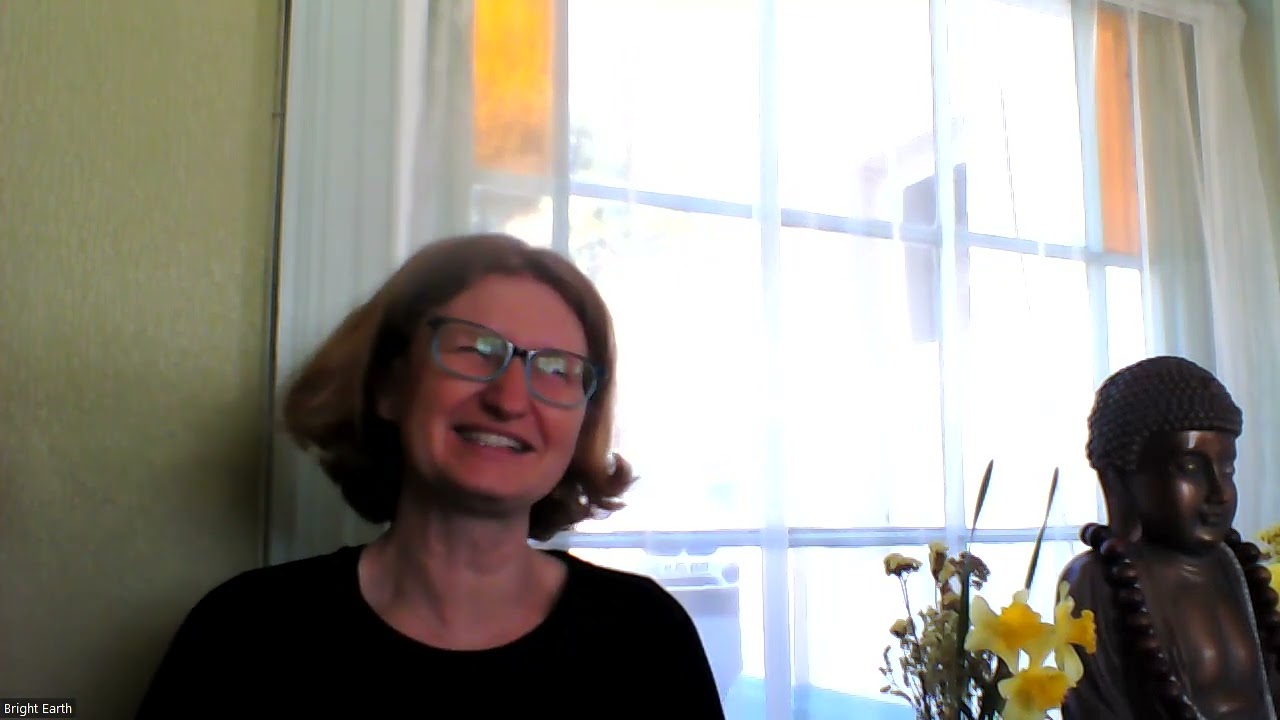
Satya Robyn explores bombu, the Pure Land Buddhist concept of foolish beings, through Shinran's writings on shame, contrition, and Amida's vow. The talk traces how accepting human limitation becomes the path to liberation and compassion.
Chapters
Namomi tabu. Welcome everybody, and thank you for being here on this beautiful sunny spring morning. It always astounds me that people would rather come and hear the Dharma than go and sit in the garden, so you must have very good karmic conditions, all of you. We'll do the sunshine later when we go on our walk. So the theme of our retreat day today is Foolish Beings, and Caspar would have heard this story, probably Jaume as well, many times. But I'll start my talk with it, which is the first time that I encountered Pure Land Buddhist practice. I was staying at the Buddhist House in Nabra doing the psychotherapy training that was run by David and Caroline Brazier. And it was both a Buddhist community and a psychotherapy training place. So the, the practice, the services as they called them, would happen, um, I think it was most mornings. Every morning. Every morning apart from Monday. And so one morning I decided to put my toe in the water and take part in the practice in the shrine room with— interestingly enough, this beautiful Buddha here used to live in the Buddhist House in Nabra, then stayed with Caroline for a while, and she donated it to the temple here. Very blessed. So this Buddha also knows this story firsthand. Because he was there. And we did lots of strange things that I'd never done before. We used to do walking and chanting, kind of circumambulating the shrine, chanting Nam-myoho-renge-kyo. There was chanting in different languages, and there was the prostrations, which we've just done here in the shrine room ourselves. And it all seemed very strange to me. I had no idea what was going on really. And then afterwards I was sitting in the living room with two of the students who'd been to more of the practice than I had, and they, uh, said this word to me. They said this word, 'Bomboon,' And I said, what's that word mean? Bonbu? I've never heard it before. And they said, oh, it means foolish beings of wayward passion, and that's what we are. And I can remember the reaction I had hearing that. It was, it was, uh, relief. It was relief that, that what they had learned from Buddhist practice is that not only were we all foolish, but that was really okay. Those two things really went together. So I've got a few, uh, I'm going to follow a little bit of a path, um, talking about foolishness with Shinran's words this morning, and Pure Land Buddhism began in Japan as a kind of a defined school, and Honen was the father of Pure Land Buddhism. He initiated, formalized Pure Land practice and theory, and his, um, the student of his that has gone on to be hugely important in Pure Land history is Shinran. Hōnin lived from 1133 to 1212, and Shinran lived from 1173 to 1263. So he was 90 when he died. I like that. I think that's a good sign, like, be a pure land Buddhist, live to a very old age. And he lived during the Kamakura period in Japan, which was very tumultuous for lots of different reasons— lots of natural disasters, lots of political turmoil, upheaval. Um, and he is quite an unusual figure in religion, in my experience certainly. Um, and I'll just read the little quote about him from the, the book of his selected writings by Alfred Bloom. And Alfred Bloom says, Shinran is unusual in never claiming to be a spiritually realized saint with supernormal experience, though he had dreams or visions on various occasions. He acknowledged his limitations and ignorance in many areas. He did not claim to be a proficient scholar, though he had studied diligently as his writings show. He was a bombu, a foolish being like others. Except that he relied on Amida's Vow as his ultimate refuge. So I'll come on to speak about that last bit, that he relied on Amida's Vow as his ultimate refuge. But I also want to give you more of a taste for how scrupulously honest Shinran was about his own nature. And I'm smiling because these quotes I'm going to read you. I just really love them for their confessional honesty. So here's something that Shinran said in the Hymns of the Dharma Ages, in the Wasan: While persons ignorant of even the characters for good and evil all possess a sincere mind, I make a display of knowing the word good and evil. This is an expression of complete falsity. I am such that I do not know right and wrong and cannot distinguish false and true. I lack even small love and small compassion, and yet for fame and profit enjoy teaching others. I really love that last line. And for the people in the room who are teachers themselves, or who share dharma teachings with other people, I just love that, that he's not really in it for them, for the love and compassion at all. He's just in it for the fame and profit. And then another little verse from Gutoku's Hymns of Lament and Reflection. Gutoku, I'm not sure if I'm pronouncing that right, means stubble-headed one. So it's kind of like stubble-headed fool. It's one of the nicknames he had for himself. With minds full of malice and cunning like snakes and scorpions. We cannot accomplish good acts through self-power, and unless we entrust ourselves to Amida's directing of virtue, we will end without knowing shame or self-reproach. So Shinran was very clear that, that he was bonbu. That was the position that he took, is that he he made a clear examination of his own nature and discovered, uh, discovered these things about himself that he didn't really— he was— couldn't really be clear about how to distinguish good from bad. He had all kinds of sneaky motivations for things that weren't pure or altruistic. Um, and I guess that for me there's something about that that means that I trust him straight away. Um, and it may be that I trust him because I think that everybody is like him, uh, but I can't really say that. I can only really speak for myself. It may be that it's just me and Shinran that are really foolish. In which case, this talk might not have much more of interest for you. You can just go away and carry on being non-foolish beings. Um, and, and I think that it makes me trust him because when I look at myself in that way, I also find these things. I also discover that there are layers and layers to my motivations for doing different things. I might think that I'm— a small example, my mum's having a difficult time at the moment, and I might think that I'm reaching out to see how she is. Um, and then when I examine that a little bit more closely, I discover that I actually want to know that she's okay so I can feel better. That is also in the mix. That if she says she's okay, I can, A, I can feel like I'm being a good daughter, and B, I can feel like I can relax because she's okay, she's handling things for the moment. And I don't like to admit that because I just really like to be a good daughter that just cares about how my mum is. But having, uh, having uncovered those different motivations, those layers, there is something that that gives me. There's the— I'm, I'm less deluded, I'm more, um, realistic about that interaction. So if she doesn't respond in the way that I want her to, then at least I've also got the information that I'm coming from a a self-protective place as well as an altruistic place into that, into that relationship. Um, and so one of the benefits for acknowledging our foolishness is that we can have cleaner interactions with each other. We can have everything on the table. And we can, um, we can be more honest both with ourselves and with the other person. And my experience of that myself, I don't know if this is your experience, is that, is that again that there's layers and layers and that I, I discover more and more as I, as I reflect. Something I'll say now, which is almost like a kind of a course correction, or, uh, um, I can't think of how to say it, but, but sometimes when, when I think about foolishness, or when we talk about foolishness in ourselves there's this tendency towards doing ourselves down and kind of dwelling in that place of, oh, I'm a terrible person. Those may be kind of touching into shame or touching into self-critical voices, imagining that other people see us as terrible. And I think that for me, some of Pure Land writing can give us the impression that we should be aiming for that, that we should, we should be aiming for a place where we're kind of self-flagellating ourselves. Is it flagellating or flagellating? Flagellating. Self-flagellating, which happens in Christian, some bits of Christianity as well, that kind of hair shirt idea. Literally, that's where self-flagellation comes from. Well, and other traditions. And other traditions, yeah. And I think that something that for a while kind of put me off Pure Land rhetoric, put me off Pure Land philosophy, is that is that danger. The way that some Japanese writers write about foolish nature is they'll use the word evil, and they'll say things like, you know, we're evil through and through, we can only depend on the goodness of the Buddha. I don't know if that's a correct interpretation of Shinran's intention or not.. But I do know that when I read his verse about lacking even small love and compassion and enjoying teaching others for fame and profit, I can't help but hear it with a kind of an affection for himself, a sort of a fondness, a kind of a wry humor at his foolishness. And that's how I choose to to take the flavor of this teaching. I don't think that the Buddha wants to make me feel dreadful, um, or wants me to, uh, kind of obliterate myself in order to to be realistic and honest about these things. I think that the Buddha, with their compassion and their wisdom, would like us instead to reach a place of accuracy and honesty without the extra kind of woe is me, I'm a terrible person sort of flavor that you can sometimes get from Pure Land breathing. Um, and there's a kind of a balance there. For me, there's a bit of a balance because I think that sometimes the experience of seeing my own foolishness, my own limited nature, does tip me into those places of self-criticism and shame. And, and I've just been writing about shame for Tricycle and just finished the edits on the article this morning. As I said in the article, the shame is when we are a bad person. Contrition is when we're a person that's done an unskillful thing, that there's something that we've done, a part of our behavior or something we've done that we shouldn't have done and that wasn't good and that we should say sorry for, but that we're not like rotten through and through. That's what shame makes us feel like, is that we are useless, we are worthless. Um, so sometimes these teachings have that danger of kind of pushing us towards those places in ourselves where we already feel so terrible about ourselves. It's like it confirms it, like, yes, I'm just the worst and I'm never gonna get better and I'm worse than anyone else. Uh, and, and I think it was Ajahn Chah that spoke about Buddhist teachings that, that sometimes the Buddhist teaching needs to— we're going a bit too far to the right, so it kind of needs to get us to the left. Sometimes we're moving a bit too far to the left, so we need to get us to the right. And I think that like all teachings, um, we need to be able to work out whether we're pointing a bit too far to the right or a bit too far to the left. If you're already full of I'm no good, I'm not, I'm not good enough, I'm foolish, I'm terrible, then I only want you to listen to the second half of my talk, which is the, the second part to this idea of Bambu Nature, which is what we, what happens after acknowledging our Bambu Nature. And of course, you could also, just to sort of layer this up a little bit more, you could, you could say that, that if you are a person that's got lots of that kind of narrative about how awful you are, that you could see that narrative as a part of your Bambú nature. You could see the, the, the shame that you're carrying or the self-critical voices as proof, further proof that you're foolish, but there's a softness to that because, oh yeah, there I am doing that thing again where I'm really mean to myself. That's also me looking at things through a particular lens that's not a clear lens. So yeah, so Shinran said he was foolish. I'm saying I'm definitely foolish. I've given you one example. Casper gave you an example this morning in practice about their very rare foolishness. Dharma talk, a Dharma glimpse was also kind of touching in that kind of the sort of the inevitability of the fact that we forget things. We know this stuff, but when we're tested, it kind of goes out the window. We have to remind ourselves over and over. That's our foolishness. And you can just, you know, just take a moment to think about your own brand of foolishness. We all have a different brand. That our Bambu nature is how it is to be human, because being human is really scary. Being human means that we are living in impermanent bodies. Those around us that we love are also in impermanent bodies. There are some things that we can rely on for a little while, but we don't know how long for. We don't know, we don't even know if our savings are going to be worth the same. My dad's worrying about his savings at the moment. He's coming to the end of his life and he's got, he's got a certain amount of money that he wants to give my mum, that that will mean that she's okay for her life. How do you know if that is, you know, it's a decent chunk of money, but it could all go completely haywire. So it's scary to be human. It's scary to really be aware of our impermanence. And so our foolishness, I would see, is a kind of a direct result of that. It's what we try to do to manage that fear and to try and protect ourselves, to try and keep away the the stuff we don't want, try and get more of the stuff we do want. All of that, that self-protection. I could talk about that for a long time, but I won't. That's, that's why, that's why we're foolish. That's why, um, we are foolish beings of wayward passions because our, our fear drives that protection. Our fear drives the greed and the hate. And the delusion that all Buddhists talk about as what kind of roils away underneath the surface. End of talk. Even in itself, I think it's good news because It means that we're not alone. That was one of the things I really appreciated hearing my fellow students in the Buddhist House is that they were really honest about being foolish beings, and then I could be a foolish being with them. So that's really great. So that's great. And it also helps us to be clearer and to be clearer with ourselves, to be clearer in relationship. It helps us to set ourselves up a bit less because we can be more honest about what we're actually capable of doing or not. That's something I'm very much working on still, the gap between the person that we would like to be, the things that we would like to be able to achieve, and the reality to what's actually sustainable, or what's possible at different points in our lives, because that goes up and down. Sometimes we have periods of great, you know, getting a load of stuff done, and then we come into a new phase because of our health or our our trauma, or, you know, our external situation, that that needs to just go right down, and that's just how it is. So there's this great permission all the time with acknowledging our limited nature. And the main part of this talk, the most important bit, is that Shinran taught that it wasn't just that he was a foolish being, it was that there was something in the world, something in the universe, um, that clearly saw his foolishness. Shinran, not just people in general, but really saw him and really saw how he just did talks so fame and profit. I don't think he did just do them for fame and profit, but that he, that, that was a part of the mix. And that saw the snakes and the scorpions in his mind and really loved him. And that is the bit that still blows my mind when I think about it, when I try to imagine it, is that The foolishness is so deep. It goes down and down and down. It's not just our foolishness that we're carrying around. It's our parents' foolishness. It's their parents' foolishness. Yeah. Back and back and back. That's a lot of foolishness. Um, and despite the, the depth of that, self-protection, that ego. We are seen and we are loved, and we are loved exactly as we are right now. We're not loved if we do a particular practice. We're not loved if we improve in a certain way. We're not loved even if we say we're going to improve in a certain way and that we kind of commit to that. Because we can do that, and we can try, and we'll probably still fail partly. But the news, the good news of Pure Land Buddhism is that we are loved right now exactly as we are, with the reality of all that greed, hate, delusion, fear, self-protectiveness. And it's quite difficult in some ways to talk about this, uh, because you're taking my word for it. Um, who knows whether— who knows whether it's true? Is it really true that the Amida Buddha accepts us and loves us just as we are? And it's a bit chicken and egg because until we engage with the possibility of it, we're not going to have any proof. It's kind of like you need to step into something and, and risk something to, uh, to allow the possibility of hearing something or experiencing something or seeing something. My experience of this is that it is impossible to prove to anyone else, um, and I feel that it is the most true thing in my life. It sits underneath everything else. And a lot of the time I don't think about it, or I'm actively dissociated from it, or I don't trust it. And I know that it is there. I know that it's there like the sun behind clouds, even if you can't feel it at all. I trust that there is something good that sees me and knows me and accepts me and wants me to be happy and well. I think that, that part of my experience of, of having this acknowledgment of the reality of my bombu nature and having Buddha see that is that Buddha really wants me to heal. Buddha really wants me to be as kind as I can. Um, they're really fine if I don't manage it, but, but it would make them really happy if I did. And so that makes me want to heal, that makes me want to be kinder and continue to do things like meet in this room on a sunny spring morning and think about these things in our own lives. The last quote I have from Shinran is from the Wasan. He wrote some very beautiful hymns, lots of short verses. And I'm really feeling Shinran's presence here today. It's really nice to have a little deep dive into his world, his experience, through his words and through his spirit. Um, I've just got this sense— I have no idea where this is coming from— but I've just got this sense that he's kind of— he's got a twinkle in his eye And I have this sense of him as having lived a good life, having been happy and, and settled, having that settled faith that we talk about in Pure Land Buddhism. And the verse is: My eyes being hindered by blind passions I cannot perceive the light that grasps me, yet the great compassion without tiring illumines me always. Namomi Dabu. So what I would like you to do now— I'm going to stop the recording.









