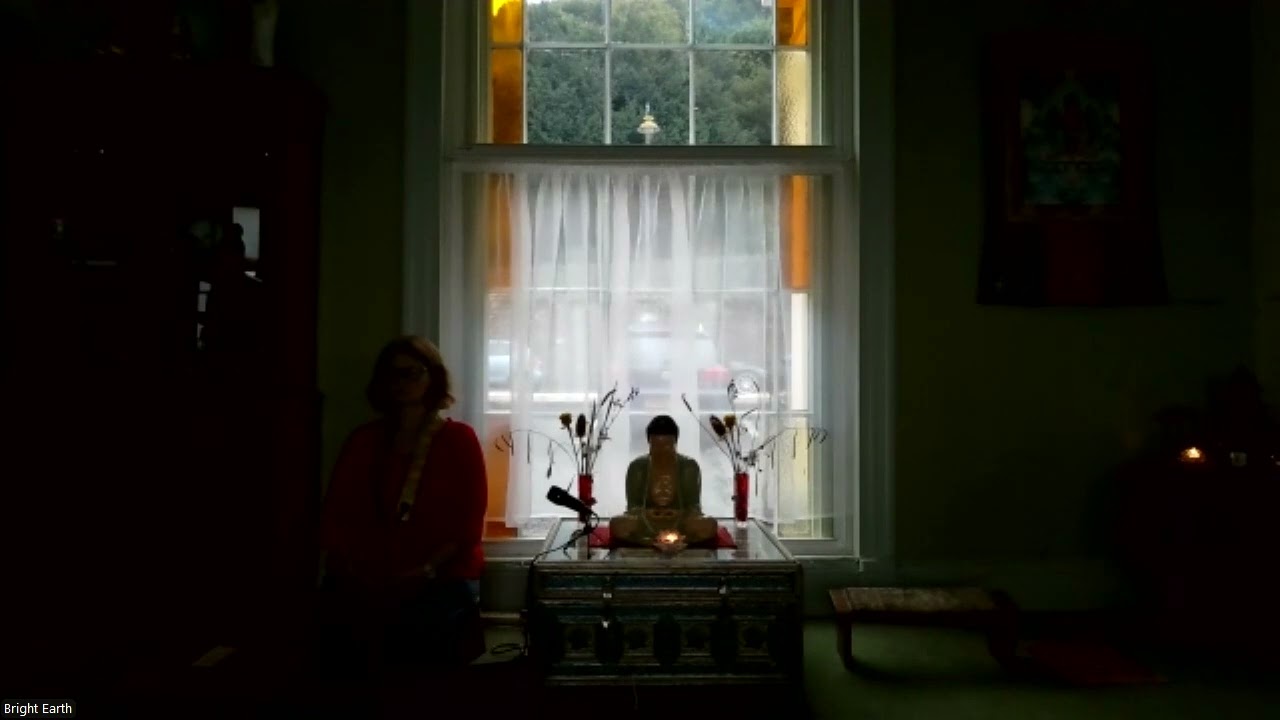
Satya Robyn leads a Buddhist group practice featuring Zen teacher Bonkei's writing on women's Buddha-nature, guided silence, chanting of Amitabha and Nam-myoho-renge-kyo, and a merit transfer for Josh's recently deceased mother.
Chapters
Welcome everybody, welcome Rob. I'm very small today, Rob, because the camera is very far away, but hopefully you can still hear me. Um, that's fine, just wave at you from here. Um, so welcome to Wednesday evening practice, and we will begin with a reading, um, by a Zen teacher called Bonkai, um, who lived more than 300 years ago, and he was a bit of an eccentric. And I'm reading this book at the moment. I wasn't sure what to read to you tonight, and the next bit in the book made me smile, so I'm gonna read it to you. And it's about women. I can tell you, so Bunkhei is basically preaching to many hundreds of people and telling them how to become enlightened, telling them how easy it is to to wake up, to become connected to our own Buddha nature, our own infinite compassion, infinite wisdom. I can tell you something about this matter of women's Buddha mind. I understand that women feel very distressed hearing it said that they can't become Buddhas, but it simply isn't so. How is there any difference between men and women? Men are the Buddha body and women are the Buddha body too. You shouldn't entertain any doubts of this sort. When you thoroughly grasp the unborn, then in the unborn there's no difference whether you're a man or a woman. Everyone is the Buddha body. You women, listen closely now. While in terms of physical form men and women are obviously different, in terms of the Buddha mind there's no difference at all. Don't be misled by appearances. The Buddha mind is identical. It makes no distinction between men and women. Let me prove this to you. There's quite a crowd of people here at this meeting. But when they hear the sound of a drum or a gong outside the temple, do you suppose the women mistake the sound of the gong for that of the drum, the sound of the drum for that of the gong? Do you really think there's any difference between the way the men are hearing these things and the way the women hear them? There is absolutely no difference at all. Now everyone, is this true only for men and women? In this hall we have young people and old, monks and householders, men and women, all here mingled together. But when it comes to hearing the sound of the gong or the drum, can you say that old people hear it this way, the young ones hear it that way? Can you tell the difference in the way the monks hear it the way the lay people hear it, the way the men hear it, the way that women hear it. The fact that there's no difference at all proves that what's involved is none other than the one identical Buddha mind that everyone intrinsically possesses. So this talk about men's and women's is nothing but names of traces produced by your thoughts. Before these traces get produced, in the realm of the unborn, there's nothing about men or women. And since that's how it is, there's no difference between men's Buddha mind and women's Buddha mind. You shouldn't harbor any such thoughts. So there's Bönkei telling it as it is. So we'll move into some silence together before we do some chanting. In the silence this evening, you might just want to make offerings to the Buddha. We don't do this practice so much anymore, but we used to do it quite a lot. But we just sit quietly, and anything that comes up— any physical sensation, any thought, any feeling— just make an offering of it to the Buddha and imagine the Buddha receiving whatever it is with a little smile. And as time goes on, you may begin to feel more settled, more quiet. But if not, if your thoughts keep spinning around, just keep offering them to the Buddha and know that the Buddha is happy to receive anything that you want to give them.
Amitabh, Amitabh, Amitabh.
Amitabha. Amitabha.
Amitabha. Amitabha.
Amitabha. Amitabha.
Amitabh. Amitabh.
Amitabh.
Amitabh.
Amitabh.
Amitabh. Amitabh.
Amitabha. Amitabha.
Amitabha. Amitabha.
Amitabha. Amitabha.
Amitabh. Amitabh.
Amitabh.
Aba, amistad, amistad. Amitabh. Amitabh. Amitabh. Amitabh.
So we will now recite the refuges, precepts, and vows together. If you'd like to see them written down, they're on the liturgy sheet, but they're mostly repeat after me. For refuge I go to the Buddha.
For refuge I go to the Buddha.
The one who is awake and full of love.
The one who is awake and full of love.
Namo Buddha-ya. For refuge I go to the Dharma.
For refuge I go to the Dharma.
All that guides us to wisdom and compassion.
All that guides us to wisdom and compassion.
Namo Dharmaya. For refuge I go to the Sangha.
For refuge I go to the Sangha.
Those who live in the Buddha's light.
Those who live in the Buddha's light.
For refuge I go to the Earth.
For refuge I go to the Earth.
The holy ground of awakening.
The holy ground of awakening.
Namobumiye.
Namobumiye.
With faith in the Four Refuges.
With faith in the Four Refuges.
And in light of my human tendencies.
And in light of my human tendencies.
I pray that I may become aware I pray that I may become aware of when I take life. I pray that I may become aware when I take what is not freely given. I pray that I may become aware of when I fall into sexual misconduct. I pray that I may become aware.
I pray that I may become aware of when I fall into wrong speech. Of when I fall into wrong speech.
I pray that I may become aware.
I pray that I may become aware of when I become intoxicated. Of when I become intoxicated.
No blame.
No blame.
Be kind.
Be kind.
Love everything.
Love everything.
Innumerable are sentient beings. We vow to save them all. Inexhaustible are deluded passions. We vow to transform them all. Immeasurable are the Dharma teachings. We vow to master them all. Infinite is the Buddha's way. We vow to fulfill it completely.
So Bonkei, that I read from earlier, is described here as being an underground hero in the world of Zen and an eccentric. And I'm really fond of those kind of slightly unusual Buddhist teachers who, who step out against the cultural norms of the day. That there would have been many teachers in Bonkei's time saying that women couldn't become Buddhas. He didn't care. And Honen, who founded, um, who formalized Pure Land, the Pure Land School of Buddhism, was also a radical. He practiced in a time when to be Buddhist you needed to be wealthy, you needed to be a part of a certain class of people. You needed to be intelligent in order to do lots of study. And he spent his life teaching something very radical, which is that, that none of that mattered. It didn't matter if you worked as a prostitute or as a samurai. It didn't matter if you had been unskillful, if you'd, if you'd done lots of things that were unethical, because the Buddha accepts everyone. And I've been passing this teaching on for many, many years now, and it still kind of blows me away, uh, that it might be possible that the Buddha accepts me and loves me regardless of what I do, what I've done, how hard I work. How much chanting I do, how often I come to the temple. Because the Buddha's love is infinite, and the Buddha's acceptance is infinite, and the Buddha's patience with us is infinite. The Buddha prefers it when we don't do horrible things to each other. It pains the Buddha when we act in that way. But the Buddha also really gets that we are doing what we're doing because of the burden of our karma, because of the, the things that have been handed down to us by generations of suffering beings, the things that we absorb through the toxicity in our culture. The Buddha really gets that we struggle. We struggle to be kind to others. We struggle to be kind to ourselves. And the teaching that Honin offers is that in order to form this connection with the Buddha's love, all we need to do is say their name. The Buddha that we connect with in this tradition is Amitabha, the Buddha of infinite light. So all we have to do is say Amitabha, and if we want to, that opens us up to being slotted into the Buddha's— under the Buddha's robe. Where we can take refuge, where we can feel comforted. I don't think dogs even need to say the name, they just need to just be dogs. And that this is available to everybody and that it's not difficult. And Bonkai had the same message. He was teaching in a very different tradition, it's a very different character to Honen, but his message was the same, is that we all have Buddha nature and that at any moment we can just that switch can, can switch, and we can be lit up by the Buddha. We can become awake. Nam-myoho-renge-kyo. So we will now stand and make prostrations to the Buddha, and we do that chanting a different form of the Nembutsu, which is Nam-myoho-renge-kyo. If your body is able to, then do Copy me and come down to the floor.
Alas, people busily engaged in secular matters take no notice of life wearing away day by day, night by night. Like a lamp in the wind, how long can it last in the six realms of vast Samsara, there is no fixed abode. Until we are emancipated from the sea of affliction, how can we rest in peace? Should we not be afraid? While we still have strength, let us each hear the Dharma. Let us strive and diligently seek the path to eternity.
So before we close practice, I'd like to transfer merit to Josh's mom who died on Friday.
Merit is all the peace and love that we've kind of generated between us this evening, so we're making an offering.
Your grace, a pure land of peace.
I hope you'll join us for a cup of tea, and there's a rumor of a cake, which isn't— we don't get cake every time, so come on a good night. A few of us do need to disappear from meeting, so hopefully the rest of you will stay and drink tea together. We do have an open morning on the 13th of September, so if people are around then to help out, that would be amazing. Any other announcements? No, great.
So we'll finish with the closing verse. Blessed by Amitābha's light, may we care for all living things.
Om mani padme hum.









