Evening practice - death, the pureland and boundlessness
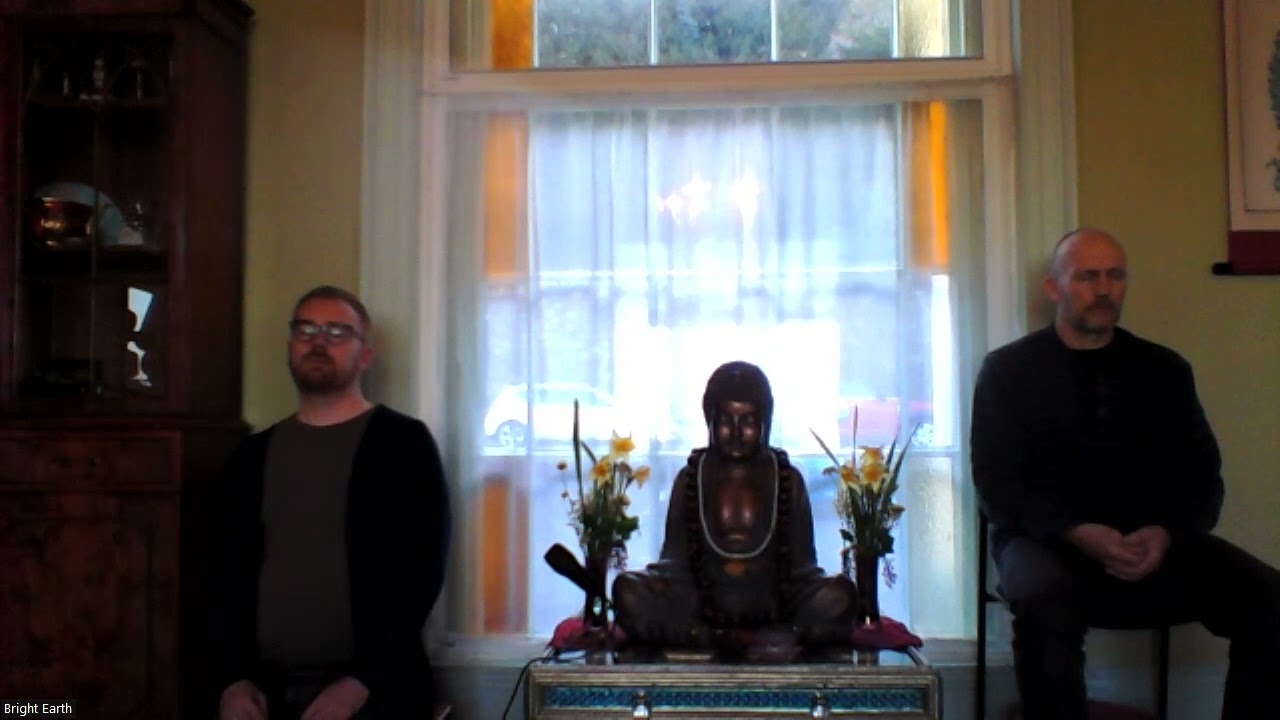
Satya Robyn leads a group Buddhist practice session with guided meditation, chanting, and refuge vows. The group discusses Pure Land Buddhism and death, explores reframing chores as privileges, and reflects on the Heart Sutra before dedicating merits.
Chapters
Nam-myoho-renge-kyo. Very quiet in the shrine room this evening. Lovely to be joined by Chris on Zoom, and hello to everybody, anybody watching on YouTube later. I know, I know there are some people too. Dave is going to read a Dharma Glimpse for us this evening.
Thank you.
All the things I get to do. I've recently been in contact with an old school friend who I've not seen for about 35 years. She was telling me about how she had to go to the dentist. Her words were, 'I get to go to the dentist today.' She then went on to explain how she was adjusting her language to include the words I get to rather than I have to. We joked about it at first, but I have since tried to adopt this into my own vocabulary. Changing your words can go hand in hand with changing your attitude and the way you think about things. Going to the dentist can seem like a tiresome thing that we have to do. It's uncomfortable and can be scary, and it takes us away from other things that we could be doing instead. The reality is we don't have to go to the dentist. We can choose not to. It's actually a privilege to be able to go to the dentist or doctor or even to the shops. Living here in Melbourne, I get the opportunity to do all these things that many other people don't get to do, yet sometimes they seem like chores and inconveniences. I can become resentful when I should be feeling grateful. I've got to go to the dentist next week. I've got to go shopping tonight because I've got to cook for everyone on Friday, and I've got to write a Dharma glimpse before tomorrow. If I just stop and think and check myself, this becomes: I get to go to the dentist next week to have my teeth checked out by a professional. It's on the NHS, so it's not going to cost very much. Then I get to go to a shop of my choice to buy the ingredients for the meal I'm going to cook for all my friends at the temple on Friday. The money will be reimbursed, and I have a huge kitchen with an oven and all the cooking utensils I could dream of, and an amazing spacious dining room in which to dish up. With an outstanding view and good company. Finally, I have been given the opportunity to write this Dharma glimpse, a chance for me to share my thoughts with like-minded people who are willing to listen. None of this is really new to me, but sometimes it's good to be reminded of things I've forgotten and to be grateful. So thank you to my old school friend for this little glimpse and a reminder to be mindful and thankful for all the things I get to do. Nam-myoho-renge-kyo.
Tell you this, Dave, but the week you wrote that glimpse, Satya and I were reading Greg Creech's book, 'Nikan,' and we read the section where he advises you instead of— I think it was in the book, or maybe it was just in the class that we were going to. He advises you to, uh, say 'I get to' instead of 'I have to.' And it was so weird because we— Satya and I were talking about it, and then the next day you wrote this glimpse, right? Yeah, very, a very weird synchronicity. Well, I'm— yeah, yeah, and which makes it even more of a synchronicity. Yeah, some message from the universe really underlining, uh, Yeah, underlining that Dharma glimpse. So we'll go into meditation, and you may want to experiment with this visualization as you breathe in, having a sense of the light of the Buddha entering into you. And as you breathe out, having a sense of that light filling your whole body. And we're not trying to force it. If there's places that feel like, oh, it's not quite going there, or it's taking a while to, to sink into the— this, um, this tight spot. Yeah, there's no rush, there's no forcing anything, but just inviting that light in and allowing it at its own pace to spread through your whole system.
Namah Kwan Shin Bosat. Namah Kwan Shin Bosat. Namah Kwanji Inbho Sat. Namah Kwanji Inbho Sat. Namah Kwanji Inbho Sat. Namah Shivaya. Namah Shivaya. Namah Shivaya. Namokwanji in Bosat. Namokwanji in Bosat. Namokwanji in Bosat. Namah Kwan Chi Imbo Satya Robyn. Namah Kwan Chi Imbo Satya Robyn. Namah Kwan Chi Imbo Satya. Namah Hwajji in Bho Sat. Namah Hwajji in Bho Sat. Namah Hwajji in Bho Sat. Namah Kwan Chi Inbo Sat. Namah Kwan Chi Inbo Sat. Namah Kwan Chi Inbo Sat. Namah Kwan Chi Inbo Sat. Namah Kwan Chi Inbo Sat. Namah Kwan Chi Inbo Sat. Namahwah Quan Chi in Bosat. Namahwah Quan Chi in Bosat. Namahwah Quan Chi in Bosat. Namahwanchi inbo sat. Namahwanchi inbo sat. Namahwanchi inbo sat. Namah Kwan Chi Invo Sat. Namah Kwan Chi Invo Sat. Namah Kwan Chi Invo Sat. Namokwan Chien Bo Sat. Namokwan Chien Bo Sat. Namokwan Chien Bo Sat. Namah Kwan Chi Inbo Sat. Namah Kwan Chi Inbo Sat. Namah Kwan Chi Inbo Sat.
For refuge I go to the Buddha.
For refuge I go to the Buddha.
The one who is awake and full of love.
The one who is awake and full of love.
Namo Buddha. For refuge I go to the Dharma.
For refuge I go to the Dharma.
All that guides us to wisdom and compassion.
All that guides us to wisdom and compassion.
Namo Dhammaya.
Namo Dhammaya.
For refuge I go to the Sangha.
For refuge I go to the Sangha.
Those who live in the Buddha's light.
Those who live in the Buddha's light.
Namo Sanghaya. With faith in the Three Jewels— I pray that I may not take life. With faith in the Three Jewels— I pray that I may not steal. With faith in the Three Jewels— I pray that I may not fall into sexual misconduct— I pray that may not fall to such misconduct—with faith in The Three Jewels—I pray that I might have wrong words of talk—that means lie—in my mouth-with trust on Buddha Dharma Guru Sangha—and compassion for all beings.—I praise our Lord Bodhisattva's conduct! With Faith In The 3 jewels... —With faithfully chosen tools? ...may avoid intoxication.
Thank you very much again. So thank God it worked out well here because we were going pretty late at night now so hopefully they will be able to get home safely today after this evening session tonight too. But yeah guys just wanted us like give some feedback about what happened yesterday morning when she was trying her driving test or whatever but anyway let me know if there anything else anyone wants asked during these sessions okay thanks everyone bye-bye goodnight everybody take care see ya later next week then do your homework please remember don't forget heheh oh wow look how dark outside already man hey Samir come back inside from walking around wait till nighttime comes before coming over huh haha nice job buddy um hello folks welcome along once more uh one last time through those questions really quickly who would want their daughter getting married by someone named Robert McDonald right?! That'd go down bad wouldn't it!? Whoa no way dude seriously bro why did Dad marry Mommy Roberts??? Oh dear lordy Jesus Christ holy moly yes indeed exactly correct Bobbie has got something up his sleeve doesn't he lol anyways moving forward tomorrow afternoon still doing another live stream until midnight No UK Time which should probably end earlier than usual actually since people aren't blame.
gonna watch anymore though am I lying??
Haha love y'all!! Byebye!!!
Love yourself stay safe keep being kind help others share goodness etcetera et cetera ehh any other comments while nobody watches yet? Okay perfect alright cool awesome amazing beautiful No incredible day off work yay happy Saturday ahead hope everything goes smoothly blame.
even better shut up dad stop interrupting myself hahaha Be kind. Be kind. Love everything.
Love everything. Innumerable are sentient beings. We vow to save them all.
Inexhaustible are deluded passions.
We vow to transform them all. Immeasurable Abhidharma teachings, we vow to master them all. Infinite Buddha's way, we vow to fulfill it completely.
So now going to read translation of the Heart Sutra by Kazuka Tanahashi and Roshi Joan Halifax. Apologies, Chris, I should have thought to find the link to these words. To share. We just have to listen for this part.
The Sutra on the Heart of Realizing Wisdom Beyond Wisdom.
Avlokyi Tesvara, who helps all to awaken moves in the deep course of realizing wisdom beyond wisdom, sees that all five streams of body, heart, and mind are without boundary, and frees from all anguish. Oh Shariputra, form is not separate from boundlessness. Boundlessness is not separate from form. Form is boundlessness. Boundlessness is form. Feelings, perceptions, inclinations, and discernment are also like this. Oh Shariputra, boundlessness is the nature of all things. It neither arises nor perishes, neither stains nor purifies, neither increases nor decreases. Boundlessness is not limited by form. Nor by feelings, perceptions, inclinations, or discernment. It is free of the eyes, ears, nose, tongue, body, and mind, free of sight, sound, smell, taste, touch, and any object of mind, free of sensory realms including the realm of the mind. It is free of ignorance and the end of ignorance. Boundlessness is free of old age and death and free of the end of old age and death. It is free of suffering, arising, cessation, and path, and free of wisdom and attainment. Being free of attainment, those who help ought to all to awaken. Abide in the realization of wisdom beyond wisdom and live with an unhindered mind. Without hindrance, the mind has no fear. Free from confusion, those who lead all to liberation embody profound serenity. All those in the past, present, and future who realize wisdom beyond wisdom manifest unsurpassable and thorough awakening. Know that realizing wisdom beyond wisdom is no other than this wondrous mantra, luminous, unequaled, and supreme. It relieves all suffering. It is genuine, not illusory. Set forth this mantra of realizing wisdom beyond wisdom. Set forth this mantra that says Gāte, gāte, paragāte, parasamgāte, bodhi, swaha. Thank you, Nirmal Meethupu. Kuan Yin. Of course, is that Lokiteshvara who, uh, who is spoken about in the Heart Sutra? There came to mind, I think, partly because of the line, boundlessness is free of old age and death, and, um, with such as that having died in the early this morning. Yeah, that I— that death has been around, loss has been around. And here is Kuan Yin and the Buddha pointing to the emptiness of all things, or the boundlessness of all things, that is luminous and pure and wise and loving, and beyond old age and death. It is like the biggest possible mind, the biggest possible heart that encompasses all of these things. It's like if we were to step so far back, we're almost outside the universe, uh, this is the, the way that we would see things. And also made me think of the importance of death. In, in how popular Pure Land Buddhism became in medieval Japan. One way of understanding how revolutionary the Nembutsu was is to think about how important the moment of death was and how significant. The belief in life after death was that the belief of many lifetimes, and for most people what they understood is that they were going into another life of suffering because they couldn't practice the Buddhist teachings, they couldn't become monks and nuns. Particularly ordinary people who were effectively serfs. You know, the, the structure of medieval Japan was different to the structure of medieval Europe, but it was the same kind of hierarchy. You know, people on the bottom had no chance of sitting quietly and practicing the Buddha's teachings. They just had to do what they were told, and they had hard lives. There are accounts from the time of landowners frightening workers with images and descriptions of hell and saying, if you don't follow the rules, that's where you're going. And these were very lurid descriptions. There's also an account of a I don't— I can't remember if it was a courtisan or a royal daughter fainting at the sight of one of the famous paintings of these depictions of hell. So this— and this felt very real, and the life that they lived was hard, and the time was hard. If you're reading the Nagarjuna book, you might get some sense of the times that Shinran lived in. And, you know, Honen was the same kind of time— civil unrest. There were several big fires that went through the capital city. There was famine, there were earthquakes, there were warlords. Even the monks had soldier— even the monasteries had soldier monks. That would be sent against other monasteries. And suddenly, into all of this, Honen reads this teaching that you don't need all these different Buddhist practices, you can just select the Nembutsu. This one thing is enough to take you out of those negative rebirths into the Pure Land. And it wasn't an intellectual belief, it wasn't something he just knew in his head. Honen had a, a deep spiritual experience that led him to trust that practice and that teaching. He knew it deep in his bones and in his heart. And other people picked up on that knowing, on that faith, on that confidence. And, and those things together— Honen's very real spiritual experience of the Nembutsu, this really simple practice, and the fear that people had and the concern that people had about life after death. No wonder the practice spread. No wonder it felt revolutionary. It's easy to imagine that some of the reason, uh, that led to Honen and Shinran being exiled was this sense of threatening the power structure. They could no longer use the threat of hell because people were practicing Nembutsu. In Pure Land Buddhism, through the ages, different people have understood where the Pure Land is and when the Pure Land is in different ways. Is it just after death, or is it also in this lifetime? Or is it that you get your ticket in this lifetime to go somewhere after you die? My own personal sense is that both of those things are true. Something happens in this lifetime that is profound, and And maybe it also opens the door to something different occurring after death. And then stepped back from all of that cycle, from the Pure Land or this life or wherever, wherever unraveling is happening. Is this sense of boundlessness which contains all of that, contains all of that mystery. And really, I like to think that the kind of— the Nembutsu propels us beyond ideas of life and death and is the Pure Land here or there, and into this sense of boundlessness that, that is these things and is also beyond all of these things. I trust that Harry is being embraced by that boundlessness, as we all are in every moment.
I'm learning to paint. We dedicate the merits of this incense offering to all Buddhas and Bodhisattvas throughout space and time. May it be as fragrant as Earth herself, reflecting our careful efforts, our wholehearted awareness, and the fruits of understanding slowly ripening. May we and all beings be companions of Buddhas and Bodhisattvas. May we awaken from forgetfulness and realize our true home.
Blessed by Amitabha's light, may we care for all living things. Thanks everybody.









