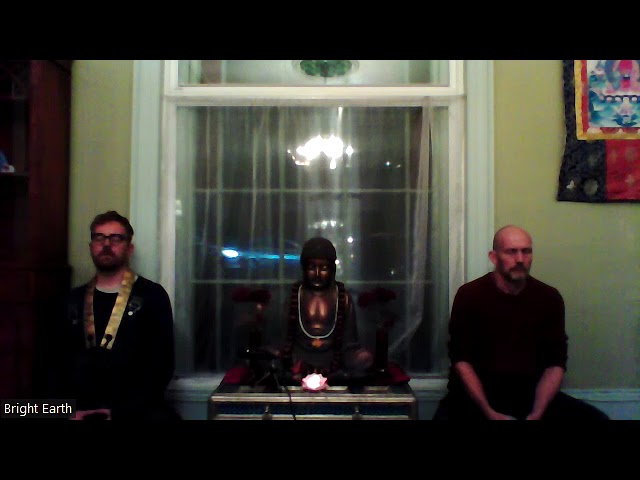
A Pure Land Buddhist evening service led by Satya Robyn with community members. The group chants Nembutsu, recites refuges and precepts, and hears a talk about Honen's life and practice. Includes guided meditation, prostrations, and a Dharma Glimpse reading by Frankie.
Chapters
Namaste. Welcome, welcome if it's your first time. Welcome if you're joining us on Zoom. Special welcome to those of you who came through the rain to get here. So when I make the offerings, I'm welcoming in the Buddha and the ancestors, all the teachers that have passed down the spirit of awakening to us, and ultimately reality itself, which is shot through with the spirit of awakening. When we ring the big bell, this is inspired by— in Japanese Zen temples, as some of us have been learning in the book groups they ring a bell in the four corners of the zendo before practice to clear away any bad spirits. And this bell at the beginning of service, the large singing bowl, is the equivalent of that in our practice. So you can imagine the vibrations helping to clear the space. And all of this is setting the scene for our rituals and practices together that allow us very slowly to settle down and start to get to know ourselves more deeply and start to get to know the Buddha more deeply. And there's lots of different ways that we do that, and one of those is someone from the community shares a piece of writing called the Dharma Glimpse. This evening, Dave is going to read a piece of writing that Frankie, who isn't here this evening, has written for us. Namomi.
Dharma Glimpse by Frankie. Serendipity, by definition, good luck, coincidence, fortitude, fortuity. I also define it in my own loose way as a coming together are falling into place. In the last week, I had been thinking about a question posed in a book by secular Buddhists Stephen and Martine Batchelor: 'What is this?' It's a question that has drifted through my practice over the years and one that is common in Zen, but I found myself thinking it quite out of the blue about something I was experiencing. The next morning I read an interview with poet Jane Hirschfield in which she talked about having a question to practice with when she first started out in Soto Zen. She mentioned 'what is this' in passing. A seed started to germinate. In the past, I'd had, I'd had words to practice with. What would it be like to have a question? What if that question were 'what is this'? A day later, I was curious about an Italian Zen priest I'd noticed amongst teachers I know and respect. I looked his page up on Facebook and was shocked to find that he held very strong political opinions, almost anarchist, and was a supporter of the Russian invasion of Ukraine. I reacted, but thankfully not with the keyboard. I then paused, took 3 sacred breaths of reflection, and asked myself, 'What is this?' That question covered all of it—his held views, my own views, also tightly held, my strong reaction. I found that 'What is this?' went a long way to getting me out of the way, taking my opinions with it. I could see the situation in its entirety, both of us holding on to views through our own suffering and our suffering for others. 'What is this?' while taking me out of the question also forced me to see myself not as myself, as other, but part of what this is, both of us, all of us. This is the practice, this is the work, and what is this will now be a valuable part of my life's toolbox.
So we're going to go into a period of silent meditation, and like other teachers It's like The Bachelor's. Reverend Master Daishi Morgan recommends entering meditation with the spirit of what is this. So we're not asking that question consciously, oh, what's this, let me try and work it out, or what's that, but just bringing curiosity to whatever we find. And we sit with a sort of upright position, not Hunched over but like not bent backwards either, allows the breath to come easily and naturally. Just a nice, uh, spine floating on our hips, floating on the pelvis. We notice the breath entering and leaving at the tip of the nose. Cooler air entering, warmer air leaving. This practice allows the mind to settle in time, like And whatever we notice, we just bring that spirit of curiosity to— oh, look what's here! Oh, here's this, here's a feeling about this, here's a thought about that. And that curiosity allows insight to arise as we notice what we didn't notice before, but it also allows for a kind of peace as we step back into the observer position and are less caught up in our thoughts and feelings. The main practice of Pure Land Buddhism is Nembutsu, which literally means keeping the Buddha in mind, but in Japanese Pure Land Buddhism in the Japanese Pure Land Buddhism of Honen came to mean saying the name of the Buddha. And they would say the name of Amida Buddha— Amida in Japanese, Amitābha in Sanskrit— who is not somebody that lived, but an archetypal Buddha who embodies the spirit of enlightenment, the spirit of particularly the spirit of wisdom that sees each of us just as we are and loves us without exception. So we'll now chant the name Amitābha together. Amitābha.
A— me— ta— A—
me—
ta— A— me— taa— Amitabh. Amitabh.
Amitabh.
Amitabh. Amitabh.
Amitabh.
Amita. Amita. Amitabh. Amitabh. Amitabh.
We'll now recite the refuges and precepts together. The first part, I'll invite you to repeat after me, and the Bodhisattva vows in call and response. And you can see all the words on the A5 liturgy sheet under your chair or next to you. For refuge I go to the Buddha.
For refuge I go to the Buddha.
The one who is awake and full of love.
The one who is awake and full of love. Namo Buddha.
Namo Buddha. For refuge I go to the Dharma.
For refuge I go to the Dharma.
All that guides us to wisdom and compassion.
All that guides us to wisdom and compassion.
Namo Dharmaya. For refuge I go to the Sangha, those who live in the Buddha's light. Namo Sangaya. With faith in the Three Jewels, and in light of my human tendencies, I pray that I may become aware I pray that I may become aware of when I take life. I pray that I may become aware of when I take what is not freely given. I pray that I may become aware of when I fall into sexual misconduct. I pray that I may become aware— —of when I fall into wrong speech. I pray that I may become aware— —of when I become intoxicated. No blame. Be kind. Love everything.
Innumerable are sentient beings.
We vow to save them all. Inexhaustible are deluded passions. We vow to transform them all.
Immeasurable are the Dharma teachings.
We vow to master them all.
Infinite is the Buddha's way.
We vow to follow it completely.
I've been thinking about Honen, Shonin, this week. Honen was a Buddhist priest about 800 years ago in Japan, in Kamakura era Japan. He went into the priesthood, he became a monk really, as they weren't married priests then, they were just monks and nuns in Japanese Pure Land Buddhism. So he became a monk about 8 years old after tragedy in the family, and eventually he went to train on Mount Hiei, which is a big mountain on the outskirts of Kyoto where there were lots of different Buddhist temples. And most Buddhism in Japan at that time was Tendai Buddhism. It was just one tradition. It wasn't, uh, there weren't all the different schools, traditions, movements as there are today. So he immersed himself in those teachings and in that practice. It was quite a turbulent time in Japan's history. There was various, uh, uprisings and civil wars and political machinations. There were fires that went through the cities that were all but built of wood and earthquakes and There was a famine, like a really serious famine, at one point during Honin's lifetime. The, um, the priesthood, according to some, had become fairly corrupt. Monks weren't keeping their monastic vows. They would have girlfriends in the villages that they stuck out to see at night. They would do the session and then go and get drunk and go to the brothel. None of those things necessarily bad in and of themselves, but they are if you've taken monastic vows and said that you're not going to do them. Honen became known as a great scholar. People went and asked him questions and he knew what the answers were. He had a very strong Buddhist practice. But when he looked inside his own heart, what he saw was greed, ill will, and ignorance, and he felt very far away from enlightenment. Now we might say that all those years of practice just allowed him to see himself more clearly in a way that perhaps others couldn't, and he was able to see those currents of greed, hate, and delusion that move through all of us. Perhaps he was just particularly clear-sighted, but he didn't like it, and he felt he judged himself harshly. Legend had it that in a sort of moment of spiritual crisis, or a period of spiritual crisis, he read all the scrolls in the library, and then he read them again and again, and he did this 5 times. And he found a few lines from a Chinese master who had lived a few generations earlier, talking about this practice of Nembutsu. Now, they did do Nembutsu in Japan at that time, but it was very much in the spirit of, if you say the Buddha's name you'll receive some good merit, you'll be purified a little bit. If you say enough times, you'll be purified a lot. It was that sort of transactional practice. Whereas what Shandao said was, if you say the Buddha's name 10 times, or even once, then you will be reborn in that Buddha's pure land where you can quickly become enlightened. And this was a great relief to Ho Un. He was like, ah, all I need to do is say the Buddha's name once. And I guess it was a great relief partly because it sounded really easy, but also because it accorded with his practice and his spiritual experience so Somehow he was ripe to have that experience of relaxing and, and being held by a force greater than himself. Oh, there is something that will hold me if I stop trying so hard, if I stop being self-critical. And in fact, even if I continue to try hard and even if I continue to be self-critical, there is something other than that. Present that, that is at work on me. So later on, after his own teacher had died, actually when, when he was about, when he was about my age, in his 40s, he started teaching this practice exclusively, Nembutsu, and it spread throughout Japan and became a big movement, became the first independent Pure Land movement in Japan. So it's a very important ancestor in this tradition, and we haven't talked about him for a long time, so, uh, and I've just been writing about him in the book that we're revising, so I wanted to bring him to practice. This evening. So he, he really trusted with his whole being that there was something that he called Amitabha Buddha that wasn't his own small mind, that wasn't dependent on whether he was good or evil, or was able to meditate lots, or keep the precepts, or do any form of practice. That would accept him just as he was and bring him into the Pure Land, which for Honen meant after death as well as meeting the Pure Land in this lifetime. And he said, if you can keep the precepts, then keep the precepts. If you can change your life for the better, then change your life for the better. This isn't This isn't a practice about resting on your laurels or not putting the energy in. If you can do those things, great, and continue to bring this Buddha to mind, because that is the thing that you need to trust in. That, that is, that is enlightenment, resting in that place. And if you can't keep the precepts, and if you can't change your life for the better, or you can't change your life for the better right now, also keep the Buddha in mind. Also say the Nembutsu, because the Buddha is especially there for those people. Namo Amida Butsu. Now we'll stand and make prostrations to the main shrine.
Sorry, I didn't notice that it was a different question when I sent it out, Satya Robyn. Namaste. So even for people like me, this is— Gratitude. We offer this incense to all Buddhas and Bodhisattvas throughout space and time. May it be fragrant as Earth herself, reflecting our careful efforts, our wholehearted awareness, and the fruits of understanding. So be it. May we and all beings be companions of Buddhas and Bodhisattvas. May we awaken from forgetfulness and realize our true home.
So come back standing. Let's find our seats, back to our seats. In a moment we'll finish with the closing verse. Before then, a reminder that the 4th of November is the Pure Land Conference at the Quaker Meeting Hall. Groups from across the country from different Pure Land traditions will be coming to share ideas and talks. So, um, details on the website, or ask myself or Satya Robyn if you want to get tickets. And I want to try and experiment as we leave the shrine room this evening. We have an informal exit, and we've been doing that for nearly 3 years now, and I want to make it like semi-formal. Or so the invitation will be, we'll leave in the same way. There won't be a particular order, but the invitation is to, once we've said the closing verse, which we'll do in a moment, to remain in silence until everybody is outside. To remain in silence while you're in the shrine room. So as soon as you're outside, you can chitter chatter. And namamitubho. So closing verse is on the visual sheet. You want to join in?
And it begins with blessed.
Blessed by Amitābha's light, may we care for all living things and the holy earth.









