Evening Practice - Understanding Others, and Impermanence and Love
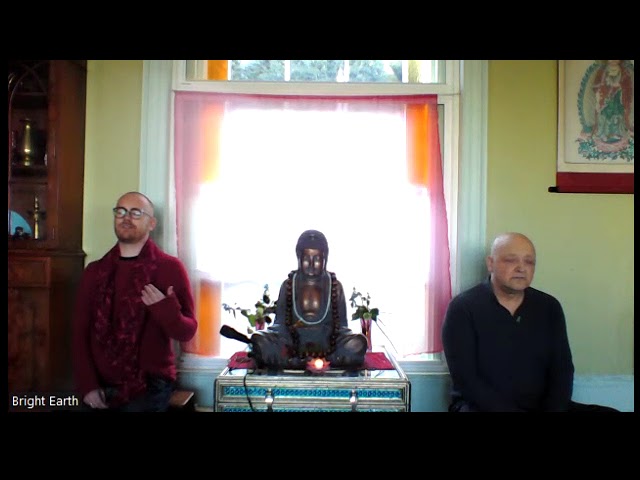
Karma Deva leads a Buddhist evening practice on compassion and loving-kindness, with reflections on understanding others in mental health work and how impermanence shapes love. The session includes guided meditation, chanting, and precepts.
Chapters
Welcome everybody. Hi if you're joining us. On Zoom. We've got Claire and Philip today, and this evening we're going to begin with a Dharma glimpse by Karma Deva. So I shall move the microphone over and then hand over to you.
I suppose I should firstly, uh, try to put this into some perspective. I work in the field of mental health, and as part of my role, um, I try to get people involved in the service. That is to find out what they want and hopefully deliver that to them wherever possible, or deliver what we can within our framework to them, uh, how we can. Um, I often reflect on my practice because I like to think about whether I'm doing it right, whether I'm doing it wrong, or how I could improve. And that's, uh, Buddhist practice and my work. I came across someone who's been involved with our service. I work with Mind, and he'd been with Mind for a number of years, very involved, works a lot within the mental health field, voluntary most of the time, but we do pay for some participation work. I think it's been very awkward in my opinion. So reflecting on it, I thought, well, how am I doing? So I mean, at the heart of Buddhism is compassion, love, compassion, and trying to help people in this world of suffering, basically. And we have metta, loving kindness. The metta is the Pali word for loving kindness. And so I drifted away from my work and I thought, am I treating this person even with loving kindness, let alone as a person? I'm paid to work for. I felt maybe I was letting him down, but maybe I was letting myself down. He'd been complaining quite a lot, and at times I was able to help him, but at times I thought it'd be so much easier if he just went away, maybe, you know, not even have services from us anymore because It was just intolerable to me at the time, and it was a lot of rando. I didn't get my payments on time and lots of complaining, and I really did just think, you know, maybe you should just leave me alone, which isn't showing. Love and compassion or kindness or worrying about people suffering. It was, it was more worried about me and what my feelings were. Um, I remembered something that one of my teachers once said, what was actually Casper, um, which was I, I came up with this idea and he was mentoring me and I said like I was going to go out and feed homeless people in Erdington, because we have a lot of them there, which is in Birmingham. He said, oh, is that what they want then? I thought, what's the question? Of course it's what they want. I hadn't asked anybody, I just decided it was what they want. Um, he gave me a book to read which was, um, about a social worker that used Zen therapy. I can't remember if it was Casper or the bug that taught us the code. About a man and his daughter, and they lived in a little Chinese village, and they had to go about half a mile or so each day to get their water. And they went off, they got the water they're carrying home on their shoulders, when suddenly the man fell over, water spilling everywhere. And he looks up at the daughter, and she looks at him, and he says, "Help me." And with that, she threw her water on the floor, and she bowed next to him. And, and, and really, the moral, if you like, is how could she possibly know how to help him? If she weren't looking at things from his perspective. That was just to think quite a lot about how I do things at work, in my life in general, how I had just decided that what people needed was— well, I'd even gone down the route of deciding what it was they were going to eat, which was baked potatoes, and I'd wrap them and get them round. And I hadn't asked person, and certainly nobody had asked me whether I wanted it. And it could well have been if I spoke to them, there was somewhere to wash each day, blankets on freezing of the night, potatoes— not much good to me if I'm going to die from hypothermia. And I related this to the person that I was working with. I just decided he was moaning and complaining. Yeah, I'd gone out and I'd asked him, what do you want? What can we do for you? And then because his idea didn't necessarily fit with what mine was, I saw him as a nuisance, that he was in some way aggravating me. But I did change. I went back to him. And I talked to him about, "How can I help you? I'm trying to work out a plan of where we can get to kind of be on the same playing field and that we're trying to deliver to him what he needs and I'm trying now to understand more about what he needs." And for me, it shows how you can drift away and not realize, one, it's my job, I'm paid to listen to people and try to deliver what they want. And two, as a practicing Buddhist, I ought to have listened and I ought to have used loving kindness, mettā, to help this person. And so for me, it's making sure that I try to keep track of my own ego. I'm not taking things so personally, but if somebody is suffering and in that much pain, maybe I ought to wonder why. Why is the person like this? Because he being involved in mental health services for so long, he's often been disappointed that people ask him questions and then don't deliver what he's asked for. Um, and that maybe I could look at things differently, uh, and attempt in both my working life and my Buddhist life to see people from their perspective, try and put myself in their shoes. Namaste.
Namaste.
Namaste. Thank you. Thank you.
So we'll go into a period of quiet sitting together now, and I'll make an invitation for what you might do in this time. Beginning sitting quietly, and if it helps, paying attention to the breath for a moment. And if and when thoughts or feelings or sensations arise, noticing what it is that's arising. Oh, here's the feeling about this. Here's a thought about that. Oh, here's a feeling in my back, whatever it is. And then inviting it, inviting some space between you and the thought or the feeling, not to get rid of what's there, but to allow some of the light of the Buddha to allow some of the light of the— of compassion into your system. So noticing what's arising and just very gently inviting it to take a step back. And if the mind becomes peaceful, just Settling into the peace. The Buddha was very clear that this world is shot through with suffering, but also that that isn't the only thing that's true. That as our minds and hearts settle and the greed, ill will, and ignorance clears, what we discover is loving kindness, compassion, both deep within ourselves and also all around us. And Buddhist practitioners through the generations have called that nirvana, or the Pure Land, or have understood that that compassion comes to them with the face of many different Buddhas and bodhisattvas in dreams or visions, or perhaps just that these artworks stand in for those qualities, but there is a real sense that that loving kindness is out there flowing towards us. This is what we awaken to. So we'll chant, we'll chant Amitabha. Which is the name of the Buddha of Infinite Light. And the light is love, of course. So we are welcoming those qualities, reminding ourselves that that field of loving kindness exists. We're not always able to feel it, but we experiment or trust that it is there in every moment. Ame taba.
Ame taba. Ame taba. Ame Saba. Ame Saba. Ame Saba. Amitabha. Amitabha. Amitabha. Amitabha. Amitabha. Amitabha. Amitabha. Amitabha. Amitabha. Mami. Amitabha. Amitabha. Amitabha. Amitabha. Amitabha.
Amitabha.
Amitabha. Amitabha. Amitabha. Amitabha. Amitabha. Amitabha. Amitabha. Amitabha. Amitabha. Ame Sama.
Ame Sama.
Ame Sama. Amitabha. Amitabha. Amitabha. Amitabha. Amitabha. Amitabha. Amitabha. Amitabha. Amitabha. Amitabha. Amitabha.
So in a moment we'll recite the refuges and precepts and bodhisattvas and so on. The refuges, the things we take refuge in, the things we experiment with leaning upon, are the things that point us towards that field of loving kindness. The Buddha, the title Buddha means awakened one, so somebody who has woken up to these deep truths about the universe and embodies them in their lives. So both the historical Buddha and all other awakened teachers. The Dharma, both the teachings that are passed on and these deep truths themselves. And the Sangha, the people who come together as a community to try and live in this light of loving kindness. And then the 5 precepts that the Buddha gave to lay people. We might choose different precepts for lay people if we were starting from scratch, but partly we use these 5 because they've been said for 2,500 years. So it's part of what links us back in with that very early community and hints at what a life lived in the light of loving kindness looks like. There's a lot of L's in that sentence, isn't there? Tongue twister. So please repeat after me. For refuge I go to the Buddha.
For refuge I go to the Buddha.
Namo Buddha.
Namo Buddha.
For refuge I go to the Dharma.
For refuge I go to the Dharma.
Namo Dhamma.
Namo Dhamma.
sexual misconduct— I pray that I may not fall into sexual misconduct —with faith in The Three Jewels—I pray that I may avoid wrong speech—with faith in The Three Jewels—I pray that I may avoid intoxication—and No blame. No blame. Be kind. Be kind. Love everything.
Love everything. Innumerable are sentient beings.
We vow to save them all.
Inexhaustible are deluded passions.
We vow to transform them all.
Immeasurable are the Dharma teachings.
We vow to master them all. Infinite is the Buddha's way. We vow to forfeit it completely. This last couple of weeks I've been very mindful of impermanence. One of the Buddha's key teachings, what is that? Things in this world are of the nature of appearing and disappearing. Moments appear and disappear. Thoughts, feelings, our mood over the course of a day, the meal we're enjoying, things that we don't like appearing in our lives. And of course Loved ones disappearing, dying, becoming memories, and then perhaps in time across the generations not even being remembered consciously. Someone recommended an article to me this this week in Lion's Roar about the Black feminist poet Audre Lorde. And it was 6 Black women Buddhists writing about their experience and connection to her words. And one of Lorde's lines just landed with me in a really powerful way in this article: we are not built for survival. And so much of what we do as a, as a, as a human culture is about trying to create something that goes against that, trying to create things that will outlast us, trying to create something solid. We do that in our own lives in small ways as well. Oh, I wish I had more time. Oh, I wish I had more ice cream. Oh, whatever it is.. And it's the same teaching, it's just phrased differently. You know, impermanence can sound a bit technical. It's— and of course that's a translation. I don't know how that word would have landed in Magadhi, which I think is the language the Buddha spoke all those years ago. Something about how that was phrased, we are not built for survival, sort of shook me and woke me up a bit. Today I was listening to somebody from Everyday Zen tell the story of Paticāra, whose family dies and she goes to the Buddha grieving. And there's two really powerful moments. One is that the Buddha accepts her just as she is. He kind of allows her to come and meet him in this state where she is wracked with grief and other people have turned her away because she's so full of emotion. And I think that's really important. It's not like— I knew somebody once, when there was suffering around, he would just say, 'Oh, impermanence.' and he was avoiding feeling what that was really like in his own life and skipped over the experience of the people he was talking to. And it was really irritating because you just wanted someone to say, "Oh yeah, that really sucks." And he was like, "Oh, impermanence." So this being received as we are in the state of feeling, "Oh yeah, life is really hard sometimes." This This impermanence isn't just a technical thing, it's affecting. And having been received, later on when she spilt some water that she was collecting, she noticed that the rivulets of water each went a different distance before drying out on the hot earth, or perhaps before disappearing into a crack on the hot earth. Some of the water went a short way, some went a little bit further, and some went a little bit further, but always it stopped. It didn't continue. And in seeing that, she achieved a level of acceptance. Oh, some lives are short, some lives are medium, some lives are long, but all of them pass away. And this wasn't the kind of, oh, it's just impermanence. This was a real deep acceptance of, oh, this is the way things are. I have really felt the grief of this, and now I understand that it is something something about how the universe is set up, and that within that it is still possible to love and be loved in the way that I was received by the Buddha in my— on my worst day. And I wonder how it would really be to live knowing that deeply. Maybe I forget about trying to create a grand legacy or something that goes on forever and really just tune into what is happening in this moment, the rising and falling of things in my life right now, trusting that in this world of suffering, where it is inevitable that I will disappear from, and that the people I love will disappear from, in the forms that we have now. It is still possible to love and be loved and to rest in loving kindness. So now, in a moment, Phi will ring a bell and we'll stand to make our prostrations in front of the main shrine. So do make sure there's some space in front of you.
Gratitude we offer this incense to all Buddhas and Bodhisattvas throughout space and time. May it be fragrant with Earth herself, reflecting our careful efforts our wholehearted awareness, and the fruits of understanding slowly ripening. May we and all Buddhas be companions to Buddhas and Bodhisattvas. May we awaken from forgetfulness and realize our true home. May all beings be happy. May all beings be happy.
So we'll bow. To each other. We'll tidy our places and back to our seats. So you're very welcome to join us for a cup of tea. After we finish practicing. And just a reminder, the donation bowl is in the hallway. There's always things that need to be done in a building this size. We're just getting quotes for getting the back windows painted because water came through when the window cleaners were here. Only a little bit, but still, it's a warning sign. So we do appreciate people's generosity. And any more announcements? Satya Robyn. So I think that's all for now. Namaste. We'll finish with the closing verse, which is on the top of the A5 sheet. Do unmute if you're on Zoom. Blessed by Amitābha's light, may we care for all living things and the holy earth. Namaste. Thank you. Thanks, everybody. I don't mind. Yeah, just stop









