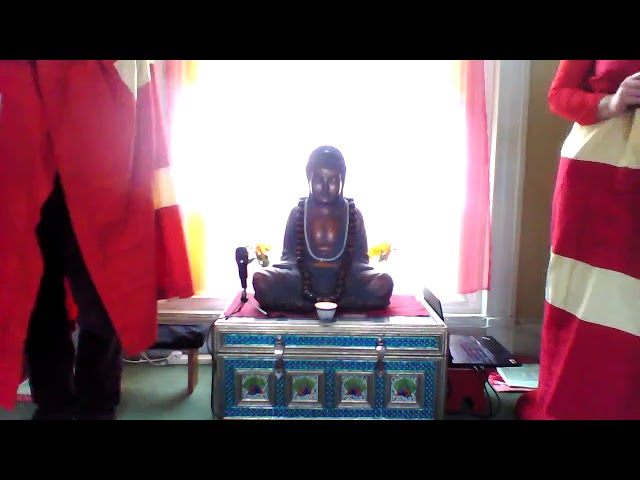
This content was created by Satya Robyn. This content was uploaded by Satya Robyn. This is a YouTube recording titled "Evening service in the shrine room" (recorded July 15, 2020) of an English Buddhist evening service held in a shrine room. The excerpt contains a Dharma talk (Speaker B) reflecting on shame, guilt, contrition, and the Nembutsu practice, followed by periods of meditation, prostrations, liturgical recitations and invocations led by multiple speakers (Speaker A and Speaker C) and communal chanting/dedications (including a get-well dedication for Jan Wysinowicz). The setting includes both an in-room congregation and online attendees; the content mixes teaching, ritual prayer, and ceremonial responses.
Chapters
Time has passed with the swiftness of light. It's already evening. Impermanence rushes upon us every moment. Mara follows every step. Oh practitioners of the way, strive diligently, attain nirvana. Rare is it to meet with the Dharma ultimate and profound, even though one may seek for hundreds and thousands of eons. Fortunately, we now hear and receive it. We pray that we may understand the Tathagata's true meaning. Let the Blessed One hear the Dharma. Let the Sublime One teach the Dharma. There are beings with little dust in their eyes who are wasting through not hearing the Dharma. There will be those who will understand. The Buddha has said, open for them are the doors of the deathless. Let those with ears now show their faith. Buddhas throughout space and time reverently pray to you. Dharmas throughout space and time, reverently do we adore you. Sanghas so exemplary, reverently do we adore you. To this holy place, Amida Buddha, highest one, bring your presence now, we pray. To this holy place, Shakyamuni, enlightened one, bring your presence now, we pray. For this place, to targeters of all worlds, bring your presence now, we pray.
Namaste. Welcome back into the shrine room, the first time on Wednesday evening since March. Welcome to everybody joining us online as well. It's strange in many ways to be in here. One of those ways is that I can't see the computer, so I don't know who I'm speaking to. But hello, welcome. I'm used to seeing all of your faces spread out in front of me. Instead, I've got some real faces. Your faces are also real. I've got the faces of real people who are present in the room. To look at, which I appreciate. I've been thinking about the difference between shame and contrition today, and maybe we can include guilt in the mix because that's something that's very similar. Dharma Vidya talks about guilt as the feeling we get when we're trying to deny that we're the sort of person who makes mistakes. I've been thinking about this because I missed one of my niece's birthdays a while back, and I only found out about it when I sent a card to my other niece and then got a message saying, 'Oh, did you know you— that you missed the other one?' I was like, 'Oh no, I didn't.' Um, and actually I didn't struggle with guilt this time. I didn't— I wasn't trying to kid myself that I was the sort of person who occasionally misses birthdays, because I've learned over the years that is the sort of person that I am. So I wasn't struggling with guilt. What arrived was shame. Shame is close to guilt, but shame is about worthlessness. It's a feeling of, because I've done something wrong, therefore nobody will love me anymore, therefore I'm going to be rejected, I have no value. Shame is very powerful and we— it's very uncomfortable to feel, so we often hide it away under other feelings. For me, this time it was a kind of freeze response. Oh, I just won't feel anything for a while. Then I don't have to notice that there's this horrible shame in my heart. Shame is also something that can be quite contagious. We often try and rid ourselves of feeling shame by getting upset with other people because If it's other people's fault, then we don't need to feel the shame anymore. And usually we do that in a way that is shaming. Oh, if I get really angry with the world or with somebody, then they will feel bad, but I will feel okay again. So shame gets passed around and passed down through generations. So that's guilt and shame. Contrition is different. We talk about contrition a lot in Buddhism. Sangei is a Japanese word, and occasionally in our services we recite the Sangeimon, the gate of contrition. In the Summary of Faith and Practice, it says that contrition can be a gateway into the Dharma. A gateway into seeing the truth, and also a gateway to the Buddha. So what's contrition? Contrition is a taking stock of what has really happened in a way that comes from a kind of easier, more compassionate place. Compassion for self, compassion for others, and it's often accompanied by regret and sadness and a desire to make amends. It's, 'Oh yeah, I am the sort of person who would do this, or at least I was today, and I feel I'm sorry about that. I don't feel like it's the end of the world. I accept that humans make mistakes sometimes, but I made a mistake today and I wished I hadn't. It's softer. It recognizes the truth, but it's kind. And contrition can soften our own hearts. And it can also lead to this sense of, oh, this is how it is to be human. If I could do this, other people can do this as well. We're all in the same boat. Because it isn't coming from a judgy place or a blaming place. We can be— contrition allows us to be a bit easier with each other, fellow feeling. And what makes the difference? The difference is love. Guilt comes from fear. I don't want to admit that I'm the sort of person that did that. Usually a fear of shame. Shame, worthlessness is also about a lack of love. So love is the antidote, trusting that we are loved. And that can be hard to do when we've made a mistake, because sometimes people really are upset with us. We can struggle to find the place that we feel loved in those moments. And this is where Nembutsu comes in, because Nembutsu is a practice of orienting ourselves to the eternal, constantly outpouring love of the Buddha that is coming towards us. So remembering that this stream of light, that this stream of unconditional love is coming towards us Establishing a sense of the Buddha's presence, if possible, maybe seeing the Buddha in our mind's eye, or if we can't manage that, trusting that the Buddha's presence is available even if we can't quite get to it in that moment. That is what supports the movement from guilt and shame to contrition. Because when we're loved, we don't need to be afraid. And when we're loved, we don't need to feel ashamed. The Buddha's love holds us in our foolish human condition. And of course, Ironically, guilt and shame often play out in cycles, and we end up making the same mistakes over and over again. But with the presence of the Buddha, coming into a place of contrition, maybe we can do something different next time. And if not, knowing that we are loved has already changed something and is already profound in and of itself. Namami Jebu. So we'll now have some time for quiet meditation. And in this space, you may want to bring the Buddha to mind, whatever that means to you, whether it's seeing the Buddha larger than life or having a sense of the Buddha's light coming towards you, or just experimenting with the idea that there is some love that you can rest in. Now we will perform prostrations. Please stand and face the shrine.
We will now recite evening service together, which is on page 13 of your service book.
With body, speech, and mind humbly I prostrate and make offerings both set out and imagined. I confess my wrong deeds. From all time and rejoice in the virtues of all. Please stay until samsara ceases and turn the wheel of Dharma for us. I dedicate all virtues to Great Enlightened The ground sprinkled with perfume and spread with flowers. The great mountain full and sun and moon. Tina's abode of land and of earth thus. May all beings enjoy such pure land. By the grace that I receive through Amitabha's vows, may I be moved to deeds for the benefit of all. By the grace that I receive through Amitabha's vows, may I be moved to deeds for the benefit of all. By the grace that I receive through Amitābha's vows, may I be moved to deeds for the benefit of all. The purpose of our practice is to be a pure container wherein the common passions mature as high alchemist's stone. A preliminary outlook comes with bowing and contrition, facing up to my obstructions and seeking life's first essence. Devotion to my teacher ends my smugness and dejection. Helped by his compassion, I will find a straight direction. My refuge: vows and precepts, recitation of the sutras. I grow through every challenge, embody sadhara aspiration. Cooperation in asanga brings so many joys and freedoms. Through gentle words and gestures comes collective transformation. Settled faith and inner cleansing brings us home to life's great need. Inner Four Divine Abidings, Buddha's light is always with us. Multitudes are disconcerted I am permanence and difference. With Dharma as true refuge, we dwell within the pure land. Now gratitude is overflowing, going forth, returning with you. I offer gifts of Dharma. Buddha is my path, bliss, bliss, the only. Innumerable sentient beings, we vow to save them all.
Immeasurable are the Dharma teachings, we vow to transform them all. Immeasurable are the Dharma teachings, we vow to master them all.
Infinitely, Sir Buddha's way, we vow to follow it completely.
Invocation of Akalana Tantra.
Hail to the mandala! Let our soul be engulfed within its traces evermore, that all our own wills and vigilance May we all fetch us God away. May we within the temple of our own hearts dwell amidst the myriad mountains. Hail, hail, hail, hail. Invocation of my heart Let us be engulfed within the mandala of the Sangha of Buddha!
Eh eh eh—
The Arrow of Emptiness!
Eh eh eh— Invocation of Arhat Chana Buddha!
Eh eh eh— Manifestant Mystic!
The treasure heaven, the golden bell that rings but once.
Each upon the hill.
So we finish this evening's service by transferring out to Jan Wysinowicz, who has recently had a new hip, and we wish her well in her recovery. By your vows and through your grace Well, I thought we could probably arrange it so there's not enough of us to—
Yeah, it's probably okay, isn't it?
No need to come out of here.
Oh, I'm not looking at the camera, but I am looking at all of you.
Oh yeah, do stop the video as well.









