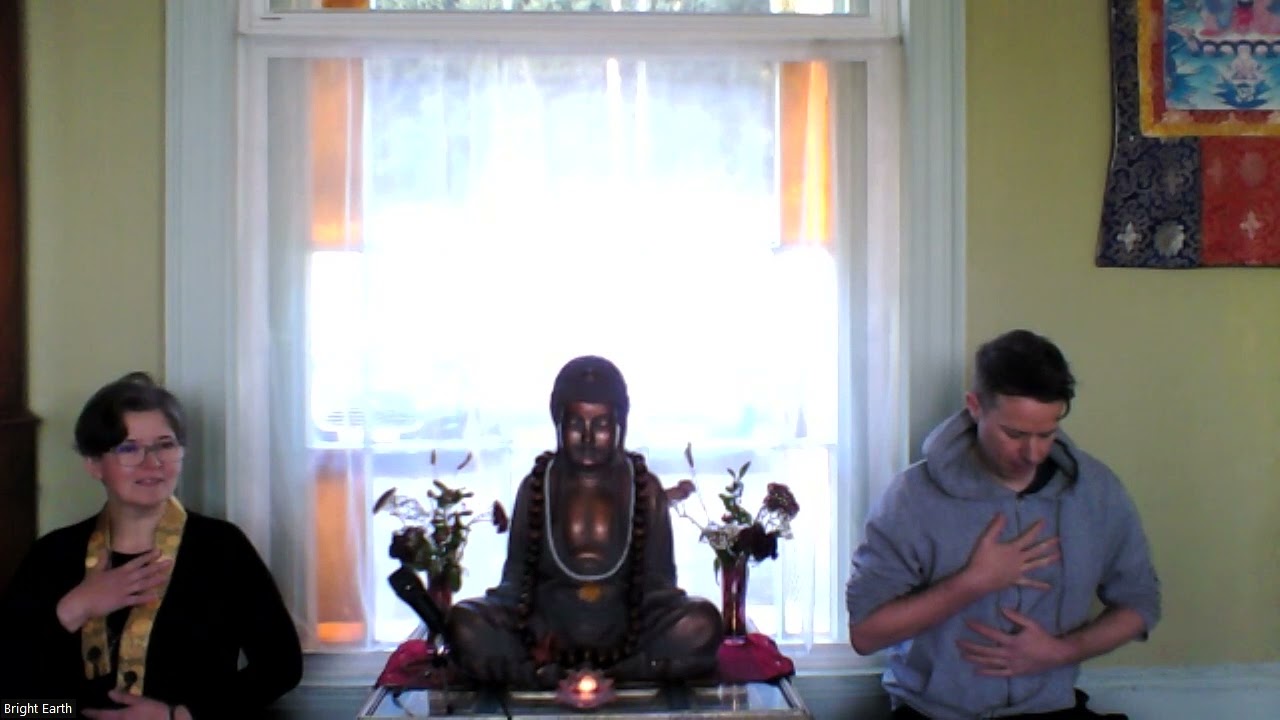
This content was created by Satya Robyn. This content was uploaded by Satya Robyn. This is a YouTube recording (titled "Exploring the Heart Sutra and Interconnectedness", published 2023-11-26) of a Buddhist morning/service-style sangha gathering. The session is led by Kusuma and includes a Dharma glimpse by Philip, guided meditation, chanting (including recitations by Satya Robyn), the refuges and precepts, a Dharma talk focused on the Heart Sutra (translation by Thich Nhat Hanh) and themes of emptiness, interconnection, end-of-life practice, and compassion (Kuan/Yin). Other participants include Dave and several attendees labeled as Speaker E/F. The recording also contains announcements and community logistics (retreats, kirtan).
Chapters
Yay!
Good morning, everyone! Good morning, Claire watching. It's been a bit of a joint effort this morning. Good morning, everybody. For those of you who don't know me, my name is Kusuma, and I'll be leading the service this morning. And, uh, to begin with, we have got a Dharma glimpse by Philip.
So this is a Dharma glimpse by me, and it says it's from 2022, so last year. So I'm kind of interested to know what I wrote back then, kind of a bit of trepidation.
Oh, was it?
Was meant to be, it was meant to be. So I think this was written when I used to live up in Morecambe in the Northwest near Lancaster, um, but I've moved back to Malvern since then. So I was thinking about location and being before a recent trip to the temple for a mindfulness retreat stay. The idea and knowledge of having a planned trip back to the temple always fills me with warmth. To be reconnected with temple mates, the sangha, a sense of action and purpose through the Earth vigils. And a stronger sense of being connected to the Buddha than where I now live up north. As I said, I've moved back down since then, but I still find parts of me unsettled by the traveling and changing surroundings. I asked myself before this recent visit, am I able to be anywhere geographically and locationally but connected to both myself and something bigger? The answer of the moment feels like it is a no. I vaguely remembered a saying along the lines of, 'You're exactly where you are supposed to be.' I assumed it meant locationally. I don't know if it also means cosmically, spiritually, and internally. Maybe it can be any or all of these, acknowledging there is an overlap between them. The saying sounds comforting to me in terms of cosmically and locationally. That sense of fate and/or being guided by something bigger, but I'm not sure it feels true or perhaps helpful to me. Maybe spiritually, internally, being compassionate is the best I can be at this moment. Maybe that is a truth of sorts, but it's not where I want to be. Brother Graham— brackets Brian— and I used to recount lines from the poem Desiderata in the temple kitchen. Sorry, we were talking about that the other day. It's a bit weird. One of our favorite shared favorites is, you're a child of the universe, no less than the trees and the stars. You have a right to be here. Having a right to be here gives me comfort and compassion. But I think accepting, embracing this right also means accepting the rights of others to be here— the trees, stars, sentient beings, and others struggling like me, whether consciously or not, with their delusions, ignorance, and reckless actions to the Earth and all its inhabitants. For me, I think there might be hard but beautiful work to do to move forward spiritually, internally. Part of that hard work feels like it could be surrendering to and taking refuge in Amida Buddha. The distance to Lhunen may be small in many ways, but in other ways it feels to me like one of the furthest and most challenging. Maybe it is both simultaneously near and far, but the further I go spiritually, the less distance I have to travel internally to be connected to myself and something bigger, so that perhaps my physical location becomes much less important to how I think and feel and what I'm able to offer and receive, so that wherever I am physically, or even internally at times, I am always, nearly always, in the right place in relation to the Buddha. Namamida Butsu.
Well, the world, or the Buddha, works in mysterious ways, because I, I picked that out literally minutes before everybody arrived. I didn't actually read it, I just saw that Philip came in the room and went, can you read this? And actually a lot of the content of what you've written about is wonderful to reflect on for you. And as a lot of the things that have come up over the last few weeks when we've talked are in there, but also it relates to what I'm going to do in the Dharma talk later. So there's a little bit of divine magic has gone on, I think, this morning. So that's really interesting. So right, we're going to move into, um, a state of meditation, and, um, we're going to, um just create an awareness of ourselves. And I want you to try and breathe in through the nose and out through the nose if you can. I know it's cold season, but let's try. And, um, try and get a sense of the self. And just sometimes it's useful if you struggle to meditate just to pop your hand on your chest and your abdomen just to start to feel the flow of that breath through your body. And what we're doing is we're just connecting with the anchor. The breath is our anchor, and just holding ourselves in this place of awareness of our bodies. We're just closing your eyes, and with every breath in, you're breathing out tension. Breathing in, breathing in relaxation. You're breathing in relaxation, breathing out your tension, just building that awareness up of yourself and using the breath just to let go. Let go of anxiety, let go of fear, cultivating kindness. Every breath is cultivating kindness to yourself. We're going to gently come out of our meditation, starting to have an awareness of my voice and the sounds outside and inside the room. And we're going to move into, um, chanting Nam-myoho-renge-kyo in bosat. And, uh, Kwan Yin is the bodhisattva of compassion who He's standing there, and I think I've got another one somewhere.
There's a couple of them in the room. That one there.
So, uh, Kuan Yin manifests in lots of different forms, and, um, it's great for ourselves when we want to give ourselves some compassion. But if you're wanting to help somebody else who's going through something difficult, then Kuan Yin is your mantra to go to, to lean into. And, uh, Kuan Yin is sometimes seen as feminine and sometimes as masculine, um, and you'll see several forms of him/her.
Um, so we will begin.
Namokwan Shinbo Satya Robyn. Namokwan Shinbo Satya. Namokwan Shinbo Satya. Namokwan Shinbo Satya. Namokwan Shin Bosat. Namokwan Shin Bosat. Namokwan Shin Bosat. Namokwan Shin Bosat. Namokwan Shin Bosat. Namokwan Shin Bosat. Namokwan Shin Bosat. Namokwan Shin Bosat. Namokwan Shin Bosat. Namokwanshin, bo sat. Namokwanshin, bo sat. Namokwanshin, bo sat. Namokwan Shin Bosat. Namokwan Shin Bosat. Namokwan Shin Bosat. Namokwan Shin Bosats. Namokwan Shin Bosats. Namokwan Shin Bosats. Namokwanshiim vosat. Namokwanshiim vosat. Namokwanshiim vosat.
So we're going to do our refuges and our precepts. For refuge, I go to the Buddha. For refuge I go to the Buddha, the one who is awake and full of love.
The one who is awake and full of love.
Namo Buddha.
Namo Buddha.
For refuge I go to the Dharma.
For refuge I go to the Dharma.
All that guides us to wisdom and compassion.
All that guides us to wisdom and compassion.
Namo Dhammaya. For refuge I go to the Sangha.
For refuge I go to the Sangha.
All who live in the Buddha's light.
All who live in the Buddha's light.
Namo Sanghaya.
Namo Sanghaya. Namo Sanghaya.
With faith in the Three Jewels.
With faith in the Three Jewels.
And in light of my human tendencies, and enlightened my human tendencies—
I pray that I may become aware of when I take life.
Of what happens to you?
Now I pray that I may become aware of when I take what is not freely given.
Or why do they say 'what's really good'? And then we've got 3 more times now for each one!
Pray that I may become aware I pray that I may become aware of when I fall into sexual misconduct—of what?
Fall into sexual misconduct—I pray that I may become aware at any time you come away—when I've fallen to wrong-speech-of-what-I-fall-into-wrong-speech; I pray that we might be more awake—we have prayed—that they'd make me go nowhere—of when it becomes intoxicating or excessive—or too much for my stomachs—and of also thank all beings who guide us on when our path toward enlightenment!
Thank God Buddha Lotus Birthplace I Temple here today bringing this practice together so many people can become receive blessings from him just like yourself now through these videos... Namaste everyone. Om Mani Padme Hum intoxicated.
No blame. No blame.
Be kind. Be kind. Love everything.
Love everything.
Innumerable are sentient beings. We vow to save them all. Inexhaustible are deluded passions. We vow to transform them all. Immeasurable are the Dharma teachings. We vow to master them all.
Infinite is the Buddha's way.
We vow to fulfill it completely.
So I'm going to, uh, read to you something of a puzzle this morning, as it's been described, not by me, but, but quite a few of the Dharma people. So, um, the insight that brings us to the other shore. This is a translation By Thich Nhat Hanh, and it's a translation of the Heart Sutra. So Avalokiteshvara, while practicing deeply with the insight that brings us to the other shore, suddenly discovered that all of the five skandhas are equally empty, and with this realization, he overcame all ill-being. Listen, Shariputra, this body itself is emptiness, and emptiness itself is this body. This body is not other than emptiness, and emptiness is not other than this body. The same is true of feelings, perceptions, mental formations, and consciousness. Listen, Shariputra, all phenomena bear the mark of emptiness. Their true nature is the nature of no birth, no death, no being, no non-being, no defilement, no purity, no increasing, no decreasing. This is why in emptiness, body, feelings, perceptions mental formations, and consciousness are not separate self entities. The 18 realms of phenomena, which are the 6 sense organs, the 6 sense objects, the 6 consciousnesses, are also not separate self entities. The 12 links of independent arising and their extinction are also not separate self-entities. Ill-being, the causes of ill-being, the end of ill-being, the path, insight, and attainment are also not separate self-entities. Whoever can see this no longer needs anything to attain. Bodhisattvas who practice the insight that brings us to the other shore see no more obstacles in their mind. And because there are no more obstacles in their mind, they can overcome all fear, destroy all wrong perceptions, and realize perfect nirvana. All Buddhas in the past, present, and future, by practicing the insight that brings us to the other shore, are all capable of attaining authentic and perfect enlightenment. Therefore, Shariputra, it should be known that the insight that brings us to the other shore is a great mantra, the most illuminating mantra, the highest mantra, a mantra beyond compare, the true wisdom that has the power to put an end to all kinds of suffering. Therefore, let us proclaim a mantra to praise the insight that brings us to The Other Shore— Gāte gāte paragate parasamgāte bodhisvaha! It takes a lot to absorb it, and it's one to definitely go and read repeatedly or listen to. There's a beautiful version of it by the community at Plum Village that you can just listen to them sing it. And, um, even if you don't understand all of it, there's something about the Heart Sutra that feels like it pulls everything together in the universe and puts it in your heart. And there's no need for you to really understand all of it. And the Heart Sutra is a really important text, um, for letting go. And not just for us as we are now, but in the state of death, um, when we need to live to leave this life, I should say, the Heart Sutra can be read to somebody to say it's okay now, nothing, nothing matters, everything is okay, just to let go of. And when we say gāte gāte paragāte, it's go on, go on to the other shore. You don't need to be here anymore.
It's we can move on.
So the 5 skandhas that it talks about— the body, the feelings, the perceptions, mental formations, and consciousness— and it talks about, uh, being empty. And it's like, well, how can you be empty? Um, but what it's saying is that when you come to this realization that all of these things are you, that is the moment when you are empty. So you're no longer confused and trying to separate aspects of yourself. So a lot of our pain and suffering comes from when we try to separate different things. I'm not going to look at anybody in particular, but for those people who've studied psychology, for example, you're looking at the mind. But also, when we look at the mind, in doing so, we can see that been opening up what's happening in the mind, it can agitate the body, it can cause pain, suffering to the physical body. So we're not— our physical body and our mind, they're not separate. They, they need to be in harmony together. Um, and this sort of practice with the, uh, Heart Sutra helps us to keep reminding ourselves that we're not separate different things. That we're all the same. And when you expand it to wider than yourself and start to use that to look at the world around you, you see that everything is connected, everything is important. And when we look at, um, you know, a flower or a leaf from a tree, you know, a tree is always a wonderful example because when the leaf falls, like now in autumn, it goes back to the tree, you know, it falls down and becomes compost and becomes food for the tree. And then once again comes spring, the tree blooms again, you know. People always talk about winter and everything being, you know, dying off, you know, autumn, everything dies off to come back again. But nothing's dead, it's all just asleep, it's all resting. Um, so it's kind of our Western view is that You know, we can look at things separately. You know, we can look at the mind separately to the body. Nothing ever feels like it's holistic from a personal perspective. As somebody who used to be a complementary therapist for many, many years, you know, it was always a struggle to get doctors to understand that you couldn't just fix one thing, that one thing is a symptom of something else. And, uh, you know, the Heart Sutra helps us to examine all those separate things and realize that they are all one. And when we stop trying to work with the separate things and just go, okay, this is us, this is who we are, we let go. A part of ourselves just lets go. Um, so in the Second part of the Heart Sutra, it talks about it being a mantra. And if anybody who does meditation, um, you know, meditation uses mantras to focus. And in a way, the Heart Sutra is a meditation. It's, it's— you're using it to bring right concentration and right thought And that's one of the key things that's asked of us on the path as Buddhists, is to try and cultivate a right mind, right concentration. And this text is one of those things that helps us to do that. And in doing so, we keep reminding ourselves of this cycle that we can fall into with the skandhas, of trying to separate things and that just becomes more suffering. So it's better just to use a meditation practice just to sort of let it all go and not be so focused on one thing or another. And just allowing us to be present with the fact that we can be all of these things but none of these things, if that makes sense. And then when we sit and practice in meditation The breath becomes this cycle that allows us to settle everything down in our bodies and just see this space, this, this peaceful space inside ourselves. And that's the space that I think when we practice the Heart Sutra, it's asking us to do is just to find this quiet space. And certainly at the time when I've offered this up as an end-of-life practice for people who are possibly already unconscious, what we're doing is we're saying it's okay now. We let go of this physical body, we let go of the mental formations, we're just going to go now. We're going to go to the other shore and we're going to meet the bodhisattvas. And the Buddha, hopefully. And, uh, yeah, this, this one of the things that Thich Nhat Hanh said about this is that, um, even if we view, if we view knowledge and wisdom as solid, they will even block our understanding of this. So it's like we, um, we put too much effort into thought and feeling, when actually if we put a lot more effort into just breathing and being present, life would be a lot less complicated. I think it's what it's trying to say. But I'm, I'm no expert on the Heart Sutra, but I wanted to share it today, and I particularly wanted to share it because, um, I'm mindful that this week I was meant to go on a visit to somebody and do this. And we can never predict when death might come. And this person died before I had chance to go to them and do this practice. But I had been working with them, with, uh, Avlokiteshvara, with Kwan Yin. And although we didn't speak the same language and he didn't always acknowledge that I was in the room, there was definitely a part of him that connected with the presence of Kwan Im. And I think it's really important to emphasize that even if we don't always understand what's on the paper or the words that are being said to us, there's this experience that happens anyway, and that we just have to be open in our hearts to what the Buddha may present. And this morning was quite an interesting example of that, I think, for some of us in the room, that we never quite know what will appear when we sit here on a Saturday morning.
But yeah, there we are.
Namaste, boo.
Look at that glorious view this morning. You can see the mist. Spectacular. In gratitude, we offer this incense to all Buddhas and bodhisattvas throughout space and time. May it be fragrant as the earth herself. Reflecting our careful efforts, our wholehearted awareness, and the fruits of understanding slowly ripening. May we and all beings be companions of Buddhas and Bodhisattvas. May we awaken from forgetfulness. And realize how much you love. Beautiful.
So we're just going to have another bell and bow to each other. And back to the Buddha, and find your seats.
Do we have any announcements? Kirtan chanting and sacred singing on Sunday night. 7:30 to 9:00. It'll be gorgeous. Come and melt into sound with me on Sunday night. Yeah, fabulous.
And, uh, we— I don't think we've announced it yet, have we? That we've got the Bodhi Retreat.
Have we said that yet?
Yeah, I'll do an early announcement in case anybody hasn't seen it on the website yet. The Bodhi Retreat is coming up. Is it the 9th?
Yeah, Saturday the 9th.
You don't have to stay for the whole day, but if you want to come and dip in and out of different talks and things that are going on, I'll be offering some meditation on the day.
Angie's going chanting on you, I think.
Yeah, there's various talks, so you'd be welcome to come to that. So we just finished with our final blessing. Let the spiral of Tara's light may we care for all living things and the holy earth. Namamiddu. Thank you to everyone for attending. Thank you to Dave for bravely attempting the bells. Is it the first time? Is it Yay!
Never easy, terrifying, honestly, the first time was terrifying, so well done, Dave. So if everyone would like to quietly lead out, that would be wonderful. Thank you. Thank you. Should I turn this off? Yeah. No, but should I turn this off?
You're going to turn this off?
I'm worried about the people online.









