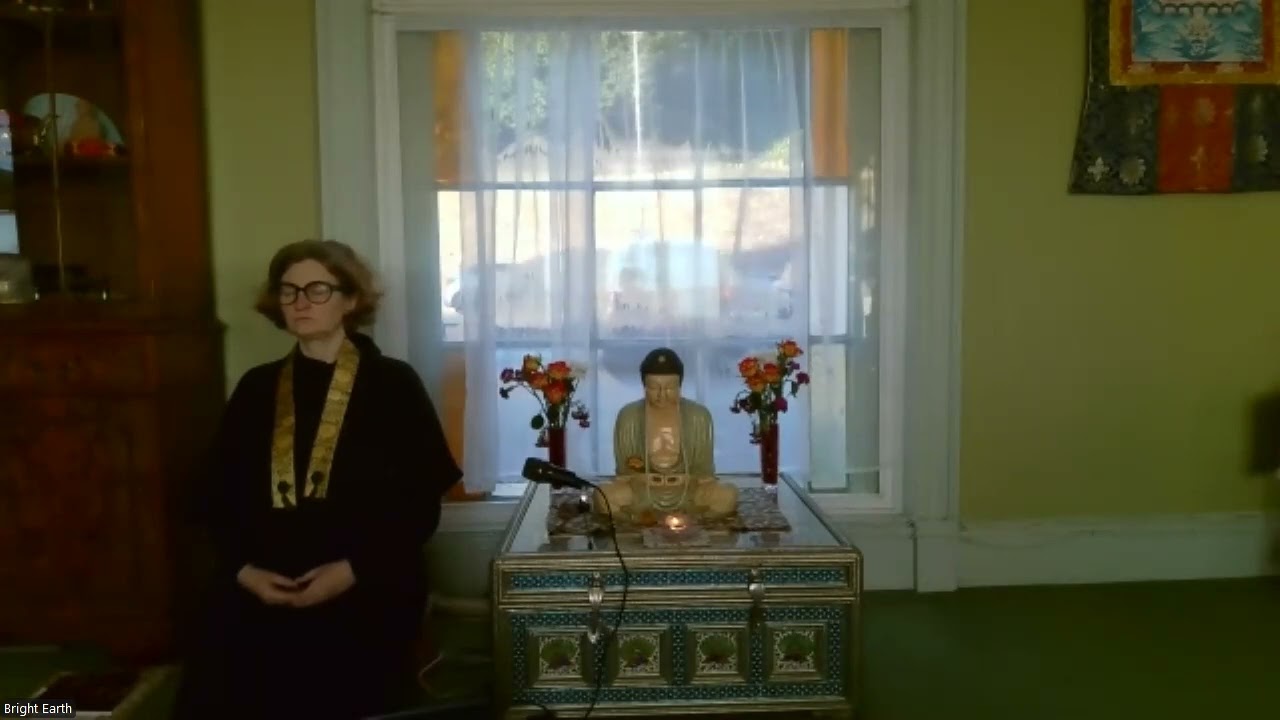
Satya Robyn leads a Buddhist group practice with readings from Gyomei Kubose on how the Buddha taught, guided silence on what real happiness is, chanting, and ritual. The group transfers merit for a recently deceased cat and discusses faith as a steady inner canvas.
Chapters
Good morning, happy New Year. Welcome to Rob joining us. Zoom, not Europe. So here we are holding the space at the beginning of the year while other people recover from too much sugar and too many— too much holidays. So I'm going to begin practice this morning with a reading from Gyomei Kubose's book book. Caspar and I did a couple of years' study with Kiyome Kubose's son, Koyo Kubose, before he died.
And he's Japanese Buddhist, trained as Pure Land priest, and had lots of Zen influence.
And they're really— his books are very accessible. They're very short chapters, very, very down to earth, very bright earth. So this chapter is called How the Buddha Taught.
Although it is important to know what the Buddha taught, in another way it is more important to know how he taught. I talked about this recently to our temple's high school students. I started out by saying, today I'm not going to tell you about the Buddha's teachings. These things you can read about later. Instead, let's look at how Buddha taught. He never gave answers on a silver platter. He never said, 'This is the truth, you should believe it and follow it.' On the contrary, Buddha said, 'Don't believe something just because I said it. Do not follow teachings until you test them through your own experience.' The Buddha always said to look into our own lives. Then I asked the students, what is the most important thing in your life? One girl said, my parents. We talked about the importance of parents. Another student mentioned money. I asked, is money the most important thing? Everybody said no. However, I countered that we can't deny that money is very important. If we did not have money, we could not function in today's society. Another boy said life itself is most important. What do you mean life itself?
I asked.
He must have taken biology because he answered, life is composed of cells. I commented, it is important to keep your body alive and healthy. Yes, he replied, without a healthy body we cannot help others. This led into exploring the value of altruism. We continue to consider many other different answers to the question of what is the most important thing in life. Although many aspects were discussed, we did not arrive at one final answer. I explained that we each have to think things out for ourselves. This is the Buddhist approach. The Buddha never handed out teachings like a pill, saying, 'Here, swallow this.' Instead, he always asked Is that right? What do you think? He offered teaching so that you could try them in your own life. He did not tabulate his teachings. His teachings were not static or statistical in form. His teachings were dynamic and always dealt with value in one's life.
For instance, what is real happiness in your life?
Many children are happy when their fathers give them a weekly allowance. However, when that allowance is gone by the middle of the week, they are sad. Happiness that is created by friendship lasts only as long as your friend is present. When your friend is gone, you are sad. Does real happiness come from external things? What is the real happiness in your life? These are the kinds of challenges that the Buddha always asked. He never commanded people. In Buddhism, there is no dogma. There is no set of formal teachings. The teachings are always put within the context of an individual's experience. Understanding should come from living, not from the head. This is the Buddhist way. This is how the Buddha taught.
So as we move into silence together for a little while, You might just want to pay attention to your breath, or you might just want to sit with this question Kobo Sei asks: what is real happiness in your life? And after some silence, we'll start chanting together, and we'll chant Amitabha. Do join in. What is real happiness in your life?
Amitabh. Amitabh. Amitabh. Amitabha. Amitabha. Amitabha. Aami taba. Aami taba. Aami taba. Amitabh. Amitabh. Amitabh. Amitabh. Amitabh. Amitabh. Amitabh. Amitabh. Amitabh. Amitabha. Amitabha. Amitabha. Me tova, ah, tova, ah, e tova, ah.
Ciao. We will now chant the refuges, vows, precepts together, which are all important things that direct us in a particular direction. They are on the liturgy sheet if you want to read along, and it's a repeat after me. For refuge I go to the Buddha, the one who is awake and full of love. Namo Buddha. For refuge I go to the Dharma, all that guides us to wisdom and compassion. Namo Dharmaya. For refuge I go to the Sangha. Those who live in the Buddha's light. Namo Sanghaya. For refuge I go to the Earth. The holy ground of awakening. Namo Bhumiyai. With faith in The Four Refuges— With faith in The Four Refugees—and in light of my human tendencies—I pray that I may become aware—of when I take life; I pray that I may become aware— of when I take what is not freely given. I pray that I may become aware when I fall into sexual misconduct. I pray that I may become aware of when I fall into wrong speech. I pray that I may become aware I pray that I may become aware of when I become intoxicated.
Of when I become intoxicated.
No blame. No blame. Be kind. Be kind. Love everything.
Love everything.
Innumerable are sentient beings.
We vow to save them all.
Inexhaustible are deluded passions.
We vow to transform them all.
Immeasurable are the Dharma teachings.
We vow to master them all.
Infinite is the Buddha's way.
We vow to fulfill it completely.
So when I was thinking about what happiness was for me. This image emerged, which was a kind of like a painting, really, and beautiful images kind of appearing, beautiful colors, and then kind of black paint coming on top or things getting smeared., things changing. Um, and the, the color also kind of represented feelings. So there'd be amazing, beautiful feelings, and then really anguish, grief, rage, the, all the changing conditions of life. And that wasn't where my happiness was. Happiness occurs in that place, in that layer, but that wasn't what I was thinking of when I was thinking, what is happiness for me? Um, so happiness for me is the canvas, is the quite plain, kind of beige, thick, steady canvas that's underneath all of that activity. And often I forget that it's there because the colors, the shapes, the sort of the intoxication or the, the, um, all the beauty or the horror or whatever it is that's happening on the picture, just, it feels like it's everything. It feels like it's, it feels like it's, um, It feels like it's life, but it's not. There is something that is steady underneath it, in my experience, and my happiness is because of that steadiness. My happiness is in knowing about that steadiness. Even when I forget it, I know that I've— that part of me that knows that it's there, but I've forgotten it, or that I'm not able to connect with it. And for me, that canvas is my faith, my faith in Buddha, and also my faith in, um, God. I would use the word God quite comfortably. I know that that freaks a lot of Buddhists out. Don't worry if that's not a good word for you, or the divine, or nature, or Gaia, or big love, uh, whatever feels comfortable to you, that that is the canvas. And my, the, the big gift for me from Buddhism, the big gift of being quite deeply involved in Buddhism for a decade and a half, couple of decades, is having a deeper connection with that thing, whatever it is. And I think, I mean, you know, Gyomei Kubose is clear in his piece of writing that we all have to come up with our own answers. So this isn't the pill I'm giving you to swallow. This is me speaking of my own experience. The gift of Buddhism is that I have been able to come into relationship with that thing in all sorts of different ways and test it out, kind of prod it, kind of notice the effects that it has on me when I acknowledge it. And that happens in all kinds of different ways. It happens a lot in this room. For me, it especially happens around other people in this room. I often feel touched that, that people come here and practice together. Or it might happen through seeing the, the amazing view through behind the Buddha, or remembering some of the objects in this room where they came from, the people that gifted them to us. We were talking— I can't remember who— when we were talking about it, we were talking about these dragons on either side of the fireplace, that these belong to Christina, who, who left her house to the Yamada Trust and basically paid for this, this whole building. I never met her, but those objects kind of represent her somehow. And I also encounter the canvas when I'm out and about. Later this morning, I'll be sitting with the vigilants who've been sitting for 5 years now, every Saturday between 12 and 1, with a picture of the Earth round, round our necks, to sit in and witness the destruction of the Earth, to, to offer our love and grief to the planet. I meet it a lot in those spaces, in those activist spaces, and also on ordinary walks with the dogs. Um, when we walk through the graveyard just beyond, just behind our house, I meet it when I talk with Dharma colleagues. I meet it on the WhatsApp that we have, Bright Earth WhatsApp, when I read spiritual books, whether they're Buddhist or other traditions. But it does take some work. In the 12-step programs, they say it works if you work it. So work it, you're worth it. And I, I really want to bring that in as a Bright Earth phrase, because we have to turn up, you know. And yeah, I, we've said this before to different people, but in the early days, Casper and I were very much, oh, just come when you feel moved to, and you know, don't, uh, don't push anything. And, and that is true. And also sometimes it's worth just, just kind of nudging yourself a little bit to get here. Um, because this is, this is the work. This is the, this is the opportunity we have to connect with the canvas. And if it affects you, if it, if it, if it changes you, changes your life in anything like the way it changed my life, then that will make me very, very happy. So very grateful for my teachers, very grateful to the Earth, very grateful to all of you for being here this morning. I would be here whether you were here or not, but it's always really nice to have other voices to chant with. And here is to a year of this place making an offering to the town. Hopefully sharing some of the precious stuff that we have. Nam-myoho-renge-kyo. So we will now make prostrations to the Buddha. So we use the chant that we did on New Year's Eve, and we go to the floor 3 times and back.
So do whatever your body feels comfortable doing and just adapt it.
If you want to just stand and bow, if that's better, that's fine. And the words are Nam-myoho-renge-kyo. And this is a way to lay ourselves down right just on the canvas.
Alas, people busily engaged in secular matters take no notice of life wearing away day by day, night by night. Like a lamp in the wind, how long can it last in the six realms of vast samsara? There is no fixed abode. Until we are emancipated from the sea of affliction, how can we rest in peace? Should we not be afraid? While we still have strength, let us each share the Dharma. Let us strive and diligently seek the path to the turn.
If we come back to stand our seats, we always finish practice by first of all bowing to each other to say thank you to each other in here. So the way this works is that I bow to Bani, and we work out which is— and then, and then you turn around and bow to the opposite person. Tie down seats and bow to our seats. One of our Buddhist ministers, Kema, lost her favorite cat yesterday, Claude, who's been like a shadow to her for many years. So we're going to transfer the merit from this morning's practice to Claude on his ongoing journey to the Pure Land. I'm pretty sure there's animals in the Pure Land. I don't know what the official line is, but I'm not interested in going there if it's not got any animals. So we'll chant some words to Claude.
Satya Robyn.
A pure and a pure. That will mean a lot to her. So we finish with the closing verse. Blessed by Amitabha's light, may we care for all living beings. Satya Robyn.









