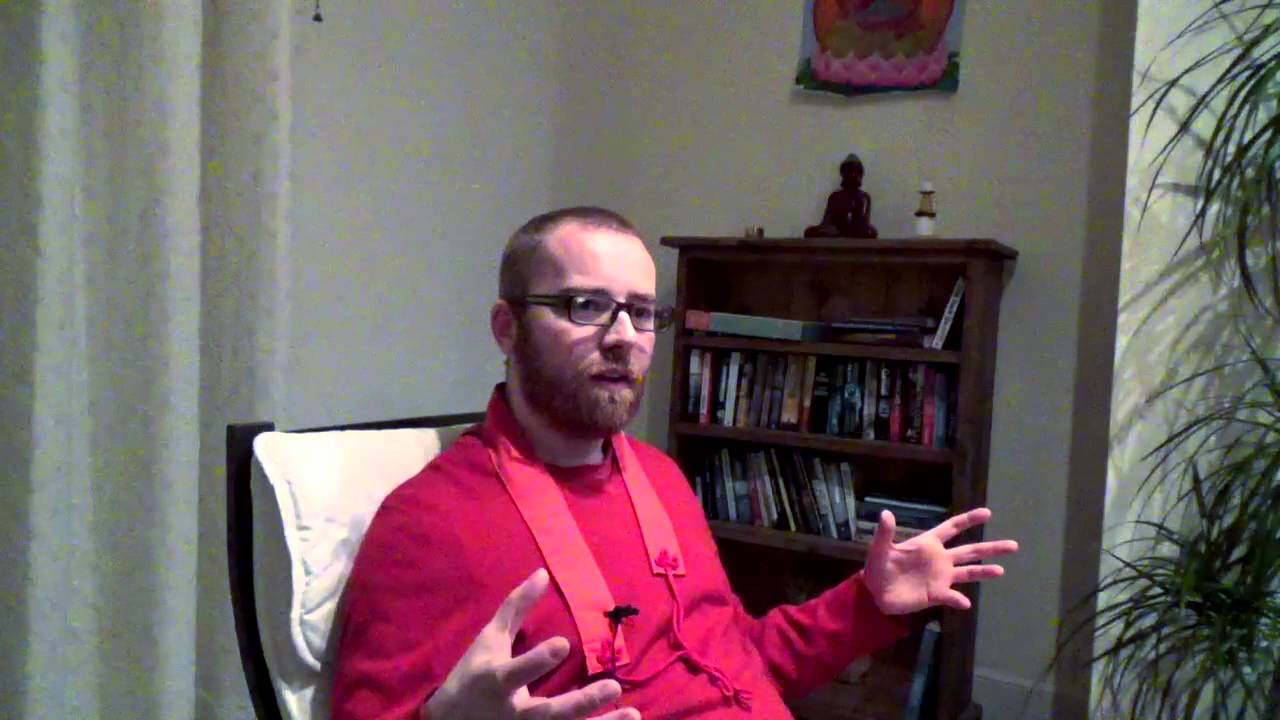
Satya Robyn explores going with the flow through Taoist and Buddhist philosophy, systems theory, and the metaphor of a river and rocks. The talk covers karmic flow versus loving flow, trust, mindfulness, and practices like the I Ching, followed by audience questions about vulnerability and ethics.
Chapters
Well, good evening everybody. Namaste, as we say here. Namaste. So I wanted to talk about going with the flow. This evening. Cats— there's a cat, for the benefit of you at home, there's a cat running across the table at the moment. Cats are very good at going with the flow. So I thought maybe it's helpful to start by just thinking about what the feeling sense of going with the flow is like. So really we're talking about being at ease, being relaxed, being able to make the right decision spontaneously and comfortably, having a sense of what the next step is without having to think too hard about it. Sort of easy navigation of whatever is being presented. So that's the sort of state that we're interested in moving towards when we think about going with the flow. And there are different models that use this, different metaphors about going with the flow, and I thought I'd share a couple. And they don't necessarily all fit together neatly, but there's sort of different images or way of thinking that maybe might be helpful. So I've been reading a lot about Taoism recently, which influenced Buddhism in China and the Buddhism that you get in Japan. And the sense of flow in Taoism is that there is something that is called the Way, the Tao, which is— if you are able to tune into it, it gives rise to the sort of feelings that I talked about, going with the flow. And the Tao is described as loving everything that is, but without possessing everything. It's described as the mother of all the things in heaven and the mother of all the things in earth, but it doesn't attempt to control them. It just sort of nourishes them and sustains them. So this is something that's maybe beginningless and maybe endless that sort of unfolds. Then there's a sense really that the more you tune into this the easier you will find life, and maybe even a sense that life, on it— left to its own devices, will tend to unfold in the proper way, will tend to lead to good results if you don't interfere too much. And we do interfere a great deal with the planets and with ourselves, which is what disturbs this sense of being at ease with the flow. And some modern ideas in systems theory seem to point to the same kind of patterns at work. So, um, systems theory is particularly interested in ecological systems. So you probably remember at school those sort of population things that you did in biology. When the foxes increase, then the rabbits decrease, and then the next year it changes, and eventually it comes to a sort of state of balance. And if something disturbs the system,, it would tend eventually to come to another state of balance. Well, something that's said about ecological systems— now, I'm not a scientist, so don't ask me to check whether this is completely true or not— is that they tend to prefer to be in efficient relationships with the systems that are around them. So they want to be in a better relationship with their environment. So we as people there's a sort of tendency in the long term for us to prefer to be in the kind of relationship with the world around us that uses less energy. So actually, this is a state where we're more relaxed. It's only the disturbances in the mind— they're going around in circles, they're getting involved, trying to control things— that interrupts this process and leads us away from being more at ease with what's happening. And the same is true for other systems as well. Now you could say, we know there's entropy in the universe if everything's decaying. But actually, if you really, if you study life, what you see is that as the energy in the universe tends to move towards a sort of flat state, as things tend to decay and become more chaotic, as the whole universe moves towards white noise, there's also movement in the opposite direction. Life tends to become more complex. Systems become more complex, more interesting, and, um, Yeah, so I think for me that's another way of looking at flow is understanding that what moves life, which you can understand in a sort of metaphysical way or in a very ordinary way, the biological and genetic processes, the building blocks that create life, they tend to move towards complexity to make more interesting systems. But those systems, part of what drives that is trying to find a way for all of these systems to work together in harmony because that uses less resources. So it's quite a rational, logical model. And as I said, we can think of that very personally as well. I'll come on to that later. That's one or a couple of different ideas of how we can think about flow. Maybe a bit heady, but I thought I'd put them in anyway. From a more Buddhist point of view, we can think about two kinds of flow. In one sense, going with the flow, often you think maybe means taking the easy route. We do whatever feels easy in the short term. In practice, what this can mean is that we tend to fall into habits and we repeat ourselves regardless of whether those habits are good habits or bad habits, but because they seem easy in the short term, they're inside our comfort zone. This is the karmic flow. It's conditioned by our environment, by the habits of our parents, by the habits of our previous lives. All of these things come together to produce a sort of mechanical, uh, going around in circles, choosing the same thing over and over and over again regardless of whether it works or not. And that's one kind of flow. That's the unhelpful kind of flow. That's the kind of flow that means you buy another pair of shoes every time you get sad, or, you know, whatever it is. And when you're in that, sometimes it can feel awful, and sometimes it can feel okay, because it is inside your comfort zone. The other flow is the flow of the Buddhas, or the flow of love. This means tending to choose things that are compassionate for the sake of all beings. And this is the flow that we're more interested in moving into, although it can sometimes feel more difficult in the short term because you have to break out of these habit patterns and cycles. And if you want to, if you want to get a picture in your head, I suppose you could imagine the source of karmic flow as sort of all the earthly conditions, impermanence, suffering, all those things that we react to. This creates the sort of mechanical, robotic compulsive flow of energy. At the same time, there is— there are beings which are loving. Beings that are completely loving we call Buddhas. So there are Buddhas in the universe who are behaving in ways that are loving, that are compassionate, that are kind, that are skillful. And that's creating another flow, another kind of energy that we can choose to tune into if we want to. So these are two slightly different models of flow. In the Taoist thinking, it's maybe about the model— the idea is that you sort of tune into nature and that there's this one big universal flow that's also a benign process that you can you into, that you can step into. There's something that's quite appealing about that image, and the perhaps the more classical Buddhist image is that actually the universe itself, the tendency for flow in the universe, isn't necessarily loving. As Buddhism moves into China and Japan, you sort of see the ideas that it is loving, appear, but that the world is shot through with suffering, with impermanence. There's disease, there's war, there's the things that trouble us personally and socially and so on. And there is hope, there's a second sort of flow that we can access. I suppose the key thing about both of them is that there is a sense that there is something beyond our ordinary way of being that we can tune into that will allow us to approach that state of being at ease and being relaxed. And you can sort of experiment with both ways of thinking and see which works for you. Regardless of exactly what words you want to frame it in, there's a very nice image that Duke Kenneth uses of a river. With rocks in it. And the sense is that good spiritual progress, or that sense of being at ease, is sort of, that's when the water's moving freely, or it's when you're in the water and you just lie back and you let the current take you downstream. You don't need to do anything, just relax and you'll be carried where you need to go. But the human tendency is when there's a rock, when we encounter something, is to hold on to the rock, and then we don't get where we need to go. I think the other thing that we do, perhaps because we're afraid of rocks further downstream, even though we don't necessarily know whether they're there or not, is that we will choose to swim in circles, or sometimes we'll choose to swim upstream. And that swimming in circles is, that's the sort of habitual pattern that I talked about, doing the same thing over and over and over and over again. So a rock might be that something happens in the world that disturbs your sense of peace. You're flowing down the river and suddenly, boom, I don't know, something like you lose your wallet or something, perhaps on the bigger end of the scale happens, a great tragedy, and you don't know what to do. You start flailing around in the water, your sense of equanimity is disturbed, and you hold on to the rock. And that's a reasonably safe place to be, because you're no longer thrashing around in the water, you're not going to drown, but you are stuck on the rock, so you're also not going to keep moving where you're going. And while you're holding on to the rock, you're in a state of tension. That's not good for your peace of mind. It's not good for the peace of mind of other people around you. There's all sorts of ways that we hold on to the rock. We recreate the suffering in our own mind. We keep telling the story of it. Or at the other end of the scale, maybe we try and pretend that it isn't happening with one part of our mind, distracting ourselves while the other part of us is holding on to the rock. And you go, "Oh no, look at me, really, I am swimming." But there's a part of you that's desperately holding on to the side of the bank, onto the, the rocks, so that you don't move forwards. Well, maybe you can find a way of letting go and moving back into the stream. Maybe you can find a way of leaning back and relaxing, allowing the current to take you where you need to go. But there's that other danger that Suddenly you remember that rock and you'll start swimming around in circles because you're afraid there's a waterfall, or you're afraid something's going to happen, or you're simply afraid that the water won't hold your weight if you relax. I think this is one of the sort of underlying fears that we all have, that if we stop swimming, that if we stop trying to control our circumstances, things will go catastrophically wrong. So we keep desperately swimming, even if we're swimming in the wrong direction, because at least we feel like we're in control. That gives us some sense of safety. But that can be exhausting, particularly if you are trying to sail upstream and the current is going the other way. So there are a number of different techniques, or tricks, or ideas that Buddhism offers to get us to let go of the rock, or to stop swimming in circles. Mindfulness is very popular at the moment. I teach some mindfulness classes. Part of that is just learning to notice the times when you are holding on to the rock, where you are swimming in circles. And sometimes that can be enough, just to give you back your sense of ease. Some meditation is about trying to recreate the sense of ease, which gives you a little bit of that sense that there is— that it is possible to relax, it is possible to be at ease in the situation you're in. It sort of coaches you to become more peaceful, to lean back into the water again, and slowly maybe you're able to loosen your grip and start floating again. In Buddhism, we also have precepts or vows. This is another way that we can start to become more at ease and more with the flow. And this is perhaps a bit counterintuitive because we often think of precepts as being restrictive, as boxing us in. But actually, if they're used appropriately, there's something that provides freedom. And why is this? Well, if your precepts are good precepts, they describe a life of being in the flow, you know. They describe the sort of choices that somebody makes when they're in that state of being at ease. Now, they can't predict exactly what the most compassionate outcome will be exactly what the most way of being at ease is in every situation, but they sort of point towards it. They describe how it is for the sage, how it is for the Buddha, how it is for the person lying back. And of course, if you're really in the state of flow, you don't notice that you're keeping the precepts, you don't notice that you're being kind, you just make somebody a cup of tea, you just open the door for somebody, you just reach out and help the suffering. Person. Maybe it's only when somebody points out to you that you realize you've been following the precepts. That's how it is for a person in the state of flow. And this is what the precepts do—they describe how it is for a person in the state of flow. So when you compare yourself, when you go, 'Oh well, am I doing that, or am I not doing that? When I'm in the situation this precept describes, Do I do this, or do I gossip about people? Do I criticize people behind their back, or in front of their back? If I'm doing those things, then that tells me that I'm in that moment, I'm not in a state of flow, I'm not relaxed, I'm not at ease, because if I was, I wouldn't be doing those things. Breaking the precepts comes out of the times when we're holding on to the rocks, the times when we're trying to swim in circles or upstream. When we're desperately trying to keep ourselves safe, we do all sorts of things that are unskillful, because we don't trust that if we don't do that, that there will be anything, that there will be any water there, that there will be anything to keep us moving downstream. So when you pick a precept, when you examine your life against an ideal, it can start to show you where these areas are, and that can be a disruption of the eddy. That can be, uh, it can sort of shake you enough that you start to let go of the rock, just the act of noticing that you're doing it. And probably what will happen in reality is the next time a similar rock comes along, maybe you'll cling to it again because the habit's really ingrained, or that sense of insecurity is, "Oh, I need to hold on to the rock again." But maybe you hold on a little bit less tight, and slowly over time, when that kind of rock comes along, you just allow the water to take you around it. And suddenly somebody says, "Tio!" 'So-and-so, you don't gossip about people in the way that you used to anymore.' You haven't even noticed, but because of allowing that precept to disrupt the sort of going in circles, or the holding on earlier on, it allows you to relax and move back into the stream. There's other tips and techniques and things that you can use as well to raise awareness, or you can sit and practice Metta meditation, being compassionate, you know, to try and sort of painting by numbers. You visualize how it is to be in the flow, and that can start to eventually rub off on you and make it more likely that you will be in the flow. In the future. But regardless which of these techniques you use, regardless which of the models that you think about, there is one fundamental thing that makes a difference as to whether you choose to let go of the rock or not, as to whether you are able to move into being more in line with the precepts, as to whether you're able to find that more relaxed, more open-hearted place. And that's trust, trusting that there is water there. If there isn't, when you let go of the rock, you just land in a dry riverbed and you're not going anywhere. And it's often the fear of that happening that keeps us holding on. To the rock. And models like the Taoist one that sort of suggests the idea of this flow, this benign process that's loving all things, that's moving all things in a sort of natural spontaneous way as long as we don't interfere. If that speaks to you, it can start to give you a sense of trust in that idea. Or the idea of loving beings in the universe, if that speaks to you, if you get a sense of that, or even if you trust somebody else that it speaks to, that can start to deepen a sense, it can start to engender and start to deepen a sense of trust. But always at some point there must be a leap of faith. You need to just trust what somebody is telling you, what you've heard, maybe some intuition or some sense of calling that you've had, and start to let go of the rock. The tricks and the techniques and the precepts and the mindfulness can help, but without trusting that the water is there, you're never going to experiment with letting go. You see, for me, this is the crucial thing about flow. It is something that's that can feel intuitive as you move closer towards it. But there has to be, at some point, there has to be a sort of just letting go, just deciding, 'I'm going to experiment, I'm going to try out, I'm going to behave as if there is something that I can relax into and see what happens.' And if you find that actually good results come of it, that you are a little bit more at ease, that you suddenly have more choices available to you because you're not going around in circles, or you're not choosing the same thing over and over again, then that starts to deepen your sense of trust that the water is there. And for most of us, regardless of how many times we're told, "Trust in the flow, trust in the Buddhas, trust in the Tao, just relax, let it all go," Until you start to do it and engage with that process, um, it's just words. And when you do start to engage in that process, the only sure way that I know to deepen that sense of trust, which allows you to continue moving into the, into the stream, into the center of the river away from the banks, allows you to flow past the rocks. Is to keep experimenting with trusting that it's there. And little by little, that sense of trust deepens. And even when you're in a very rocky stream, it's more likely that you'll be able just to navigate through them a little bit more easily. Or maybe in this lifetime you always get bruised by a few rocks because You know, look at the position that we're starting from and the culture that we're in. But there is a sense that the more deeply you're able to trust, the easier it will be. And I suppose at the same time I'm saying, don't— well, you know, in some sudden, what we call sudden enlightenment schools, sometimes you do hear stories about people who go, Oh, that's what it's all about. And they just relax. And from then on, they're just flowing downstream. But for lots of people, excuse me, it's an incremental process. It's, oh, I'll just try letting go of this thing here. I'll just try relaxing in this moment. Now, I wonder what I would do if I was in the flow in this moment. Oh, that's okay. Well, maybe I'll experiment with doing that and see what happens. And little by little, you're able to let go of the rocks and move into the center of the stream. And then you move from consciously thinking of what would a person of flow do, just to spontaneously doing whatever in Taoism would be called the natural thing. In Buddhism, we might say the wise thing or the loving thing in each moment. And as a sort of sidebar, I suppose, I wanted to mention something about the ethics of flow, because we often think of ethics, or I thought of ethics, as a system that tells me how to be good and what not to do. It's sort of— perhaps I'm just saying what I said before about the precepts. We'll see. I'm not sure until I've said it. But often ethical systems are mechanical. If you do this, you will get this result. If you do it in this way, then you get a better result, and so on and so forth. And they're very causal in that sense. These causes lead to this set of results. If you change yourself in this way, if you change the world in this way, you're more likely to get a good set of results. When you're in the flow of things, You don't need to worry too much about that, because what happens is spontaneously the right choice is made. This is, I guess, what's called acting without acting in Taoism, or Dōgen talks about flowers appearing in an empty sky. And it's the idea that ordinarily, if you want to make a flower, you have to plant a seed and water it and give it sunshine and so on, and it comes out of this whole host of causes. And conditions. And perhaps this is where it all gets a little bit mystical, because the idea is that when you are completely in the flow, actually, you don't need to worry too much about those things. If you are completely at ease and completely trusting the stream, the Tao, the river, the Buddhas, whatever, actually, regardless of the causes and conditions, even if you don't plant a seed and water it and show it to the sunshine, the flower can still appear, because that— you're not being moved in that moment by your own efforts. You're not calculating, you're not trying to work out what the best result is. When you trust that there is something that you can lean back into, it becomes possible for you to somehow offer that to other people. And that means that you do things that you didn't know you were going to do. You make choices that you didn't know you were going to make. There's a sense of just offering something as if it came from nowhere. And, you know, if you look at some of the old Taoist texts and some of the Buddhist texts and various traditions, there are stories of things literally appearing from nowhere, you know, castles and various things. I think what we're really— and sometimes Taoist teachers would take that and they would try and become magicians and turn lead into gold and all sorts of things. But if you speak to people who really study Taoism or Buddhism, often what they'll say is that the true meaning of this is not that I can manifest a cup of tea on the table if I want to, although I did know a Buddhist teacher once who thought that was possible, although I never saw him do it. But that the spirit of my actions can become loving regardless of the causes and conditions that are set up around me. Normally, if I make an offering to you, if I give you a present, the spirit that I give you the present in will be conditioned by how I'm feeling, what I think of you, what I had for breakfast, all sorts of things that maybe lead to me being a bit selfish when I give you the gift, or wanting a particular response back from the world or from you, or I want somebody else to see, or whatever. When you're completely in the flow of the Tao, when you're completely in the light of the Buddha, regardless of what the causes and conditions are, if you can just trust that there is something that will carry you along. If you can let go of that fear, it doesn't matter what the causes and conditions are. It doesn't matter what you had for breakfast or who you spoke to or the fact that a junk salesman, you know, has been phoning you just before you wrapped the gift to give it. It can be a completely loving offering, a completely selfless offering in that moment. And that's the real gift. That going with the flow can offer. All those sorts of, the sense of being at ease and being relaxed and good things coming to you, they're all really nice, but they're almost side benefits compared to this essential feature, which is, as we start to become less afraid, as we start to trust that there is something bigger than us, there is a benign process, what Dhammavijja, our teacher, once called a benign process at work in the universe. It doesn't matter too much whether you call it God or Buddha or the Tao, though they maybe have slightly different implications to how you think about it. When you're really in the flow of it, the model doesn't matter, the ways of thinking about it don't matter, the selfishness drops away and love appears. Flowers appear in an empty sky. Nam-myoho-renge-kyo. I think that's probably where I'm going to finish. So I'm happy to take any questions if there are any, or have any comments. We can leave the tape running, and then if someone's desperately embarrassed about what they say, I'll just cut the recording off before then.
I've been thinking recently about this phrase, learning to trust those who are trustworthy, and I wonder how that fits with what you're saying about trusting, that there are people that we can trust and people that we can't, or things that we can trust and things that we can't, or shouldn't, or would be Yes, so just because I don't know if the microphone will pick it up, you're saying you've been thinking about the phrase, just trusting people who are trustworthy and how that fits with what—
we learn to trust those who are trustworthy and how that fits with what I'm talking about. Well, I guess one way of thinking about that is to say that In the causal world, that makes sense. If you're trying to protect yourself, that makes sense. But if you're completely at ease, then you don't need to worry about that, and you can, you can love people regardless of whether they're trustworthy or not. And of course, trusting somebody to do something probably means trusting them to behave in a way that you find acceptable. Whereas being in the flow means being able to be at ease with whatever's happening and still making a loving response to them.
So when we're talking about trusting, we're not learning to trust that things will happen in a particular way. We're learning to trust that things probably won't happen in a particular way.
Yeah, it's not about trusting that if I do X, I will get result Y. That's the the mechanical model, that's swimming in circles. It's trusting that there is a stream that's going somewhere, but we're not given to know where it's going. We don't know what the shape of the riverbed is, but we can have a sense that it's a good river. You know, and well, it's just one metaphor, isn't it? Because you could argue that there's lots of different rivers, but maybe that's another story, different talk or another story.
Yeah, I most identified with the Taoist idea that you expressed about the river. I suppose I can only talk from my own experience, and I see that as, like, I relate to that as a an individual thing that deepens, I suppose, as I kind of get clear the obstacles to that, almost. Yeah, and I think there's a thing around, like, the idea of unmotivated action as well in this flow. You know, when I gave you that rock earlier on, like, I just, you know, that wanted to 'Be given to you?' You know, I had a bunch of others and like, 'Which one?' 'Okay, this one.' You know, it's like, you know, there wasn't any thought around that, you know, and then you received it really beautifully, you know. It's just, you know, obviously there have been lots of times when I've kind of given, and maybe there's different layers of kind of, 'I want this person to like me,' or whatever it is, or, 'I think I should get this response,' I think there's something about flow around being kind of not in the head. I suppose it's a heart thing, isn't it? There's a presence, isn't there?
Yeah, and there's a wisdom. There's a wisdom. One way of thinking, another model of thinking about it is that there's a wisdom beyond our conscious mind and that some of that wisdom resides in the body, in the heart, in the nervous system. And if you are able to relax the ego, relax that kind of conscious sense of storytelling or trying to control the world, it allows information, wisdom, it allows responses from other parts of the body that we don't necessarily, can't necessarily put a narrative around. And we just, that's gut instinct, that's the intuition. I mean, you can also think of it as coming from outside of the body as well. There's different models, but there is an experiential sense, as you say, that things become more intuitive and less conceptual. But I do value conceptual thinking and there's a place for it. But when we're really in the flow, we're not worrying too much about outcomes or what can I get. Yeah, definitely. It reminds me of a story that Satya Robyn has probably heard me tell about a million times, sorry. When I was in France a few years ago with Samara, we'd gone mushroom picking and we went back to a friend's house, back to Derek's house, and we showed him, I think Samara had found a cèpe mushroom, which he really likes, and his eyes lit up. And we, on the way back, maybe we'd been talking about the different ways we were going to prepare this when we got back. Got home. And in that moment, she just gave it to him. And I could see that that was a completely selfless act. There was no thought involved. It was just, this is the right thing to do in this moment. And I was personally a little bit disappointed. But at the same time, I could see that it was the right thing to do. So that was the rock that I was holding on to, was the dinner that we were going to. One mushroom wouldn't have gone very far in the community, I guess, but I'm still sore about it. But yeah, for me, that was a really clear example of being in the flow, I guess.
There's always a sense of listening in that as well, isn't there?
Yeah, tuning in.
Yeah, I've got to be present enough to kind of feel that impulse almost and then follow it.
Yeah, and there is, I guess there is something in what you're saying about the possibility of, which I didn't talk about, of not only just trusting that it's there, but of also becoming more sensitive to which way the current is flowing, or which way, you could say which way goodness is flowing, or which way love is flowing, or wants to flow. And perhaps when we relax. What we can think is that we're, you know, tension creates barriers. If we relax, we're going to be more sensitive, and we're going to be more sensitive to that kind of sense of where is the love flowing, you know, where is the Tao moving me, what is it that the Buddha wants. And things, there's certain rituals, there's certain ways of praying which are designed to move us into a state where we can become more in tune with that. I've been doing some work with the I Ching recently, and part of what's recommended is a ritual around formulating your question and how you choose. And all the rituals, what they're really doing is encouraging you to be sensitive to that wisdom, to that sense. And before I came up and did the talk this evening, I lit a stick of incense. To the Buddha, and what I was really doing was putting a form around the act of trusting, which hopefully would allow me to become more sensitive to whatever needs to be said tonight. But at the same time, I also brought my piece of paper with all the notes on it, you know, so that shows the distance, that there's still some— personally, there's still a degree There is another degree of trusting which could happen, which would be leaving the paper outside and just saying whatever, just really tuning into whatever needed to be said. I suppose if I think about my experience of just giving this talk, I was more nervous in the beginning, and as I relaxed, I felt like what I was saying became more interesting and appropriate. If you are watching or if you are in the room, you probably maybe had a sense of that as well. And that's a sort of real-life example of letting go of the rock and trying to tune in to that sense of what is being called for. What is— or maybe even being called for is wrong, but where is the water already flowing and how can I just go with that rather than fighting against it because of a fear of not looking silly or not being intellectual enough or whatever it is. So do you think that piece of paper is one of your rocks? Absolutely, yeah.
I'm also thinking that a lot of the examples you've given are sort of loving, generous actions when we go with the flow, but that sometimes it might be that we need to say no to someone or something, or we need to Well, what I'm talking about is this.
I'm not talking about the form of the action, I'm talking about the spirit of the action.
So you do it in a loving way, isn't it? But it's not always giving in that way.
Well, if you're saying no and the spirit is completely selfless, then you are giving something.
It might not be received so well.
No, well, but you know, that depends on how in tune the other person is with the with what rock they're holding on to. I suppose being loving is not always being nice, is it? No, it's not idiot compassion, because being nice can often mean reassuring somebody that the circle they're swimming in is being with the flow, rather than saying, or not saying, rather than going with the flow yourself, which can set up in the short term what feels like a conflict, because they're desperately trying to get back onto the rock or, you know, to go in the other direction. And actually, often what the most loving thing to do is in that situation is see if you can tune back in, see if you can stay at ease, see if you can relax, and just remember that, um, yeah, that, you know, they may not— what, what you see may not be what the other person thinks is going with the flow, or what you— I mean, really, we don't really know whether we're going with the flow in that moment. We have some sense of it, I suppose. Keith, I think you do develop a sense. I'm losing the end of my sentence, but I think you know what I'm talking about.
Yeah. Yeah, I got— when you were talking before, I got a real sense of like, like the visionary quality of going with the flow, like there's a sense of pattern. Like when I've experienced this, it's like I'm perceiving a pattern in things that's perhaps a deeper— I'm using like a deeper faculty to see. And then that lets me navigate in a kind of different way almost.
Yeah, I think we can move in and out of those states. And the realistic position is that we do move in and out of them. And actually, We don't necessarily— we can practice trusting and relaxing, letting go, but we don't necessarily get to choose whether we see that pattern or not. We just put the conditions in place that make it more or less likely that we see the pattern. And that's partly why the Taoists talk about nature, because what they were trying to do was understand the patterns. And you know, Dharma Vijja wrote something about the I Ching recently, which if you know about it, it uses symbols which are made up of 6 lines, either broken or unbroken lines, and that either you toss coins or you— there's something that you do with them, sticks of yarrow, which tell you which hexagram. And then you go, okay, that's the symbol, so what's the meaning of this? As you become more intuitive, actually, you start to see that symbol, you start to see the meaning of that in the pattern of the situation that you're in. So you don't have to throw the coins and be led to, "Oh, the beginning, that's what's happening at the moment." You just tune in to the situation, you have a sense of, "Oh, okay, so what's happening at the moment is the beginning, so I can look for some commentary on that and see if there's any advice." for this situation, or see if there's anything else I can tune into more deeply in this situation. And sometimes that will happen, and sometimes, sometimes we'll see, and sometimes we, we won't. And that's, for me, that's partly what comes with this deepening process of letting go, is a deepening process of becoming more sensitive. But it's not something you can leap to, and it's maybe not something that you can completely get to in this lifetime. So I guess I would say, if it happens, then enjoy it and appreciate it. But it can become something else that you try and manipulate. Certainly for some people that's true.
Yeah, I concur with that. So I was thinking about what leads you up to the point of even going to venture into and forever. I think for a lot of people, even different times. And I guess there are a lot of people like myself who really struggled in the beginning because of a lack of faith, a lack of trust in life and in people and everything totally. And this is where finding some of the things like the precepts I found were incredibly helpful. Helpful in the early days when I was scared stiff of religion, totally. You know, I'd come from being an atheist. And it was actually the scaffolding of the kind of more rational teachings, like the precepts, that were useful in the beginning. And then gradually, you know, sort of dip the toe in, then throw yourself in, but still cling on to the side is the image I've always had. Yeah. And going on that way for a long time. And one thing that Dalai Lama said many, many years ago, And I was struggling with the idea of faith and trust. Was the opposite of faith, the opposite of trust is not doubt, it's worry and flurry.
Yeah, absolutely.
It was like you said there, a penny dropped. And so catching myself, and even now many years down the line and lots of practice down the line, I can go into that space when times are really dark, but can catch it and let go of that clinging onto the rock of worry and flurry.
So it's a nice route. Yeah, good, thank you. We need to get one of those microphones that you point around at people. So just for the benefit, if there is anyone who ever watches the tape, Mark Gardner was just talking about for some people how difficult it is even to dip a toe toe in the water, and that for her the structure of the precepts is really helpful, because as you start to follow them, even in a slightly mechanistic way, they lead you into places where you do start to dip your toe in, then it becomes more able, you become more able to trust it. And also at the end, that something Dhammavijja said, that the opposite of faith isn't doubt, it's worry and flurry, which is a, yeah, that's a very nice image. Thank you. Do you mind if I add something else?
I've been thinking about vulnerability recently. It's been— I've just been noticing how there's like a contour of vulnerability in my journey, you know. Like, I just got back from retreat and I was very vulnerable on retreat and I came back very vulnerable, you know. And I kind of— I want to stay in the van. I'm like, oh, I don't really want to go. It's almost like that clinging on the rock is a defense, isn't it? As I sort of get, I suppose, trust more, I'm able to be more vulnerable. I suppose trust myself and my ability to set boundaries. And the precepts are limits on my behavior, aren't they? So those are boundaries that are helpful because they give me a working ground almost. I think, yeah, I think the more I'm able to sort of be vulnerable, like being in Being in the flow is a vulnerable experience, isn't it? Because I'm not in control, I suppose.
You don't get to choose where you're flowing to, necessarily. Yes. Yeah, being vulnerable. When we feel more vulnerable, it's harder to step outside of our comfort zones. If there is one other thing that I would add, it's not directly related to what you said, but about the whole thing, is that in Pure Land Buddhism, the idea that's offered to us, or the solace that's offered to us, actually, is that trusting the flow is there is enough. That act of entrusting guarantees that you will become at ease in the stream at some point. You know, classically in Japanese Buddhism, it's after death you're reborn in the Pure Land where everything is, you know, everything is at flow, everything is at ease. And the idea is, I guess, it's like a guaranteed ticket or a guaranteed seed that's going to flower at some point. We don't necessarily choose when it's going to flower, because we've still— even when we receive that seed, even when we receive the ticket or start that moment of trusting, we've still got heaps of karma with us. But we sort of don't need to worry too much about how it's going to unfold from that point onwards, as long as we remember the moment of trusting or remember the possibility of trusting, that will keep moving us in the direction of flow. We don't really need to be too worried about our progress because the river is there, and just simply the act of beginning to trust is enough to guarantee that at some point we are going to let go of the rock. There are some Buddhist schools that believe everybody will let go of the rock at some point, and there are some Buddhist schools that say it's not guaranteed. Well, I can't make a judgment call about that. But if you have that moment of entrusting, or one moment of fearlessness, is enough to guarantee that at some point you will let go into the river completely. That you just taste. Yeah.
I was just, I hope you don't mind, I was just reading Spiritual Materialism in your office. I've read that before, but it really jumped out at me. Just this real, getting this, there's a real power in his attainment that I was really appreciating. I like, there's a sense of egolessness that he was, describing, it very much fits with what you're talking about in terms of dissolving into the river. Yes, yeah. And he was talking about the Lord, these three Lords, the Lord of Speech, Mind, and Form. And yeah, I was just sort of through reading that kind of getting a sense of my patterning almost, I suppose.
Yeah, yeah. Those ways that I That you avoid that. You can unconsciously avoid the flow. Yeah, absolutely. Yeah, well, we all do that. That's why I've got my piece of paper here. And I think what's important for me to remember is that it's not just a neutral river. It is a loving river. It is a soft river. It doesn't mind that we're holding on. It's going to keep loving us whether we hold on to the rock or not, actually. Yeah.
It seems surprising that it seems like people have to make such a conscious effort to do the thing that seems to be so easy and natural. Like, we live in a world— do you have any thoughts on that, why we've managed to build the sort of place we live in, where most people have to make a conscious effort to not be constantly like that, on the rock?
Well, because fear is very powerful. That's what keeps us on the rock. And that's in the— regardless of where it came from, you know, there's the sort of, you know, the Christian story is about biting the apple, that there was a state of grace and then something happened and we fell from grace and we're trying to get back to it. Or whether, you know, however, or whether you believe that there never was a state of complete of grace in the beginning. It doesn't really matter how you tell the beginning of the story. We're in a world where there is suffering, where there is impermanence, where there is fear. And if you manifest in a family where there's insecurity, where there's fear, it becomes harder to trust. And although when you're in the flow, it can feel like the easiest thing in the world, when you're on the side of the riverbank, you don't know that. And it's much easier to do something that feels safe in the short term than it is to do something that's going to be beneficial in the long term. Human beings are very good at protecting themselves in the short term at the cost of long-term benefits. Yeah. And well, it doesn't— I suppose We could talk for a long time about why it is, but what's important is that this is the world that we've inherited where both of these things are. Actually, for me, one of the dangers of some spiritual teachings is that once the teacher is completely in the flow, or they've gone to the other shore, whatever the metaphor is that you're using, they say, oh well, everybody's enlightened, I can see that everybody's loved. I can see that everybody's enlightened, it's really easy over here, come and join me. But if you're not there, it doesn't feel like that. And actually, the process of getting from where you are on your rock on the side of the riverbank to believing that what the teacher's saying is true, that everybody's loved, that the flow is moving all around you, man, you just have to relax and go with the flow. That can feel like a massive gulf. And that's why I guess I talked about this incremental process of trusting and the phrase Magali is slowly putting one toe in the water.
I think for me it's also helpful to acknowledge the depth of fear in me. It's quite easy for me to look at the world and think, oh, they're doing those awful things and they're far and blah blah blah, but actually when I think about how hard it is for me to give my chocolate away to Ivan. Yeah. The last time I gave a talk and I talked about I had thought to give some chocolate away to my friend, but I also really wanted to keep the chocolate, so I didn't give it to him. And that's the kind of tiny example of my selfishness or my, you know, if I don't have this chocolate then I might not have enough chocolate. Those little tiny things in ourselves are pretty powerful.
Yeah, but yeah, being realistic is really important because actually if you can see, if we know that we're clinging on to rocks, it becomes much easier to be sympathetic to the people that are clinging on to rocks. And even if we do manage to reach the sort of state of being completely at ease, and let me know if you do, because I'm quite interested. To remember what it was like when you weren't in that state, I think, is really important as well.
I think, like Warren, from what you were saying, it's almost like we're embodying the entire evolutionary history. Do you know what I mean? I've been feeling that this week, the way there's a real depth of intensity of animal experience that we're all walking around. With the reptilian brain and the experience of being eaten alive. There's all these really intense things that we kind of like have there under the surface when we come here.
Absolutely. Yeah, very powerful. The fight or flight or freeze response, the fear that comes up when you think you might be excluded because actually when we were just in a tribe on the plains, being excluded meant that probably you might last a few days or a few weeks, but it's very hard to make it on your own in the wilderness. You know, we've still got all of those things in us, absolutely. And so we're not just letting go from, you know, that's why I sort of talked about the beginning of the story. It can be told in different ways, but actually one way of telling the beginning of the story is that we've emerged from a dog-eat-dog world. World actually, and now we've got the capacity of letting go into something that isn't that. But we've still got all the history, what we talk about as karma in Buddhism. That's the place we're starting from. We're not starting from a place of being mostly at ease and then just doing the final bit of relaxation.
I think like My experience of the flow is that there's a benevolence to it, like you say. Yeah, absolutely. It's a healing process in itself, almost. I'm gently led along the lessons and led through the lessons I need again and again.
Yeah, because that's the process of deepening of trust, isn't it? The healing process is the process of deepening of trust or of faith, and the more you experience the benign process, the flow, the fact that you don't need to be in control in that sort of egotistical way, it's a positive feedback cycle that the easier it is to experience it, the next time something difficult emerges and slowly those parts of ourselves that are wounded, we don't need to worry about them so much. Yeah, well, we've gone We've gone for an hour, I think that's plenty. Thank you very much everybody. The most interesting part of the talk, for me anyway, was the discussion we had at the end. So thank you very much. Nam-myoho-renge-kyo. Nam-myoho-renge-kyo.









