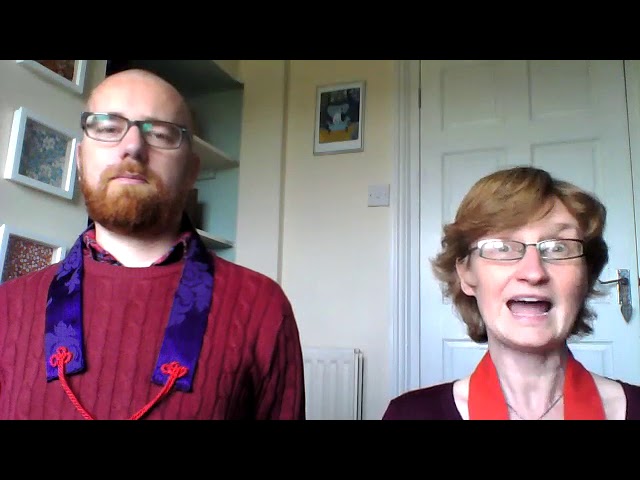
Reverend Satyavani and Casperito from a Pure Land Buddhist temple in Malvern, UK discuss how Buddhist practice helps during hardship. They cover the Nembutsu, refuge, and handling negative thoughts, with practical guidance for the early COVID-19 lockdown.
Chapters
Okay, so welcome everybody, and this talk is called How Buddhism Can Help You in Difficult Times, something like that.
Exactly that.
Great, exactly that. My name is Reverend Satyavani, or Satya, and my name is Casperito, or Casper.
I wasn't sure if you were going to introduce me then.
No, I didn't know either. And we run, for those who don't know us very well, we run a little Buddhist temple in Malvern in the UK, and we usually offer Dharma talks in the temple on a Saturday morning sometimes, and obviously at the moment we can't, so we thought we would do it here instead. So thank you all for coming. It feels like you're— we can see you along the top of our screen, it's like you're in the room. Nice little arc of chairs. So people listening today are a mixture of people who know about Pure Land Buddhism and those who don't. I'll maybe begin with a very, very brief summary of how we practice, the practice that is this tradition of Buddhism. There are many traditions of Buddhism, just like Christianity,, and they can resemble each other almost not at all. We are Pure Land Buddhists, which is a Mahayana form of Buddhism, very popular in Japan, and the core of our practice is that we connect with the embodiment of infinite love through a Buddha called Amitābha, who is the Buddha of infinite light, and we do that by saying the name of that Buddha, and we say the name of that Buddha, Namo Amida Butsu, Amitābha, Namo Amitābha, in different languages, as a way of kind of plugging into that source of compassion and acceptance and patience and wisdom. So in a very, very brief nutshell, that's the the way that we practice here. It's quite a devotional practice. We do meditation, but that's not the foundation, that's not the core of our way of taking refuge. All Buddhists take refuge, and we take refuge through saying the name of the Buddha. So I wanted to controversially start with a book which isn't a Buddhist book. Richard Rohr, some of you may know, who is a Franciscan father, and he writes, he writes beautifully about love. And love is really at the core of all great religion and great— anything that's good in the world has, has love at the core of it. And This sentence that I read really stuck with me in the context of the situation that we're in, which is an unprecedented global crisis. So he says that from the very beginning, God's love has never been worthiness contest. This is very hard for almost everyone to accept. It really makes me smile, that quote, because I recognize so deeply how, how in such, in such a determined way I fall back into thinking that in order to be worthy of love, I have to be a very particular way. I have to do something special. I have to be making progress. I have to be being kind. And the suggestion here from Richard Rohr, at least, is that, is that God, Buddha, The world, Gaia's love, is not dependent on me doing certain things. Pure Land Buddhism holds that we are all bonbu, and bonbu is a Japanese word that means foolish beings of wayward passions. I could ask you to sit your hands up if you think you might be one of those, but I can definitely stick my hand up. And Kaspa? Oh yeah, there's a couple of people admitting to it. This is really, for me, the beginning of why Buddhism, my faith, my Buddhist practice, is so supportive and consoling to me in these times. Is that we begin from a position of acknowledging how flawed we are. We begin by looking inside or looking outside other people and seeing how, how frail we are, how fallible, how scared, how deluded, how greedy, how hateful. That as, as fallible human beings, we, we do whatever we can to try and keep ourselves whole, to try and prop ourselves up, to try and avoid, um, to try and avoid pain, to try and avoid not getting what we want, to try and avoid things that we don't want coming towards us. And that all of that is a really kind of intricate machine that mostly goes on without us even knowing. It goes on like clockwork. All these kind of systems get built up and they just kind of roll. I've certainly been aware of my own bonbu nature over the past few weeks and maybe especially the past week. The UK having entered officially into lockdown, just noticing how, how many things I usually rely on to feel okay, and most of those things are ridiculously small things. We're actually hugely lucky here at the moment. Our livelihood isn't threatened, we have a beautiful garden at the temple, we have a dog and a cat to keep keep us company and each other. There are lots of things about us— we don't have two small children to look after. There are lots of things about our situation that we're really blessed. And I find myself having these kind of little tantrums about not being able to do things, fear about not being able to get in the car and drive to the nearest city to go shopping, guilt about not doing more to help out locally. All these different feelings kind of bubble up all the time, and, and they bubble up, and then another part of me also gets involved. So I I feel guilty about not doing more to help people practically in our local area. And then another part kind of says, oh yes, but you already do all this stuff. And then another part says, yes, but blah blah blah. And then it all just kind of gets really noisy in there. So that's a small sort of example of how it is to be a foolish being. I said I was going to talk for 10 minutes. I've already— oh no, we started at 2 minutes past. I've got a minute. I hand it over. Right now my bombu nature is thinking, oh, what can I say that's clever? What can I say that's going to expose me and embarrass me? Don't say that. How do I look? How does my office look? All of these thoughts are are pointers towards the, the Bambu nature of all human beings.
What are you thinking? What am I thinking? Yeah. I'm just anticipating—
What you're going to say. What I'm going to say.
If you're not going to sum it up nicely, then I'm going to pick up that thread and make a different tapestry out of it. So I'm just anticipating doing that instead of what I thought I might say earlier.
Yeah, well, I might get ready to hand you over the threads, actually. So the first thread is our foolishness, the foolishness of all people, and I'm going to hand that over to Caspar and see what he's going to do to it, with it.
I guess I'll talk about the second half of the relationship, the second part of the relationship. The first part is is recognizing ourselves, as Satya said, as foolish beings of wayward passion, and also knowing that we're all in the same boat with that. Honen, the Buddhist monk who set up Pure Land as an independent tradition 800-odd years ago, was renowned amongst his peers as being almost saint-like in how closely he kept the precepts. And how wise he was, and how much he knew about other people's traditions. And yet, even Honen, when he looked deep into his own heart, saw these wayward passions rising, saw this busy mind distracting him, saw his ego coming in and taking over. So if it's true for Honen, then it's true for me. It must be. But the other side of this equation is that there is love in the universe. As Satya Robyn said right at the beginning, there is a presence that is not foolish, that is not impermanent. Buddhism is often characterized by impermanence, but it's more correct to say that this world we live in is characterized by impermanence, but this world we live in, from a classical Buddhist point of view, is not the only thing. There is something beyond the world that we live in which is completely loving, something that comes to us from a realm of pure love and meets us in this condition that we find ourselves in— flawed, foolish human beings— and loves us just as we are. And I guess this is why our friend Venerable Shenyan talks about Pure Land Buddhism as being inside-out Buddhism, because it isn't, I am going to do these practices in order to change myself and then I will receive great benefit, which is maybe— I saw a question in the chat about the difference between this and other sorts of Buddhism. In some sorts of Buddhism, there is very much the sense that you do this practice, you receive this benefit. You do this practice, and you receive this benefit. In Pure Land Buddhism, we emphasize the other direction, that you come into relationship with something loving, and then you are able to practice differently, because as you're received by love, as I'm received by love, something in me relaxes, some of that defensiveness relaxes, and then it's easier for me to meet other people from a place of loving kindness. It's easier for me to be compassionate. And we can see this working in a very mundane way in our own lives. If we're going home to an environment that is supportive, we can go out into the world and be supportive to others. If we go home to an environment that is unsupportive, it's much harder to be supportive to others. And the thing about this world is it is guaranteed that support will always fail at some point, because that's the nature of human beings, it's the nature of samsara. And yet the Buddha's support is always available. So we do this practice of plugging ourselves into something that is always available. 'Ah, now I can relax. Now I can feel at home. And from this place, I can reach out and begin to offer things to the world.' And that is a process that happens in an instant, and it is also a process that happens across many lifetimes, as each time we come into relationship with the Buddha, there's a deeper layer of settling. There's a deeper layer of relaxing. And then perhaps we go into the world and the anxiety and the agitation comes, and we come back to the Buddha, we say the Nembutsu, something in us relaxes again. And over many years of practice, that depth of settledness deepens. And even if we become agitated, it's settling down in that deep to that deeper level. So I suppose Buddhism can help in difficult times because from any moment, at whatever point we are in our life's journey, we can begin to experiment with the idea that there is something beyond impermanence, that the Buddha is there somewhere accepting us just as we are. And in a moment, that can make a difference. And it's also true that over many years of doing that, there is something cumulative, something that settles in a deeper way. Both of those are true, the timeless and the over time. So foolish beings, Buddha, our practice bringing them together, making the connection between the flawed and the completely loving. And this is where all the gifts of spiritual practice come from, all of the virtues that you hear about in Buddhism. They are the fruit of this rooting. Okay, you're handing me back the baton, whatever it is, a thread, a baton, a mixed metaphor.
Yeah, when I give talks, I've said this before, but I'll say it again, I have the question, what is it that people are needing to hear? What is it? What are their questions? And we'll ask you in a minute your actual questions. But there's a sort of a curiosity about both what needs to be heard but also what needs to be spoken through me. I don't really know where I'm going with this, but there was something, an experience I had this morning that I wanted to share. I've had quite a turbulent week. There's been things happening here in the temple that have been difficult to manage. I work as a psychotherapist and a lot of my clients have understandably had lots of fear and anxiety and, you know, different things getting triggered because of the pandemic. And I've also had my own kind of process about the new world, the new world that we are, that we find ourselves in. I've been quite preoccupied by that. I've had that sense of just sort of, you know, when you're just kind of treading water and you've just got your head above water and you can breathe okay, but there's a bit of an effort and it wouldn't take too much to sink you. And then this morning I I somehow remembered something bigger, and I had the space to decide to watch a film that somebody had sent me. A Dutch filmmaker came to film me a couple of months ago for a film he was making about eco-activism, and as a thank you, or to show me what kind of— what his films were like, he sent me a link to see one of his films, which was about Plum Village, about Thich Nhat Hanh's community in France. And I just sat on my office chair just behind me here and spent an hour watching this beautiful film. It was very slow, sparse and clean and empty and lots of silence, and it was interviewing people who lived in a way that was really connected to the earth and connected to spirit, connected to community, and as I watched it I was just crying, and I think that the tears were a kind of a remembering that even though these times are unprecedented and difficult and horrible, and we still don't know what's going to happen next, we don't know what's going to happen to the people we love, to the everyday lives that we used to live in, that there was some— there was something much bigger than all of that. There there was something that suddenly just, just connected me to the earth and to this feeling I have of everything being okay. And when I say everything being okay, I don't of course mean that everything will be okay, because everything isn't okay. Lots of things are not okay, and everything is okay at some Somehow, right now, I can handle it. What's here right now is actually very ordinary, and, you know, our cupboards are full of food, and we've just come back from a walk on the hill with our little dog, and we're talking to lovely people. Just that kind of deep grounded sense of refuge, of refuge. I don't think that you have to be Buddhist to find that sense of refuge. Different people find refuge in different places. Some people find refuge in 12-step groups, or in their garden, or I mean, lots of people find refuge in places that they maybe aren't so healthy. There are lots of refuges that have been taken away from us at the moment. Chocolate's one of my favorite ones. So refuges can be more or less healthy, but the best refuge of all according to spiritual practice is that refuge in boundless compassion, in boundless acceptance. I think that the other thing that happened to me this morning as I was moved to tears by this film is that I was also seeing myself through the eyes of the Buddha again, and I was kind of feeling fonder of myself again, and fonder of the critical parts of me that are critical of me and critical of other people, and everything just kind of softened. Yeah, and I felt grateful again. I think that when we connect in with refuge, we can feel grateful even in the midst of horrible places and horrible things, that there are little spots, little spots that we can receive, little bits of light, little bits of chocolate, I want to say, little flowers. That we can feel pouring into us. And I think that they're pouring all the time, but a lot of the time we forget to see, we forget to hold our hands out, or forget to taste them. Yeah, so I feel like I'm getting ready to hand my threads back over to Casper.
So hand gestures make me think of the Buddhist mudras, the way that the Buddha holds his hands. And I've been feeling, remembering two hand gestures as Satya was speaking. This hand gesture which you can try and see how it feels in your body if you want to, is the gesture of fearlessness. This is one of the gifts of being in relationship to unconditional love, that we can have confidence, confidence to meet whatever is coming towards us. And sometimes that confidence is about this energy. And often when a Buddha does this with one hand. His other hand— I have to move, I think. You imagine it down here, but it's— how can I get on the camera?— is doing this. This is the gesture of welcoming. So this quality of unconditional love contains both fearlessness and the open hand of welcoming together, which may feel like a contradiction. How can you say no and yes at the same time? But actually, when I do those hand gestures, it gives me the same feeling as being in a meditation posture. It's like, oh, I'm here, I'm steady, I'm connected to the earth, I can receive and welcome whatever is coming towards me because I'm supported by something greater than myself. My own little busy mind doesn't have the capacity to meet what's happening in the world, but there is something beyond my own little mind, and sometimes I can reflect that or tap into it, that spiritual power of the Buddha, which gives me both fearlessness and the ability to welcome whatever is coming. And in our practice, going right back to the beginning, the way that we connect with that is through reciting the name of the Buddha, saying 'Nam-myoho-renge-kyo.' And you can find recordings of chants on the temple website at amida-mandala.com, where you also find a couple of Zoom links to practice sessions that we're running in these strange times of lockdown. So if you want to join us, you can experiment with that practice that we use for connecting with that boundless love, that confidence and compassion that the Buddha brings. But as Satya said, there's many different spiritual traditions in Buddhism, there's many different practices, there's many different gates to accessing this So it's about finding the one that's right for you, and it's also, I suppose, about not opening too many gates because at the end of the day you just need to step through one of them. Maybe I'll pause there, maybe we'll both pause there. So there's an opportunity to ask questions now, so if you can either do that by unmute, maybe raise a hand if your video's on, otherwise just speak. Yeah, Cindy's raising her hand. Do you want to unmute and ask a question?
Yeah, what I wanted to ask was, because I've been interested now in Buddhism now for some time, I'm really interested in the different sort of concepts of Buddhism. So you say this one comes from— this form of Buddhism comes from Japan, is it?
All Buddhism comes from India, but this became its own thing in Japan, if you like.
Okay. And what I've always really liked is, you know, the sort of ideas of unconditional love, and, you know, trying, you know, the ways of blocking out negativity. Something I'd really love to learn in Buddhism is I really like the way it's about the mind and Something I really feel I want to work on is sort of breaking this negative cycle of thinking, like even when everything going on is positive and everything is going wrong, it's always trying to get the positive out of everything. And I feel Buddhists have really got a good way of tuning that energy, you know, of trying to focus on the optimism of everything, if you like.
To make sure you repeat slowly. Yeah, so it sounds like the question is something about how about how one might handle negativity, negative thoughts. Is that right?
Yes.
Yeah, and different people will have different ways of answering that. I can give you my own answer, which is me speaking as a Buddhist, but also as a psychotherapist and as a human being, kind of having learned what works for me. My own experience of negative thoughts is that what they respond really well to is being welcomed and being made friends with. So that sounds very counterintuitive because I think often negativity, the idea is that we need to cut it out and push it away. But my own experience is that those parts of us that are being negative feel that they're helping us. They're doing something that they think is helpful. Maybe they're criticizing us so they can stop us from getting things wrong, because when we got things wrong in the past, we got hurt. Or shamed. Maybe they're, you know, if they don't criticize us, then we might feel worse than other people. So for me, what's really important is to just get curious about what those negative thoughts might be trying to do for us. What's their positive intention? And why is it so important for them to do that? What might happen if they didn't do that? What are they afraid of? So really it's meeting those negative thoughts as the Buddha would meet them, looking at them through eyes of compassion and through eyes of understanding. So we learn to— it's not easy to do this, but we learn to see those parts of ourselves that we really don't like and just soften towards them, just be able to say, yeah, I there's this bit of me that gets really jealous, and there are other bits of me that hate that jealous bit. And I wonder why the jealous bit is jealous. I wonder why the jealousy is there. What purpose is that serving? And sometimes it can take a bit of getting to, because it seems like, well, there's no purpose for jealousy, or there's no purpose for beating myself up. My experience is that if we just keep getting curious then we find that there is a reason, and that part has a really good reason that might not make sense, but it makes sense to it. It kind of makes sense to it. And I feel the same thing about people that do things that are unskillful, so people who are violent to other people, people who steal things. What they're doing is trying to keep themselves together. In some way, and they're doing what they've learned to do, which isn't the best way of doing it, but it's kind of all they've got. So, do you want to add anything to that?
Yeah, I suppose, you know, the Buddhist idea is about welcoming demons or negative thoughts, as Satya said. I really like the image of depression as being the black dog, and sometimes I'll say to my clients, just invite it, you know, if you notice it hanging around, just make a space for it by the fire and let it know that you know that it's there, and then that you're going to carry on doing whatever you're doing, sort of thing. So it's really, as Satya said, just working towards being kind to all the different parts of our system. And what helps me sometimes is to remember that on days when I can't be kind to other real people in my life, usually there's somebody who isn't getting irritated by the person I'm getting irritated with. And if I can see that, it reminds me that, oh, it's not that they're inherently irritating, it's just that there's something in me that is blocking my compassion today. And that's true for the parts that irritate me about myself, or the thoughts that come in and irritate me about myself as well. If I can't see them in a kind, compassionate way, it isn't necessarily because they're inherently irritating thoughts, It's just because right now I'm not in a space where I can receive them. So doing my practice helps me get back into this fearless and welcoming state with my own thoughts as much as it does with the world.
I really relate to that actually, because, and just about a bit about, you know, what we were saying that even when all these negative thoughts are there, you know, like when you see negativity like violence or jealousy or all these kinds of things, even though it's playing in your head, there is always this bit of me that's saying, but is it worthy? You know, it's not worthy in my life, and I need to try and, you know, see where everyone's coming from in a negative way and be compassionate as to why they're being like that, you know, and to see that in everyone, because there's always reasons and psychology behind, you know, the way people have of the way they are, whether it's the way they've been brought up, what they've experienced, and we never know what they've experienced, so I think it's always important, isn't it?
I think that's right, and I trust that even if I never get to the bottom of it, there'll be a good reason in there somewhere, even if they don't know what it is, so we kind of trust that. So yeah, thanks very much for your question, Cindy. And does anyone else have a question about anything we've said or anything else that's going on? That's Mark, I think. Yeah. Do you want me to unmute? Yeah, you can.
Hello.
When you say, each of you say the Nembutsu, what comes into your mind?
What feelings or thoughts? How does that happen for you?
Thanks, good question, Mark. So the question is, when we say the Nembutsu to ourselves, which is the Buddha's name, which is our central practice, what happens for us in our minds? So often when—
You suddenly started speaking really loud. I think, Mark, because you were quiet, Satya Robyn started speaking really loud, like you're really far away. But the mic is pressed to me.
Okay, I'll answer that first. Okay. Quietly. Often when I say the Nembutsu, it's kind of like brushing my teeth. So I'm just doing it, and I trust that there's a good effect. So sometimes I'll have a nice feeling of peace, sometimes I'll have an insight, sometimes I'll be thinking about what I'm gonna have for dinner, but for me it's less about the experience of saying it or how I feel after saying it and more about a trust that it's a good thing to do because it's putting me in relationship with something that's really good.
Yeah, I am— my experience is very, very mixed. Often it does bring a sense of peace, and sometimes when my mind is particularly busy, it can't cut through that. But I always remember doing, I think it was an 8-hour or 12-hour chanting session years ago, and through the day my mind was really busy. It was really critical of myself, really critical of other people. And after that practice— it was a group practice— and after that practice had finished, I really didn't want to speak to anybody because I was still holding this heavy weight. And yet somebody came over and said hello, and I found myself really feeling really warm and open and smiling. And it really— that kind, compassionate warmth took me by surprise. And on reflection, I had just such this— such a strong sense of that Buddha's love, the blessings sneaking in underneath my busy mind, sneaking in underneath my ego, and sort of affecting me at quite a deep level. And I trust that that happens whether I notice it straight away or whether I notice it years later. And certainly when I reflect on my average state of mind now compared to 12 years ago when I started Zen in Embutsu, there's been a huge difference.
Thanks for the question, Mark. If anyone else wants to ask a question, you can also put it in the chat box if you're not able to unmute yourself.
There's also an electronic way of raising your hand, but I I don't know how to do that.
No, me neither.
You have a few more sessions, is it, coming up too, right?
Yeah, we've got some practice sessions.
Repeat the question.
Oh yeah, so there was a question about what have we got coming up. Yeah, so this evening at 6 o'clock UK time, we've got a listening sharing circle where people can just come and check in. We start with a Buddhist reading. And finish with a little bit of practice. That's just a check-in space. And then on a Wednesday evening at 7:30, we've got our practice session, which includes some chanting and quiet sitting and a short talk as well, and reciting some literature together. That's every Wednesday, and the listening circles every Saturday. And then periodically we will do these as well. I don't know that we've got the dates in, but we will do some more of these as It's all on the website.
Okay, thanks. I'm wondering if that might be all the questions for now. Yeah, so thank you all very much for turning up.
Thank you.
Good to see you, and yeah, hope that you have a good weekend, and we'll see most of you again at some point, I'm sure. No mo ni du bu.
Yeah, sending love and stay safe.
Bye-bye.









