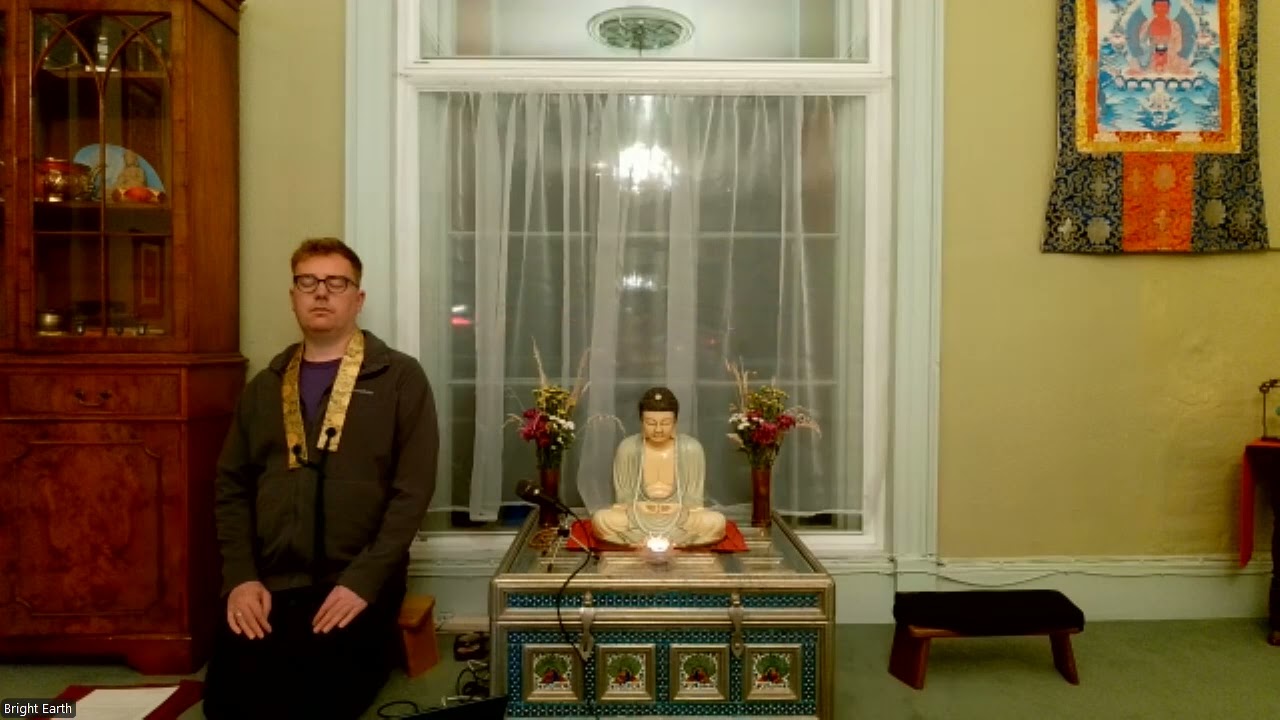
This content was created by Satya Robyn. This content was uploaded by Satya Robyn. This is a YouTube recording titled "How to become more than just our parents" (posted 2025-10-01) of a Buddhist dharma session held in a shrine room. The excerpt contains group ritual elements (ancestor prayer, chants, refuge vows, incense offering) interleaved with a reflective teaching and personal story delivered by Satya Robyn, with other speakers joining in chant responses and short liturgical lines. The talk focuses on ancestral inheritance, habit patterns passed through families, and Buddhist practice as a means to release those inheritances and awaken to one’s Buddha-nature. Language of the excerpt is English.
Chapters
So we're going to begin this evening by reading the ancestor prayer together.
I was going to put a link in the chat, Robyn, so you could read along, but it doesn't seem to be where I thought it was.
Apologies.
So you just have to listen this evening. But lovely to see you, lovely to see everyone here in the shrine room.
Remembrance of ancestors.
Before we take our next action, we pause to remember our ancestors. We remember our Indian ancestors, firstly Shakyamuni, who was born in Lumbini and enlightened in Bodh Gaya and set the Dharma wheel turning in this age. We remember those who came before Shakyamuni and passed their wisdom to him. We remember Maha Prajapati, who walked 150 miles, one step after another, before becoming the first Buddhist nun. We remember the monastic and lay disciples of the Buddha and generations of teachers that spread Buddhism through the East and throughout the world and who refreshed the precious Dharma. We remember awakened beings of all spiritual traditions, trusting that wisdom appears in the world in many different ways. At many different times in many different places. We call to mind the wisdom of marginalized and oppressed groups, much of which has already been lost. We remember our biological ancestors, our parents and grandparents, known and unknown, generations stretching back through time to the first humans in Africa. We remember the ancestors of our chosen families. We remember the ancestors of our own mind stream, the beings of our previous lives who practiced Dharma and brought light and joy to others. We remember people across the world who stood against oppression and for human rights and the rights of all living things and for the Earth. We remember those who have oppressed and marginalized and harmed. We carry the legacies of all of these ancestors, their gifts and their burdens. How wonderful to have the opportunity to work with all that has been handed down to us. We remember our great ancestor the Earth and her great ancestor the universe itself. Ancient Buddhas and ancestors were as we. We shall come to be Buddhas and ancestors. Venerating Buddhas and ancestors, we are one with Buddhas and ancestors. Contemplating awakened mind, We are one with awakened mind.
Namokwan shim bosat. Namokwan shim bosat. Namokwan shim bosat. Namah Kwan Chim Bosat. Namah Kwan Chim Bosat. Namah Kwan Chim Bosat. Namah Kwan Chi Inbursat. Namah Kwan Chi Inbursat. Namah Kwan Chi Inbursat. Namah Kwan Shin Bo Sat. Namah Kwan Shin Bo Sat. Namah Kwan Shin Bo Sat. Namah Kwan Chi Inbursat. Namah Kwan Chi Inbursat. Namah Kwan Chi Inbursat. Namokwanji in Bosat. Namokwanji in Bosat. Namokwanji in Bosat. Namoh Shivaya. Satya Robyn. Namoh Shivaya. Satya Robyn. Namoh Shivaya. Namah Shivaya. Satya Robyn. Namah Shivaya. Satya Robyn. Namah Shivaya. Namahwanchi in Gosat. Namahwanchi in Gosat. Namahwanchi in Gosat. Namahwanchi in Bhoosat. Namahwanchi in Bhoosat. Namahwanchi in Bhoosat. Namah Kwan Chi Ingo Sat. Namah Kwan Chi Ingo Sat. Namah Kwan Chi Ingo Sat. Satya Robyn— Namah Shivaya! Namah Shivayam! Namah Shivayan! Oh, oh, namaha shivin vasat. Namaha Shivain bosat. Namaha Shivin vosat.
For refuge I go to the Buddha.
For refuge I go to the Buddha.
The one who is awake and full of love.
The one who is awake and full of love.
Namo Buddha.
Namo Buddha.
For refuge I go to the Dharma.
For refuge I go to the Dharma.
All that guides us to wisdom and compassion.
All that guides us to wisdom and compassion.
Namo Dharmaya.
For refuge I go to the Sangha. Those who live in the Buddha's light. Namo Sangha. For refuge I go to the Earth. The holy ground of awakening. Namobuddhayai. With faith in the Four Refuges and in light of my human tendencies, I pray that I may become aware of when I take life. I pray that I may become aware I pray that I may become aware of when I take what is not freely given. I pray that I may become aware of when I fall into sexual misconduct. I pray that I may become aware of when I fall into wrong speech.
Of when I fall into wrong speech.
I pray that I may become aware.
I pray that I may become aware of when I become intoxicated. Of when I become intoxicated.
No blame.
No blame.
Be kind.
Be kind.
Love everything.
Love everything.
Innumerable sentient beings, we vow to save them all. Inexhaustible, undivided passions, we vow to transform them all. Immeasurable Abhidharma teachings, we vow to master them all.
Infinite Lotus Bodhisattva way, we vow to forfeit completely Many years ago when I was in India, maybe one of the first times I was in India, I went to visit one of the volunteers. I think it was Sivitiya. It may be, maybe it was after he moved. He sold— he had a very poor house, but he sold it to raise a dowry for his daughter and moved somewhere even poorer, in this further away from the city, even further away from the city center, in this sort of sparsely populated area. And everywhere was just just these single-story, one or two-room buildings dug into the earth, made out of this sort of sandy red bricks. And, um, there was the sand and the dust was everywhere. And maybe you get electricity in the morning and the evening, but not during the day. And The water would come on and off intermittently, and he was sat just hanging out, looking out of the open front of this house into sort of a square open space beyond. Again, dusty, just— it was the edge of the desert, really. There wasn't much green. Around, and there were a couple of cows wandering through this space, and two young boys started throwing stones at the cows. Just kids with nothing to do. And, um, I leapt up out. I think I was in like one of the plastic garden chairs. That was the sort of back style of chair. I leapt up out of my seat and roared and shook my fists and sort of— part of me wanted to throw some stones at the children. They looked at me as if I'd gone crazy, which I had, and sort of wandered off. And then I sat down feeling a bit sheepish and thought, oh, I've become my dad. Who whenever anyone would cycle over the end of the driveway or go over the end of the, the bit of grass in front of our house would become that creature. I think I thought, oh, what else could I have done? I could have gone and talked to them. I could have taken a ball out. And you know, there's so many different ways that I could have engaged with those children. I could have just shown them my pasty white face from the United Kingdom, and that would have grabbed their attention. Instead, well, I became intoxicated by anger. Certainly wasn't right speech, if there even were any words involved at all. So this is one of the gifts of my ancestors, right? That pattern of behavior. When, when there's a kind of, uh, when you see something wrong, get, get explosive about it. And there's a gift in that as well, you know, a sensitivity to noticing when things aren't as they should be. But undoing that, releasing that habit pattern, releasing that energy from my system has been part of the work of being in this lifetime. Other inherent in inheritances are things like, oh, work is something to be endured. Um, and then like from children should be seen and not heard to, uh, like as adults, don't get above your station, don't play your own trumpet. And, and each one of these beliefs that gets passed down to us that we enact unconsciously is a place that we're not free. Like, I wasn't— I didn't have any freedom in that moment where I roared and leapt out of the chair. I was just behaving like a, a clockwork toy that somebody had wound up and released. So One way of understanding Buddhist practice— and there is a Japanese school that explicitly defines their practice in this way, I can't remember their name. I know they've got groups in France, and probably that's not helpful to anybody, but they think about practice as releasing the karma of their ancestors. Like, that's what your job is as a Buddhist practitioner, and that's how you become free. So we notice these things, the pla— the places that we're not free, and we practice having some space from them. Oh, there's that belief, there's that story, there's that habit pattern, and there's rituals that we can use to support that, and there's inner work that we can do to support that. But essentially The principle is the same. It's one of noticing. And for pure land Buddhists, it can also be one of offering. Oh, I will hand this habit over to the Buddha. You help me with it. In fact, you can frame it as asking for help. Amida, help me with this anger. That can be someone's practice for a long time until suddenly something changes. Yeah, we learn not to believe everything that we were told consciously and unconsciously about our own lives and the lives of people around us. And, and even good beliefs that are handed down to us, when we hold on them too tightly, become places that we aren't free. For example, I learned Let's say I'm not entirely sure where I picked this lesson up, but let's say from something like a Sunday school class. I learned about the goodness in all people, and I made that into something fixed within myself. It's important to see the goodness in all people. And that became a place where I wasn't free, and it's something that has gotten me into trouble in my life when it was important to notice that people also had other qualities. And the, the work of undoing and releasing all of these different kinds of inheritances is to bring us back to what Zen calls, uh, your face before you were born, your Buddha nature. This is also something we receive from our ancestors, from the whole world, the quality of enlightenment, of liberation. That's also getting passed to us all the time. But it gets covered up by all of these other things that we also inherit.
So this is the—
this is one way of understanding Buddhist practice, releasing all of these things. That we've been given to become free, so we don't just end up like copies of our parents. Namaste. I'm going to stay here tonight.
In gratitude, we offer this incense to all Buddhas and Bodhisattvas throughout space and time. They be fragrant as the earth herself reflecting our careful efforts, our wholehearted mindfulness, and fruits of understanding slowly ripening. May we in all beings be companions of Buddhas and Bodhisattvas. May we awaken from the darkness.
Blessed by Anathapa's light, may we care for all living things. Anahalya.









