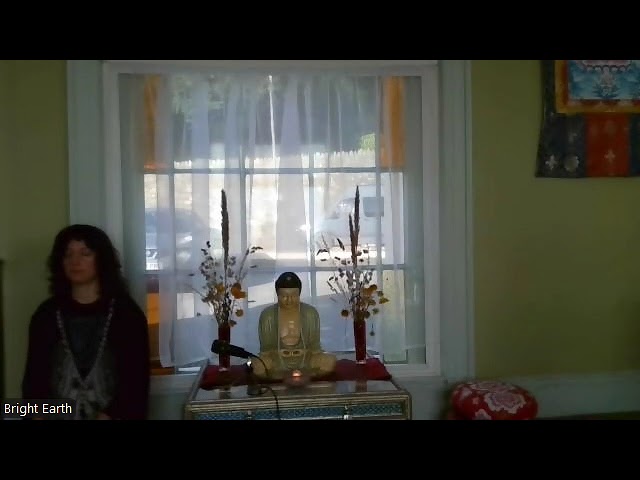
Satya Robyn leads a Buddhist group practice session combining guided meditation, chanting of Amitābha and Nam-myoho-renge-kyo, and a Dharma talk on inner versus outer pilgrimage drawn from the Vedas. The session includes prostrations, refuge recitations, and community announcements for both in-person and online participants.
Chapters
Welcome everybody to this lovely, very unusually little quiet Saturday morning practice. So we're going to begin by Dharma Glimpse, written by Nick, which has come out of one of the book groups that we hold. As someone who has an outlook on life that tries to find the positive in every situation and has comfort in the impermanence of life, Sometimes this can actually be a struggle when you experience loved ones in pain, whether that be emotional or physical, and in that moment they can't see the impermanence. It's hard. You want to try and reassure and show that this will change without frustration in the situation. This is hard when you sometimes feel powerless to help. Learning to accept that you may not be able to help is hard. I've learned that helping can be just being there or doing something they need. You don't need to say it will be all right and it will pass. Namu Amida Butsu. So we're going to move into a short period of meditation. So have a little wiggle and make any little adjustments you need to make to the body so that you can be as comfortable as possible, maybe rolling the shoulders back or Moving the hips a bit, noticing the parts of the body that are in contact with the floor or the cushion, the chair. Taking a moment to sense the external space, the room that you're in. The physical holding. And then little by little, slowly bringing the awareness gradually into the body. To the breath. So we're going to move into a period of chanting, and we're going to chant Amitābha. And that's, that's the whole of the chant, is Amitābha.
Ameetabh. Ameetabh. Ameetabh. Amitabh. Amitabh. Amitabh. Amitabh, Amitabh, Amitabh. Aamiidaa. Aamiidaa. Aamiidaa. Amitabh. Amitabh. Amitabh. Amitabh. Amitabh. Amitabh. Amitabh. Amitabh. Amitabh. Amitabh. Amitabh. Amitabh. Amitabh. Amitabh. Amitabh. Amitabh. Amitabh. Amitabh. Amitabh. Amitabh.
Reciting in response the refuges and precepts, which are on the little liturgy sheet. So refuges, also called the Three Jewels, are places of inspiration guidance, support, anchoring. And the precepts are ideals that are thought to be natural expressions of the awakened mind-body, yeah, and are held valued by Buddhists all over the world. For refuge I go to the Buddha.
For refuge I go to the Buddha.
The one who is awake and full of love.
The one who is awake and full of love.
Namo Buddha.
Namo Buddha.
For refuge I go to the Dharma.
For refuge I go to the Dharma.
All that guides us to wisdom and compassion.
All that guides us to wisdom and compassion.
Namo Dharmaya.
Namo Dharmaya.
For refuge I go to the Sangha.
For refuge I go to the Sangha.
Those who live in the Buddha's life.
Buddha's science.
Nam-myoho-renge-kyo.
Nam-myoho-renge-kyo.
With faith in the Three Jewels.
With faith in the Three Jewels.
And in light of my human tendencies.
And in light of my human tendencies.
I pray that I may become aware.
I pray that I may become aware.
Of when I take life.
Of when I take life.
I pray that I may become aware— 'A'pray tha sa mai bekomm awaer.' —of when I take what is not freely given. Of when I take what is not really given. I pray that I may become aware— 'Ai prai dha soi mae bekomm aweh.' —when I fall into sexual misconduct. Och wa na i fao ntsèy shuon misconderd? I pray that I make them aware I pray that I may become aware of when I fall into wrong speech.
I fall into wrong speech.
I pray that I may become aware—
I pray that I may become aware—
of when I become intoxicated. No blame. Be kind. Love everything.
Love everything. Innumerable are sentient beings. We vow to save them all. Inexhaustible are deluded passions.
We vow to transform them all.
Immeasurable are the Dharma teachings.
We vow to master them all. Infinite is the Buddha's way. We vow to perfect completely.
Momo me daboo. So I was listening to a little talk the other day, um, about the Vedas, and they were talking about inner and outer pilgrimage. So they were talking about how outer pilgrimage has obviously been valued for a long time, this idea that it's valuable to travel to holy places and that there's a ritual, the very, you know, rituals involved in that. And often you might go to the same— people might go to the same site and develop a relationship with that site and with the route to that site. And so I was thinking how we make a little outer pilgrimage to this shrine room. People who join in person and people joining online, there's still an outer pilgrimage. Maybe you get up, maybe you go to your computer, or you get your laptop up, or your phone. You, you go to a space in the house or wherever where you're less likely to be disturbed. And so there is still this kind of outer pilgrimage even if you're joining us online. And if you come here physically, there'll be a number of things that you do, and you probably do them quite similarly every time you come. Like maybe you have something to eat before you come, and you know, if you drive here, you'll get your keys or your coat if you walk here, or if you live in the building There, there'll be the, the route to the shrine room, which will be very familiar and may feel different if you're walking to the shrine room for practice than if you're walking to the kitchen, which is through the shrine room. So that walk through the building will feel different, will be this kind of external pilgrimage. And the familiarity can be helpful in creating a bit of sense of comfort and ease and help you to get in the right— well, not really right, but helping to get in a mindset which is receptive and Then there is the internal pilgrimage, the pilgrimage to the sacred holy site of the somatic world, of the body, of the heart, of the mind. And it's possible to do that kind of inner pilgrimage at any point throughout our day, but it's a bit more noticeable when we're doing it if we're coming to practice, or you're going to meditate, or chant when there's this, this more deliberate turning inward. And if you do that spiritual practice quite frequently, you're quite familiar with it. There might be a sense of like the internal pilgrimage sometimes may feel a bit like we're off to see the Buddha, wonderful Buddha. So it might feel like there is this intention or anticipation of going inward and meeting more fully the ocean of love, compassion, awareness, radical acceptance, and that we here relate to as the Buddha. So there may be this experience that it set up that kind of, um, yeah, set up that kind of intention of going to meet, going to encounter, going to hang out within the inner pilgrimage. Or the inner sacred site to hang out with the Buddha. And that can be really helpful in getting in touch with that, you know, intensifying the connection. And there may be times when it feels like a kind of personal connection. There may be images And there may be a, yeah, very embodied sense of being in the presence of the Divine or of the Buddha. And it may be quite different. The inner pilgrimage might be quite different, and it may be a turning inward to whatever is there in— and here in, in this moment and the next moment, with no sense of a specific personal, um, presence that we're connecting to. It might be simply, yeah, what's here? What's here in the— here in the sensations? What's here in the emotions? What's here in the thoughts? And through that, there may be a gradual quietening which reveals the same qualities as you might find if you're deliberately associating with the Buddha. And so you might find that with the quietening there is this revealing of the presence of love, of awareness, of being embraced by the sacred, because they are there all the time. They are always accessible. But often in our distractions and our thoughts, in our day-to-day and in our difficulties and struggles, it gets a bit noisy and it can be hard to get in touch with them. But because they're thought to be the quality and found to be the quality of reality, part of the nature of reality is that there is this presence, that it doesn't really matter in some ways whether you think, oh, we're going to go and hang out with the Buddha, or we think we're simply going to be with what is, that mean we, we may still come in contact with them. And in some ways, that way of thinking about it also helps to dissolve a bit this metaphor of the pilgrimage, because on one sense, I quite like this idea, the metaphor of the inner and outer pilgrimage. And it's helpful. And on a relative sense, it makes sense in the— on— in a relative sense, there, there is a distinction between external and internal, and there is a different quality to when we're really connected to when we're feeling, perceiving ourselves to be less connected. But on an ultimate level, we're both as far from awakening and the Buddha and as close to awakening and the Buddha as we can be in every single moment. We're as connected as we can possibly be. So on an absolute level, the pilgrimage idea doesn't work. The pilgrimage metaphor doesn't work. There's nowhere to go. We're not trying to get anywhere. There's no endpoint, there's no goal, there's nothing separate from ourselves. Uh, and, and yet on this other relative level Sometimes, like, metaphors like the external pilgrimage and the internal pilgrimage can be quite helpful, I think, or can be fun to entertain for a little while. So I was grateful of— grateful to the Vedas for introducing this metaphor to me of the inner pilgrimage and the outer pilgrimage. Namami Devi. In a moment, we're going to move into prostrations whilst chanting Nam-myoho-renge-kyo.
Namoh Amida.
Namoh Amida.
Namoh Amida. Namoh Amida.
In gratitude, we make this offering to all Buddhas and Bodhisattvas throughout space and time. May it be as fragrant as Earth herself, reflecting our careful efforts, our wholehearted mindfulness, and the fruit of understanding slowly ripening. May we and all beings be companions of Buddhas and Bodhisattvas. May we awaken from forgetfulness and realize our true home.
So now in the buildings, we're going to bow one way and then to the other. So we do that, we're going to ask the main chan— We tidy our seats. I don't think we've got any announcements.
End of the month is last Saturday's volunteer hour. I can't remember the actual date.
Great.
We've got a few weeks to go. Volunteer. Yes, yes, yeah, thank you. Yeah, chanting day on the 22nd, on Saturday.
Bless us. May we care for all living things.









