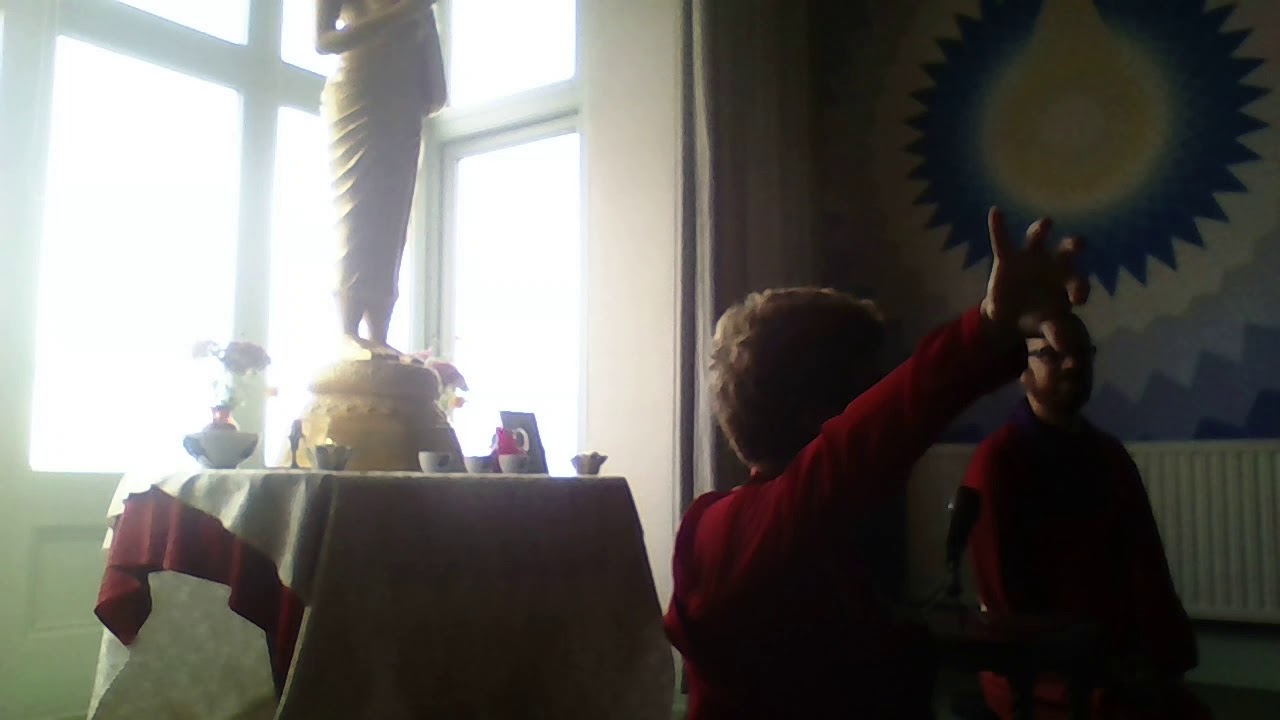
Satya Robyn leads an introductory talk on Pure Land Buddhism with Acharya Casper Lita, covering the history of Honen and Amida Buddha. The session includes Nembutsu chanting, meditation techniques, and personal conversion stories from the teachers.
Chapters
Okay, nam-myoho-renge-kyo. We got there eventually. And welcome everybody to this introduction to Pure Land Buddhism, and particularly this will be an introduction to our school of Buddhism. Do get a chair and bring it to the other side, Ross. And the people in this room, just to let you know, are a mixture of very old hands, well, oldish hands, being Caspar and Keima is pretty old hands, and then we've also got people who have been a part of the group for some time, and there are also some people who haven't been before, so we've got a nice mix of people, and there will be a space for questions in a little while, but I wanted to start at the heart of what we do.
Satya Robyn? Hmm? Satya Robyn?
I want to start at the heart of what we do, which is why Caspar's just remembered he needs a bell, which is our practice. And when most people think of Buddhism, they think of meditation. That's the first practice that springs to mind. So people often ask me, how often I meditate, and meditation isn't the main practice for this group of Buddhists. All Buddhists practice taking refuge, and I'll talk more about that after we've done a bit of practice. And the way that this variety of Buddhists take refuge is through the Nembutsu, and Nembutsu means remembering the Buddha. So when we say the Nembutsu or chant the Nembutsu, we are simply remembering the Buddha. And it's a chanting practice, so put your hands up if you've chanted before, and put your hands up if you've ever sung a song. Yeah, so if you haven't chanted before, then you'll be alright, because if you've sung a song, it's It's pretty much the same, but it's the same phrase over and over. And I think that when you haven't chanted before, it can feel unusual. I'm saying this more for people who might be watching later, because old hands in this room. My experience is that the only way to get through that kind of feeling of unusualness or self-consciousness is to just keep doing it for a while., and then it wears off at some point. I can remember one of our old sangha members, we used to do quite a lot of practice where we do all day chanting, and he'd been coming for the group for 6 months, and I remember the moment that he suddenly became unself-conscious, and it was a really freeing moment for him. So it might take 6 months, but that's unusual. It usually takes a few minutes, a couple of minutes. And the, the Nembutsu, remembering the Buddha, the words that we use for that are the Japanese words, because this form of Buddhism was born in Japan. It goes back, way back, to Shakyamuni Buddha in India, but it was founded in Japan as a separate school, and the words are Namo which means "I call out to" or "I take refuge in" or "I give thanks to" or "I pay homage to." And then Amida, which is the Buddha that we connect with, who is the Buddha of infinite light, and "Bu" is short for Buddha. In Japan they say "Butsu" instead of "Bu," which is also nice, but because it's 6 syllables, we just kind of shorten it to "Bu" rather than "Butsu." So in Japan they say Namu Amida Butsu, and we say— that was my terrible Japanese accent—
more like Namu Amida Butsu, because the "zu" disappears, so they can sing a 7-syllable phrase in 6 syllables. So when it came to the West, actually, we just use a 6-syllable phrase to sing over 6 syllables.
Yeah. So we'll be chanting Namu Amida Butsu, and we'll be using the tune that we most often use when we practise in our private practise, as well as the tune that we use when we do prostrations here in the shrine room. And most of you will know the tune, but if you don't know the tune, I encourage you to just start, start chanting and pick it up as soon as you can, and don't worry about getting it wrong. So we'll just do 5 minutes of Nembutsu, and then after a little short silence, I'll start talking again.
Nam-myoho-renge-kyo.
And if you want to add the bows in, we do lots of bowing, so if in doubt, bow. But we usually bow at the beginning and then at the end, so there's usually 2 bells at the beginning and we bow at the second bell, and then 3 bells at the end and we bow at the third bell. And you can see bells as like punctuation, it's a way of demarcating practice periods. I haven't introduced ourselves yet, maybe I'll do that afterwards. Namur, meet me.
Namur, meet me. Namur, meet me. Namoh Amitabhu. Namoh Amitabh. Namoh Amitabhu. Namo Amitabha. Namo Amitabha. Namo Amitabha. Namo Amitabha. Namoh Amitabhu. Namoh Amitabhu. Namoh Amitabhu. Namoh Amitabhu. Namoh Amitabhu. Namoh Amitabhu. Namoh Amitabha. Namoh Amitabhu. Namoh Amitabhu. Namoh Amitabhu. Namoh Amitabhu. Namoh Amitabhu. Namoh Amitabhu.
Thank you. So everything else that I say this morning will be extra. Additional to what we've just done, because what we've just done is all that's necessary. So hello, my name is Satya Robyn, Satya Vani, and I run this temple with my husband Casper, Reverend Casper Lita, Acharya Casper Lita.
Got promoted into ceremony.
Sorry. Hence he has a beautiful Purple Wagesa, and we've been running this temple for 4 years now, nearly 4 years. We're in the process of being blessed by a mandala artist who's been visiting and just completed the mandala in the hallway as you come in and is currently working on this one here, and it feels like we've been given a blessing. It's like, yep, carry on. You're doing all right. And I will say, I want to— I want— it's always very difficult to know what to say to people who are interested because you are all— each one of you here has a very different history, very different set of preferences and things that you don't like and things that you're hoping for. But I'll say some personal things and some things about our form of Buddhism, and then I'm hoping that when we come to questions, then you'll be able to drill down into the things that really interest you. The process of— for me, the process of becoming a Buddhist and sitting here in front of you in my robes in this beautiful temple was very much like being rained on, you know, that you— it's a very fine rain and you don't really know what's happening, and then one day you realize you're completely soaked, soaked through. And I think that for everybody that happens in a different way, and there, you know, all of your approaches to this place have been very different. And also you have all sorts of experience and things that you do already and things that are in your life and beliefs you have that are helpful to you. So I don't want you to let go of any of those either. Bring them all, bring them all here. But I am sitting here because I do feel like there is something very specific about what this form of Buddhism offers that I have found hugely consoling and steadying and inspiring that I want to pass on to other people, or I wouldn't be doing this on my Saturday morning. I'd be, I don't know, what would we be doing? Not gardening. And I want to start with a quote, incongruously, from a book by a Christian called Gerald May, who was a psychiatrist and spiritual counsellor, and I'm falling in love with his writing at the moment. I found him via Richard Rohr, and this book is called Addiction and Grace, and in it he describes the call that comes to us all from He would say God, but I would say— I don't know what I would say— the great mystery, the unknown, there's something ineffable that is always calling to us throughout our life, is his proposal, and that we have three choices in responding to that call. So the choices that are open to us in response to our experience of God's/Buddha's loving threatening call may sometimes be excruciatingly difficult to execute, but they are quite simple to understand. There are really only 3 options. We have already touched on them, and most of us have already used them all extensively in our lives. First, we may try to deny or avoid the call. Repressing our desire and displacing its energy. Much of the time we are successful at this, but the call is bound to break through our defences and haunt us with gentle nudges or hound us with relentless yearnings. So in this first choice he's talking about, we displace our response to this call into other things, things other than the great mystery And so addiction, compulsion, attachment is what he's talking about. We try to find refuge in money or praise or fame or chocolate or television or people or dot dot dot, you know, it carries on forever. But he says that even when we do that, there's something that breaks through. And my guess is that there is something that's broken through for all of you, enough to get you here in this room on a Saturday morning. Second, we may make images of spiritual reality, cellular representations that enable us to feel a measure of power over it instead of remaining dependent on it. So here he's talking about we are beginning to get in touch with something other, something spiritual, but we still want to be the boss, we still want to be in control. So we manipulate things in order to feel that we're still in charge. Third, we can try to be present to the mystery in a gentle, open-handed, and cooperative way. This is the contemplative option, not any system of complicated exercises, but the simple and courageous attempt to bear as much as one can of reality just as it is. To be contemplative then is not to be a special kind of person. Contemplation is simply trying to face life in a truly undefended and open-eyed way. So for me, when he's describing this third option, this contemplative option, and he says, yeah, that we just, we just try to see life We try to bear as much as one can of reality just as it is. This is, this is what we are doing when we chant Nembutsu. We are, we are coming into contact with reality in, in a much more direct way, and we are letting go of all the things that usually stop us from meeting it. And there are lots of different ways to do that. Throughout history, man has— man and woman have devised different techniques or methods to get to the heart of the matter, to bring us into relationship with the things that are important. And these include things like taking taking precepts, trying to be very good, meditation, making offerings, all kinds of different— you want to say something?— all kinds of different techniques. And this is where Honin began when he was living in Japan, and he was born in the 1100s. And he wanted to find a way of connecting to this power, this inspiration. Just to step back a bit, Honin, when he was 8 years old, his dad was assassinated, and on his deathbed, his dad asked him to come to him, and he said, He said— his name wasn't Honen at that point, I can't remember what his name was, Seishimaimeru, something like that— he said to him, "I don't want you to take revenge for my death. I want you to use this experience and live a good spiritual life." So at the age of 8, that's what his dad told him to do, and at the age of 15, he went off to the monastery and began training, and he was known as an incredibly intelligent and diligent man. He read all the sutras, he did lots and lots of practice, he was very ethical, he lived a very principled life and he kept the precepts. In Buddhism, precepts are like the Ten Commandments really, they're kind of guides for how we should live. And as time went on, Honin was dismayed to find that he continually disappointed himself, that he felt like he wanted to be a certain sort of person and he tried really hard and he failed. He was, he was buffeted around by his greed and his hate and his delusion and And this is a really central part of our school of Buddhism, is that deep acknowledgement of how difficult it is to do what we think we want to do, to do the right thing, and to find our path to to living a spiritual life through kind of trying harder. Honin really tried, he really, really tried, and he kept discovering that it wasn't enough. So he went back to the sutras and he read the teachings over and over again, and at the age of 43, in the springtime, he came across a quote in a commentary by Shan Dao, who was a Chinese teacher, a Pure Land teacher. Pure Land teachings were around for a long, long time, but they weren't a sort of a separate school. And this quote, which I haven't written down so I can't read out exactly, was something like— Shan Dao was saying that whether you're standing up or sitting down, whether you're lying down, just say the Nembutsu and everything will be okay. That was Was that a fair spraysi?
10 times or even just once and you will achieve rebirth in Amida's Pure Land.
Yeah, yeah. So this quote, when Honin read this quote, all the reports say that he had an experience of awakening. He was like, "Yes, this is it!" And he was full of emotion. I like that bit in the story. I'd forgotten that. I've got a quote here from a biography of him: "Then in the spring of 1175, at the age of 43, Honin abandoned all practices outside the Nembutsu and took refuge in the exclusive Nembutsu." So this was the moment at which our variety of Buddhism, Pure Land Buddhism, was founded, and The reason why— there were lots of reasons why he did this, why he pulled this one practice out and said that this is the key, but I like to think that one of the main reasons was his deep acknowledgement of his foolishness and other people's foolishness led him to want to offer something that anyone could do and that anyone could use to bring themselves closer to this other that we've been talking about, this wisdom, this compassion that can transform us if we let it. And saying the Nembutsu doesn't mean you've got to be clever, it doesn't mean you have to know anything about the history of Buddhism, you don't have to be born in the right family, which was the case in Honin's time. People you had to be born into certain noble families or religious families. You don't have to be doing a job that is a skillful job, so it was also open to butchers and prostitutes and warriors. Anyone could say the Nembutsu and feel that sense of security that they would be that they would be held by this light, by the light of this Buddha, Amida Buddha. And there's another bit to the story, which is that at that time in Japan, there was an idea that because the Buddha had been alive quite a long time ago, his teachings had degenerated. They sort of decayed to a point at which there wasn't much hope for us, basically. It was a degenerate time. It was known as Mapo, an age of degeneracy, and there were lots of feudal fights going on in Japan at that time. There were natural disasters. There was all kinds of chaos that meant that Honin could see even more clearly the sort of pitiful state that we were in, is one way of putting it. So he chose this practice, Nembutsu, as the only practice that was necessary in order to open ourselves up to the inspiration of the Buddha. And once we open ourselves up to the inspiration of the Buddha, or another way of putting it is once we are able to be courageous enough to see things as they actually are, rather than clinging on to all our favorite compulsions or propping ourselves up, then we become transformed. We are— that rain falls on us and we slowly feel better and we are less afraid and we are more able to help other people because when we're less afraid, we're more able to be generous. It just sort of happens automatically. So what comes first is the Nembutsu, and everything else comes out of that as a natural process. So I will just say a little bit more because I said I was going to say something about myself, and then I'll bring you in. My own journey has been a kind of idiosyncratic one. And I think this is often how these things work. The idea is that there is always something calling to you or inviting you forwards, but we're too busy getting on with our lives to hear it and too busy finding security in other places. So I was an atheist growing up. I was a very staunch atheist and very— I've always been a bit of a control freak, so I like to be the person in the first and the second categories. I like to shore myself up, and I'm very good at, you know, organising things. It has advantages. And that went along very nicely. Well, it wasn't that comfortable, but it was, you know, it was okay until I was in a relationship for a long time with an alcoholic. And that was the— that was my equivalent of Honin realising that he couldn't control himself, and that was the thing that broke me open enough to nudge me into asking for help and into becoming open to other ways of dealing with life. And so I went to a 12-step group, and that was where I began my spiritual life, and at that point it wasn't the Buddha I was in connection to, it was just— I used to call him Bob. He was just something that I didn't believe in, but I just thought I'll practice for it. Everyone was telling me to just go with it for a while and see what happens, so I'm like, okay. So I had Bob, and I'd occasionally talk to Bob, and when I signed up, I became interested in Buddhism online because I was reading quotes by Pema Chödrön and really liking I read Suzuki Shunryu's book, Zen Mind, Beginner's Mind, and there was something, just a little kind of quiet call. I'm a psychotherapist and I wanted to do some more training, so I put into Google psychotherapy Buddhism, and what popped up was the Buddhist House in Leicester, where I left my old partner I married a Buddhist monk and I became a Buddhist priest and moved here.
And you did the therapy training.
Oh, and I did the therapy training too, yeah. Yeah, I did. So that's a really, really short version of how I got here, but I guess it gives you a little taste of how these things just happen in weird ways and gives you one example of of what a journey can look like, but you all have your own journey. I mean, I wonder if it might be nice for you to just tell yours very quickly. Would that be okay? Yeah, and then you can say whatever you like. See, I like to control things.
I'll probably just say some of my own stuff.
I've chosen an uncontrollable husband.
So when Satya was speaking, I was really just enjoying what she was saying. I'd forgotten that I'd said, 'Oh, bring me in later if you want to.' So what's helpful to say at this point? How is it that just saying the name, just these few words, can have such a powerful transformative effect? When you say the name of a person, when I say the name of a real person that you know, it brings that person to mind. And in the same way that spending time with a person has an effect on you, positive or negative, depending on who you're hanging out with, just saying the name and bringing them to mind also begins to put you in relationship with the qualities of that person. So you might then ask, "Well, I don't know anything about the Buddha. I've not read all those stories that were written down about him after he died, all his teachings, so how can saying those few words, what is that putting me in relationship in with?" And I think Satya hinted at the answer. There's a, in this school of Buddhism, in all Buddhism really, there's a sense of a benign process at work in the universe that has been given different names by different traditions throughout the ages. And we have an intuitive sense of what that is. And the Nembutsu, if we understand that we're saying the Nembutsu with that intention, the Nembutsu connects us with our own intuitive sense of what that is and brings us into alignment with with goodness and with wholeheartedness. But because our minds and hearts are clouded, there are other things that can help with that. So hanging out with other people who are also doing the same thing, and we each reflect different bits of the light back to each other. So community, at its best, is a place where people love each other. It's also a place where people fight and get into tangles. But bigger than that, it's a place where people love each other. And coming into a space like this, you might notice that you feel differently when you leave. If you come a few times, you notice, "Oh, I felt very welcome," or, "This particular interaction was very good." And as Satya said, slowly, almost it sneaks up on you, the feeling that there is something affecting you. And my experience was that I was quite snuck up on by this feeling. My story is a little bit different to Satya's. When I was young, until I was a teenager really, I had quite a strong Christian faith, and I would say quite a contemplative Christian faith and quite an intuitive, heartfelt sense of relationship with something bigger than me that came and went. And as a teenager, there was— I had this crisis of faith that came because the framework that my religious teachings were delivered in was quite narrow-minded and conservative and literal. And as I was growing and developing as a person and enjoying science lessons at school, I just couldn't, I couldn't keep my intellectual integrity and be part of the faith community that I was in, so I left. And years, a few years later, when I was, when I'd started working and I didn't really know what what I was going to do with my life, and nothing really was satisfying me. I read some stories about Buddhist monks, Chinese Buddhist monks, koans. I didn't know they were koans at the time. And there was something about the monks, and they were probably 99% monks in the story, unfortunately, that, oh, they'd got something. That I hadn't got, or that I'd lost, that sense of underlying peace, a sort of trust in something beyond my own capacity, beyond my own ability to control things and make things line up, which really wasn't working for me, because I was in a job that I didn't like, and my own capacities felt very limited at that time. But I was still very anti-religion. Still, I found some suggestion that I could practice meditation without worrying about faith, so I started meditating. And I did that for a few years, and I slowly started reading Buddhist teachings. And a few years before Saptar, I also arrived on the therapy training that this organization used to run. In Leicestershire. Actually, there's a bit in between there. The only Buddhist group near to my parents' house was a Tibetan centre, and I— that didn't resonate with me at all at the time. I really couldn't make sense of all the different deities and Buddhas, and yet they were very welcoming, and I did get that strong sense of friendliness and acceptance when I went there., and I went and said, "Look, I'm not really interested in Tibetan Buddhism. I really like Japanese types of Buddhism, but can I come and practice anyway?" And they said, "Yes, great." So we practiced for a while, and slowly, without me really noticing it, my practice began to incorporate more and more devotional aspects. I kept kidding myself that I wasn't a religious person, but I I created a shrine, I started doing prostrations instead of meditation in the morning. And then when I found Pure Land Buddhism, in my mind I was still like, "Oh no, I'm not a religious person at all," and yet my practice was quite devotional already by that point, so I fitted quite easily into life in the Buddhist community where I started training. And about a year after that, I've been doing this kind of practice for a year, services every morning, study, keeping the precepts. Before my novice ordination, I did a 5-day chanting retreat. So, in a little meditation hut at the bottom of the garden, wake up, start chanting until you go to sleep in the evening. And about Halfway through that, maybe on the third or fourth, I had fourth day, I suddenly had an experience that was a little bit like, I felt like I was a bell that had been struck by a hammer. That was one way of putting it. And the other way, and this is kind of similar I suppose, I felt like my hard shell of control, of intellectualism, I still value my intellect, but I was using it as a sort of ego defense at that time, was also tapped by a hammer and a crack appeared. And into that crack, suddenly, there was a sense of this benign process again that wasn't anything to do with me, that wasn't my own creation. It was like, "Look, I've been knocking all this time," but actually this time something in me was thin enough for it to break through. And I was like, "Oh, maybe there is something that, that maybe there is something to this. Maybe there is something beyond this sort of materialistic world that I've been imagining." That was, I would only allow the possibility at that point intellectually, even though I'd been practicing for years by this point, and my heart was becoming more and more open. And now my faith, my trust firmly rests upon that, because I've seen how limited my own willpower is, and I've seen how entrusting myself to that mystery has led to a flourishing in me that I can't imagine I would have been able to engineer, and that's been supported by real people and real encounters and real organizations. But when I look back at my life, there is a sense of something alongside me just giving me a nudge at the right time that has enabled me to grow in confidence, in empathy, in capacity for kindness.
Namaste, Bhutanese.
Namaste, Bhutanese.
So we've been talking about things that are difficult to put into words, but they may have inspired questions in you, and those questions might be metaphors, physical, or they might be very practical, like what do we do, or how, you know, something that's happening in your own practice that you have a question about. So has anyone got anything they would like to ask?
I heard a really good trick the other day, and we didn't do this, where at the beginning of the presentation you used to say to people, I want you to think of two questions, as we go through I want you to think of two questions.
We'll do that next time.
And then the other one was rather than saying, "Have you any questions?" there was a way of phrasing it. This is from a teacher and I can't remember what that was. So just imagine that we've said that in a really skillful way and that you feel really free and easy to ask whatever.
And simple questions are also really helpful because I think if you have a simple question there's a guarantee that other people will also be wondering or, you know, Just let— sorry, I've been wondering, with the meditation, how on a practical level, how should we start that? So with the chanting, you know what you're doing, but with meditation, is that incorporating chanting, or are you just sat quietly? Yeah, so the question is, how do we incorporate meditation into our practice if we already know what we're doing with chanting? So just to step back a second for people who haven't had any experience with the chanting, we do do a free 30-day email course for people who are interested in experimenting with doing 5 minutes of Nembutsu every day, and that's where we tend to send people if they're interested in experimenting with a Nembutsu practice. The idea is that everything on On top of that is extra, so none of it is necessary, but it may be that you find ways of supporting your spiritual journey that are helpful. So there's no rules. We do half an hour of silent meditation here in the mornings during the week, which is quite nice. It's nice to practice with people. We finish with some notebooks at the end. You might just do 10 minutes of sitting. You might do some reading, you know, Zen Buddhism's got lots of information about how to do sitting.
Well, I mean, you know, so there's, there's a few different forms of meditation. The basic form of meditation that most people start with is a breathing practice where you just notice the breath and it's completely without judgment. So it's not trying to change the breath, and when the mind gets distracted, which inevitably it will, by a thought or a feeling, you just come back to observing the breath. That's a good foundation practice. In this tradition, we also have to— sometimes we speak of them as spiritual exercises, neikwan and chinnikwan, which I can send you the instructions for. So neikwan is an investigation part of the practice where we ask ourselves, "What have I received today? What have I done in return? What trouble has my existence caused?" And then a second part of the practice, chi kwan, where we put ourselves in relationship with the Buddha, and anything that has stayed with us from the first exercise, we make an offering of, which kind of returns us to a peaceful state. And that's a more sort of Pure Land style of practice.
Is that okay? Thank you. When you say make an offering, what do you mean?
I don't know how to make an offering. So it depends on the sort of person you are. So some people will visualize.
The question was just how do we make an offering?
In a meditation practice.
In a meditation practice.
Yeah, so it might be that you, something particularly painful has come come up, or a tangle that you're in, and you might, if you're a visual person, you might literally see a tangle that you imagine, and you kind of almost pass that over to a visualized Buddha, or you might have a felt sense of what that is. Or if you're a more thought or speech orientated person, you might say, "I'm handing this back. I'm trusting that this— I'm trusting the process of this entanglement to the process of handing it over to the Buddha.
The idea in Qigong, which is really beautiful, is that whatever you give the Buddha, he's really happy to receive it. So that's quite difficult to believe, but if you've got like an ache in your knee, he's like, "Oh, thank you." And if you've got a real, you know, you really want to you're really angry at someone, he's like, "Oh great, thanks." So everything that he receives, he makes use of somewhere.
Yeah, so if you're handing over anxiety, there's this phrase in Piyān, "Buddhas and bits of rubble turn into gold." If you keep bringing your anxiety into the light of the Buddha, handing it over in your practice, however you want to describe it, then it's not necessarily that the anxiety disappears, but it becomes transformed. Transformed into something useful. So it might become, so an anxiety around, keep like a high vigilance around people, actually can become transformed through your Buddhist practice into a deep empathy for others, for example. Or an aching knee might be transformed into a deep capacity for modeling rest and relaxation. I don't know.
We're not the Buddha, so we don't know what he does, but—
Yeah.
But, you know, whatever. And there's a practice that Dhammajji taught a few years ago where if it's a greedy thought, then you imagine handing it to Amitābha, and if it's a hateful thought, you imagine handing it over to Kuan Yin, who— Amitābha represents acceptance and wholehearted acceptance. Kuan Yin represents loving kindness and compassion. Sometimes I do practice that, so literally if a thought comes up, I'll examine it. Even on quite a subtle level, I might just be thinking about, "Oh, when I go downstairs, I'm going to make such and such for dinner." Well, that's a greedy thought. Okay, so that's to Amitābha. You know, or it might be something much more obvious. Thank you.
Any more questions? Okay, so I think we'll just finish with a little bit of numbers. We've got 5 minutes left, and if you do go away and questions arise, then you can always just email or get in touch with me, Caspucy. Yes, in person.
I quite like getting questions by email because it means I can write an answer and then send it to everybody. I can use it as an inspiration.
I think if you think about asking questions as a service to others, that's quite a nice way of thinking of them. And thank you very much for coming. I really appreciate having some people here to speak to.
It's much more more fun than just being recorded, particularly because the livestream didn't work.
Yeah, we may well have done it without the video, but it would have felt a bit odd sitting here for an hour talking at a microphone. So very pleased that you came. Okay, now moment of peace.
Namah Amitabha. Namah Amitabhu. Namah Amitabhu. Namah Amitabh. Namah Amitabh. Namah Amitabh. Namah Mitabhū. Namah Mitabhū. Namah Mitabhū. Namoh Amitabhu. Namoh Amitabhu. Namoh Amitabhu. Namoh Amitabhu. Namoh Amitabhu. Namoh Amitabhu. Namoh Amitabh. Namoh Amitabhu. Namoh Amitabhu. Namoh Amitabhu.









