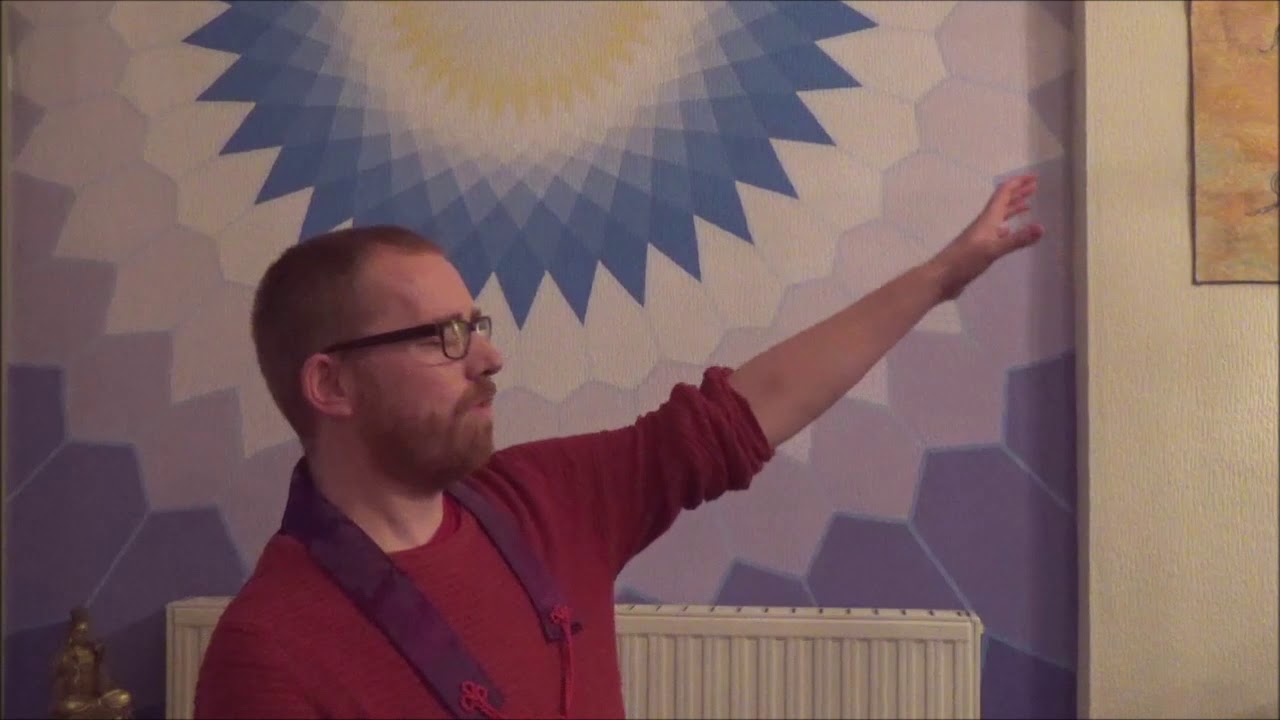
Namami Teppu shares a Dharma talk about practicing outside and spiritual insight. During an extended outdoor practice in the Forest of Bowland, chanting Nam-myoho, the speaker arrived at a realization of "just as you are" and sensed the presence of Taishichi. The talk explores courage, compassion, acceptance in sangha, and how faith transforms experience.
Chapters
Namami Teppu. Namami Teppu. Good afternoon, everybody. Lovely to see the shrine room full of familiar faces. Magic trick. I didn't know what I was going to talk about this afternoon. I was imagining that I would make some kind of response to what Don Vige said, and then I heard Satya Robyn talk and I thought, well, she's definitely prepared, maybe I should think about something. So I wanted to say a little bit about practicing outside, because I've done quite a bit of practicing outside this year and it's been very nourishing personally to me. And when I look back at the sutras, the words of the Buddha, he doesn't say a great deal explicitly about practicing outside. He mentions it a couple of times in the Fear and Dread Sutra. He talks about going into the jungle and taking it step by step and noticing what's there and just allowing those feelings of fear to arrive and settle and going another step into the jungle. And yet implicitly it's there on every page, more or less, because the percentage of time when the Buddha is inside is minuscule, actually. His community of practitioners gathered together in the forest, in parks, basically outside. In the natural world. I remember years ago, Jānavicci, we were having a conversation about Carl Rogers, and you said something like, towards the end of his life, somebody asked him why he hadn't written anything about spirituality or Christianity, when he was obviously such a devout religious practitioner, a deeply spiritual person. And he said, well, at the time, I just took it as read. That was the sea that we were all swimming in. I didn't need to mention anything about it. It was part of the normal culture. Everybody understood that we had a spiritual life. So now when you read his writings 50, 60, 70 years later, that's not apparent in them, and society has moved on and become secular. So you'd be forgiven to thinking that he's talking about something that secular, or in a secular context. And the same is true for Buddha Shakyamuni and outside practice. Why would he have needed to mention it when it would have been obvious to anybody at the time that he was practicing outside? And yet time moves on, technology develops, we move into places that are colder and wetter and less pleasant to to spend time in the forest. Naturally we move into Dharma centers and we lose sight because there's no explicit teaching saying, 'Go outside and sit in the natural world,' but of course they were doing it all the time. Earlier this year, at the end of the summer, I had an extended period of practicing outside. On, let's say, Saturday, I think it was a Saturday, part of a training I was doing, we went out into small groups and found a place that spoke to us, that had some sense of meaning or some sense of there will be something to meet you in this place. So we spent the day walking around in the countryside up in Lancashire on the edge of the Forest of Bowland, and my instinct is to go, oh well, I'm outside, so anywhere's good, I'll just go over there in the corner. But actually it was really lovely to be supported and guided beyond that impulse, and I found a spot on the edge of the river out of the sunlight, which Logically, that surprised me. I thought, "Oh, if it's sunny, I want to be in the sun," but this was the place that spoke to me. The grass was sodden. There were very smooth river-washed boulders around, and something about it just said, "Here, this is the place." As we were walking along, before then I'd been questioning with my mind 'Should it be like this? Should it be like that?' Trying to work it out like it was a puzzle. When I arrived in this space, it was just a deep intuitive sense of, 'Oh, it's here.' So the next morning, woke up, zipped up the tent, took my breakfast, went out into the woods, came back because I'd forgotten my something, went back into the woods, came back because I'd forgotten a second thing. Third time, went into the woods, went over a rickety bridge to the other side of the river and sat in this place for several hours. And to begin with, a little bit of the same process, my mind kicking in and trying to solve the place that I was sitting in as if it was a puzzle. Well, here's the river, it's this wide, On the day I was there, it was full of peat. It was like Coca-Cola. It was like a river of Coca-Cola that had been stirred up. And I was trying to sort of consciously relate the place that I was in. What is it about? Often rivers are slow, but this one's going quite quickly, so what's the lesson from that? Or is it to do with this or that? Really tying itself up in puzzles. And eventually I settled into chanting because that's the thing that I know how to do when I'm on my own. And I was chanting a Tai Chi Chi mantra, Nam-myoho-tai-chi-chi-o-satt, because I'd arrived with some question in that space about Courage. I'd been noticing times in my life when I hadn't been brave enough, when I'd been reluctant, when I hadn't taken the step that would have led to a deepening of relationship or something surprising, or— so there was a sense of regret and a question about how to develop courage. Taishi Chi, master of the practice, the Bodhisattva of strength and courage, so it seemed appropriate. So I sat next to this river. I'd got a tarpaulin so I wasn't getting damp, but I was getting colder. The cold was seeping in through my bones. I could see the sun moving through the sky and occasionally it lined up with a hole in the trees and I just would perhaps move so I could get a little bit of sunlight. And as the chant progressed, I had a very strong, clear sense of the presence of Tai Chi Chi being with me. My logical brain had moved to one side, so there was no questioning or trying to work out or make sense of this experience. Experience. In my mind's eye, there was the vivid figure of Tai Chi Chi, pretty much as he appears here in this gloriously glittery tapestry above Keima, floating above the river. And I turned and looked back upstream and had a same sense, 'Oh, and there he is floating above the river.' And I turned behind me and there he is floating, standing in the woods. So I just kept chanting and enjoying this presence and quite filled with joy at times. Part of my mind still ticking over, trying to work out what the lesson of this place was. And then I noticed a rivulet of water coming down the side. I was at the bottom of the valley, coming down the side of the hills into the river. In fact, the whole hill was saturated, so there are lots of rivulets of water coming down. Into the river. And I had this deep, deep sense of, oh, I don't have to be the whole river. I've been trying to be the whole river. I could just be one of these little drops of water coming down the side of the hill. And the words that came to me seem very trite in retrospect, to the extent that I've noticed I feel slightly embarrassed about going to share them. So I'm going to have a sip of water which is my displacement activity. Something— these words arrived, and it's like what you might find in a Hallmark greeting card or something, so I apologize, but it was something like, I don't have to be the river, I don't have to be the sun in the sky, I don't have to be the sea, I just have to be me. And it felt deeply profound at the time, despite the sort of almost clichéd nature of the rhyme. And of course, really what that was, was a deep experience of just as you are, really just as you are. One of the themes of the couple of days so far, one of the words that's been used has been control. How can I change my circumstances to make my circumstances better? Is it possible, is it possible to change the world to make the world better? Is it possible to change myself to to make myself better. One of the other themes that's been around has been how much suffering there is in the world, how deeply people have been affected by ill health, by the climate crisis, by just being human and living in samsara. And I noticed that one of my habitual responses to that is to try and do something about it. And when I really examine that impulse deeply, it has two roots. One is a root of genuine compassion and being moved, 'Oh, they're suffering, I want to do something to alleviate the suffering.' And the other is, 'If I don't do something, something catastrophic is going to happen.' to me. That's a fear-based response. And when I unpick that, the image that comes to mind, the scenarios that come to mind are memories of being very little in Sunday school. Dalaai Lama mentioned in his talk yesterday the difference between Western religion and Eastern religion. The memories of being in Sunday school and receiving these really clear messages. You, in order to go to heaven, in order to be loved, in order to be approved of by your Heavenly Father, you must do these things, you must follow these rules, you must be the Good Samaritan. That was a story that stuck with me in a really moralistic way, actually, to the extent that as a child I would really judge others if they weren't being the Good Samaritan. Which I'm sure isn't the true meaning of the story at all, on reflection. And then there's the words to this song that have come back to me through the years that I learnt at Sunday school. Envy, jealousy, malice, pride, they must never in your heart abide. Impossible. I heard you like— I'm not singin' you out for any other reason. Rule upon rule upon rule, this heaviness that you described the other day that feels like a load to carry. You must behave in this way. And of course, from a superficial glance from the outside, helping somebody, alleviating suffering, it might look more or less the same from both of these different places, from being moved by a genuine sense of compassion or from being weighed down by all of these messages and feeling, "If I don't do this, I'm going to burn in the fires of hell." Well, you still help the person. But one is from a place of liberation and one is from a place of deep— being deeply enmeshed in the karmic world. And when we act from the place of being deeply enmeshed in the karmic world, the cycle continues. We're feeding that back into the world. I think one of the conversations we had yesterday, somebody said something like, 'There's no way of standing still. Either you're becoming more liberated or you're becoming more deluded.' Dōgen said. So either you're acting from compassion, in which case more compassion arises, or you're acting out of this sense of karmic weight. In which case you're creating more karma. Both of those things have lived and still live within me. And on that day, uh, a few months ago, there was an experience of being released from some of that, some of the weight of that. You just have to be yourself. Myself at the moment includes the mind that's suddenly gone blank, but bear with me. Well, that's the That's the key point, isn't it? That actually what we're released from when we're accepted just as we are is, to use Dharma Vidya's word, conceit. It's pretense, it's pretending to be the thing that is better than we are, if that's what you're buying into, or worse than you are, or different than you are, whatever your particular brand of self— selfishness self-consciousness is. It's the weight of trying to distort yourself to fit into the right view as defined by an institution or a family or some part of myself. And my experience is when I feel deeply accepted in that way, just as I am, and I'm able to say, 'Oh, and that includes all of this dysfunction and embarrassment and conceit sometimes.' That without anything else changing, without gaining any superpowers or suddenly being able to do more good works or whatever it is, just existing with a trust in being accepted just as I am by the Buddhas and Bodhisattvas, like Tai Chi Chi, is enough. That is already a perfect offering. And anything else is gravy, as Raymond Carver would say. Of course, it's good to do good works, but when you're in a state of feeling deeply accepted as you are, warts and all, good works tend to flow naturally without much efforting. Of course there's times when efforting is required. The theme of this week is 'In less than a day,' and it takes lifetimes to perfect the Buddhist virtues. It's said that it took Buddha Shakyamuni 10 lifetimes practicing each one of the 10 paramitas in the Theravadin tradition. Before he was able to then be reborn in the body that became enlightened. That's a lot of lifetimes. 100 is quite an easy sum, isn't it? I should have got that earlier. 100 lifetimes. That's more than a day. It's definitely more than a day, 100 lifetimes. And yet, what can happen in less than a day is that moment of stepping out of fear, stepping out of pretending to be something other than you are, and stepping into faith, into trusting that the Buddhas and Bodhisattvas are already streaming their affection and love towards us, and already deeply accept us. Just as we are. And in doing that, there is a transformation. We enter into the dance of the Dharma. I'm not sure about that dance of the Dharma. Again, it's a bit Walmart-ism. But something important happens in that moment, and it doesn't necessarily mean that suddenly you're going to be a good person, or I'm going to be a good person. Maybe another 100 lifetimes like the Buddha, or more. But actually, that moment is enough. Over the rest of the lifetimes, if you keep resting in that deep sense of entrustment the virtues will appear naturally. And that's been my experience. It's not that I've consciously had to work to change myself particularly, just that I keep coming into rooms like this one and saying the Nembutsu and experiencing relationships in the sangha where I'm accepted accepted. And in small moments in everyday life, and in bigger moments like on the edge of the Berlin Forest, I'm reminded that I'm accepted just as I am. And it's tempting, and I've even been doing it a little bit in this talk, it's tempting to tie that moment into an idea of progress because as a society we are so tied into the idea of I must get better, that's how deep those roots go in me, that even I even want to frame that experience as the 'and then you'll be better.' And actually, the deeply profound truth of Pure Land Buddhism is you don't need to be better. That moment of seeing the Buddha's light coming towards you is enough. Namami Te Pu. Namami Te Pu.









