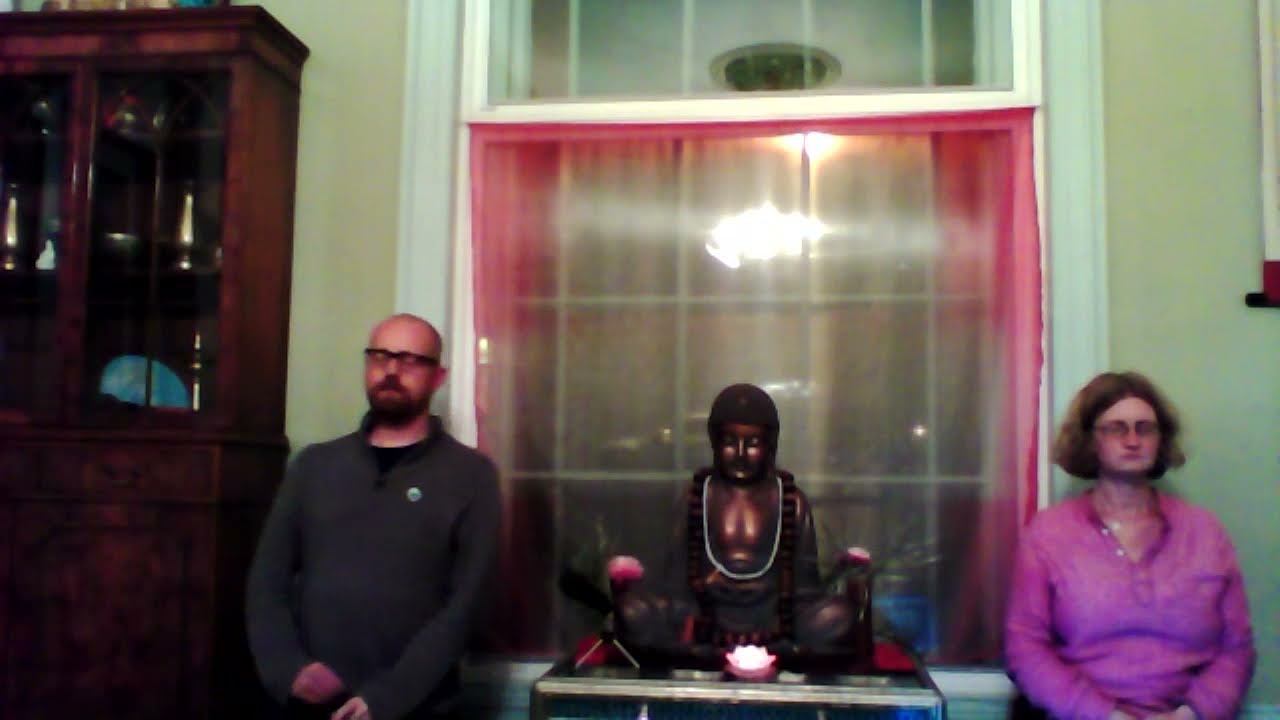
Satya Robyn leads an evening Buddhist practice session with dharma talk on the three trainings: restraint, meditation, and wisdom. The group does guided sitting, chants Om Amitabha, recites refuges and precepts, and bows together.
Chapters
Good evening, Mrs. Robyn.
Welcome to evening practice. Um, and this evening in shrine room we have Lord Kathleen, Jack, Dave, Jean, Caspar, and me. And joining us from Zoom, we've got Bruce. Hi Bruce, who looks very comfy, and Beth and Chris. So over to Caspar.
Thank you, welcome everybody. I've been thinking about how I give talks. In this space. Because occasionally— well, I don't know how often— recently, let's say, because recently when I give a talk, I know that I'm doing a performance and that that performance is covering up some anxiety, for example, or frustration, or insecurity, or grumpiness, whatever I've been carrying through the day. And I've been doing this for a long time, so I know how to give a decent talk when I'm feeling those things. I can just kind of tamp them down and present something. And that's a pretty good skill to have, because if I come in and really shout at everybody, that's not a good look for a Buddhist teacher. If I break down in tears or can't get my words out because I'm feeling anxious, they are all things that happen to human beings. But they maybe introduce some disturbance which isn't helpful. So this is called restraint in Buddhism, and it's often the first thing that the Buddha taught people, was to learn how to hold back slightly. From putting bad vibes into the world through their speech, through their actions. But that on its own isn't enough. If that's all you do, you just become a kind of robot. With this rumbling, swirling mass of emotions underneath that probably gets bigger and bigger and more and more uncomfortable because all we're doing is holding it in. So the Buddha also taught meditation, and the Buddha taught people to have faith that ultimately they would be okay. So trusting in this sense of okayness, and with the quiet and the space that meditation brings, we allow in some of this mix of feelings. Whatever it is that happens to be here, we just notice it. Oh, here's the anxiety, maybe it's in my tummy. Oh, here's that frustration in my fist. Just noticing it, and if we can, sending some friendliness to it, sending some warmth to it. And this begins to turn down the volume, to turn down the intensity. It helps things to disperse and dispel. And sometimes we need some extra help from the people around us. And finally, the Buddha taught wisdom, which is the idea that the Buddhist word for wisdom, prajna, is sometimes translated as looking underneath the surface of things. And the Chinese symbol for wisdom is— now maybe it's not for wisdom, but there's a Chinese symbol for a form of meditation that is a heron. And a heron is very good at seeing beneath the surface of things because water makes the light bend. So where the fish looks like it is, actually it's a few inches in a different direction. But the heron is able to take that into account and get the fish where it really is, not where it looks like it is. So wisdom is seeing beneath the surface of things. And when we look beneath the surface of these negative emotions, what we discover is that there is a place of loving kindness within us and within the world. That it's possible to speak and act from a place of genuine loving kindness and compassion, that it's possible to feel that for ourselves, not all the time, but that it's possible, and it's possible to feel it for other people. So I started by saying I was reflecting on giving talks, and I guess the best talks come from when I have personally done that looking beneath the surface in my own system, and I'm able to meet whatever feelings I'm carrying from that place of loving kindness.. And that creates a real sense of spaciousness and groundedness. And I know myself that there is a different feel when I'm speaking from that place as compared to when I'm just doing a performance. And tonight is a mix of both, if I'm honest. So these are the 3 things that the Buddha taught, holding back negative energy. Meditation and faith, practices that create space, and the wisdom to see beneath the negative things to the foundation of loving kindness and how deeply connected we are. To each other. Namamitabuddha. So we'll go into a period of quiet sitting together, and if you would like to, you can follow the breath. This means noticing the cool air entering at the tip of the nose, noticing where the breath comes into your body, into your chest or your tummy, and then watching it as it leaves, noticing the warmer air leaving at the tip of your nose, and any thoughts or feelings or sensations that are around. Noticing what they are. Oh, here's that anxiety. Here's that pain in my foot. Here's that hunger. And then gently bringing attention back to the breath. And if you can't You know, if even that seems too tricky tonight, just sitting quietly with us is also really good. Wherever the mind goes, gently bringing awareness back to the breath. So in a moment we will chant together Om Amitabha. Om Amitabha is the Buddha of infinite light, and the light is love. So saying the name of this Buddha, we are reminding ourselves that love is at the foundation, that underneath everything in ourselves and in the universe is love. And hopefully I can remember the tune.
Satya Robyn.
Yeah, go ahead. I had it in my head just then, and then just as I was describing it It blanked out.
Om Amitabh Hum. Om Amitabh Hum. Om Amitabh Hum. Om Amitabha. Om Amitabha. Om Amitabha. Om Amitabha Om Amitabha. Om Amitabha. Om Amitabha. Om Amitabha. Om Amitabha. Om Amitabha. Om Ami. Om Amitabha. Om Amitabha. Om Amitabha. Om Amitabha. Om Amitabha. Om Amitabha. Om Amitabha. Om Amitabha. Om Amitabha. Om Amitabha. Om Amitabha. Om Amitabha. Omami tabaho. Omami tabaho. Omami tabaho. Om Amitabha. Om Amitabha. Om Amitabha. Om Amitabha. Om Amitabha. Om Amitabha. Om Ami Tabam. Om Ami Tabam.
So we'll have a few more minutes of silence together. And in, in this 4 or 5 minutes, don't try to meditate, don't think, try to notice this or get your mind to do that. Just sitting quietly together. Please repeat after me. For refuge I go to the Buddha.
For refuge I go to the Buddha.
Namo Buddhaya.
Namo Buddhaya.
For refuge I go to the Dharma.
For refuge I go to the Dharma.
Namo Dhammaya. For refuge I go to the Sangha.
For refuge I go to the Sangha.
Namo sanghaya. With faith in the Three Jewels—
with faith in the Three Jewels—
I pray that I may not take life.
I pray so I may not take life.
With faith in the Three Jewels—
with faith in the Three Jewels—
I pray that I may not steal.
I pray I may not steal—
With faith in The Three Jewels .
—with Faith In Their 3 JewelS!
...Pray that I May Not Fall Into Sexual Misconduct...?
Prays That You Would Stop Molesting Me— ...With Faith In their three jewels!? Threepoolz!!?!
...Praise And Worship It All By Your Heart!!!) "I Praise Them" by Chaiyawan Jirapongkulnicholpoomjibbunmahamudra. "...with faith in there three jewls!" ...praise them they have fallen into wrong-speech...? wrongful-speech...) ..."with faith in therethree-jewelss?" With faith in the Three Jewels, I pray that I may avoid intoxication.
I pray that I may avoid intoxication.
No blame. No blame. Be kind. Be kind. Love everything.
Love everything. Innumerable are sentient beings.
We vow to save them all. Immeasurable are the Dharma teachings. We vow to transform them all. Exactly.
Rewind on that. Inexhaustible are deluded passions.
We vow to transform them all. Immeasurable are the Dharma teachings. We vow to master them all.
Infinite is the Buddha's way.
We vow to fulfill it completely.
I nearly did it wrong twice there.
How many years have I been saying this?
Well, I mean, 15. No, Fi did it wrong. No, no, I did it wrong. Well, I take full responsibility. So we're going to do some bowing, so make sure you've got some space in front of you if you want to join in. We'll bow all the way to the floor. Namaste. To Buddhas and Bodhisattvas throughout space and time. May it be as fragrant as Earth herself, reflecting our careful efforts, our wholehearted awareness, and the fruits of understanding slowly ripening. May we and all beings be companions of Buddhas and Bodhisattvas. May we awaken from forgetfulness and realize our true home. Make sure our seats are tidy, bow to our seats, and then we'll recite the closing verse together, which you can find on the little piece of paper on the top of one of the pages, I think.
Closing verse is on the top.
Blessed by Amitābha's light, may we care for all living things and the holy earth. Namāmitbhu. Thank you. You're very welcome to stay for a cup of tea.









