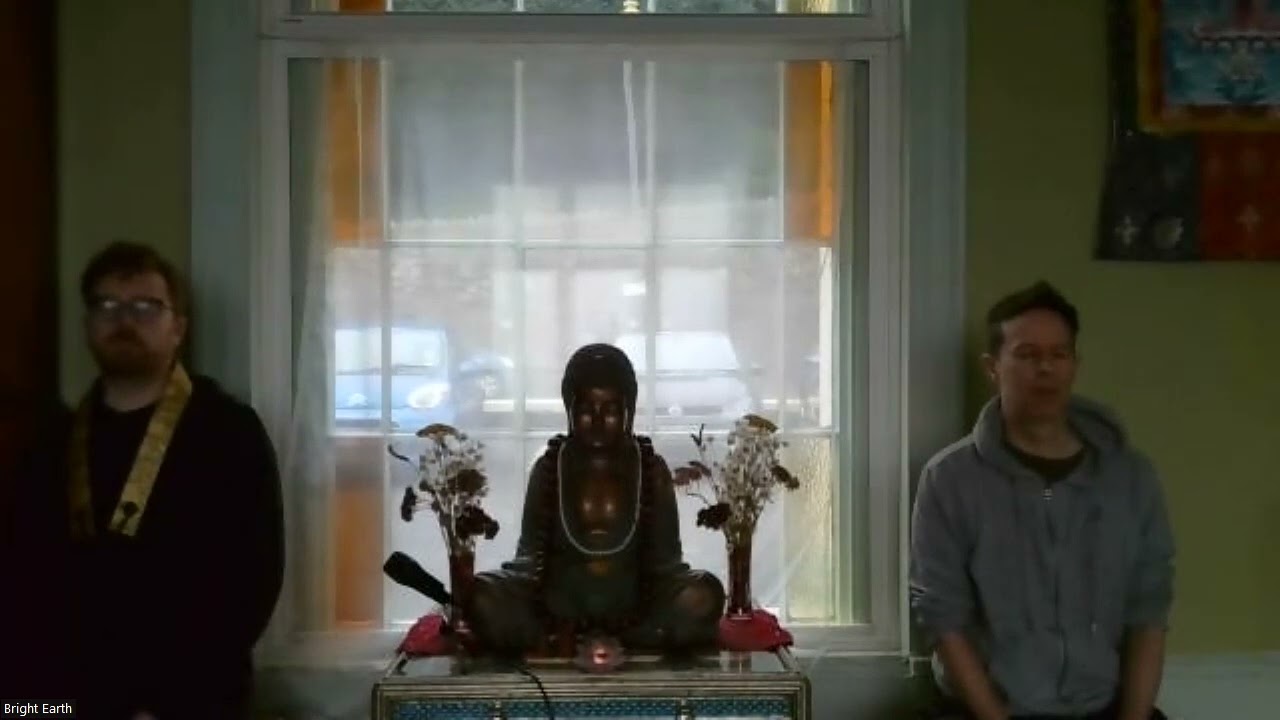
A Buddhist group morning practice led by Satya Robyn and participants including Philip, who reads a reflective piece by Luna about coming home and devotion. The session includes chants, recitations of refuges and precepts, prostrations, and a Dharma talk using a story about a rotten deck to explore Jodo Shinshu practice.
Chapters
Good morning, everybody. We'll begin with a glimpse from Luna, who's, uh, some of you know, recently moved to Totnes and is studying in one of the book groups at the moment. And Philip has agreed to read for us.
Thank you.
Thank you, Jasper.
I haven't read one of these for a while, so I feel surprisingly nervous about doing it. Um, and I haven't read it yet, so I saw the title, Allowing Ourselves to Come Home and Be Held, um, by Luna, as Casper said. So I was intrigued by it, so I'm interested to read it. So here we go. I've been wandering and exploring for the past 4 years since fleeing to Australia after a very long PhD. My spiritual connection has deepened through many practices and experiences during this time, and I feel like I've been on a long pilgrimage to come home to myself. In the past few months, it landed for me, the magic I experience when I allow myself to feel held, supported by life/God/the Divine, brackets, in whichever form they present themselves to us, whichever form feels supportive for us, whichever way/language we can relate to. I started to feel more witnessed and encouraged to go to the places where I feel called to go, to follow my heart. Through this process, my values have been revealing themselves. At one point, I thought I wanted to travel more, but when I really looked at what I was desiring— community nature, to feel welcomed and valued, and actually put down roots and allow myself to build a nourishing life where I can feel connected, of service, and aligned all year round, not just when visiting or traveling. I realized it was time to let myself surrender into the way I've been paving, to trust in the Divine and in myself. To see the beauty and everything I, I desire is right here. After a challenging experience this Christmas with multiple friend— multiple house moves and family tensions following a very supportive year of living with my friend, I was humbled by the reminder the supportive conditions are really important no matter where we are in our spiritual path. In my hour of need, all of the amazing connections in my life revealed themselves in a deeper way, and everything felt like it got richer. I know that I have this deep longing to be home and be with the Divine. The idea of devotion no longer causes resistance in me. My perceived capacity is no longer being judged through the lens of my ego. But feels like an opening in my heart and deep calling. So now that my practice has brought that to life in me in a way that is accessible every day and is being woven through my everyday life, I'm really excited to be exploring different language to bring me closer to that. I just relocated to Devon and have been reflecting on my practice and the practices that do bring me to this place, one of which has been the Gayatri Mantra for the past few months. My friend introduced me to it, tells me that this mantra is never not being chanted. It is being chanted throughout India. It feels really powerful for me to sense this interconnectedness and this collective desire to feel at home with the Divine in ourselves and in the world when hearing/chanting this. When I practice this within, it is mirrored in my life. A deep sense of where feels like home for me, one particular place of which I appreciate on a new level after a recent visit, is the temple in Moldovan. As I stand in my new back garden Looking out the River Dart for the first time since moving to Devon, feeling the sun on my face as I close my eyes and enjoy the patterns that appear behind my eyes, I chant Namu Amida Butsu. I feel a wave of gratitude for the depth of connection I feel with people and in my external world that are closer to home. The clarity that I needn't search, the support is here. I feel the power and beauty of feeling connected to the Bright Earth Sangha and how I've always felt so supported, welcomed, and accepted just as I am. I feel very blessed to have this intentional community and teachings to help me sense feeling at home with the Divine and help me live and serve from here. I remind myself daily to connect to these feelings that feel like home, to choose to live from here and let everything unfold from here. May we allow ourselves to come home and to have the conditions around us to support this, to allow ourselves to feel, feel held and supported by the warm sun on our face, the birdsong, the hills around us.
Namaste.
Thank you, Philip. Thank you, Luna. So moving into meditation.
Amitabh.
Amitabh.
Amitabh. Amitabh. Amitabh. Mami. Amee. Amitabh. Amitabh. Amitabh. Ameeta. Ameeta. Ameeta.
It's in a moment we'll write— we'll recite the refuges and precepts together. I'm just going to put the words into the chat for people who've joined us on Zoom. That's a link to the liturgy. But I'll begin by inviting you to repeat after me, so you don't necessarily need to see the words. Please repeat after me. For refuge I go to the Buddha. For refuge I go to the Buddha. The one who is awake and full of love. The one who is awake and full of love. Namo Buddhaya. Namo Buddhaya. For refuge I go to the Dharma. For refuge I go to the Dharma. All that guides us to wisdom and compassion. All that guides us to wisdom and compassion. Namo Dhamma. Namo Dhamma. For refuge I go to the Sangha. For refuge I go to the Sangha. Those who live in the Buddha's light.
Those who live in the Buddha's light.
Namo Sangha.
Namo Sangha.
With faith in the Three Jewels. With faith in the Three Jewels. And in light of my human tendencies. of when I fall into sexual misconduct— of when I fall into sexual misconduct—I pray that I may become aware— —of when I fall into wrong speech— —I pray that I may become aware—
No blame!
Be kind! Be kind. Love everything.
Love everything.
Innumerable are sentient beings.
We vow to save them all.
Exhaustful are deluded passions.
We vow to transform them all. Immeasurable are the Dharma teachings, we vow to master them all. Infinite is the Buddha's way, we vow to follow it completely.
Namaste.
So I'll begin with a health and safety announcement, which is also a segue into my Dharma talk. I noticed when we were doing the walking meditation that the wood on the deck, which I already advised people not to go on, um, but through the winter has become even more rotten, and there's a real visible patch where I can see just less— resting a small amount of weight there would mean that your foot went through it. So don't put your foot there, or do, and, you know, find out what happens. Um, yeah, we've all got free will, but it, it brought to mind the process of how that deck was built, in that, uh, we had a volunteer who claimed expertise and had expertise in other related areas and had done a good job in other related things and was very confident. And I knew nothing about what was required, but I was happy to say, okay, off you go then. Well, I'm making the decision to trust you. And I'd already got the sense like, oh, maybe this guy's a bit awkward to give feedback to, but if he knows what he's doing, that, like, that isn't an issue. So off you go, we'll order the materials. And it looked very good when it was finished. It did have a slight bounce to it, but I trusted this guy. I was like, oh, maybe that's okay. And then someone else walked on it, I think my father-in-law and said, I'm— I think this is too fancy. And, um, had a conversation with the then chair of the trustees, Tony, who was, uh, among many different things, and had been a garden designer for a very long time and did know the specs of what a deck should be. And this wasn't up to those specifications. There wasn't quite the right number of supports underneath. It wasn't far off, so I had a word with this volunteer and it went in one ear and out the other. And then Tony came and had a really warm conversation with this volunteer, and then they went out and looked around the garden together, and he, um, he talked to him about the deck, and then we never saw the volunteer again after that. Well, I bumped into him in the supermarket once, and he seemed okay, but he never came here again. And so the deck was bouncy, sort of use at your own risk, and I knew what needed to happen in my head, but actually translating that thought into making it happen was outside my comfort— was both outside my comfort zone. And, and that sort of outside my comfort, that pot of energy— we have one pot of energy, and, uh, it was getting spent on other things. And things that are outside your comfort zone require more of that energy. So, so, uh, I kept putting it off and putting it off and putting it off, and then here we are with a deck that you could put your foot through the middle of. But that isn't an unusual process. We, we often make decisions not having all the information in front of us. Like, so many times I, I had to buy a new phone this week because my old one stopped charging. I'd already replaced the battery. I thought, oh, it's not anyway. And I spent 3 hours doing research one morning. I had other better things to do, but there's so many choices out there. In the end, I'm like, okay, fine, I'll go for this one. And who knows whether that's a good decision or not, because I simply don't have the expertise. And in our personal lives and in our relationships, We're doing the same thing over and over again, working on our best guesses. And then sometimes we do know what the right thing to do is, and we still can't manage it because of other circumstances in our life or other thoughts and feelings that are going on inside of us. And then whatever the situation is becomes rotten in some way, like the deck became rotten. It's something very familiar about how that process unfolds. It feels very human. And, and often spiritual practice seems to offer a way out of that process. If you do this much meditation, if you follow these precepts, if you learn these teachings you'll get to a stage where you can make the right decisions, where things will unfold and you won't be affected by them, where you will know what the right thing to do is and have the capacity to act on it. And it— yeah, that would be lovely, but it can become very disheartening doing that, because as much as those things can move— can and do move us along the path, at some point we will always make a decision that leads to something rotten, because that is the nature of being human. And that's why I was reassured, uh, this morning when Satya sent me— oh, I think she's just put on the chat, actually, maybe the same photo. Anyway, she sent me a photo of the book she was reading while she's away on retreat. This morning, which is called, um, the book's called Let This Be Known by James Pollard. And I keep opening the wrong thing, apologies, because she's posted it in two places now. So I don't know what this chapter's about, but something about it sort of somehow speaks to what I'm talking about. We face a serious difficulty in following a path where the primary emphasis is on morality and ethics. There's temptation to shift the focus away from where it should be, namely the recognition of my own deluded ideas. Instead, standards of conduct give me a pretext for judging the apparent moral and ethical failings of others and myself. Misdirecting my focus in this way prevents me from becoming a spiritually mature person. So for me, it is not skillful means to make charity the basis of a spiritual path. The aim in Jodo Shinshu is to gain self-awareness rather than to uphold ethical standards. When this was first explained to me, I realized that Jodo Shinshu would be my path and Shinran would be my teacher. Not that doing charitable things is bad to do, but it isn't the primary thing we set our goals on, set our sights on. The primary practice is becoming aware of our bonbu nature, of our foolish nature, and knowing that is held by Amida, by this sea of vast compassion. The story about the deck and the things it made me think of, that is our bambu— that is my bambu nature at work. That is a consequence of that. And if I just focused on getting it right or doing a good job, that can lead me into a shame spiral. If I really pay attention to that process and notice, well, what, what was alive in me? What actually happened? And no that I'm not on my own with that, then where that leads to is a deepening sense of refuge. And with refuge comes a little bit of relaxation, a little bit of growing trust in myself and the world. And maybe next time it's a little bit easier to do the thing that was hard to do this time. But even if it's not, that process of paying attention— which is why we change the precepts to 'let me become aware' rather than 'let me keep them'— that process of paying attention leads me to the Buddha. Nam-myoho-renge-kyo. So we're going to stand and make prostrations. That's hard to see on the Zoom screen, but we're making 3 bows to the main shrine as we say Namo Amida Butsu, which means I take refuge in the Buddha of infinite light. So please, as we're chanting, make 3 bows to a Buddha nearby, or maybe just the Buddha that you can see on your screen if you're joining us on Amsing.
Ammo, amigo. Ammo, amigo.
In gratitude, we make this offering to all Buddhas and Bodhisattvas throughout space and time. May it be as fragrant as Earth herself, reflecting our careful efforts, our whole path of mindfulness. And the fruits of understanding so enlightening. May we and all beings be companions of Buddhas and Bodhisattvas. May we awaken to true awakeness and realize our true home.
You can't see, uh, heads anymore on Zoom. So in a moment we'll finish with the closing verse. Just a reminder before you before we do, but there is a workout this morning after the cup of tea if you want to join us. The main thing I'd like to accomplish is finish clearing the cupboard at the bottom of the fire escape, which not many people can get involved in because it's not a very big— it's big for a cupboard, but it's not very big for lots of people to get involved in. But if you do want to help out in other ways, there are various cleaning things. There is even things in the garden, although it's very waterlogged, so let me know if you want to lend a hand, but no pressure. And otherwise, we'll finish with the closing verse. Blessed by Amitābha's light, may we care for all living things and the holy earth. Namāmitabha. So stop the recording.









