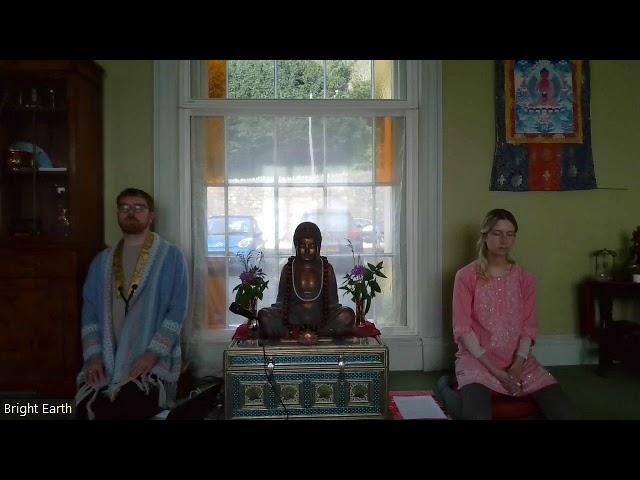
This content was created by Satya Robyn. This content was uploaded by Satya Robyn. This is a YouTube video titled "Morning Practice" (created 2024-04-13) containing a guided Pure Land Buddhist practice held in a shrine room and streamed to Zoom. Participants include the session leader (SPEAKER A), Katrina (who reads and leads chants), and Koku (who submitted a Dharma glimpse read aloud). Content includes a Dharma reflection on the "more-than-human sangha" and environmental interdependence, guided sitting meditation, chanting of Amitābha, recitation of the refuges, precepts and bodhisattva vows, prostrations, and a short Dharma talk on impermanence that references an upcoming change in temple responsibilities (with Satya Robyn mentioned).
Chapters
Welcome everybody, a special welcome if you're joining us on Zoom for the first time. We are recording the practice, but I've pinned my screen, so it's only, uh, us that will be on the recording, not you. We're going to begin with a reading, a Dharma glimpse that's been sent in by Koku, a Zen Buddhist priest who sometimes attends the Zoom practices on a Wednesday evening, and Katrina has agreed to read for us this morning.
Thank you.
Let me hand you the—
More than human. My Zen friend Sarah told me about the Merlin app for identifying birdsong. I live in a small village in East Kent, and one day when I was sitting outside with the dogs, I opened the app to see what birds it would recognise. The most interesting thing for me is that the app identifies birds that I may not be able to see, and that afternoon it heard songs from goldfinches, kestrels, and long-tailed tits, none of which I can recall seeing in the area before. A week earlier, it identified the call of a little owl. Buddhism largely deals with the human condition of suffering, as it was taught by the Buddha in his Dharma, and this is practiced in sangha of human beings. However, One Earth Sangha is a Buddhist community I often practice with that focuses on the intersection of environmental issues Buddhist practice, and there it is emphasized that the Sangha is largely— the Sangha is larger than we often think and includes other species which they term more-than-human beings. The more-than-human may be considered to include animals, plants, fungi, and other microorganisms, but also rivers, mountains, rocks, and in the air. Dogen, the founder of Soto Zen Buddhism in Japan, reminds us that the land, grasses and trees, fences and walls, tiles and pebbles, all things in the Dharma realm of the 10 directions perform the work of the Buddhas. The birds I find using my app are definitely part of My more-than-human sangha, as are the oak trees that surround my flat, the squirrels that live in them, the grasses, sorrel, buttercups, and other flowers that adorn the lawn, and the chalk rocks that this part of the country rests upon. Why is it important to consider our more-than-human sangha? Firstly, I find that thinking about them makes me feel grateful for the trees, flowers, birds, and the soil of where I am, providing us with not just the beauty but shelter, oxygen, and food. Secondly, my actions impact on the more-than-human world for good or ill, whether that is leaving seeds out for the birds and squirrels in the winter, using chemicals in the house which may find their way into local water sources, or the mode of travel I choose to take. We are all interwoven in this world in a cycle of giving and receiving. And however much we might like to think that human beings are special and separate from nature, we are not. Going further, Buddhism would even say that as we drop our attachment to ideas of self and other, This lack of separation is laid bare. Listening to bird calls may be a tiny step to seeing that, but it feels like a good one to take. Namamida bu.
Thank you, Katrina.
Thank you, Koku. So we go into a period of meditation. If you're in the shrine room, you can listen to the birdsong. You may not be able to identify it, but there's definitely some outside the window. So we'll sit quietly together, just noticing what we notice, stepping back into the position of the witness. Not making judgments, not telling stories. And if we do those things, also noticing those things. So in a moment we'll chant Amitābha, the main Buddha that we take refuge in as Pure Land Buddhists. Amitābha, whose name means limitless light. Also known as Amitāyus, whose name means limitless life. Not a historical person, but a figure that stands in for a greater truth. Manjushri stands in for the wisdom that cuts through delusion. Kuan Yin stands for Kuan Yin, whose name means the one who hears the cries of the world, stands in for compassion. Amitābha stands in for loving all beings just as they are. So both the wisdom aspect of the Buddha to see us clearly and the compassion aspect of the Buddha to love us just as we are. And There's all these different Buddhas, but some Pure Land Buddhists would say that Amitābha is not just one among many, but also stands in for reality itself. That when we are clear of delusion, well, as Koku said, mountains and rivers are also doing the Buddha's work. Everything Everything is loving and wise. If we are enlightened, everything is loving and wise, and Amitābha is everything that's loving and wise. So with that in mind, we'll recite their name.
Amitābha. Amitabh. Amitabh. Amitabh. Amitabh. Amitabh.
A mi ta.
A mi ta. Me. Amita. Amita. Me. Amitabh. Amitabh. Amitabh. Ame.
Ta. I wonder if people online can hear the bells. I know sometimes you can't since the last Zoom update. So we're going to go into reciting the refuges and precepts and bodhisattva vows. The refuges and precepts, I'll ask you to repeat after me. The bodhisattva vows are call and response. I'm going to put a link to the words in the chat if you're joining us on Zoom and would like to be able to read them as well. So please repeat after me. For refuge I go to the Buddha.
For refuge I go to the Buddha.
The one who is awake and full of love.
The one who is awake and full of love.
Namo Buddha. For refuge I go to the Dharma, all that guides us to wisdom and compassion.
Namo Dhamma.
For refuge I go to the Sangha, those who live in the Buddha's light.
Nam-myoho-renge-kyo.
With faith in the Three Jewels, and in light of my human tendencies, I pray that I may become aware of when I take life. I pray that I may become aware Of when I take what is not freely given. I pray that I may become aware of when I fall into sexual misconduct. I pray that I may become aware of when I fall into wrong speech. I pray that I may become aware.
I pray that I may become aware.
Of when I become intoxicated. Of when I become intoxicated. No blame.
No blame.
Be kind.
Be kind.
Love everything.
Love everything. Innumerable are sentient beings.
We vow to save them all. Inexhaustible are deluded passions, we vow to transform them all.
Immeasurable are the Dharma teachings, we vow to master them all. Infinite is the Buddha's way, We vow to fulfill it completely.
Namamitabhu. I said last night as we were playing Jenga at the dining room table that I would try and build that into the Dharma talk. So we'll see. I've actually been thinking about, um, one of the chapters in Naboa Honeida's book, What Is Ameeda?, which I shared on the chat about 6 months ago. And you'll get to in the book group at some point. And, and what I really like about it is this, um, This description of Shakyamuni's enlightenment as a change in how he viewed impermanence, it's a sort of unique take. I've never seen it expressed in that way, but there's something quite profound about it. So from being in the world of change, where everything is contingent, where everything passes away, and experiencing that as a world of suffering. Oh, I don't get the things that I want. People are always dying. When you start to reach a certain, certain age, that's what you notice. All the celebrities that I remember from my childhood that were adults are now dying. Impermanence. Um, and, and that focus creates suffering. I suppose it's another way of the classic Buddhist teaching that attachment creates suffering. Being attached to the way things are when they change Oh, it hurts. And there is something normal and natural about that, but that's the kind of pre-enlightenment view. And the post-enlightenment view, Anada describes as seeing impermanence as something that is positive. As something that's creative, natural. Because unless some things die, there's no room for new things. And that's true for living beings on the planet. It's true for thoughts and feelings in our own hearts and minds. When we cling on to something, we're not allowing something new to appear. If the Jenga Tower doesn't fall down, you can't make it back up again.
Something like that.
So most people, uh, will have read the email yesterday that In the autumn, Satya and I are going to move out of the temple and hand over some of our responsibilities, many of our responsibilities, to a small team of people. And that is impermanence, that is change. And, and we might experience that as suffering if we're attached to the way things are now. And the way things are now is pretty great, right? So it's understandable that we'd be attached to them. And don't— I don't— I'm not inviting anyone to suppress any feelings that come up when something changes. It's really important to notice them and tend to them, but to be aware that they can obscure the possibility of something new appearing, and to practice releasing and letting go, and knowing that we're supported by the Buddhas and bodhisattvas in that releasing and letting go, to allow for something new and spontaneous and creative, and who knows exactly what. Just like, uh, I'm noticing the camellias on the shrine, you know. And there, there is all these lessons we can learn from the natural world. A few days ago, Satya Robyn deadheaded the hydrangeas in the garden, and while those old dead flowers are on, there's no room for the new ones to grow. And this is also impermanence. And, uh, and this is what Haneda says Amida is. It is the world, it is the dance of impermanence in the world viewed through the eyes of the Buddha, that we are able to see things as they are, which is creative, fresh, changing, and, and to, um, yeah, to be all right with that, more or less.
Namaste.
So in a moment, we're going to stand and make prostrations. You won't be able to see that very clearly if you're joining on Zoom, but we're going to do 3 bows to the ground as we recite Nam-myoho-renge-kyo. I take refuge in Amida Buddha. So feel free to bow 3 times to the Buddha on your screen or a Buddha in your own space as we do that practice here in the shrine room.
Nam-myoho-renge-kyo. In gratitude, we make this offering to all Buddhas and Bodhisattvas throughout space and time. May these fragrances of incense reflect in our careful efforts our whole past mindfulness and the fruit of understanding, may we and all beings be companions of Buddhas and Bodhisattvas, and we awaken from forgetfulness and realize our true person.
So in a moment we'll finish with the closing verse. If you're on Zoom, we're going to have a silent exit from the shrine room, and then if you want to stay, someone will come back in and say hello to you on the computer.
Namami Tabu.
Blessed by Amitabha's light, may we care for all living things and the Holy Earth.
Namami Tabu.









