Morning practice: Remembering Shinran and Spider Dharma Glimpse
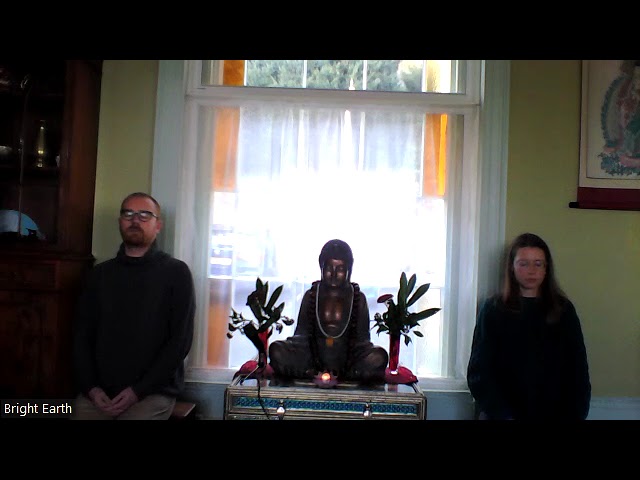
Satya Robyn leads a morning practice session with guided meditation, chanting of the Nembutsu, and a talk on Shinran and Pure Land Buddhism. A dharma glimpse story about a spider explores impermanence, followed by community announcements and closing verses.
Chapters
Good morning everybody. Nice loud gong to wake us up this morning. Special welcome back to Wendy who hasn't been here since before COVID Namaste. Welcome to Philip joining us remotely. Due to the gift of technology. And welcome to everybody else. We'll begin with a Dharma glimpse by Hissee.
Spidey Buddha Dharma glimpse. I'm back from a weekend away staying with my brother in Bristol. It was nonstop from the moment I walked through the door, briefly meeting housemates and then straight out, setting off on a walking tour of the city. I was led along pavements, through residential streets, along bustling high streets and around the harbour side. It was Saturday night and the city had a buzzing, frantic energy to it. At 7 PM, people stood in a drunken haze, looking vacant next to pools of sick. We saw a couple of people crouching behind a warehouse container by the side of the road. They were shooting up. Their slight skeletal frames were silhouetted in the fading light. I was struck by how creative and destructive energies seemed to coexist in the city. I thought about how these energies, and the impulse to create and to destroy, both exist within me. A moment of stillness came the following day when we walked past a student house and I spotted a spider making a web between a bin and a stone wall. The spider had the foundation secured and was now meticulously working its way around in circles, spiraling into the center. The spider was speckled brown with a big round body. It moved with speed and accuracy. Dancing with silk, absorbed in its task completely. A pang of sadness struck me as I thought about the bin being moved and the web being destroyed, the fine silk strands breaking. I admired the spider. It made me think about the idea that's come up in The Centre Within, a book I've been reading in one of the book study groups at the temple. The idea that you should act because your life force commands it. The bin might move, a gust of wind might break the web, and yet the spider continues spinning its web because its life force commands it. Something in the deep focus, single-pointed attention and devotion of the spider in amongst the noise and chaos of the city struck me as Buddhist. The spider was just being a spider, doing its spider thing, but in that moment, to me, the spider was a perfect Buddha. After staring in awe at the spider for some time, I glanced up and spotted someone at the window looking out at me and my brother. They were laughing, probably wondering what it was, the space between the bin and the stone wall that had us both transfixed. I laughed too and gave a little wave before carrying on walking.
So moving into a period of meditation, invitation— moving into a period of meditation, an invitation to notice the breath. And when other things appear, thoughts, feelings, sensations, to notice those Oh, here's a thought, here's a feeling, then returning attention to the breath.
Amitabha. Amitabha.
Amitabha. Amitabha. Amitabh. Amitabh. Amitabh. Amitabha. Amitabha. Amitabha. Amitabh. Amitabh. Amitabh. Amitabha. Amitabha. Amitabha. Amitabha. Amitabha. Amitabha. Ame taba. Ame taba.
Ame taba.
Amitabha. Amitabha. Amitabha. Amitabh. Amitabh. Amitabh. Amitabha. Amitabha. Amitabha. Amitabha. Amitabha. Amitabha. Amitabh. Amitabh. Amitabh. Amitabha. Amitabha. Amitabha. Amitabh. Amitabh. Amitabh. Ame ta.
So we'll now go through the liturgy. The first part is repeat after me, and the second part call and response. So please repeat after me. For refuge I go to the Buddha.
For refuge I go to the Buddha.
The one who is awake and full of love.
The one who is awake and full of love.
Namo Buddha.
Namo Buddha.
For refuge I go to the Dharma.
For refuge I go to the Dharma.
All that guides us to wisdom and compassion.
All that guides us to wisdom and compassion.
Namo Damaya. For refuge I go to the Sangha, those who live in the Buddha's light. Namo Sangaya. With faith in the Three Jewels, I pray that I may not take life. With faith in the Three Jewels— I pray that I may not steal. With faith in the Three Jewels—
I pray that I may not fall into sexual misconduct.
With faith in the Three Jewels— I pray that I may not fall into wrong speech. With faith in the Three Jewels. I pray that I may avoid intoxication. No blame. Be kind. Love everything.
Innumerable are sentient beings. We vow to save more. Inexhaustible arduity and passion, we vow to transform the death of all. Amazing light teaching, we vow to master them more. Infinite is the Buddha's way, We bow to Pope Benedict.
Namamitbu. This weekend, Shin Buddhist temples all around the world are commemorating Shinran. Shinran, considered the founder of the largest Pure Land school in Japan, although in his own lifetime not really intending to start a new tradition. He was a disciple of Honen. Honen was the person who came down from the mountain, as they say. The mountain was Mount Tiei, which was full of Buddhist temples schools and places to study, like a massive university campus. And there was just one tradition of Buddhism in Japan, Tendai Buddhism. And Honen became dissatisfied with it and came down from the mountain. He left Tendai Buddhism and started this new movement, Jōjō-shū, the Pure Land tradition, as a separate thing as its own thing with the Nembutsu practice. That's all you needed to do. Don't worry about precepts, don't worry about complicated meditations. Having struggled in his own personal practice and observing himself as failing to keep the precepts, he discovered this text by a Chinese master that said all you need is the Nembutsu. He was like, thank goodness. Or Than Khamido, I guess. Um, and Shinran was one of his disciples. A similar experience of watching himself failing at traditional Buddhist practice and then hearing, oh, there's a guy who lives down in the city who's teaching this new practice. So he wandered down and joined him. Um, And not long after, just I think 3 years later, Honin and Shinran were exiled from the capital city, Kyoto. They'd always been a bit of trouble because they were challenging the establishment. They were challenging it by setting up a new religious community. They were challenging it by saying Anybody can go to the Pure Lands, not just special people who go into the monasteries. One of the social dynamics at the time was that if you were a serf, your landlord would use stories and pictures of hell to scare you into doing your work properly. Plow another field or you're going to hell. And suddenly here's this Buddha teacher, Buddhist teacher, saying just say the Nembutsu and you'll be saved from all these horrible things. So really challenging the social structure. And when two of Honin's disciples tried to convert the— I think the daughter of the prime minister, or someone close to the emperor anyway, to, um, maybe a daughter of the emperor, I lose track of the details. To Pure Land Buddhism, they were beheaded for their troubles. They were convinced by the established Buddhists that this was a really bad thing to do, so chopped their heads off. And the rest of the— Honen and the rest of his disciples were exiled, and Honen and Shinran never met again in their own lifetimes. Shinran went out to the countryside and taught a lot of ordinary people this practice. He did a lot of writing, and eventually in his old age age, he moved back to the capital city and, yeah, produced more and more writing and letters. And in his life, he called himself a stubble-headed fool, neither a monk nor a layperson, because he was sort of conscious that he was living outside the established clergy. He got married, maybe even got married twice, unclear. History is unclear on that fact. He had a big family, whereas, you know, the monastic tradition was celibate at the time. But he still felt this calling to a kind of priesthood, so continued to teach what he called the essence of the Pure Land teaching, the essence of what Honen taught. Which for him was that everything, everything, the Buddha and, and 10,000 things and everything is, uh, is working to enlighten us. We don't need to work from our own side. As Enrique said, it's called the easy practice. It's, it's easy to practice but hard to accept that it's true. Yeah, and he just thought he was propagating Honin's teachings. If you'd asked him, he would have said that's what he was doing. But his grandson or great-grandson, Renyu, um, great-great-great-great-great-great-grandson— 5 greats. I knew there were a few generations in between. Yeah, thank you.
Therapeutic.
Yeah, worked really hard to, to sort of get Shinran's— he thought this is really good stuff, and maybe he also thought, also I'm related to this person. So he worked very hard to get Shinran's teachings out there, and it essentially created a new movement within Pure Land Buddhism that is now much bigger than, uh, the Jodo-shū that traces its, uh, lineage back to Honen. And the emphasis really in Jodo-shū, they emphasize that you still need to do your Buddhist practice. Honen did tens of thousands of Nembutsu practice every day, you know, just when he was walking around and in his own mind and out loud. Whereas Shinran went that step further and said Great if you can do that, but you don't need to because it's all taken care of. Everything is already working to enlighten you. All you need to do is trust that that is true, and the merit of the Buddha will carry you where you need to go. And we can sort of be curious about the specific, slightly you know, the slightly different emphasis between Honen and Shinran, and the different emphasis that teachers through the ages since then give things, or say, well, when Shinran said this, he meant this, and someone else said, oh no, actually he meant the opposite. But that's the gist of it, entrusting ourselves to this process that is inherently wise and loving. And each of us is called to find out quite how that works in our own lives, in our own ways. But we're more or less doing things in the spirit that Shinran invites us to.
Namaste. Patience now, feel free not to go all the way to the floor. In gratitude, we offer this incense to all Buddhas and bodhisattvas throughout space and time. May it be as fragrant as Earth herself, reflecting our careful efforts, our wholehearted awareness, and the fruits of understanding slowly ripening. May we and all beings be— Buddhas and bodhisattvas, we awaken from forgetfulness and realize the pure We back to stand in our places. We bow to each other.
Namaste. We finish with the closing verse that's on the top of the little piece of paper. Blessed fire and its harvest light. May we care for all living things and love with love. Namamitabodhi. So just, I mean, everyone knows this, but we really want people to come. It's the Bodhi Day next Saturday, so make a date.
And Angie.
Oh, and the kirtan, yeah, that's tomorrow evening, which isn't so much in my diaries. I've got my study group, so I'll only be able to catch catch a brief bit of it, but it will be really lovely. Yeah, devotion, devotional singing in the shrine room, 7:30 till 9 tomorrow evening. Namami Devi.









