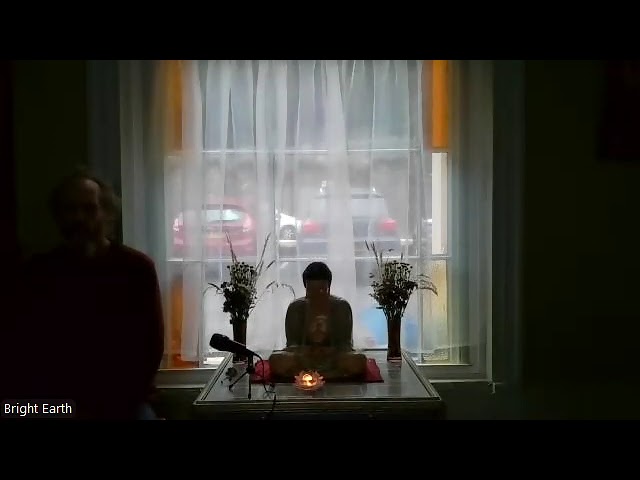
This content was created by Satya Robyn. This content was uploaded by Satya Robyn. This is a YouTube video titled "Morning Practice with Dave - no lotus without mud" (created 2025-10-18) containing an English-language guided Buddhist retreat/morning practice led by Dave with several community participants. The session includes a Dharma glimpse reading (
Chapters
Morning everybody, service at the start of our retreat day.
Um, lots of people online.
Hello.
I don't know who all of you are.
So what we do at the start of service is more people. We read a Dharma glimpse, which is a piece of writing written by a member of our community, not necessarily a minister. So I'm going to start by reading one of those.
This is from the Bright Dawn Book of Dharma Glimpses.
Bright Dawn is an American organization, Buddhist organization.
And this is called Grateful to the Last, and it's written by Shakyu Seishun. Gratitude is the spiritual life. These are the words of my teacher, words I try to live by every day. No matter what the day brings, gratitude is important to foster. It is said that the more we're grateful the more we attract more things to be grateful for. Gratitude is said to be the remedy to guard against greed. Being thankful helps us lessen our attachment to wanting more. We are satisfied just as things are, with nothing lacking. Living in gratitude is a practice, the practice of being free from attachment to desires or wanting more, to flowing freely without pretense or artificiality. To know nothing is lacking. Of course, we will always need things to survive, but gratitude is key to never needing more and more. If we can live a life of gratitude, a life filled with a thankful heart, when we meet the end of our physical karmic existence, we can leave this life with nothing but a thankful mind, a mind that rests in a calm, abiding state of peace. Our last thought is simply thank you.
So we now go into a period of sitting silent meditation. Um, to those of you that haven't done this before, um, there isn't the right way or wrong way. Just sit quietly and calmly. I try to concentrate my breath Um, and as your normal everyday thoughts will inevitably come to you, if you go back to your breath and keep thinking about your breath, that's my little bit of advice. After a few minutes, we'll go into some chanting. We'll be chanting Amitabha.
Ciao!
So, excuse me, we will now recite our refuges and precepts. The refuges are the things we take refuge in, and the more sort of solid, slightly more permanent things. That we can always go to. And then the precepts are our guidelines that we try to live by to the best of our ability. And that's all, just repeat after me. And then after that, Jāme will lead the Bodhisattva vows, which are call and response. And if you don't know them, they're on the top of the second page of the liturgy sheet, Bodhisattva vows. For refuge I go to the Buddha.
For refuge I go to the Buddha.
The one who is awake and full of love.
The one who is awake and full of love.
Namo Buddha.
Namo Buddha.
For refuge I go to the Dharma.
For refuge I go to the Dharma.
All that guides us to wisdom and compassion.
All that guides us to wisdom and compassion.
Namo Damaya. For refuge I go to the Sangha.
For refuge I go to the Sangha.
Those who live in the Buddha's light.
Those who live in the Buddha's light.
Namo Sanghaya.
Namo Sanghaya.
For refuge I go to the Earth.
For refuge I go to the Earth.
The holy ground of awakening.
The holy ground of awakening. Namo Bumyai.
With faith in the Four Refuges, and in light of my human tendencies, I pray that I may become aware when I take life. I pray that I may become aware when I take what it's not freely given—
of when I say that this was really good?
—I pray that may become aware—I'm afraid to try maybe come away—but then fall into sexual misconduct or my falling sex on these contacts! Pray they might be coming here but right now we're going over there...
When I've fallen wrong-speech—or am fully engaged-I prayed if I make them go way out from me because you know how many people will follow your lead for example I so please pray don't give us examples about bad behavior like stealing things etc., okay thank you very much.—Prayed if I made him get more awareness that I may become aware of when I become intoxicated.
Of when I become intoxicated. No blame. No blame. Be kind. Be kind.
Love everything. Love everything.
Innumerable sentient beings, without you, save them all. Exhaustible are the passions, we vow to transform them.
Immeasurable are the Dharma teachings, we vow to master them.
Infinite is the Buddha's way, We bow to portrait completely. Welcome again to our retreat day. As you probably know, the theme is the Earth, which is our fourth refuge which we added quite recently, a few months ago. And later on this morning, if you choose to stay, we'll be having a creative clay workshop and a few talks as well. So we chose clay because it seemed like a perfect medium, as it is literally the Earth.. And we want to try and make something beautiful out of the clay, out of the earth. And what we've decided to make is lotus flowers. And the reason we chose those is because there's a strong connection between lotus flower and Buddhism. There are many images of the Buddha either holding a lotus flower or sitting in a lotus flower even. It is said that the lotus flower represents the Buddha's journey into spiritual enlightenment. With its roots in the muddy and cloudy waters, the lotus flower rises above the water and unfolds into a wonderfully delicate and beautiful creation. There's a saying, no mud, no lotus. This is a way of saying that love and compassion, and ultimately enlightenment, Arise out of suffering as the lotus rises out of the murky, muddy waters. The two things are connected. You can't have one without the other. When a lotus has finished blooming, its petals fall off one by one and return to the dirty waters where they decompose and become part of the mud again at the bottom of the pond. Here the lotus roots are nourished, ready to produce new flowers the following year. Suffering and compassion also go hand in hand. They are interconnected. If we look around at what is going on in the world today, we can see examples of love and compassion rising from suffering everywhere. The flotilla of boats attempted to transport humanitarian aid to the besieged and starving people in Gaza a few weeks ago was organized and carried out by people filled with love and compassion for others in need. People prepared to give up their time, energy, and freedom to help others. This applies to all charitable organizations. When people, animals, or even the planet itself are in need of help, you always find someone willing to step up and offer kindness and support. Suffering can bring out the best in us. It can create solidarity and unity, and it can give us the conditions in which we can start to grow. Recently, there's been a craze spreading across the country for hanging English flags from lampposts. Some people find this intimidating and threatening. Particularly people of colour and people who have settled here from outside the UK. Some people believe there to be a racial and nationalistic motive behind these actions. Whether this is the case or not, many people feel genuinely threatened and uncomfortable. And out of this has arisen a Facebook group called Worcestershire Against Hate, where local people have come together to reassure those that feel threatened that they are not alone and that many English and British people stand with them. And welcome diversity in our country, or county even. It was the suffering of those who felt threatened and intimidated that gave rise to this group and many other similar groups around the country. From what has been seen as hatred by many has given birth to love and support. The analogy of the lotus in the mud can also be applied to our personal struggles as well as these broader political issues. If we can find it within ourselves to face up to and come to terms with our inner suffering, whatever it may be, we are creating better conditions for our own personal flowers to bloom. In the last few years, I've had the misfortune of attending several funerals of various friends of mine. These gatherings are always filled with grief and despair, but somehow I always come away with so much love in my heart, seeing my friends, many of whom I haven't seen for years, all coming together to support one another with true unconditional love. It's such a beautiful sight. I can't help but feel joy amongst all the tears. If we can meet our own suffering with compassion and understanding, we are in a better position to see others with compassion, even those who share different opinions to us. We are taught not to avoid suffering but to confront it, even embrace it. It is a fact of life that cannot be avoided. So we must learn to live with it, not in a depressing negative way, but in a compassionate and caring way. We must nurture our suffering, investigate it, and try to understand its origins. Sometimes it's easy to put on a brave face and deny that we have any problems, but in doing so, we are only burying them deeper where they can continue to affect us subconsciously or rise again at some unexpected time in the future. When we look closely at our personal inner suffering, we often find that it originates from our childhood or even our ancestors, not actually from the present situation we find ourselves in. All these previous events have caused us pain in the past and led to us becoming the people we are today, are the soil or mud in which we grow. Suffering is where our roots are firmly planted. When we experience hardships and suffering, this is an opportunity for us to learn and grow. If we stop avoiding our suffering and acknowledge it, we can transform it into something beautiful, like a lotus flower growing out of the mud. It's not just suffering that influences who we are today. It's the good times and the positive experiences as well. These are equally important, but to become a fully rounded and balanced individual, we need to accept and embrace all aspects of who we are, like appreciating a sad love song or a poem. Sad songs can be beautiful, and they can enrich us and help us blossom into wonderful flowers. And I'm going to end with a little saying which is attributed to the Buddha. I don't know whether they actually said it, but it's, um, as the lotus rises on its stalk, unsoiled by the mud and water, so the wise one speaks of peace and is unstained by the opinions of the world. Namaste. Um, so now we're going to make prostrations, um, whilst chanting Nam-myoho-renge-kyo. Um, after Charming's rung the bell, I'll go to the front. If you haven't done it before, you can copy, or not, if you don't want to.
Alas, people busily engaged in secular matters take no notice of life wearing away day by day, night by night. Like a lamp in the wind, how long can it last? The six realms are vast samsara, there is no fixed abode. Till we are emancipated from the sooner affliction, how can we rest in peace? Should we not be afraid? While we still have strength, let us each hear the Dharma. Let us strive and diligently seek the path to attainment. So before we take questions, first announcements.
Today is our retreat day. We have talks, Mother Ani and Katha share lunch, play workshop, walk, listening circle. And November 16th, 15th, whatever Saturday, 13-ish, next month, there's a continuous chanting day and morning, morning. There's donation bowl The Prose Verse is on the back of the liturgy sheet if you don't know it. Oh no, we bow. We bow. We bow to Satya Robyn. So when Johnny rings the bell, we'll bow once to one side, then the other side, and then there'll be two bells, we'll bow to the entrance.
Back crossing to tidy our seats. Then we take the closing bath.









