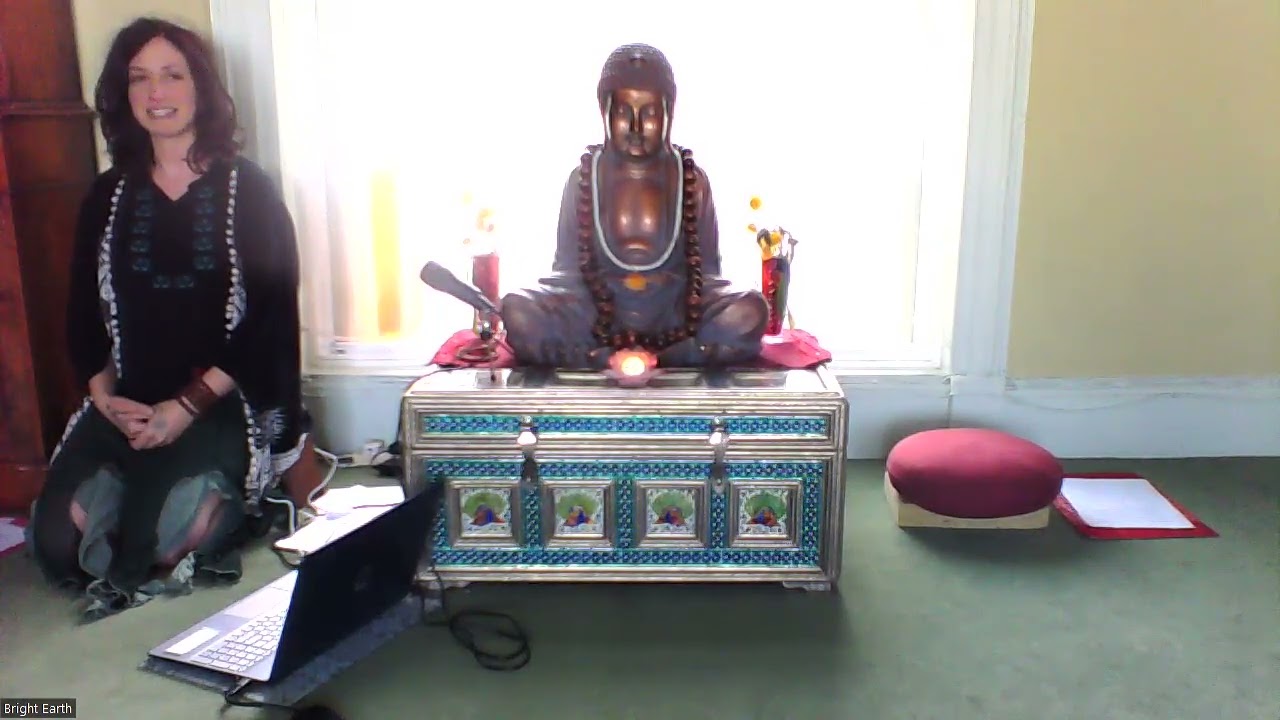
A Buddhist sangha practice session featuring meditation, chanting, and recitation of refuges and precepts. The group discusses activism and writing to imprisoned activists, including Morgan Rowland, drawing on remarks from Chris Packham.
Chapters
Welcome everybody to this small and select summer— yeah, highly exclusive summery evening practice. Satya Robyn and Casper, who normally hold the practice, are away. Yeah, so we'll begin with a Dharma glimpse by Matt, who's one of our sangha members. So a Dharma glimpse is a moment of seeing reality, of seeing truth, of insight that can occur at any moment throughout our day. And we invite everybody, members from the sangha, if they have a kind of aha, insightful moment—
hi, welcome—
to write it down. It doesn't have to be amazingly written, it doesn't have to be a moment of pure everlasting awakening. It is the Dharma, the truth, which is available to us at any point. So I've been in London for the past few days after a brief stint stewarding Extinction Rebellion's wonderful 20K Strong biodiversity march. I joined Just Stop Oil for the start of its new campaign of disruptive slow marches on the streets of London. Knowing how much can be stirred up by taking part in these gatherings, I thought I might have something or other to write about on the train home. Here I am on the train, though, feeling decidedly empty-handed, except for the sense that it might be just as fruitful to write about not having any moment of insight to share. As having one. Maybe I could start with how afraid and exhausted I felt as my first slow march approached. But what I'd like to write about isn't so much the fear and exhaustion itself, as the people I met and heard from these past few days, whose passion and insight and vulnerability touched me, grounded me, and re-motivated me. The first encounter was with the English naturalist Chris Packham. Chris spoke of his anger, his fear, and most of all, of his sense of failure as a conservation biologist. He spoke of how much has been lost on his generation's watch. Not just in terms of the big stats, but as an emptying out which he can see and touch for himself. Chris spoke of how he reads the full texts of every IPCC report as soon as they come out to fuel his fear, as he puts it, and to refocus his determination to channel that anger and fear into something better by acting on it, including in this case by joining us in Just Stop Oil's slow marching campaign. The second encounter happened in a room full of about 140 people on Sunday as we prepared to set out on 7 simultaneous slow marches around London this morning. Most of those in the room were in their early 20s. As we were being briefed, by chance the speaker got a call from Morgan Rowland phoning from prison. Morgan and his friend Marcus have just begun 3-year prison sentences for their much higher stakes disruptive action on Dartford Crossing. The speaker told Morgan who he was standing in a room with and wondered if Morgan had a message he'd like to share with us. By the time he finished relaying Morgan's reply, repeating it to us phrase by phrase, along with the shouting and clapping and foot stamping and laughing Most of the room seemed to be in tears. I was anyway, which made it hard to see. I can't do Morgan's words justice from memory, but here's the gist of what he said. When we step out of our comfort zones, when we take on difficulty or stress in service to something greater than ourselves. What we act on behalf of acts in turn through us. We become channels for that greater life, and we find a strength acting through us that we haven't known before. This is grace. The beauty and power of the living world opens up within us a reservoir of courage, of stamina, of compassion, of endurance greater than our— oh, there's a second page which I don't have. Normally they're already on one. Hold that. This is grace. The beauty and power of the living world opens up within us a reservoir of courage, of stamina, of compassion, of endurance greater than our own, once we make the choice to step up in service to that reality. This is grace, and everything Joanna Macy says is true. The third encounter happened in that same room. A young woman stood up, spoke about not needing to feel brave, not needing to feel inspired to step up. Stepping up just as we are— those were her words— was all that was needed. We are more than enough just as we are, and coming as we are is all that matters. So, a borrowed glimpse this week, cobbled together from three other voices. As I said, I traveled to London feeling tired and afraid and almost didn't go through with it, which would have been fine. The Extinction Rebellion gathering down the road, where so many of my friends were at that moment making beautiful things happen. We're certainly offering an attractive alternative to deliberately inciting drivers' anger and frustration on Kennington Road. In the event, these three fragile humans helped me to go through with what I come to do, and for that I'm grateful to all three of them, as I am to my XR friends for the wonderful work they're doing. But that's another story. I do have one small glimpse of my own to add. Dharma isn't just about feeling, is it? It's surely a doing word as much as a being word. Anyway, I remembered there's something we can do for Morgan, Marcus, and the others in prison. We can write to them, and if we don't feel we have anything much to say ourselves, maybe we tell them about the living world outside their walls. The returning swallows, spring's first ladybird, small and black with a single bright red spot on each of its wings. The rats that seem to be doing remarkably well here on our questionable British habit of feeding the birds. Anything will do. All that matters really is that we let them know that we see what they're doing and remember they're there, and that they know they have our abiding thanks. Maybe a silly weekly poem, who knows. Anyway, a small group of us here already meet every Tuesday lunchtime to send cards to those who find themselves in prison for stepping up. So my dharma glimpse this week is to write to Morgan and Marcus every week until they're out of prison and find another way each week to say thanks. These words are a spell to smuggle in the blackbird singing in yourself. Namah Amida Butsu. So we're going to move into a period of meditation now. So maybe just taking a moment to shuffle about, making any little last adjustments that you want to make to your posture, your position, that might make you a bit more comfortable. Just noticing what the body feels like in this space, in this room, noticing the parts of the body that are in contact with the floor. Cushion, chair, the parts of the body that are open to the air. Allowing experience to flow to you and through you, whether that's through sounds or through the breath. We're going to move into a period of chanting, and the chant we're going to be doing is Om Amideva Hare. Om Amideva Hare. So if you need to see that written down, you're not familiar with it, then it's written on the little pieces of paper which will be, um, on your side, at your side, and, um, uh, it's 3 up from the bottom. And one of the ways you can think about— or yeah, conceive what we're doing when we're chanting this is we're calling out to the limitless source of love and compassion and presence that is ever available and always reaching out to us.
Om Mami Dei Wari. Om Mami Dei Wari.
Om Mami Dei Wa.
Free.
Oh, Mami, they worry. Oh, Mami, they worry.
Oh, Mami, they worry.
3.
Om Nami Deva Hari. Om Nami Deva Hari.
Om Nami Deva Om Nami Devi, free.
Om Nami Devi, Om Nami Devi. Om Mani Deva Sri Ram. Om Mani Deva Sri Ram. Om Mani Deva Sri Ram.
Om Mani Deva Sri.
Om Mani Deva Sri. Om Nami Deva Hari.
Om Nami Deva Hari.
Om Nami Deva Hari. Omami ne warri.
Omami ne warri.
Omami ne warri. Om Ami Deva Hari.
Om Ami Deva Hari.
Om Ami Deva Hari. Om Ami Ne Wa Rie.
Om Ami Ne Wa Rie.
Om Ami Ne Wa Rie. Om Amidevare.
Om Amidevare.
Om Amidevare. Om Ami Deva Hari.
Om Ami Deva Hri.
Omami de warri. Omami de warri.
Omami de warri.
Oh, ma mi ne wa ri. Oh, ma mi ne wa ri.
Oh, ma mi te wa ri.
So we're now going to recite the refuges and precepts, which are on the little piece of paper as well. And these are ideals that Buddhists all over the world aim to move towards, in the knowledge that in subtle ways and in not so subtle ways, we fall short of these ideals all the time. For refuge I go to the Buddha.
For refuge I go to the Buddha.
The one who is awake and full of love.
The one who is awake and full of love.
Namo Buddha.
Namo Buddha.
For refuge I go to the Dharma.
For refuge I go to the Dharma.
All that guides us to wisdom and compassion.
All that guides us to wisdom and compassion.
Namo Dharmaya.
Namo Dharmaya.
For refuge I go to the Sangha.
For refuge I go to the Sangha.
Those who live in the Buddha's light.
Those who live in the Buddha's light.
Namo Sangha.
Namo Sangha.
With faith in the Three Jewels.
With faith in the Three Jewels—
I pray that I may not take life. With faith in the Three Jewels—I pray that I may not steal. —with faith in the Three Jewels—with faith in the Three Jewels—I pray that I may not fall into sexual misconduct. Pray that time they're not fallen to sexual misconduct. With faith in the Three Jewels—
With faith in the Three Jewels—
I pray that I may avoid wrong speech.
I pray that I may avoid false speech.
With faith in the Three Jewels—
With faith in the Three Jewels—
I pray that I might avoid intoxication.
I pray that I may avoid intoxication. No blame!
Be kind! Be calm! Love everything.
Love everything.
Innumerable are sentient beings.
We vow to save them all. Exhaustible are deluded passions. We vow to transform them all. Immeasurable are the Dharma teachings. We vow to master them all.
Infinite is the Buddha's way.
We vow to fulfill it completely.
So about once a week, maybe a bit more frequently than that, in my email inbox I get a short little section of a Dharma teaching. So it'd be something like something from the Dharma Pada or the Pāli Canon, something like that. And most of the time I don't really connect with I'm not always in agreement exactly with what it says. Quite often I find them a bit dry or a bit idealistic, and sometimes they come through and they really resonate with me. And one came through a few weeks ago, and the image of it just really struck me. And in it, it was saying why the Buddha, this historical Buddha, was such a good teacher. And they said the Buddha teaches their sangha directly in person, and the Buddha shows the palms of his hands. He shows the palms of their hands. And in the kind of small print, it said the translation of this means that the Buddha had no hidden teachings. And I thought that was quite interesting because, you know, it suggests lots of different things to me. One being that the Buddha didn't achieve perfect enlightenment and then come back and give little tidbits to people, like little bits of Dharma teachings, but kept, kept the secret of perfect awakening for themselves. And they didn't only teach to those who they thought were really already quite spiritually advanced, or who were the elite, or who were particularly privileged. I mean, of course, because of the society— like, society structure in India at that time Certainly there would have been some just built-in inequality in terms of who had more readily access, more ready access to his teachings than others, but still showed the palms of his hands. He didn't have secret teachings or hidden teachings. So that's the kind of most obvious way of thinking about that. That showing the palm of her hands. But I think what really also struck me was the actual embodied movement of showing the palms of her hands. So if I, if I try that out, if I imagine what happens in that action of showing the palms of our hands, what happens is my torso opens up, my heart space opens up, my shoulders roll back a bit, my arms open up. And maybe this suggests something about how the Buddha taught how the Buddha held themself with this kind of openness, openness of heart, openness of body, and the receptivity that comes with that, able to receive other people, able to receive the people around him who came for teachings, and also able to really encounter the world with a real openness, a lack of defensiveness, and also able to give, to give open-handedly, open-heartedly. So I felt that in that very short two-line little bit of Dharma teaching that I read there was, was quite a powerful image, and one that conveyed quite a few different aspects about the Buddha. The importance of equality, of not having hidden teachings or only teaching to some people and not others, meaning that everybody has the potential for enlightenment, everyone has the potential to wake up. And to access the kind of things that might help them to move in that kind of direction. And also conveying, um, in a felt sense kind of way, how an awakened person lives out in the world with that openness, with that open-heartedness, with that ability to to receive and to give. So maybe there's a little invitation in this rambling talk that I'm giving at the moment to see in, in moments, maybe in a moment when you feel safe enough to give it a go, how it is to encounter the world with your palms open, and to maybe see if that brings you even a little bit more close to the Buddha. Nam-myoho-renge-kyo.
Another very embodied way of moving towards the purification of taking refuge in something that is bigger than ourselves.
With gratitude, we offer this incense to all Buddhas and bodhisattvas throughout space and time. May these fragrant deserters, reflecting our careful efforts, our wholehearted awareness, and the fruits of understanding, slowly light May we and all beings be companions of Buddhas and Bodhisattvas. May we awaken from forgetfulness and realize the pure land.
Sorry, standing up. Sorry, I left out that crucial detail. And we bow to each other. So, um, I bow to Jerome first, and you see, we'll bow to each other, and then turn around and we bow the other way. And then we bow to the Buddha and the main shrine. We tidy our seats and bow to our seats.
And we end with the closing verse, which is on the piece of paper, and it starts with blessed.
Blessed by Amitabha's light, may we care for all living things and the whole Earth. Nam-myoho-renge-kyo.
Thank you. Interesting, the palms of the heart in the Tai Chi book. So when you're doing all that, you're opening up Help your heart.
Like I say, the heart meridian runs through here, doesn't it?
Yeah, and it's in yoga as well, I think. But also, this side of the hands in body language is control. Okay, so that's passive, like giving up.
Yeah, yeah, it's quite interesting. I'll stop the recording. We don't









