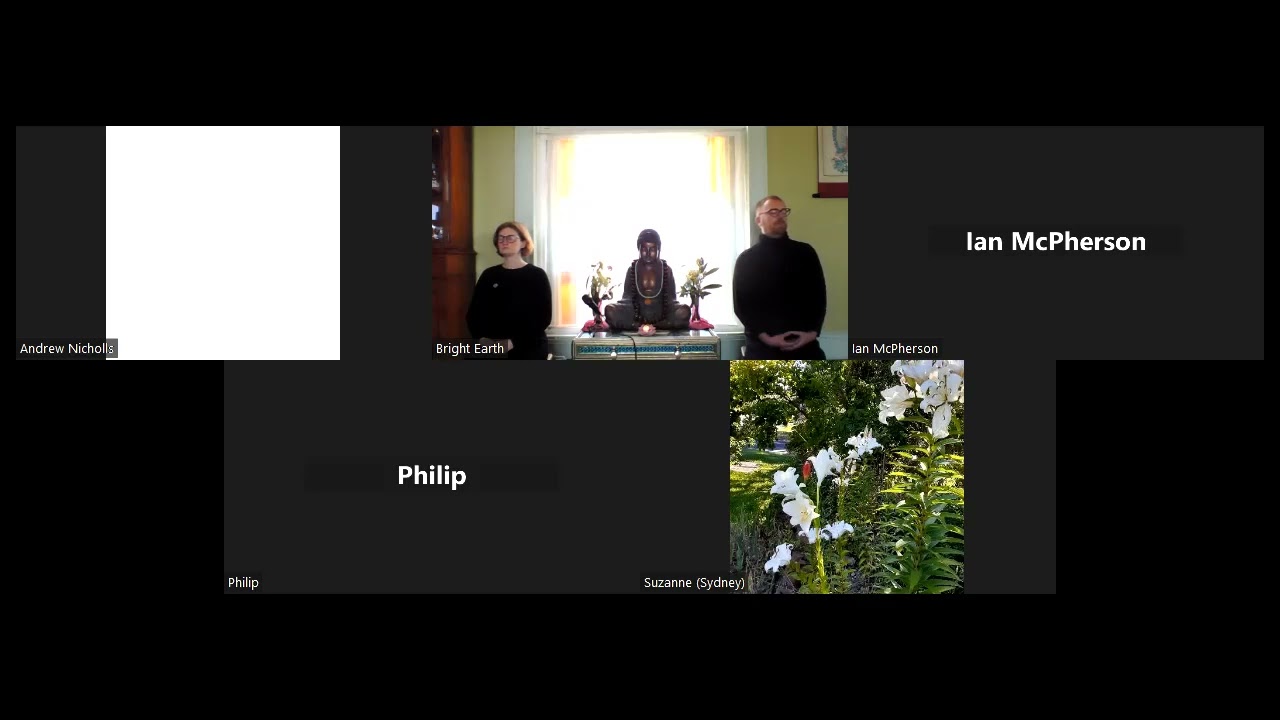
Satya Robyn leads a Buddhist group practice session with chanting and guided silence. Karmadeva shares a personal reflection on grief and finding home after his ex-wife's death, while the group explores Pure Land practice basics and the Nembutsu.
Chapters
Morning everybody, welcome on this very chilly morning, and welcome to Ian and Karmadeva joining us on Zoom. And Karmadeva, hopefully you're prepared with your Dharma glimpse. Ready to read out for us. Wonderful. So I will unmute you, and without further ado, over to you. Let me just see if I can—
you're a bit quiet at the moment.
Say something again.
Uh, yeah, hello.
Perfect.
Thank you. Okay, so, um, recently I've noticed I'm spending more time at home. Uh, over the past few years, probably around 7 years, I've spent much of my time doing things— go to the gym, train a little, and then spend hours just sitting by the pool. Attending meditation at lots of different venues was another of my activities. Overtime at work, spending 2 or 3 nights a week working on our helpline. Whilst the above are all enjoyable or worthwhile, they don't need to be done every night. There was no time to just sit and relax at home. My home didn't really have a homely feel to it. Most rooms nearly bare except for essentials, and that would include a TV, although I don't watch many TV programmes. Lately I tend to be home more. I still do all of those activities but not as long spent doing them. My ex-wife passed away 2 years ago. Although we'd been separated for some time, we remained friends. When you've known a person all your adult life, it's hard not to see them. And of course, we had children and grandchildren to consider. Before she died, she spent 2 years having treatments. A challenging time for her and our children. 3 years before my ex-wife became unwell, my daughter and granddaughter, who both lived with me for many years, moved out. My daughter had met someone and decided to share her life with them. I was happy for her. I'd never lived alone. I lived with my mother and stepfather. Went straight to my wife and then I lived with my adult daughter. Now I realize the activities were my way of coping. Firstly being alone, then the helplessness of my ex-wife's illness. The activities in a way were my clinging. I missed the company of my daughter and granddaughter And although happy for them and their new life, I was distressed at being alone. So I looked for things that would take up my time. This would allow me to move on. When my wife became unwell, I hid behind the activities. I'm finding my new life is okay. I'm happy to sit alone and enjoy reflecting on my day. Pottering around doing bits and pieces in my home. I've actually purchased a number of items, uh, put up photos, etc., and it feels like a home. I have a bedroom for my grandkids. It has their drawings on the wall and is decorated for them. I cook more and even have my children around for Sunday lunch. Babysitting with my 17-year-old granddaughter. She's their big sister and is the one who lived with me. So it's all different now. Although my life has changed, it's still full of beautiful people and lots to do and lots not to do. Learn to slow down, to relax and enjoy my own company sometimes. Most of all, I've learned to be grateful for what I have. Do not cling to the past and concentrate on today. Namaste.
Namaste. Thank you so much, Karma Deva. Really lovely to hear your voice and about your life. And welcome to Philip and Suzanne who've also joined us. So we'll now move into some silence together. In the silence, you might want to just allow the Nembutsu to follow your breath. Namo Amida Butsu. Namo Amida Butsu. As you breathe in and out, when your mind becomes distracted Just notice it. Bow to the thought or the feeling or the sensation and return to your breath. Namamitabhu.
Amitabha. Amitabha. Amitabha. Amitabha. Amitabha. Amitabha. Amitabha. Amitabha. Amitabha. Amitabha. Amitabha. Amitabha. Amitabha. Amitabha. Amitabha. Amitabha. Amitabha. Amitabha. Amitabha. Amitabha. Amitabha. Amitabha. Amitabha. Amitabha. Amitabha. Amitabha. Amitabha. Amitabha. Amitabha. Amitabha. Amitabha. Amitabha. Amitabha. Amitabha. Amitabha. Amitabha. Amitabha. Amitabha. Amitabha. Amitabha.
For refuge I go to the Buddha. For refuge I go to the Buddha. The one who is awake and full of love. The one who is awake and full of love. Namo Buddha. For refuge I go to the Dharma. For refuge I go to the Dharma. All that guides us to wisdom and compassion. All that guides us to wisdom and compassion. Namo Dharmaya. Namo Dharmaya. For refuge I go to the Sangha. For refuge I go to the Sangha. Those who live in the Buddha's light. Those who live in the Buddha's light. Namo Sanghaya. Namo Sanghaya! With faith in the Three Jewels— I pray that I may not take life. —with faith in the Three Jewels—I pray that I may not steal. —With faith in the Three Jewels— I pray that I may not fall into sexual misconduct. With faith in the Three Jewels— With faith in the three jewels I pray that time may avoid wrong speech. Faith in the 3 Jews? In this region I pray that time may avoid intoxication. Intoxication! No blame! Be kind! Love everything! Love everything!
Innumerable are sentient beings, we vow to save them all. Inexhaustible are deluded passions, we vow to transform them all. Immeasurable are the Dharma teachings, We bow to Master Nam Ho. Infinite is the Buddha's way. We vow to follow faithfully.
So this morning I wanted to, uh, go back to basics, which I think is a helpful thing, certainly for me, to do from time to time and to just be curious about why we are here and what we are doing. And that will be slightly different for everyone present, but what is the, what is the project of Buddhism? What is the project of spirituality, of living a spiritual life? And as Pure Land Buddhists, we only need two words to sum that up. Which is Namo— 3 words. Did anyone think that before me? Okay, that's only one word. That's what I was thinking of, Namo Amitabha. 3 words, back to basics, counting. Namo Amida Butsu. And I said two, and this isn't just to get out of making a mistake. I said two because there are two parts to that equation, to that, uh, code, to that mantra, to that phrase which is at the heart of everything we do here in the temple. When we used to do long continuous chanting days here in this shrine room, the longest we did was 24 hours of voice continuing. People would come and go, but the chant would continue. We had some bits of paper that I'd hand-drawn more than 10 years ago now, and they lasted for a good 8 years. And they said, 'Nam-myoho-renge-kyo.' And under 'Nam-myoho-renge-kyo,' I wrote 'little me.' And that's one way of looking at the word 'Nam-myoho-renge-kyo.' It's little me calling out to the Buddha. Amida-bu, Amida Buddha. And that's all we need to do. That's all we need to know. It's all we need to practice. Is just saying the Nembutsu, Namo Amida Butsu, but with the intention of asking for help, opening ourselves up, leaning in. That allows us to begin to realize that Amida is already there. Amida has been holding us up all along. And we, we do lots of different things in this shrine room and in this temple, and we say lots of different things. I've just— I was in the library this morning, like the temple library, looking for a book, just kind of scanning the shelves of Buddhist texts, never mind all the other books in there. And Casper's office is also full of books in my our flat is full of books. There are lots of things that lots of people have said about this, and it's really helpful for many of us to explore that, to sign up for book groups, have a look on the website, some coming up soon, to come at this project from lots of different angles. We can look at precepts, we can look at the sutras. We can be curious about different ways of understanding different bits of theology, but none of that is necessary. None of that is necessary if we want to find peace, if we want to trust that we are loved just as we are. We just need to say Nam-myoho-renge-kyo. And whether we can feel anything changing or not, transformation will be underway. Sometimes transformation is sneaky. It kind of happens without us really being aware, and it's only when we look back a month or 6 months or a year that we can see the influence of the Buddha on our lives. So I just have a little bit of emotion arising. Just the— it's, it's the emotion of gratitude. It's the emotion of, um, feeling so lucky to have found the ground under my feet, having lovely people to practice with. And this morning after practice, we're going to have the first meeting for, uh, it's actually the second meeting. The first is the first big meeting with all the trainees.
It definitely is.
There are a few trainings at the last It feels significant, and it's very important that we are all in harmony as a community this morning. Thank you, Kate. And that we will be in harmony, and we will also be in disharmony, And that is a part of the, the flawed nature of sangha, of human beings. But luckily we are surrounded by something that is much more reliable, and that's what we rely on. That's what we can lean into. That's what we build a relationship gradually over the years. So, Namu Amida Butsu, whenever we say it, whenever we hear it, it's just bringing us back to that basic fact that we are loved as we are, that there is wisdom and compassion in the universe and deep inside us. And that all of these things that pass away, all of these things that are impermanent, are not real. But what's real is something much deeper, and we can relax and trust that. Namomi tobi.
Dedicate the merits of this incense offering to all Buddhas and Bodhisattvas throughout space and time. May it be as fragrant as earthness reflecting our careful efforts, our wholehearted awareness, and the fruits of understanding slowly ripening. May we and all beings be companions of Buddha and Bodhisattvas. May we awaken from forgetfulness and realize our true home.
For announcements, do look at the book groups on the website if you're interested in signing up. And tomorrow night at 7:30, Angie will be running kirtan in this room.
Welcome to join. Bless us.
May we care for all living things and the holy earth.









