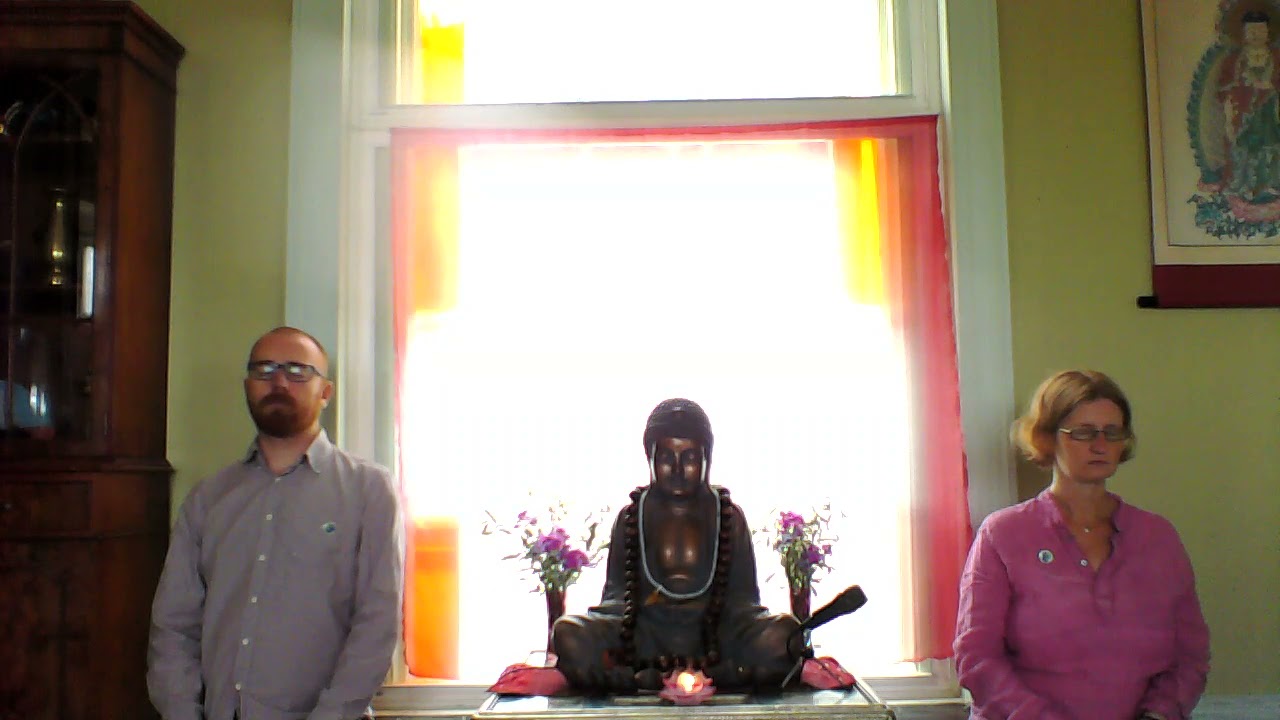
Satya Robyn leads a Buddhist practice session with in-person and remote participants. The group chants Amitābha, recites refuges and bodhisattva vows, and practices prostrations while Satya reflects on climate and feeling closer to the earth.
Chapters
Welcome everybody.
Nobody's joining us on Zoom at the moment, but some people might pop up as we go along. I wonder if the change in time might have thrown some people as well.
Possibly.
Half an hour earlier, we'll see. Anyway, welcome to the inside part of practice, which Satya Robyn will be leading.
Namaste. It's very strange to be here with real life people. We've had real life people from the house, but this is the first time since last March that we've had Saturday practice in the shrine room. So, yeah, really good to see you all. So what am I going to talk to you about this morning? I think what's been on my mind this week is is the climate crisis, that whenever we have very hot weather now, it's always bittersweet for me, it's tinged with that knowledge that this kind of extreme weather will become more frequent and more extreme, and I've been getting to know the weather a lot more this year. I've been doing— most of you know I've been doing a daily vigil in town for the Earth and sitting outside for an hour, whatever the weather. One of the things that's been a real gift about that offering is having more faith in myself as being able to be in different weathers. I've always been someone who's been quite a fair weather, out in nature person, like, you know, if it's drizzling a little bit then I wouldn't go out for a walk, or if it was too cold or too hot, and sitting for an hour in different weathers, in the snow, in the hail, in the baking heat, has shown me that my body actually can manage more than I thought. And that the worst bit of being in extreme weather is usually my thoughts about it. What I noticed is that if it was very cold, the thought, "Oh, I might get so cold that I'm going to start shivering, and then I'll go into some kind of, I don't know, frozen mess," was actually more troubling than the actual experience of the cold. And that I noticed that thought, that kind of little panic, and I let it pass, and then actually I kind of warmed up again. Bodies are quite quite good really at doing that, and that's been really nice because I can take that with me everywhere. I can take that with me when we do our morning practice on a Saturday and quite enjoy the damp drizzle, quite enjoy coming into closer contact with the earth. And yeah, and as I do that these days, the thought of how the weather will be over the next few decades is never far from my mind. I think the other advantage of coming into contact with the weather and with the outside has been feeling closer to to the earth, feeling less insulated from it. It's actually quite nice. We usually have this door open, but because of the getting a through breeze for the virus, we've got the— this fire escape open as well. It's actually quite nice to have more of the outside inside, and I feel like we've all brought the outside in with us as well. That we can really appreciate warm houses and shelter and electric blankets and all those things that we're very lucky to have, but we can also have an experience or a taste of what it's like to just kind of snuggle up a little bit closer to the earth and open our senses to the complexity and the unexpectedness and the beauty of what the earth offers us. Whenever I walk around the garden, there's always one or two gifts that, that just sort of step forwards. This morning there was a wren as we walked behind the bamboo. The amazing roses that are in the gravel garden. And then alongside the gifts, there's also the things that are not so easy, the seeing how many weeds we've got at the moment, and knowing how busy I am, and how some of those weeds will probably remain for some time. And that's what Buddhism is inviting us to do, is to get closer to the world, to have a less filtered experience of being alive, to open ourselves up to the messages of the world and the offerings the world. And often we spend our time preoccupied thinking about how we can make ourselves comfortable or get more of something or keep something away. Buddhism encourages us to open our eyes and to wake up to what's real, what's here right now. These beautiful flowers on the shrine, the flickering candles, our company. So as we move into silence together, you can either just pay attention to your breath as it goes in and out without changing it, or you can just let the world be around you and notice it. So notice the noises from the street, notice Notice the air as it comes through and keep returning to the world. And then after some time, we will start chanting together, and we'll chant the word Amitābha. Amitābha is the Buddha of infinite light, the Buddha that we're in relationship with here in this temple. And if this is your first time chanting with other people, hope you enjoy it. Don't worry about whether you're in tune or not. It's always good to have at least one person who's singing out of tune because that makes everyone else feel better. So you might be that person. And it can feel strange to start with. Some people feel self-conscious. My encouragement is to just kind of stay with it, just notice the self-consciousness, and you'll notice that it just kind of wears away after a while. Either today or another day. So just keep, uh, keep doing it. Namaste. Amitabha.
Amitabha. Amitabha. Amitabha. Amitabha. Amitabha. Amitabha. Amitabha. Amitabha. Amitabha. Amitabha. Amitabha. Amitabha. Amitabha. Amitabha. Amitabha. Amitabha. Amitabha. Amitabha. Amitabha. Amitabha. Amitabha. Amitabha. Amitabha. Amitabha. Amitabha. Amitabha. Amitabha. Amitabha. Amitabha. Amitabha. Amitabha. Amitabha. Amitabha. Amitabha. Amitabha. Amitabha. Amitabha. Amitabha. Amitabha. Amitabha. Amitabha. Amitabha. Amitabha. Amitabha. Amitabha. Amitabha. Amitabha. Amitabha. Amitabha. Amitabha.
We'll now recite the refuges, the precepts, and the bodhisattva vows together. Please repeat after me. For refuge I go to the Buddha.
For refuge I go to the Buddha.
Namo Buddha.
Namo Buddha.
For refuge I go to the Dharma.
For refuge I go to the Dharma.
Namo Dharmaya.
Namo Amitabha!
For refuge I go to the Sangha. Namo Sanghaya! With faith in the Three Jewels— I pray that I may not take life. With faith in the Three Jewels— I pray that I may not steal. With faith in the Three Jewels— With faith in the three jewels I pray that I may not fall into sexual misconduct.
That's right! May not fall into sexual misconduct.
With faith in the 3 Jews— Faithful to Jesus—I pray that I may not fall into wrong speech. I praise our Lord for its own sake—with faith in the Three Jewels, we believe in the Three Jewels—I pray that I may avoid intoxication.
I pray that I may avoid intoxication.
Innumerable life-sentient beings, we vow to save them all.
Exhaustible ardent compassion, we vow to transform them all. Immeasurable are the Dharma teachings. We vow to master them all.
Infinity is the Buddha's way. We vow to forfeit completely.
So in a minute we'll stand up and make prostrations to the Buddha. So just kind of make sure you've got a bit of floor in front of you and that you're pointing towards the Buddha. And I might just show you how we do it because it's hard to see on Zoom and you're hearing me all live now. So the words are Nam-myoho-renge-kyo, and then it's Nam-myoho-renge-kyo Ameeda boo. So kind of head, mouth, and heart. And then Nam-myoho-renge-kyo, you go down like that. And then when just Jaume is saying Nam-myoho-renge-kyo, we lift our hands above our heads like that, which is to symbolize that the Buddha is higher than us. And then Nam-myoho-renge-kyo, Nam-myoho-renge-kyo. And then over again, 3 times. I'll be at the front, so you should be able to copy me anyway. And then stand to— we always stand at the end so we can bow to each other to thank each other for practicing. With each other. Sorry, no, because whenever I do it, you tell me I've got it wrong.
We're doing different now. So I will always bow to whoever's here, you will always bow to whoever's there. I didn't know that. Well, you hear when we talk to the bags.
I wasn't listening. That's what we always do, so we've just formalised that.
This is the point at which you have a little domestic So we're bowing, we're bowing in pairs, first to one side and then to the other side. So Satya and I will always bow outwards, so if— Jermay will know that he's going to bow to me. Ash, you'll know that you're bowing to Satya. So Sam and Philip will bow to each other. What about Taylor? Taylor? She'll bow to Sam. No, Satya, you don't bow to anybody the first time, and then Dhyāma will turn to you and you'll bow to each other.
But he could bow to the Buddha if he wanted to.
He could do, but we're going to do that all together afterwards. So you can't bow to the Buddha too many times. That's how it would work.
So is everybody clear? And then we do bow to the Buddha, bow to our seats and tidy our seats. And then if you're okay to stop the recording, I'll do the announcements. Oh no, just— yeah, so then we finish with the closing verse, which we haven't printed out yet, so if you don't know it, you'll just have to listen. May we care for all living things and the whole earth. And then Kasper will stop the recording so I can do the announcement.









