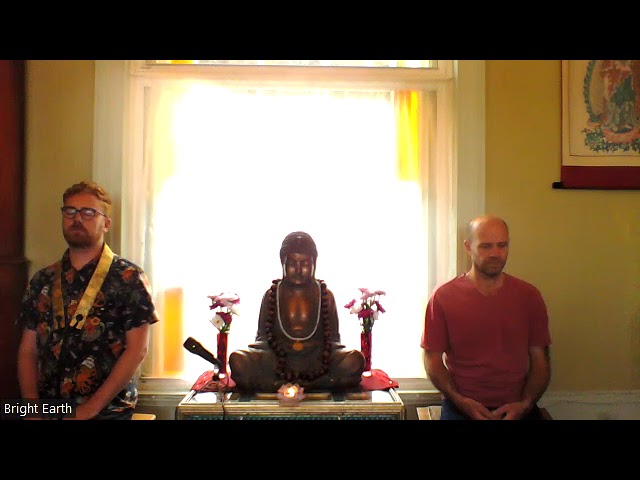
A Buddhist shrine-room practice session led by Satya Robyn with chanting, refuge vows, and guided meditation. A speaker reflects on therapy and a restorative walk in the Malvern Hills, then shares what a Calvin and Hobbes documentary taught about tenderness and vulnerability.
Chapters
Welcome. Quiet in the shrine room this evening. Everybody was here on Saturday. It was— there wasn't an empty seat, I don't think. So maybe it's just a rebalancing. Nice to see Beth and Philip joining us on Zoom.
Welcome.
And we'll begin with a Dharma glimpse from Jomay. Nam-myoho-renge-kyo.
Nam-myoho-renge-kyo.
Thank you.
This is called Pause. This week I was given an opportunity to pause. My regular schedule gave way to a cascade of conditions which meant that I couldn't fulfill some of my usual duties, and the flow of my ongoing therapy sessions came to a grinding halt as my internal family parts decided that they needed to build up some more trust before they allowed any more unburdening healing to happen, which I've learned to take as being an indispensable function of the overall process, but which still left me with a sense of dissatisfaction because I didn't feel like I was riding forward in the way that I've come to associate with success. In other words, I had to stop. This, along with some other unavoidable factors, meant that a space opened up for me, which I quickly proceeded to fill with worry and fear about what I should be doing, what others might think of my perceived failure, and what I could do to compensate. At this point, I managed to catch myself in the process and remembered a promise that I had made to my tired parts in therapy. That I would take some more time out than usual and do something nice for myself. As it happened, a friend in the community was going for a long walk, and so I joined them and spent some quality time in nature, absorbing the energy of the land and connecting with the nourishing sights and sounds of the Malvern Hills. I recognized this as progress of sorts. At one time, I might not have felt the potential for healing and reflection in the situation. I may just have slogged onwards relentlessly and then paid a higher price somewhere down the line. Unboundaried and compulsive perseverance is written into our social contracts in small print. It serves the system of haves and have-nots and the agendas of the controlling elite. In some ways, we are expected to keep going no matter what, to keep up with the pace of life even if it's obviously detrimental to our health and well-being and the best interests of others as well. I feel this is a sort of collective defense against our accumulated wounding. If we just don't stop, we won't have to face the pain. But pain is not the only thing that arises in these fertile spaces. Just the act of relaxing the grip of our white-knuckled fingers on the steering wheel can bring great relief, peace, and spiritual perspective. My day off became two days off. And I now feel refreshed and revitalized. Once again, I've been shown that I do not always know what is best for me, that my human strategies have weak points and blind spots, and that there is another power operating in my life that shows me a different way if I can just keep the door open to it. Namah Amida Butsu.
Welcome.
Just going into meditation. Take a moment to individually, individually to center yourself, to physically center yourself. That's the word I was looking for, physically, if that's necessary. If your mind's particularly busy Perhaps counting breaths, each in-breath and out-breath. One in-breath and out-breath.
Two.
If you get to five, coming back to one again. If you get distracted or lost in thought, starting from one again. But maybe if you feel a little bit more settled, it's possible to just notice the breath without any labeling, entering and leaving Not changing it, just observing.
Me ta ta. Me ta ta. Me ta ta. Me ta ba.
Me ta ba.
Me ta ba.
Amitabh. Amitabh. Me ta ba. Ah, me ta ba. Ah, me ta ba. Amitabh. Amitabh. Amitabh. Amitabh. Amitabh. Amitabh. Amitabh. Me ta ba. A me ta ba. A me ta ba.
For refuge I go to the Buddha. For refuge I go to the Buddha. The one who is awake and full of love.
The one who is awake and full of love.
Namo Buddhaia.
Namo Buddhaia.
For refuge I go to the Dharma. For refuge I go to the Dharma. All that guides us to wisdom and compassion. All that guides us to wisdom and compassion. Namo Dharmaya.
Namo Dharmaya.
For refuge I go to the Sangha. For refuge I go to the Sangha. Those who live in the Buddha's light. Those who live in the Buddha's light. Namo Sanghaya.
Namo Sanghaya.
With faith in the Three Jewels— —and in light of my human tendencies— I pray that I may become aware— —of when I take life. I pray that I may become aware— —of when I take what is not freely given. Of when I take what is not freely given.' 'I pray that I may become aware—' 'Of when I fall into sexual misconduct—' 'I pray that I may become aware—' 'Of when I fall into wrong speech—' 'I pray that I may become aware—' of when I become intoxicated. Of when I become intoxicated. No blame. No blame. Be kind. Be kind. Love everything.
Love everything.
Innumerable sentient beings, we vow to save them all.
Inexhaustible are the religious passions.
We vow to transform them all.
Immeasurable are the Dharma teachings.
We vow to fomaster them all.
Infinite is the Buddha's way.
We vow to fulfill it completely. Namami Taboo. I had some free time. Earlier today, and I started watching a documentary about Calvin and Hobbes, not the philosophers but the American comic strip. And, um, I don't even— I've hardly even seen any of the comic strip. I think Calvin is a little boy and Hobbes is the tiger. Correct me if I'm wrong, but, um, It was really, it was really affecting, the documentary. And it, it wasn't really a documentary about Calvin and Hobbes. It was a documentary about people who liked Calvin and Hobbes, made by a filmmaker who liked Calvin and Hobbes, who traveled to build, uh, Waterson's hometown, and looked in the newspaper archives of when the first strips appeared, and spoke to other comic book— not comic book, but comic, like, you know, like you get in the back of the Sunday papers, comic strip artists who'd been inspired by this work, and saw some of the original drawings in a museum. He described how his bedroom wall was full of all the strips that he'd cut out from the papers. And what struck me about it, or what was moving about it, was the sense of care that came across, that these people, particularly other comic book artists had been inspired to do a really good job because they'd seen someone else doing a really good job. They'd seen somebody caring about not just good line work and good colors and a funny punchline at the end of 4 panels, but the sense of care for humanity really that came through that inspired them to sort of humanize their own stories and also inspired them to up their game with their artwork and the words they used. People don't really know much about the artist. He shied away from publicity and had a very private life. And maybe that makes it easier to project really good things onto somebody if you don't know anything about them. But the work clearly was very inspiring to all of these people, um, and the way that they talked about it gave me a real sense of, of the care that he must have put into the work. Wherever that came from, I don't know. I don't know anything about his personal life or what inspired him to create these characters and put them on the page in this way. But I felt tender while I— and like, it wasn't like really a particularly well-made documentary. It was just a load of talking heads, you know, clearly. Had no budget, and this guy was, you know, 20-something, I guess, just out of— I'm imagining just out of filmmaker college, but just a big fan. But I felt very tender-hearted watching the whole thing, and I think for that feeling to be transmitted to me suggests that it was present in the work. In the way that the artist created the work. And it reminded me of the way we're invited to take care of our lives in Buddhist practice. I mean, particularly in the shrine room, we sort of try and exemplify that with our actions in the way that we slow down to make offerings at the shrine and do it in a particular way. It's not just like— we're not just performing when we do that. The idea of moving in that way and slowing down is to, to create the opportunity for tenderness to arise, for care to arise. We practice with Amida Buddha because Amida Buddha exemplifies care for all living things. We're inviting that energy into our practice as we observe our thoughts and reactions, as we sit formally in meditation, but also in our daily life as we observe ourselves, as we bump up against each other, as we observe others. And maybe it's kind of easier to do that when you're sitting away from everybody in your artist studio with your sloping, you know, board and your light box and your favorite pens in a very controlled environment. That's like the equivalent of the shrine room, right? The chaos isn't in that space. It's the same here. It's easier to evoke that in this space. And that's why we do it, to get a sense of, oh, this is what it's like. But the invitation is to take that out into the world in the way that those comic strips went into the world and affected others. We take our tender hearts into the world and affect others. Namaste.
Namaste. In gratitude, we offer this incense offering to all Buddhas and Bodhisattvas throughout space and time. May it be fragrant as earth herself, reflecting our careful efforts, our wholehearted awareness, and the fruits of understanding. May we and all beings be companions of Buddha and Bodhisattva Robyn. When we awaken from forgetfulness and realize our true nature.
Blessed by Heaven's harvest light, may we care for all living things and the Holy Earth. Namaste.









