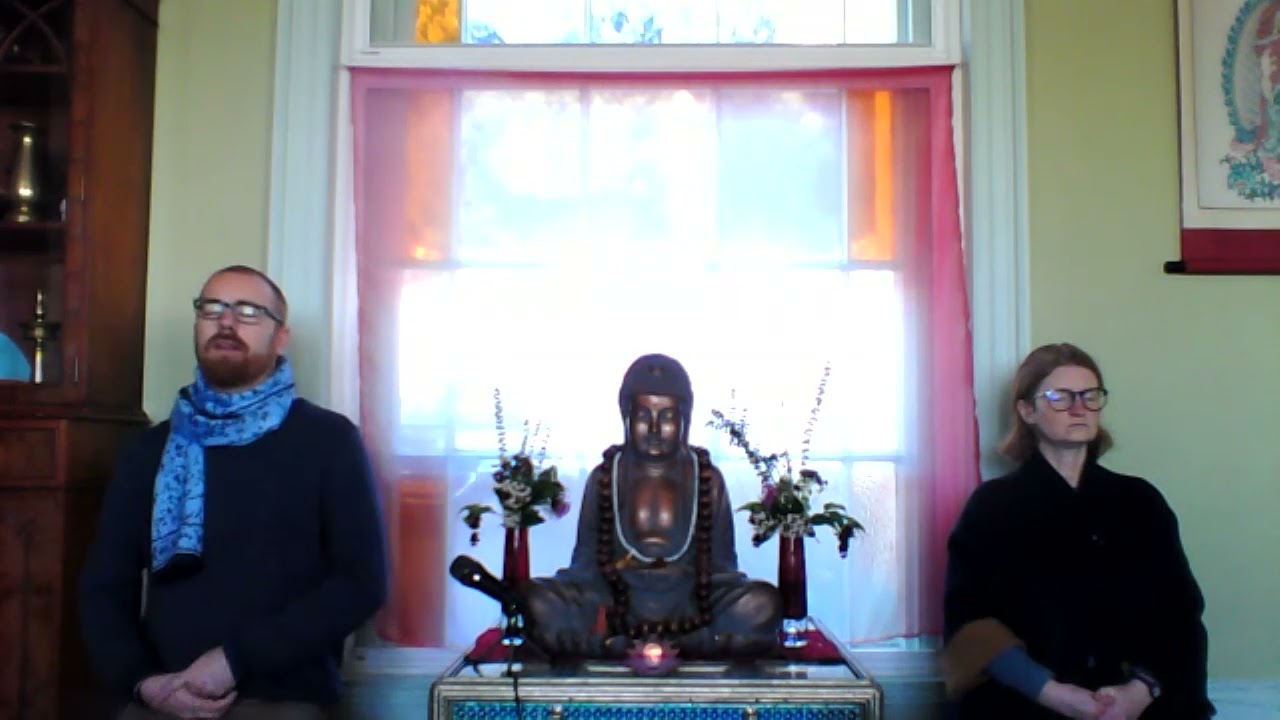
Satya Robyn teaches on two kinds of comfort zones: one that soothes the self, another rooted in Buddha-nature. The session explores balancing activism with compassionate practice, woven through group chanting, refuge vows, and ritual offerings.
Chapters
Good morning. It's, um, it's Saturday morning and there are about 6 of us in shrine room. It's literally just Thank you.
I've been thinking about comfort zones this morning. I think there's, there's two kinds of comfort zone. There's the comfort zone. That is the place we retreat to when we're self-soothing, and maybe we've pushed ourselves too far, and then there's a kind of coming back and doing something That gives us some sense of, uh, recovery. So yesterday afternoon, after my client— that client work in the morning, and before a meeting I had at 5 o'clock, I spent about an hour and a half in the bedroom watching television. Just slowly allowing my energy levels to creep back up so that I could go to that 5 o'clock meeting. And the other kind of comfort zone is emptiness. Which— or Buddha nature, or whatever you want to call it— the place of spaciousness, connectedness, open-heartedness, a place that enjoys connection, that enjoys creativity, that is naturally compassionate without calculation. And there's a lot of little, uh, Chinese and Japanese sayings and phrases and bits of writing that are all about telling us to live entirely from this place. This is the mark of the true Master, these writings suggest. Just dwell in the seat of enlightenment. And I know in my own ways there's There's different ways of preserving that seat of enlightenment. And one way is to— when I'm there, when there's a glimpse of that spaciousness, if I don't want to lose it Don't do anything else. Don't talk to anybody. Don't go outside the room. Don't do anything that might create a disturbance in the force. And you know, there's some merit to that. It's kind of the idea of going on retreat, I guess. Although on retreat there can be plenty of niggles, but we come away from our ordinary circumstances, and that gives us some opportunity to dwell in spaciousness. And it's to some degree what coming in here does, or doing the slow walking around the garden.
It's—
it creates a good set of conditions for us to experience. That doesn't guarantee that we experience it, but We create conditions that make it more likely that we can find that place within ourselves. And very occasionally you meet somebody who says, oh, you shouldn't be trying to help people, or you shouldn't be an activist until you can do it completely from that place. You shouldn't be trying to achieve anything for anybody else until you can do it completely from that place, which is lifetimes of work. And there's something in that. When we act from reactivity or from ego or from doing things because we want to look good or achieve a particular result, or we're afraid of what will happen if we don't act. That makes our own lives more complicated, and it makes the work we're doing more complicated and less likely that we'll achieve good things, because there's that element of selfishness, either subtle or big, mixed in with it. So that's the danger of one extreme, is that if we act and there is no sense of spaciousness, if there's no sense of Buddha nature, if there's no sense of emptiness that we're acting from, we're just acting out, we're just causing a mess. But maybe if we wait until we have perfected emptiness, we don't act at all, which seems equally foolish. To me. So this is what I've been thinking about, comfort zones.
What—
how do we each in our own lives find that right mix of stepping forward into the things that are difficult, which is where a lot of learning is, even if we're not doing things completely compassionately, completely altruistically, without tipping over into that extreme where we lose all sense of spaciousness and compassion. I think it's a bit of a dance, you know, that we can, we can think of it as a dance between the times when we practice with that intention of landing and finding that place and coming down and creating space and receiving compassion and being able to give compassion more easily, and times when we're more in the world and more engaged and at the coalface. And for some people, just swinging between those two extremes is the way of doing it. But I guess I'm wondering about the possibility of Bringing both of them together more often so that daily life, or the life of an activist, is some mix of things that are difficult and those Buddhist qualities that we aspire to. I guess just noticing the shape of my own life, you know, that push, push, push, or now I just need to be quiet and not do anything. Push, push, push, now I need to be quiet and not do anything. And so I'm making that invitation to myself: ease off on the pushing, come back to that place where there can be some of each of these ways of being. And if I do that, maybe there'll be less collapsing and tiredness and needing to close the door on the world so often. It's a work in progress.
Amitabh, Amitabh.
Amitabha. Amitabha. Amitabha. Amitabha. Amitabha. Amitabha. Amitabha. Amitabha. Amitabha. Amitabha. Amitabha. Amitabha. Amitabha. Amitabha. Amitabha. Amitabha. Amitabha. Amitabha. Amitabha. Amitabha. Amitabha. Amitabha. Amitabha. Amitabha. Amitabha. Amitabha. Amitabha. Amitabha. Amitabh. Amitabh.
For refuge I go to the Buddha.
For refuge I go to the Buddha.
Namo Buddha. For refuge I go to the Dharma.
For refuge I go to the Dharma.
Namo Dharmaya.
Namo Dharmaya.
For refuge I go to the Sangha.
For refuge I go to the Sangha.
Nammo Sanghaya.
Nammo Sanghaya.
With faith in the Three Jewels—
with faith in the Three Jewels—
I pray that I may not take life.
I pray that I may not take life.
With faith in the Three Jewels— I pray that I may not steal— With faith in the Three Jewels—I pray that I may not fall into sexual misconduct—with faith in the Three Jewels—I pray that I may not fall into wrong speech—with faith in Three Jewels. With faith in the Three Jewels, I pray that I may avoid intoxication.
I pray that I may avoid intoxication. No blame. No blame.
Be kind.
Be kind. Love everything.
Love everything.
Innumerable are sentient beings.
We vow to save them all.
Inexhaustible are deluded passions.
We vow to transform them all. Immeasurable are the Dharma teachings. We vow to master them all.
Infinite is the Buddha's way.
We vow to forfeit completely.
In gratitude, we offer this incense to Buddhas and bodhisattvas throughout space and time. May it be as fragrant as earth itself, reflecting our careful efforts, our wholehearted awareness, and the fruits of understanding slowly ripening.
May we and all beings be companions of Buddhas and Bodhisattvas.
May we awake, awaken from forgetfulness, realize our true being.
Please come back to standing at your seats. Do we do the verse and then the announcements? So, yeah, okay. Blessed by Amitābha's light, may we pray for all living things and the holy earth. Namamitabha. So Wednesday is Bodhi









