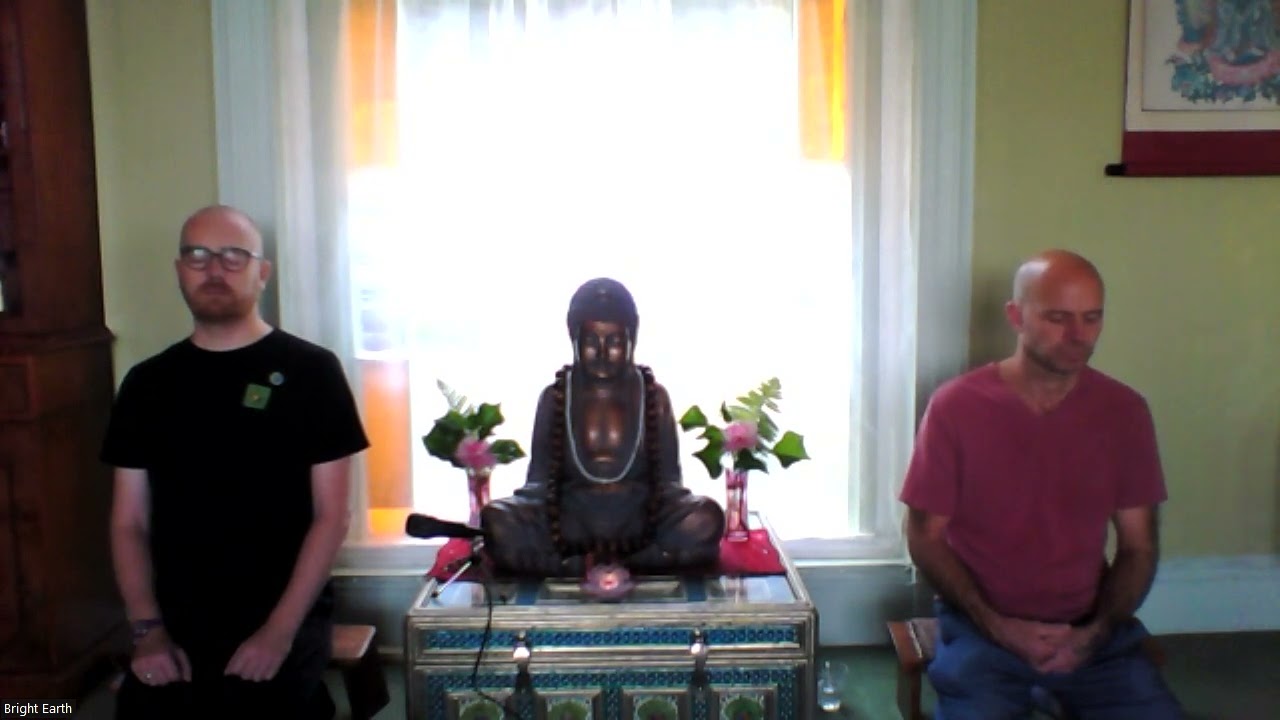
Satya Robyn leads a Buddhist practice session with John Mason's Dharma talk about a dog bite and repair. The group chants the Shakyamuni mantra, takes refuge vows, and explores psychogeography: how different places shape our feelings, drawing on Kim Stanley Robinson's work.
Chapters
Good morning, good morning, good morning to Beth joining us on Zoom.
We're going to begin with a Dharma glimpse from Jama this morning, who we're very blessed to have in person to read to us.
Thank you.
When I was walking on the hill the other day, I got bitten by a dog. I was wearing my favorite shorts, and thankfully they bore most of the brunt, but I was left with a gaping mouth-shaped hole in the fabric which at first looked unrepairable. The owner looked terrified as he apologized profusely, and I felt like I wanted to make it easy on him, so didn't make a fuss and carried on my way. I was gutted inside as I knew that they don't make the same style of shorts anymore, definitely not in pink. The next day I decided to try and fix the shorts despite the fact that I pretty much can't sew to save my life. The hole now looks like a Cornish pasty and stands out like a sore thumb. Immediately after, I decided to wash my car which was covered in dust from the recent dry spell. As I opened the passenger door, the handle came off and fell in about 3 pieces on the car park tarmac. I felt frustrated and helpless and made my way down to Wilko's to get some glue. The handle went back on fairly successfully and I had a certain sense of accomplishment, thankful that I wouldn't have to pay a lot of money for somebody else to fix it at a garage somewhere. I thought about my beloved possessions and how in some ways they reflect myself, my character, my life, and my way of being in the world. It seemed like an act of self-compassion to spend some time on and put some love into repairing my broken stuff instead of discarding the short or palming the car off onto some grease monkey who might have no sense of what it means to me. I thought about how my external reparations might be considered a metaphor for the internal work that I'm engaged in at the moment, taking care of all my wounded parts and helping to heal the internal system that constitutes my psychological landscape. For me, these occurrences are never arbitrary, always loaded with meaning, and quite intentionally sent to show us a deeper perspective on the bricks-and-mortar world that we live in. The recurring breaking and fixing might reflect the fragility and resilience of the human condition, and how our efforts to fix ourselves are part of a greater work that includes both matters of the heart and the seemingly inanimate things that support us on our journeys.
Amo ni deku.
Thank you, John Mason. We'll go into some quiet meditation together. Invitation to move your awareness down into the body, noticing the breath, noticing physical sensations. And to keep returning to this embodied sense of being through the practice. chant the Shakyamuni mantra, bringing to mind the founder of Buddhism in this age. Om Muni Muni Maha Muni Shakyamuni Swaha, which means something like, oh sage, sage, great sage of the Shakya clan.
Om Muni Shakya Muni Swaha! Om Muni Muni Mahamuni Sakya Munisvaha! Om Muni Muni Mahamuni Sakya Muniswaha! Om muni muni mahamunishakyamunisvaha! Oh Muni muni Mahamuni shakya munisvaha!
Ooh...
Munimuni Maahaa Moonyi Shaktiya Muuuneee Svahaha! Om Muni muni mahamunishakyamunisvaha! Ohh... Munimuni Mahamunishakyamunisvaha! Ooh... munimuni mahamunishakyamunisvaha! Om muni muni mahamunishakyamunisvaha! Oh Muni muni Mahamuni shakya munisvaha! Ooh... Munimuni ma-ha-mu-ni sha-kya mu-nis-vah-a— Om muni muni mahamunishakyamunisvaha! Oh Muni muni Mahamuni shakya munisvaha! Ooh... Munimuni Mahamuni Shakya Munisvaha! Om muni munimaha muni shakya munisvaham! Om muni munimaha muni shakya munisvaham! Om muni munima— Muni Shakya Muniswaham! Om muni munimaha muni shakhyamunisvah! Oh Muni Munima ha-muni Shakhya Moonies— Ooh-hoo... Muuuh-ni muu-nee ma haa mooonii sha-kkyya mooniee ssfva haha-aaaa ahm mm? Moooni mooney mahahaha muhni Shakyamoonees fa hammm oh Moony Moody Mahamaanishaka ya moons va harhamma um hmm oom loo neemoonee mama hmooty shack-yay amoones ba haarhaummahamacca yamma nah-amoom nih-shack-ye amoons vaa harmhmhmmaarhumga hooha hai hanjaai kathaaya namasteya om mani mudhi maha mundhee shakyamuune spa ama hum phal sahafara adiyata Om Muni muni mahamunishakya munisvaha! Ohh... Munimuni mahamunishakyamunispah? Ommmuni munima muhni shaktiamunisva ahm—
Ahhh... Munimumma mumishakyamamunismava amumuspa ma mamuna namaskaramu baharadhamo bhagavananda ramana prabhupada. Am unmuktiyati tattvatvaraswamyama. Ameenom hama manohara paramatmya mama. Namaskaaramuhai jaya guru devatare nama vasudevasvaraḥ. Om Mani Mudhi Mahā Mukṣīkya Mūnisvaha! Om Mani Mudhi Mahā Mukṣīkya Mūnisvaha!
Om Mani Mudhi Ma ha-Munishi-kya Mu-nis-vaa-a-am. Om Muni muni mahamunishakya munisvaha! Ohh... Oohhh— om mani mani mahamunishakyamunispahahaha! Om mani mani mahamunishakya munispaha! Om mani mani mahamunishakyamunispaha! Om muni Muni mahamunishakhyam munisvaha! Ahm uni muni ma ha-mu-ni shaa-kya mu ni sva ah-hah— om muni muni mahamunisha-khya muhni svahaha... ohh moonie moonymah hamooney shaq-yuh mooonees fwa-aaaaha—aawmmooneee loonii mmma haaaa amoo neeshakh ya mootnees va aa-hooo? Ohhh Moonimoni Mahamoonym Shakhiyamu Ne Spha-AḥāʻĀṁ.
Aww MooNī MoOnī MaHá MuNi ShaK-YA-Mū-NI Svå-Hă·Ahⁿ. Ooh MooNeemoOneyMaHaMuNie ShakkYAmUonesVa AHM Om muni Muni mahamunishakhyamunistvaha!
Ohm muni muni mahamunishakyamamnispaahaa— ohmmuuumni muunnii maahhmmmoooniii shaakeeyyammoonisspaaaahaha! Hohhhhmummi mooni mahhaa mooni shakkyyammoonyisvaahaaaa... Ahhoom mummeemounimoha munishakeyamooneyeswaahaaa? Om muni Muni mahamunishakhyamunisvaha! Ahm uni muni mahamuni shakyamuni svah? Ohh... Mooni mooni ma ha mooni sha-kya moo-nii sva-a-haa— Aum oom ni munee ma haaa-mooniee-shakk yae-moo-nees vwa—a-a-Ahm unni mooneemma haha-moony shakyamoonespa'a-Haaaa—a-ammooney meeniiii mmahaha-meeneeshakt ya mooties ba'ha Om muni muli maham uni shakhya munisvaha! Ahm-mu-nii mu-nee ma-haa muh-neesh-shah-khee-a-mmunees-vahaha— Ohhmm... Muuneee moooneemaaa haan mooneyish shaakeeya mmooonesva? Huh huh uh ahhm?! Moominey mooneyma hamoonieechhaakeyyaanumumeyswa~ Hmm hmm um hum hm.
Please repeat after me. For refuge I go to the Buddha.
For refuge I go to the Buddha.
The one who is awake and full of love.
The one who is awake and full of love.
Namo Buddha. For refuge I go to the Dharma. For refuge I go to the Dharma. All that guides us to wisdom and compassion.
All that guides us to wisdom and compassion.
Namo Dhammaya. Namo Dhammaya. For refuge I go to the Sangha.
For refuge I go to the Sangha.
Those who live in the Buddha's light.
Those who live in the Buddha's light.
Namo Sangha. Namo Sangaya! With faith in the Three Jewels— I pray that I may not take life. With faith in the Three Jewels— I pray that I may not steal. With faith in the Three Jewels— I pray that I may not fall into sexual misconduct.
I pray that I may not fall into sexual misconduct—
With faith in The Three Jewels...
—with faith in The Three Jewels...
I pray that I may not fall into wrong speech—
...I pray that I might not fall into wrong speech—
With faith in The Three Jewels... —With faith in The Three Jewels... I pray that I may avoid intoxication—
I pray that I may avoid intoxication...
No blame! Be kind to all! Love everything!
Love everything. Innumerable are sentient beings.
We vow to save them all. Inexhaustible are deluded passions.
We vow to transform them all.
Immeasurable are the Dharma teachings.
We vow to master them all. Infinite is the Buddha's way. We vow to fulfill it completely.
I've been thinking about psychogeography, which is how we feel differently in different places. I was listening to an interview with Kim Stanley Robinson yesterday, who I read most of his novels. I haven't read the most recent one, and the interview was about his latest book, which isn't a novel, it's more sort of a little bit autobiographical about his time in the Sierra Mountains in the States. And he's a really thoughtful, interesting person, so I was pleased that I listened to the interview. And one of the things he was talking about was the different feeling that is evoked when he's in different sorts of mountains. And even when he's in the same range of mountains, depending on the kind of rock that he's walking on. They also talked about the difference between being in a city which has, like Manhattan, which has skyscrapers that are maybe 1,000 or 1,500 feet, and being in mountains where they're 10,000 feet high. And even though they're both huge, how both the interviewer and Kim Stanley Robinson didn't have a sense of feeling small in Manhattan because it's constructed for humans. That was the kind of conclusion that they drew. But in the mountains— and apparently as you approach these mountains, the eye can't really understand the size of it. So there's a sort of optical illusion that happens where you can't really take in how tall they are, but part of the experience of coming into that space is a bit like looking into the night sky and feeling small. And I was thinking about other kinds of spaces and how they do evoke different feelings. And I guess the idea of psychogeography is, is perhaps not simply that Individuals have different feelings in different spaces, but there is something human about— there's something shared about the feeling that's evoked by the sea or a lake or a stream or looking out at this view. There's some shared quality of experience to do with the landscape, how we meet the landscape. And I was also thinking of places where tragedies have happened or atrocities, or of visiting the Holocaust Memorial in Berlin, and how those evoke— those spaces evoke feelings as well, very different to the feelings of looking out at this view, for example. And I'm trying to square that with this phrase that I read a few days ago in December Fan that I mentioned on Wednesday, that everything is shining with light. Because the experience of being in these different places is that we feel differently. Some, some places bring about melancholy, some about awe, some fear. How do we make sense of that if they're all shining with light? Well, the light is love and wisdom, the pure love and pure wisdom of the Buddha that both sees things as they are in this human, er, samsaric world, and the differences between things and the suffering that's in, and also sees through things to the shared quality and the shared unfolding. And I think we can— I can imagine the Buddha, any Buddha really, but I guess I was thinking of Shakyamuni, which is why we did the mantra earlier, walking through these different spaces and having different feelings evoked in him depending on whether he's walking through the jungle or through a city or going up into the foothills of the Himalayas. Or in the springs at the top of Rajgriha, the top of Yorkshire Peak, the hot springs there. Different human feelings being evoked, but beneath all of those things, these two foundational qualities of love and wisdom. Because it's possible to feel love and sadness, or love and awe, or love and melancholy, or love and— perhaps not love and fear, but love and respect for something that is very large and forceful and might roll over your human life in a way that without consideration. So this is one way in which these spaces are all shining with light, even though they're very different, in that that's how a Buddha sees them, affectionately. And the other thing a Buddha sees is, is that all of these things have their own Buddha nature, even when they're completely being themselves and creating these different feelings in us, that that is also somehow an aspect of love and wisdom unfolding. Things being completely themselves are Buddhas. What does it mean that the mountains are Buddhas and the skyscrapers are Buddhas and the war memorials are Buddhas?
Namamitabha.
Ah, that's right.
Namoha mi dabru! Namoha mi dabru! Namoha mi da— namoha mi da. We dedicate the merits of this incense offering to all Buddhas and Bodhisattvas throughout space and time. May it be as fragrant as earth herself, reflecting our careful efforts, our wholehearted awareness, and the fruits of understanding. Slowly ripening. May we and all beings be companions of Buddhas and Bodhisattvas. May we awaken our forgetfulness and realize our Sangha.
Blessed by Amitabha's light, may we care for all living things and the Holy Earth.









