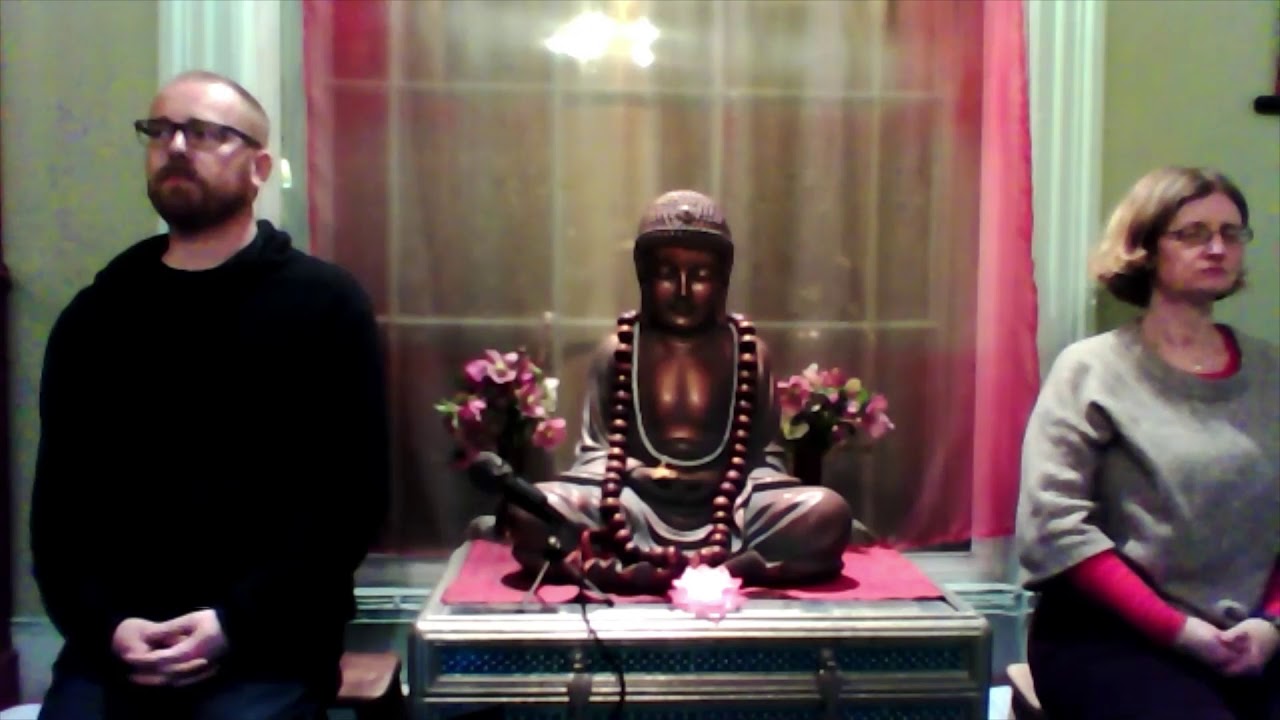
Satya Robyn leads a post-lockdown Buddhist service using the metaphor of filling a wire cage with bricks to teach about mindful practice and letting go of karma. The group chants Amitabha, recites refuges and precepts, and takes Bodhisattva vows together.
Chapters
Namaste. Welcome to the in-person post-lockdown service. We've got Dave, Brian, Philip, Jarmaine, Satya Robyn here in the shrine room, and on the screen in front of me I can see Beth, Judith, Chris, Paul, Becky, welcome everybody. Today I was filling up a gabion and I was pretty sure there was a dharma talk in that activity, so I'm going to see if I can draw it out. It seemed very clear at the time. So gabion is one of those wire cages that holds up bits of landscape. Sometimes you see them on the side of motorways, and Tony next door has got some holding the various layers of his garden up. And Tony's gabions are very, very neat. The cubes are— have got perfect corners, 90 degrees each corner. The the stones have got all their flat faces turned out to one side, making a perfect finish. Even the neater ones of the ones that we've done here are slightly bulging and haphazard. So I'd found some bricks and rubble and stones, and I knew that one of the gabions was three-quarters full, so I thought, oh, I can get close to finishing it off today. And with that goal of finishing it off in mind, just collect armfuls of bricks and stones and kind of dump them in the middle. And then as I put them— this load of stone in the middle— just this seeing the sides bulge out slightly further. And realizing that if I worked in this slightly rushing way of just wanting to get to the end of the job— armful of bricks put in the cage, armful of bricks put in the cage, armful of bricks put in the cage— sounds like a '90s rave song— that I'd have a very messy gabion. So slowing down and paying attention, uh, putting in one brick or one stone at a time into the right place. And what I realized as I tried to find the right place for the next brick or half brick was that I would probably have to move around a couple of layers of what was in there already to bring it more or less back into alignment. So rather than filling it up, suddenly I'm emptying it out, which seems like the opposite of what I want to be doing. But eventually doing that, some kind of neatness appears on the top few rows. I realized that if I had lots of time and the inclination, I could have taken much more out, um, and really straightened up the whole thing. And something of that process reminded me of spiritual practice, or a couple of things. One, this changing of the quality of awareness or attention that I was paying from this that's the end goal, just try and get there as quickly as possible, to, oh, actually, what does each step of this look like? And what is the consequence of this way of behaving? And if I don't like that consequence, can I change what I'm doing? Now, also something about going deeper taking things out, examining them, and putting them back again in a slightly different place reminded me of therapy or spiritual practice, because this kind of curiosity that I was bringing to the bricks is the same kind of curiosity that we can bring to our inner states of mind. We notice some disturbance or emotion inside, or sometimes the physical feeling of being tense or uncomfortable, And we bring it into the light, into the light of Amida, which allows us to have a look at it without judgment, from a place of loving kindness and wisdom, and get to know it and get curious about it. Maybe we learn something. Usually we learn something. Often we let something go that we've been carrying in that process. But we don't keep thinking about it forever. Once there's been some kind of reconciliation or learning, we place it back inside again until the next time we look beneath the surface of the mind. And this reluctance in me to go right to the bottom, I think, says something about the bottomless nature of karma that we all carry. I didn't want to go right down to the bottom of the Gabion because I had a sense that there just wasn't time for that. And I think in life, the amount of disturbance, the amount of negative karma that we carry, certainly from a Pure Land Buddhist point of view, is more than we can take out and examine consciously in one lifetime. So we trust that whilst that is a good thing to do, and it can really straighten up the sides of our metaphorical gate, then we can really tend to our inner states and make some difference there. We also keep in mind the endlessness of that, a bit like the Bodhisattva vows: innumerable are sentient beings, I vow to save them. Or we could say the same of our own negative habit patterns: innumerable are negative habit patterns, I vow to transform them. Or I guess we do say something like that in the Bodhisattva vows. So it's good to do this practice, and it's also good to know that whether we do it or not, we are still held in this light of unconditional love that accepts us just as we are. Namami Tobru. As we sit quietly together, if you like, as you notice a thought or a feeling or an impulse, pausing for a moment to hold it in the light of awareness. Noticing what it is and then releasing it and bringing awareness back to the breath.
Amitabha. Amitabha. Amitabha. Amitabha. Amitabh. Amitabh. Amitabh. Amitabha. Amitabha. Amitabha. Amitabh. Amitabh. Amitabh. Amitabh. Amitabh. Amitabh. Amitabh.
Amitabh.
Amitabha. Amitabha. Amitabha. Tapa. Ami Tapa. Ami Tapa. Amitabha. Amitabha. Amitabha. Amitabha. Amitabha. Amitabha. Ami. Amitabha. Amitabha. Amitabha. Amitabha. Amitabha. Amitabha. Amitabha. Amitabha. Amitabha. Amitabha. Amitabha. Amitabha. Amitabha. Amitabha. Amitabha. Amitabha. Amitabha. Amitabha. Amitabha. Amitabha. Amitabha. Amitabha. Amitabha. Amitabha. Amitabha. Amitabha. Ami. Amitabha. Amitabha. Amitabh. Amitabh. Amitabh. Ame taba. Ame taba. Ame taba. Ame taba. Tapa. Ami Tapa. Ami Tapa. Ami Tapa. Amitabha. Amitabha. Amitabha. Amitabha. Amitabha. Amitabha. Amitabha. Amitabha. Amitabha.
So we'll recite the refuges and precepts together. So please, if you'd like to repeat after me: For refuge I go to the Buddha. For refuge I go to the Buddha. Namo Buddhaya. Namo Buddhaya. For refuge I go to the Dharma. For refuge I go to the Dharma. Namo Dharmaya.
Namo Dharmaya.
For refuge I go to the Sangha . Namo sanghaya! With faith in the three jewels— —I pray that I may not take life; With faith in the Three Jewels... ...I pray that I may not steal; With faith in the Three Jewels, I pray that I may not fall into sexual misconduct. With faith in the Three Jewels, I pray that I may avoid wrong speech. With faith in the Three Jewels, I pray that I may avoid intoxication. I pray that I may avoid intoxication.
Innumerable sentient beings, we vow to save them all. Inexhaustible undiluted passion, we vow to transform them all. Immeasurable are the Dharma teachings. We vow to master them all. Infinity is the Buddha's way. We vow to fulfill it completely.
So prostrations to the Buddha, 3 prostrations, and we'll finish standing.
Namaste. Thank you, Buddha.
We'll tidy our seats, and then we'll say the closing verse together, which isn't written down anywhere, so I guess, um, Just probably just Satya and I'll say it together. Gentleman maybe knows it as well. Should we just say it once so people can at least try and remember? Yeah. It's blessed by Amitabha's light, may we care for all living things and the holy earth. Okay, so we'll try it all together. Do unmute if you're on the, uh, if you're on the whatever this is called, on the Zoom. So you can join in with us. Okay, here we go. Blessed by Anisaba's light, may we care for all living things and the holy earth.
Namo Amitabha. Namo Amitabha.









