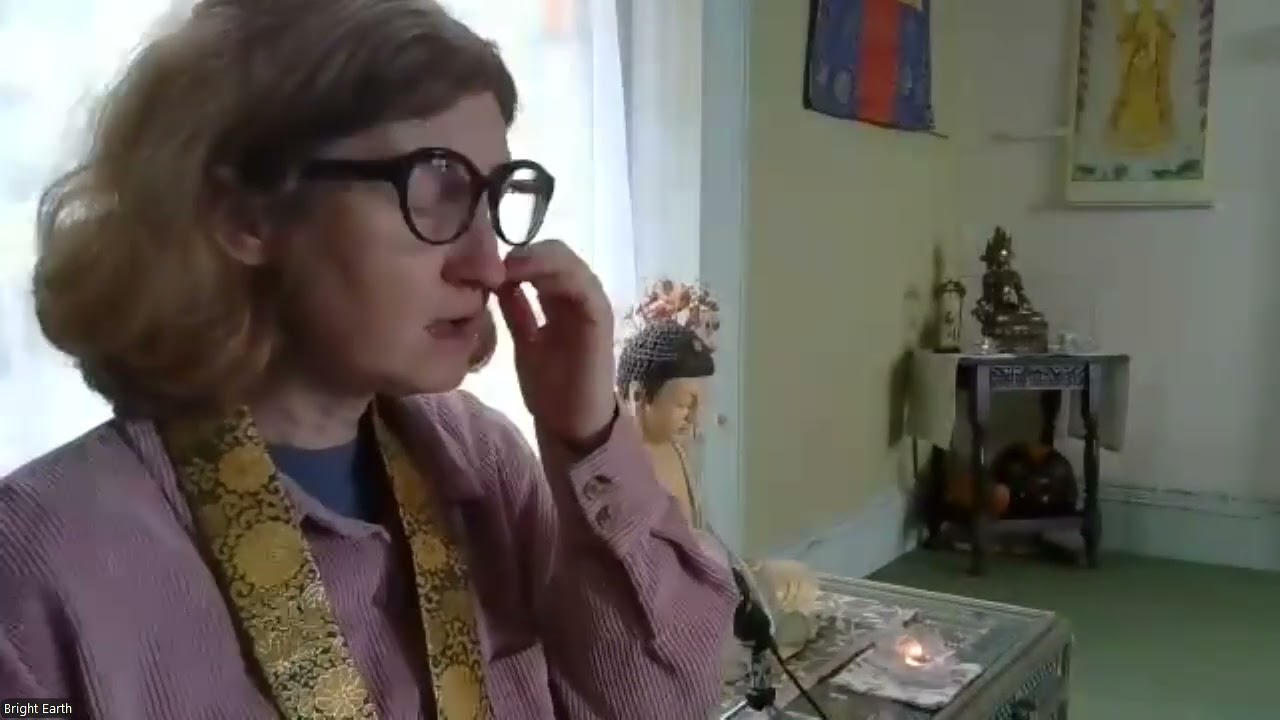
Satya Robyn leads a Buddhist practice session featuring a reading from Cole Arthur Riley's Black Liturgies, guided Nembutsu chanting, and a Statement of Faith for a Pure Land sangha. Participants share reflections on living a dharmic life in everyday moments.
Chapters
Good morning, lovely to see you here in the Shrine Room, and hello to Ellie, Robyn, Satya Robyn, and Chris. Great to have you here. So I'm going to begin this morning with a reading from a book 'Black Liturgies' by Cole Arthur Riley. Prayers, poems, and meditations for staying human. She writes really beautifully. I would really recommend her, any— anything she's done. And this one is from a section called 'Wonder' and it's called 'For Beauty in the Mundane.' And it's a prayer. God of every beautiful thing, make us people of wonder. Show us how to hold on to nuance and vision when our souls become addicted to pain, to the unlovely. It is far easier to see the gloom and decay so often it sings a louder song. Attune our hearts to the good still stirring in our midst. Not that we would give ourselves to toxic positivity or neglect the pain of the world, but that we would be people capable of existing in the tension. Grant us habits of sacred pause, Let us marvel not just at the grand or majestic, but beauty's name etched into every ordinary moment. Let the mundane swell with a mystery that makes us breathe deeper still. And by this may we be sustained and kept from despair. Amen. I'm going to read it a second time. For Beauty in the Mundane. God of every beautiful thing, make us people of wonder. Show us how to hold on to nuance and vision when our souls become addicted to pain, to the unlovely. It is far easier to see the gloom and decay, so often it sings a louder song. Attune our hearts to the good still stirring in our midst. Not that we would give ourselves to toxic positivity or neglect the pain of the world, but that we would be people capable of existing in the tension. Grant us habits of sacred pause. Let us marvel not just at the grand or majestic, but beauty's name etched into every ordinary moment. Let the mundane swell with a mystery that makes us breathe deeper still. And by this may we be sustained and kept from despair. Amen. So we will sit quietly together. You might want to do the suggestion, some, uh, Nembutsu breathing today, which is just imagining the word Amitabha just accompanying your breath. You can use the word Amitabha, you can use Namu Amida Butsu, and just imagine that word just floating on your breath as it goes in and out. No need to change your breath. Allow the Nembutsu to be with you.
Amitabha. Amitabha. Amitabha. Amitabha. Amitabha. Amitabha. Amitabha. Amitabha. Amitabha. Amitabh. Amitabh. Amitabh. Saba, ami taba, ami taba, ami taba. Amitabha. Amitabha. Amitabha. Amitabha. Amitabha. Amitabha. Amitabha. Amitabha. Amitabha. Amitabh. Amitabh. Amitabh. Amitabh. Amitabh. Amitabh. Amitabh. Amitabh.
So we'll begin by reading the Statement of Faith together, which is on the website. Slides under the liturgy page. Statement of Faith. The purpose of our practice is to open us to the wisdom and compassion of the Buddhas. Our heart practices the Nembutsu the recitation of Amida Buddha's name. We also connect with the Buddha's wisdom through practices like listening to teachings, meditation, and being in the natural world. We treasure Shakyamuni Buddha, who set the wheel of Dharma turning. We learn from Buddhist teachers throughout the ages. Awakened beings everywhere and the world itself. We especially revere the great Pure Land sages Honen and Shinran. Held in Amida's loving gaze, we come to know ourselves deeply, both our bambu nature and our Buddha nature. As bambu beings, we grasp at unreliable refuges and sometimes we cause harm. Knowing the harm we cause offers us the chance to lessen that harm. Seeing our fallible nature also strengthens our refuge in Amida Buddha. The more deeply we take refuge in Amida, the more our greed, ill will, and delusion will melt like ice into water. Allowing our natural compassion to flow into the world. We trust that at the center of each of us is the heart that loves all living beings and that wishes for their liberation. We take action powered by this love in response to suffering in the world. We pay attention to the causes of suffering We mitigate for power. We practice discerning what work is ours to do. We wish that all who may benefit are able to access the jewels of the Buddha's teachings. Moved by the Buddha's love, we vow to take care of all living beings, including ourselves. Held tenderly by the Buddha's love, We find clarity, consolation, and settled faith. For refuge I go to the Buddha.
For refuge I go to the Buddha.
The one that is awake and full of love.
The one who is awake and full of love.
Namo Buddha. For refuge I go to the Dharma.
For refuge I go to the Dharma.
All that guides us to wisdom and compassion.
All that guides us to wisdom and compassion.
Namo Dharmaya. For refuge I go to the Sangha.
For refuge I go to the Sangha.
Those who live in the Buddha's light.
Those who live in the Buddha's light.
Namo Sanghaya. For refuge I go to the Earth.
For refuge I go to the Earth.
The holy ground of awakening.
The holy ground of awakening.
Namobhumyay.
Namobhumyay.
With faith in the Four Refuges.
With faith in the Four Refuges.
And in light of my human tendencies.
And in light of my human tendencies.
I pray that I may become aware I pray that I may become aware of when I fall into wrong speech.
Of when I fall into wrong speech.
I pray that I may become aware.
I pray that I may become aware of when I become intoxicated. Of when I become intoxicated.
No blame.
No blame.
Be kind.
Be kind.
Love everything.
Love everything.
Innumerable sentient beings, We vow to save them all.
Inexhaustible are the Buddha's passions.
We vow to transform them all.
Immeasurable are the Dharma teachings.
We vow to master them More infinite is the Buddha's way. Breathe out to forfeit completely. I need to pee.
So last June, the end of last June, Casper and I moved into our new house, and it was quite a full-on time. I have parts that want to get everything finished all at once. So moving into a new house, I wanted to get unpacked immediately, sort out all the problems, get workmen in to fix all the things that weren't working, go and buy stuff that we needed. And we'd also just come out of a very stressful year and a half of house moving shenanigans. And one of the things that we discovered when we moved in is that we had— we were the owner of some fish, 7 comet fish. 5 orange and white and 2 dark, dark and shimmery. And I found myself sat cross-legged on the concrete next to the pond, just looking in the pond, looking at the ponds, looking under the water, watching the fish. Um, being in the garden. And for that time, watching the fish was my practice, was my spiritual practice. It connected me back to something that I really needed, which was steadiness, um, spaciousness, a kind of calm holding, and beauty. The beauty of the fish as they moved under the water. There are many ways of living a life of dharma. This is a phrase that came to me this morning, a life of dharma. What is a life of dharma and how do we live it? Cole Arthur Riley is Christian, Black Christian woman, American woman, and And her prayers for me are a connection to the divine, that they are dharma. She wouldn't use that word, but my experience of the piece we read this morning, I read this morning, is that it connects me into the Buddha, it connects me into the dharma. The beauty of the mundane world. On Sunday night, we chanted to various deities, and that connects me to the Dharma. So I think it's a very personal thing. That we choose, as far as we can, the conditions, the activities, the habits, the company that connect us to something that is deeper than ordinary life, the ordinary life that most people live, that we find the things that that, that strengthen that relationship. Might be creative practice. It might be nature. We, we try and build a life that is shot through with those experiences, even if they're little tiny glimpses, only little tiny glimpses of of a dharmic life, of a life that has a deeper meaning. And the, the sangha of, uh, watching the fish was just one, was just me. And it may be that people would have wanted to come and sit next to me and watch the fish with me. But probably that's not going to work for a long-term sangha, that, um, that we also need to find something that unites us. We also need to come together in this room, on the— wherever you are in the country, you're with us. We're together here, and we're together because We kind of like the Buddha. The Buddha is a channel through which we all experience that divine energy. And, you know, hopefully we kind of like the Pure Land Buddhist teachings, which are simple and radically inclusive. And accessible, that we just say the Nembutsu. And that doesn't mean that we just say the Nembutsu. We all do all kinds of things in our lives that support us spiritually. And it is really helpful to have a sangha. It's really helpful to have that, that kind of what happens when we come together that doesn't happen when we're on our own. Someone recently who, who decided not to come to the group anymore said that they felt like practicing on their own kind of suited them better, and that, that may be true for them, but certainly in my experience, there is a richness that comes from practicing together that is very difficult to find on our own. Even if we pop in a couple of times a year just to strengthen that relationship again, um, that we're in this together somehow with our differences and with what happens when we come into community, which is that people are complicated and, uh, we learn things about ourselves. So yeah, I'm very glad to have you all with us today, with me, with, with each other, and, uh, you'll make some prostrations together. Namomi tabu. —people busily engaged in secular matters take no notice of life wearing away day by day, night by night. Like a lamp in the wind, how long can it last? In the six realms of samsara, there is no fixed abode. Until we are emancipated from the seed of affliction, how can we rest in peace? Should we not be afraid? While we still have strength, let us each hear the Dharma. Let us try a DigiPC. So this morning we are going to do some meditation for peace after practice. If you'd like to join us for a little bit, um, we have Casper's talk tonight online, 5 o'clock to 6 o'clock. So look on the WhatsApp for details. Yeah, on the website.
Um, a couple of weeks there's a talk here.
Yeah, the first weekend in June, is it the 5th or the 6th? There'll be a talk after practice on no blame. So we say that every week.
Anything else from the students?
No. Okay, so I'll come back and say hello in a minute, guys online. Blessed by Amitabha's light, may we care for all living things. Hello everybody, good morning. Hello. Hi.
Oh, Satya's coming as well. Hi, hi everybody.
Hello, hello, hi.
I haven't seen you for a while, Ali.
Good to see you. How you doing? You're muted. You're all very, very quiet. Very, very quiet. It's the old microphone problem.
Can't hear you. Can't you hear me?
Oh no, now maybe just needs to be closer. That's all right, I just came right close. Yes, that's fine now, actually. Yeah, no, I'm fine. I had a bit of a blip with my ME and It slows me down, I can't do things, so yeah.
Yeah. Mm.
You're out of the dip a bit now. Yeah. Good, good to hear it. Lots of bluebells where we live, absolutely loads. Okay. And cuckoos. Oh, yeah, I've heard a lot of cuckoos this year, more so than last year. Yeah. Yeah, wow. Our bluebells are mostly over, I think, aren't they? Yeah, they're over here. You must be later over there. How's everyone else? Okay?
Yeah, fine, thank you.
Yep, you've got a lovely, uh, flowery meadow behind you, Chris. Yeah, that's from last year. My lawn doesn't look like that yet. I'm hoping it will do soon, but, uh, is it your lawn? It is, yeah, yeah. It's not really a lawn, it's like a meadow. Gorgeous. We've actually just stopped mowing one. We've got 3 little lawns, and one of them we've just stopped mowing to see if we can get some wild things in. Yeah, yeah. Well, sorry you can't join us for a cup of tea. Yeah, my husband's just brought me a big slab of chocolate fudge cakes. Oh yeah, at 10:13. Yeah, I know. Excellent. I'm impressed. Excellent. Well, we'll imagine you enjoying that. Yeah, we'll see you all later.
So nice to see you. Bye-bye. Bye. Bye, Cathy.
Bye, Mum.









