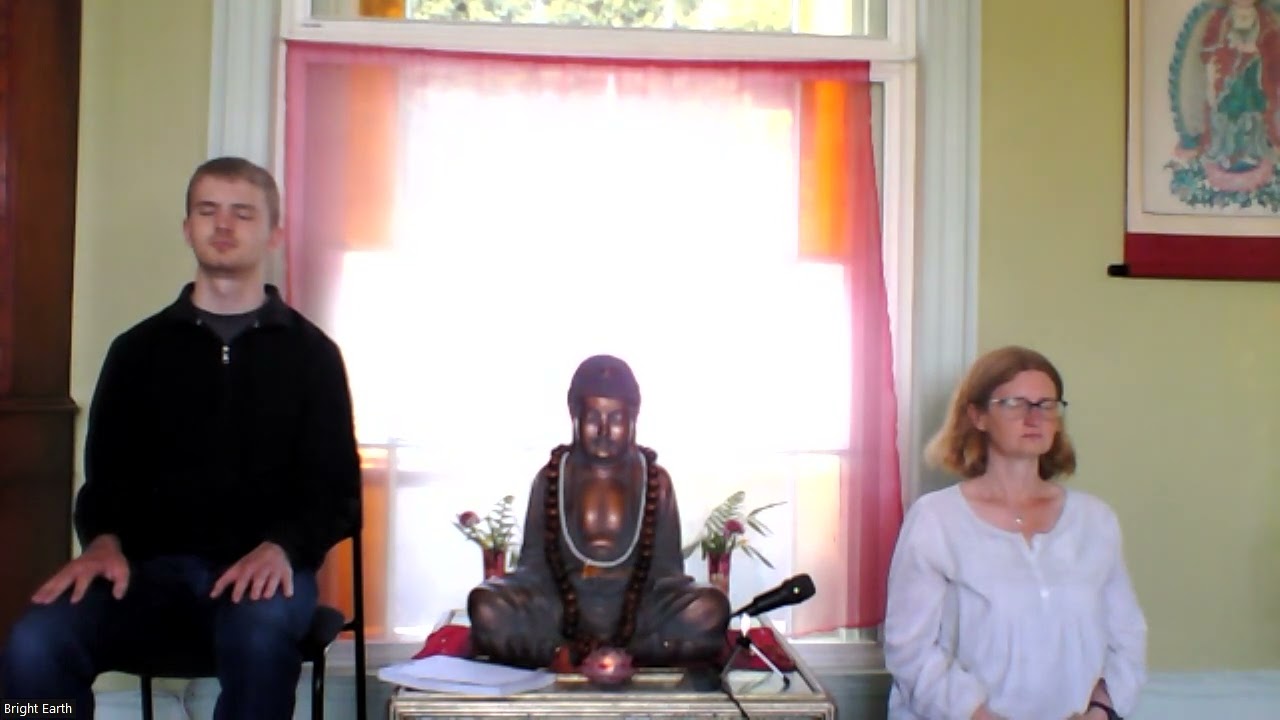
A Buddhist group practice led by Satya Robyn at a temple with Zoom participants. The session includes a Dharma reading on acknowledging limitations, guided meditations, chanting, and a story about the temple cat Roshi.
Chapters
Just enjoying that bell. Good morning everybody, welcome to those of us who weren't in the garden, not many. Everyone, I think. And welcome to Claire, who is joining us on Zoom. So this morning, it's a sad state of affairs because we've run out of Dharma glimpses again, so we're having to resort to the book. So hint, hint, if you would like to write a little Dharma glimpse, always welcome. Doesn't have to be very long. Paul did one that was just a few lines long that was really beautiful, so Yes, send them through. We have got a couple actually, but Angie's not here to read hers. But yeah, always welcome. So today Sam has kindly agreed to read from the Bright Dawn Dharma Glimpses book. Over to you, Sam.
This one is called Acknowledging Limitations. By Nico Bio Bio Burkhardt. Recently, our group has been exploring the topic of realizing enlightenment through whatever means we have. As a group, humans tend towards the dramatic and glamorous, so sometimes we think we will get to enlightenment by a grand gesture or event. I have been exploring the concept of enlightenment through acknowledging limitations over the past few weeks and find it very liberating. There are so many judgments we have as individuals, as a society or culture, about what we should or should not be doing. For instance, someone with a very strong work ethic can feel very useless unless they are constantly engaged in some result-oriented task. When we encounter limitations in life, whether financial, physical, or mental, we tend to judge ourselves and feel guilt. In the past few weeks, I've had a chance to choose a different response to my own limitations. Rather than feeling guilty or defeated, I have experienced acceptance. After acceptance sets in for a while, I was able to see reasons to appreciate these limitations and have been able to use them as a springboard for new opportunities I could not have seen before. To me, this is a glimpse of enlightenment, and it keeps me going when things seem too challenging. As long as we are in resistance to a problem, we cannot see the way out. By resisting, we are in a state of mind that believes in duality. There is a problem and then there is me. They are two separate entities. By practicing acceptance, we become one with limitation and thereby are empowered to move past it.
Nam-myoho-renge-kyo. Nam-myoho-renge-kyo. Thank you. So this morning I thought we might practice a Nei Quan and Qi Quan, which we haven't done for a long time. I can't quite remember the bells, can you, Keima? We'll see what happens as we go along. So Nei Quan and Qi Quan is a pairing of spiritual exercises, so the idea is that you do them together. We start with Nei Quan and move on to Qi Quan. So Nei Quan is a period of reflection beginning to connect in with all the different ways that we are dependent on the world and each other, all the different things that we receive, all the different ways that we put other people out or cause inconvenience. And so there are 3 questions, and we usually focus on just the previous 24 hours. The questions are: What have I received? What have I offered in return? And what trouble has my existence caused? And if that feels like a bit much, just, just ask the first question: what have I received? And as you spend some time reflecting on that, don't worry too much about making a massive long list. Sometimes my mind gets really busy trying to sort of catch everything. It's just a sort of dwelling in that space with that question over the 24 hours. What have I received? What have I offered in return? And what trouble has my existence caused? Is it just like a stopped bell? We don't have to do it. Is it, is it Nam-myoho-renge-kyo? Is it that one? Okay, anyway, we'll see what happens after 5 minutes. Kei, we'll do something. Infinit Light, be my delight. Shine on me, an ordinary Infinit Light, please my delight, shine on me, an ordinary. Infinit Light, Be my delight, shine on me, Anuradha Nair. I think that's made both me and Kema tear up a little bit. It's been a long time. So now we move into chi kwan, and chi kwan is the most beautiful meditation. We're basically making offerings to the Buddha. So everything that was stirred up in the ne kwan part of the meditation Any thoughts that come to you as you sit, any feelings, any physical sensations in your body, just make an offering of them to the Buddha. Imagine handing them over to the Buddha, and then you can imagine the Buddha receiving whatever it is you've offered with a smile on their face. And what we say is that the Buddha can— the Buddha is a Buddha, so the Buddha can make use of whatever it is you offer, you offer them. Even if it's a bit of jealousy or an ache in your knee, the Buddha will really gladly receive that and find some use for it somewhere. So as you sit in chi kwan and make these offerings to the Buddha, you may find your mind just becoming a little more settled. If that happens, just dwell in that peace. If it doesn't become more settled, just keep making the offerings and know that that is a good thing to do. Namaste. Me. Nam. Me. Nam. Me. Nam. Me. Nam. Me. Namoh Amitabhu. Namoh Amitabhu. Namoh Amitabhu. Namoh Amitabhu. That's it. A good bell master is always ready to follow the crazy impulses of the celebrant, just coolly rummaging around in the cupboard. Yeah, top mark. Okay, so we'll move into the refuges and There's some new middle lines for people who haven't yet recited them. For refuge I go to the Buddha. For refuge I go to the Buddha. The one who is awake and full of love. The one who is awake and full of love. Namo Buddhaya. Namo Buddhaya. For refuge I go to the Dharma. For refuge I go to the Dharma. All that guides us to wisdom and compassion. All that guides us to wisdom and compassion. Namo Dharmaya. Namo Dharmaya. For refuge I go to the Sangha. For refuge I go to the Sangha. Those who live in the Buddha's light. Those who live in the Buddha's light. Namo Sanghaya. Namo Sanghaya. With faith in the Three Jewels. With faith in the Three Jewels. I pray that I may not take life. I pray that I may not take life— With faith in The Three Jewels . —with faith in That jewel of enlightenment... ...prayer for Buddha's happiness! Pray to Bodhidharma. With Faith In The 3 jewels..... ....With Faith In That Jewel Of Enlightenment...) .....I prayer that I may fall into sexual misconduct....... .....that I should never commit such misdeeds...... With Faith In The 3 jewels......... ......faithing through your jaws........ I prayed at time A.O.— not fall into wrong speech. I pray that I may not fall into wrong speech. With faith in the Three Jewels, with faith in the Three Jewels, I pray that I may avoid intoxication. I pray that I may avoid intoxication. No blame. No blame. Be kind. Be kind. Love everything. Love everything. Innumerable are sentient beings. We vow to save them all. Inexhaustible are deluded passions. We vow to transform them all. Immeasurable are the Dharma teachings. We vow to master them all. Infinite is the Buddha's way without to fulfill it completely. Nam-myoho-renge-kyo. So those of us that walked around the garden this morning had a special treat of Roshi on the wall waiting for us. Roshi, our cat. Roshi means venerable one. It's like an honorific. And he's always been a teacher. And what I was struck by as we rounded the back of the bamboo and walked towards him is how delighted he was to see, to see us. As soon as I approached, he started talking, meow, meow. And I think by the time Keima came around, he just rolled onto his side in delight. And then we came up the steps and, and we're at the top of that slope where the view is just stunning. And both of the dogs were just sat at the bottom, just kind of watching and waiting, and eventually sort of ran towards me. And I was thinking how lovely it would be if we greeted each other in that way. Sometimes we do, but how would it be if every time we bumped into each other in the hallway we were like, "Oh, Keima! Oh, Isi! I haven't seen you for 5 minutes!" That's definitely what the dogs do for me. And there's something just very simple, very simple and pure about that. I guess as humans we get complicated because we have relationships with each other that involve, involve our parts, the parts of us that get triggered, the parts of us that have hopes and fears and prejudices and protection. Sometimes I do feel frustrated with the pets for various reasons, but it doesn't seem to last very long because I know that whatever it is they're doing, they're not doing it specifically to annoy me. They're just being dogs. But with people, I think it's maybe harder to remember that sometimes. 'Actually, when Blah Blah said those things, they weren't doing it specifically to make me feel crushed. They were just being them. They were just doing what they needed to do to keep themselves safe.' And I imagine that the Buddha also manages to step aside from all of that entanglement and greets people as old friends. The Buddha was well known for accepting people into his community, or offering teachings to people who had lived lives that were you know, prostitutes and warriors who'd killed lots of people. There's a famous story about Angulimala, a murderer who would save the finger bones of his victims and strung them around his neck. And the Buddha welcomed Angulimala into his sangha, and he became reformed and his karma continued to unfold. And when he went to villages where he'd killed people, people would beat him up. And, and that was a part, you know, that was a consequence of the way that he'd lived. But, but nonetheless, he was a part of this, the, the peaceful community of the sangha. Um, and yeah, it's an advanced practice for us to do that. But maybe when you next form a judgment about somebody, or feel like you're not that pleased to see them, or notice some of that entanglement happening, you can just imagine how it would be to be able to see that person through the eyes of Roshi, through the eyes of Aiko and Ralph, through the eyes of the Buddha. As like, oh, it's a person, and allow a little bit of that warmth to just seep out. Namaste. So we'll now go and do prostrations. Is there anybody who's near the verse who'd be willing to read it out? Alex, would you be willing to do that? The Or Beatrice, the, um, that one. Yeah, yeah, great. So not too loud to frustrate you, I'm just giving you the heads up. We dedicate the merits of this incense offering to all Buddhas and Bodhisattvas throughout space and time. May it be fragrant as Earth herself, reflecting our careful efforts, our wholehearted awareness, and the fruit of understanding slowly ripening. May we and all beings be companions of Buddhas and Bodhisattvas. May we awaken from forgetfulness And realize our true heritage. And to stand back at our seats.
Find your seats.
The closing verse: Blessed by Amitābha's light, may we care for all living things and the holy earth. Nam-myoho-renge-kyo. Just a couple of things to let you know about. We're having our first mindful gardening session this afternoon at 2 o'clock, which is basically ordinary gardening but in a temple garden. And we'll be having a cup of tea at 3, so if you want to skip the gardening and just come to the tea, you'd also be welcome. You won't get so many points, but you still get a biscuit. And the next retreat day, Casper is speaking about sacred awareness. And that will be the usual format of the walk on the hills and the talk and the vigil. So that's the 11th of June, two Saturdays' time, I think. A moment of big— time for cup of tea. Let me stop the recording.









