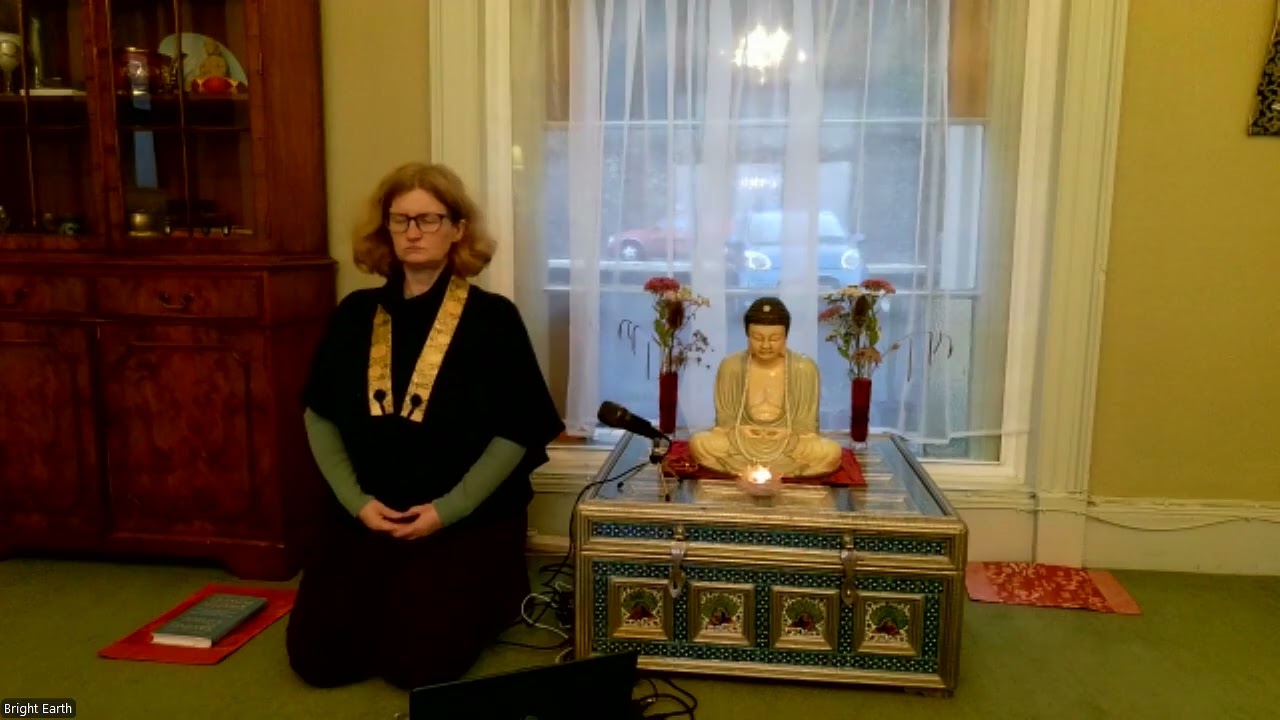
A Buddhist group practice led by Satya Robyn and Stuart, featuring readings on grace, chanting of Amitabha, recitation of the Four Refuges and precepts, and guided prostrations. The session includes reflections on compassion and boundary-setting, community announcements, and closes with tea.
Chapters
Welcome to everyone here in the Shrine Room, and welcome to Tim joining us on Zoom. So we'll begin this evening with a reading from a book that I've just started. It's called Saving Grace: Speak Your Truth, Stay Centered, and Learn to Coexist with People Who Drive You Nuts. So whether or not you have anyone in your life that drives you nuts, she, um, she's a— she's basically a senior political analyst and columnist. So she, um, she's interested in in the, the division in our culture and how we can kind of speak to that without falling into hating, basically. And, uh, yeah, so it's just a description of grace, and the quote at the top is by Philip Jansky: we live in an atmosphere choked with the fumes of ungrace. Grace is what makes human coexistence possible. Every thriving relationship in history between friends, family, communities, and countries has been saturated with grace. Grace is what lets us stumble, fall, get back up, and try again. Grace is what welcomes you back after you have failed someone or failed yourself. Grace is what the Franciscan priest and writer Richard Rohr calls the X factor. It knits families, friendships, and countries back together after betrayal, hurt, and even violence. It's the father running to embrace the prodigal son when he's starving, penniless, and drenched in shame. It's refusing to reduce people to the sum of their worst actions. We see it in the humility of the utterance, 'There but for the grace of God go I.' True grace is unworldly, otherworldly. It goes against every instinct we have to seek revenge for wrongs or to shame and humiliate people who have acted immorally or unethically. It is what the theologian Dorothy Soll, who grew up in Nazi Germany, called Borrowing the Eyes of God. It enables us to see the divinity in every person, no matter what they've done, what they believe, or who they voted for. Grace is giving other people space to not be you. It's the sweet sound that cracks open a hardened heart. It smooths the edges of rough regret about the things we did and the things we failed to do. It gives us permission to accept that we were doing the best we could with the information we had. Or as Maya Angelou says, you did what you knew how to do, and when you knew better, you did better. Grace tills the ground so that peace, wholeness, and completeness can take root in our burdened bodies, relationships, and the world. Reduced to its absolute essence, Grace is unmerited favor. In the Christian tradition, it's what God gives us free of charge. But in a country that fetishizes accomplishment, tells people they can hustle and grind their way to worth, and fancies itself a meritocracy, many are offended by the idea that other people would get something they haven't earned. Practicing grace, in other words, can be really freaking hard. It's something we love to receive, but often the last thing most of us want to offer. Instead, we incline ourselves towards what the author Philip Yancey calls ungrace— withholding that which the world desperately needs. We become the prodigal older— the prodigal's older brother, glowering in the background, jealous and fuming about how undeserving his other younger brother is of his father's reflexive affection and forgiveness. More often than not, it's the lens through which we view people who don't share our religious, political, or moral values. Our lack of— our lack and misunderstanding of grace and shrunken capacity to give grace is one of the things that makes the world such a brutal place. Lisa Sharon Harper, the writer and anti-racism leader, told me, "Discernment is necessary, judgment is vanity." Yet our mortal daily bread is to sit in judgment of bad people, to call out those who hold bad beliefs, and to punish people who have done bad things. This is what the good guys do. Doing so makes us feel strong, and righteous, like we're on the side of the angels, until it doesn't. So we will sit quietly together for a while, and after some silence, we'll do some chanting together. And the word that we will chant is Amitabha, the name of the Buddha of infinite light. And then we'll have a bit more silence.
Amitabha. Amitabha. Amitabha. Amitabh. Amitabh. Amitabh. Amitabha. Amitabha. Amitabha. Amitabha. Amitabha. Amitabha. Amitabha. Amitabha. Amitabha. Amitabha. Amitabha. Amitabha. Amitabha. Amitabha. Amitabha. Amitabha. Amitabha. Amitabha. Amitabha. Amitabha. Amitabha.
We'll now recite the refuges, precepts, and vows together, which are on the liturgy sheet. So please repeat after me. For refuge I go to the Buddha.
For refuge I go to the Buddha.
The one who is awake and full of love.
The one who is awake and full of love.
Namo Buddhaya.
Namo Buddhaya.
For refuge I go to the Dharma. For refuge I go to the Dharma, all that guides us to wisdom and compassion.
All that guides us to wisdom and compassion.
Namo Dharmaya.
Namo Dharmaya.
For refuge I go to the Sangha.
For refuge I go to the Sangha.
Those who live in the Buddha's light.
Those who live in the Buddha's light.
Namo Sanghaya.
Namo Sanghaya.
For refuge I go to the Earth.
For refuge I go to the Earth, the holy ground of awakening. The holy ground of awakening.
Namo Bhumi.
Namo Bhumi.
With faith in the Four Refuges.
With faith in the Four Refuges.
And in light of our human tendencies.
And in light of our human tendencies.
I pray that I may become aware.
I pray that I may become aware.
Of when I take life. I pray that I may become aware— —of when I take what is not freely given. I pray that I may become aware— —of when I fall into sexual misconduct. I pray that I may become aware— —when I fall into wrong speech.
Of when I fall into wrong speech.
I pray that I may become aware. I pray that I may become aware. Of when I become intoxicated. Of when I become intoxicated. No blame. No blame. Be kind. Be kind. Love everything. Love everything.
Innumerable sentient beings, we vow to save them all. Inexhaustible are deluded passions, we vow to transform them all. Immeasurable are the Dharma teachings, we vow to master them all. Infinite is the Buddha's way, We vow to fulfill it completely.
So the, uh, one of the bits I really liked about this reading is the description of grace as unmerited favor, which reminds me very much of what we talk about here a lot, that the Buddha loves us just as we are. We don't have to do anything to earn that love. Um, and I also like the quote about looking through God's eyes. I often talk about looking through the Buddha's eyes at people or the world, and I think that that is something we can aspire to, to, uh, to see other people as fallible, struggling bambu beings with a variety of spiky self-protection that causes harm to usually the person involved as well as people around them. And of course, different people have different levels of protection, different kinds of spikes, but we all have a few of those spikes. And that's, uh, great, but it's also for me really important that that comes alongside an acknowledgement that accepting someone as they are doesn't mean not setting boundaries. It doesn't mean, um, being naive about how it might be to be in relationship with that person, or it doesn't mean staying quiet when they say things that are unkind. And that happens with, you know, with groups of people too. I'm in this, uh, I've mentioned this last week, but a Facebook group, a new Facebook group called Worcestershire Against Hate, which is speaking up in various ways against the racism that's popping up around the country. And I asked myself in the silence just now, did the Buddha set boundaries? Like, did the Buddha— what did the Buddha do in these kind of situations? And, and there's two things that the Buddha did that I often return to because they show me something about, um, how an enlightened person lives. The first is that when he was tired, he would tell his assistant Ananda to turn people away. Because he needed to rest. And the other thing he did was disappear into the mountains, uh, for periods of time to spend time in contemplation. So certainly when it came to his own limits, the Buddha was a human being as well as an enlightened being. Certainly when it came to his human limits, he was pragmatic about what he was able to offer and what he wasn't able to offer. And that brings me great comfort because I have a tendency to think that I ought to be able to offer unlimited whatever it is. That if somebody has a need and, and if I could meet it, then I just should. That's what good people do. That's what good Buddhists do. And that clearly isn't what the Buddha did. And the other thing that the Buddha definitely did was give a lot of guidelines to the people in his community, certainly his monastic community. The, the writings from the monastic community are the ones, mostly the ones that we have left. From the Buddha. We don't know so much about how he, um, how he dealt with lay people, but there were, there were, there was a very long list of rules for people in the monastic community, some of them quite amusing, and, and some of them that obviously came into, into being after something happened in the community that he wanted to try and stop from happening again. Um, and that is another way of, of setting boundaries. It's another way of saying, look, I love you just as you are, and if you're going to be a part of this community, you need to speak kindly about each other. You need to not be angry at each other. And I think that it's something that can get confused, that we think that if we are able to see through the Buddha's eyes, if we're able to see a person through the Buddha's eyes, then, then we'll just forgive them, and, and that it isn't appropriate to think about how to keep ourselves safe. And how to keep other people safe, that both of those things can happen at the same time. And in my experience— this is my experience more and more— is that when I do actually look after myself properly, the other person might not like it at the time, but in the long run, it's often better for both of us, not just for me. And it's also helpful to remember that it's not within our capacity to see through the Buddha's eyes all the time, because we're not Buddhas. And luckily, that's the Buddha's job. So if we are really struggling to, um, to not put someone in a position of bad— and this book was written, you know, during the early days of Trump, so that's what she's— that's where she's coming from— if it, if it's hard to do that, then that's okay, because the Buddha does that. The Buddha is able to love and deeply understand where that, that spiky or violent self-protection comes from and why it's necessary for that person. And, and hopes— I, I imagine that the Buddha hopes that there is some unfolding, that karma kind of does its job, and eventually, maybe in several lifetimes, that person can become kinder. That we can also be kind to ourselves when we don't manage that. And sometimes as a sangha, we can manage it, that, that there are different people that are poking each other in various ways, and that there's someone else that, that isn't poked in that way that can kind of hold that, that space of grace. But I can't remember the phrase that she used, but it's definitely, it's definitely very hard sometimes. So gratitude to, gratitude to not having to be perfect at it. And gratitude for the example that the Buddha sets and continues to set, and gratitude for the grace that pours down in every moment. Namomitabha. So in a minute we will stand and make prostrations to the Buddha. So if you make sure that you've got some floor in front of you and point towards the main shrine, and the chant we will chant is Nam-myoho-renge-kyo.
People busily engaged in secular matters take no notice of life wearing away day by day, night by night. Like a lamp in the wind, how long can it last? In the six realms of vast samsara, there is no fixed abode until we are emancipated from the sea of afflictions. Affliction? How can we rest in peace? Should we not be afraid? While we still have strength, let us each hear the Dharma. Let us strive and diligently seek the path to sanctity. If you'd like to come and stand back at your seats. We always finish practice by thanking each other for being here, so we aren't on our own. Buddha has also been here with us, so thank you to the Buddha.
Thank our seats and tidy our seats. So this Saturday morning we have an open morning which will include introductory talks to Buddhism, and there's been an amazing array of cakes offered. Millionaire shortbread. So if nothing else, come and have some millionaire shortbread on Saturday morning. Vegan millionaire shortbread is quite a rare thing I have a book group starting tomorrow night.
If you speak to me very nicely, you might be able to squeeze in. Any other announcements, Stuart? No, I don't think so. Great. So we will finish with a closing verse.
Blessed by Amitabha's light, may we care for all living things and holy earth. Hopefully you'll join us for a cup of tea. The donation bowl is in the hall.









