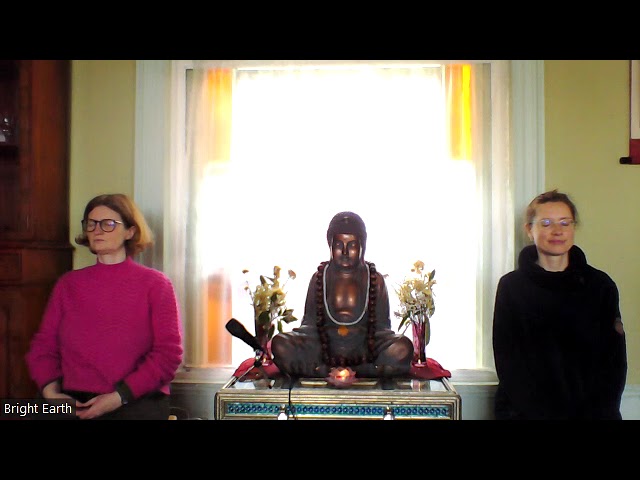
Satya Robyn leads a guided Buddhist group practice with haiku, silent meditation, and chanting of Namu Amida Butsu. The session includes prostrations and a merit transfer dedicated to the recently deceased Reverend Saito, held both in a shrine room and on Zoom.
Chapters
Good morning, everybody. Welcome to Ian and Matt and Judith on Zoom. Welcome, Judith, your first time, and everyone in the shrine room. Um, a few people here who haven't been before today, so I'll attempt to explain some things. If I don't, then don't worry about it. You can ask me questions after. Um, so this morning we will begin with some, uh, some Dharma Glimpse haiku from Sonia, who was in my book group with Alison, and we've just finished. And a Dharma glimpse is a piece of writing that describes a little moment of inspiration. Something suddenly comes into focus, or little insight, and they're usually just bits of prose, but, but Sonia wrote hers as some lovely little haiku. And so I will hand over to Izzy, who's kindly agreed to read them out. A series of haiku inspired by River of Water, River of Fire, Dharma Glimpses by Sonja Sunim. Higher synth bulbs break free in darkness, seek out light, dizzying blue heights. Dandelion clocks puff, pretty drift, weeds gently checked make way for clover. Yarn pulled loose unravels my winter shawl, shape new skeins, namo amidabu. Through flame valley wave, cave mount maze weaves golden thread, namo amidabu. Namomidabu. Touched by light, awaken now. Namu Amida Butsu. Okay, so we will move into some silence together. Really beautiful in the garden this morning. The rain stopped just as we began walking around and the air felt cleaned by the, by the rain somehow. So as we sit quietly this morning, you might want to imagine yourself in some natural space, or be here in this room knowing that we're surrounded by the sky, the ground far underneath us. The trees. You might be able to hear the birds. And in the silence, as thoughts come up, just notice them. You might want to do a little bow and let them go. As feelings come up, notice them, do a little internal bow and let them go. Over time, you may find that things begin to settle a little bit. If they do, then enjoy that. But if they don't, know that it's still worthy, that's still of worth to sit still and quietly as things inside rumble around. Namaste. Now we'll move from silence into chanting together. Chanting is a different way of connecting with infinite love personified by Buddha or Buddhas. And the Buddha, or the qualities that we're connecting with with this chant, is Amida Buddha, also known as Amitabha. As you begin chanting, it may feel— you may have self-consciousness or worry about whether you're getting it right or not. The best advice is just keep going, and the The more you do it, the quicker that wears off. After the chanting, we'll go in silence again, and then after a little bit of silence, Kusuma will ring the bell 3 times. So we always have bells to punctuate so we know when to stop. So the word is Amitābha.
Amitabh. Amitabh. Amitabh. Amitabha. Amitabha. Amitabha. Amitabha. Amitabha. Amitabha. Amitabha. Amitabha. Amitabha. Amitabha. Amitabha. Amitabha. Amitabha. Amitabha. Amitabha. Amitabha. Amitabha. Amitabha. Amitabha. Amitabha. Amitabha. Amitabha. Amitabha. Amitabha. Amitabha. Amitabha. Amitabha. Amitabha. Amitabha. Amitabha. Amitabha.
So now we recite some words together which link Buddhists throughout the world and throughout history. It's mostly repeat after me, but it is on the small liturgy sheet in front of you if you want to follow along, starting with the refuges. Are you happy to do the Bodhisattva vows?
Great.
So please repeat after me. For refuge I go to the Buddha. For refuge I go to the Buddha. The one who is awake and full of love. The one who is awake and full of love. Namo Buddhaya. Namo Buddhaya. For refuge I go to the Dharma. For refuge I go to the Dharma. All that guides us to wisdom and compassion. All that guides us to wisdom and compassion. Namo Dharmaya. For refuge I go to the Sangha, those who live in the Buddha's light. Namo Sanghaya. With faith in the Three Jewels, I pray that I may not take life. I pray that I may not take life. With faith in the Three Jewels, I pray that I may not steal. With faith in the Three Jewels, I pray that I may not fall into sexual misconduct. With faith in the Three Jewels, I pray that I may not fall into wrong speech. I pray that I may not fall into wrong speech. With faith in the Three Jewels, with faith in the Three Jewels, I pray that I may avoid intoxication. I pray that I may avoid intoxication. No blame.
No blame.
Be kind.
Be kind.
Love everything. Love everything.
Innumerable are sentient beings. We vow to save them all. Inexhaustible are deluded passions. We vow to transform them all. Immeasurable are the Dharma teachings. We vow to master them all. Infinite is the Buddha's way. We vow to forfeit on thee.
Nam-myoho-renge-kyo. So this is where I say some things. Caspar, my spouse, and Tiaame, my colleague and friend who lives here in the temple, are not here this morning because they're at the funeral of Reverend Sykes. Saido, which is happening right now in Telford. And Reverend Saido has worked with Casper for more than a decade as a part of the network of Buddhist organizations, which is like the umbrella group in the UK. And he is— he was a member of the Order of Buddhist Contemplatives. Which was an order started by Reverend Hugh Kennett. So we have links with Reverend Hugh Kennett through our history in the sangha. And Reverend Saido was a very kind and good man. Um, he spent his life— he was a monastic, but he spent his life visiting people in prison to teach them about Buddhism. And he was on, I think, many different trustee groups. He did a lot of work for a lot of people in a very quiet, humble way. And he received a cancer diagnosis only a few weeks before his death, and he was in pain, and he spent that time handing everything over, meeting with people in his sangha and writing down all the things that needed to be done. That right until the end, he was thinking about other people. I really hope that he's getting a holiday wherever he is now. He definitely deserves it. So it's really an important part of our practice as Buddhists or as spiritual people to praise others, to see the good in others, and to appreciate them. And I really feel— I didn't know Reverend Saito very well myself, but I really appreciate his presence the legacy that he's left. And at the end of practice today, we'll transfer all the merit that we've gathered by sitting together, and, and we'll, we'll transfer that all to him. And it's easy to praise some people. Some people live lives that are very clearly centered on generosity, and that plays out in many different ways. I felt extremely grateful. I spotted— I was quite glad to spot at one of the commons the man who was collecting the dog poo from the dog poo bin, because whenever I put my dog poo in that bin, I think I'm really glad I haven't got the job of collecting this. So I ran over to him from halfway across the common to say thank you so much for collecting all the poo. He was like, oh, part of the job. I think he was a bit like, oh, I've never done that before. Some people, like the dog poo collecting man, are easy to praise, and other people not so much. And I'm sure that we all— I won't name any examples from the media because I'm sure we can all think of examples from our own life of people who are more difficult to appreciate. And it reminds me of a sutra. I wish I was the kind of person that remembered the names of sutras. If you want me to try and look it up, I will. But a sutra about how to relate to the good in others, and it said something like, if the person in front of you has a lake of goodness inside them then relate to that lake of goodness, appreciate that and connect with it and be grateful for it and let that person know that you appreciate it. And if they've got a puddle of goodness inside them, then relate to that puddle and notice it and cherish it. And if they've got a teensy weensy drop of goodness in them, find that and relate to that. And I really love that teaching because it reminds me that, um, that the goodness is in there. To extend that metaphor, my experience is that we all have a lake of goodness in there somewhere, but it often gets crusted over with self-protection, trauma, and preoccupation with needing to keep ourselves steady or to ward things away. So often what we see is just a tiny little drop, but we can trust that if we see that drop, we can get little glimpses of the lake of goodness that's in there. And it may be that during this person's lifetime that, that lake is always crusted over, that we never get to see it, or it never gets expressed in the world. But Buddhism talks in long periods of times. Sometimes it takes many lifetimes for something to break through, for goodness to, to, um, to blossom. So maybe over the course of the day, you might want to see if you can notice the goodness in those around you. And if you can, tell them, say thank you. But if not, then just know that your appreciation will, will cause some sort of shift in the, in the universe. But it all counts.
Nam-myoho-renge-kyo.
So in a minute, Kusuma will ring the bell, which means that we all stand up and face the main shrine, and then we make prostrations to the Buddha. Do go as far as your body and mind will allow you to go. So if you're able to copy us and do a full prostration, great. If not, then a standing prostration— a standing bow is fine. Um, prostrations are another way of relating to that goodness that I was talking about, and they're something that I found very difficult when I first started doing Buddhism because it felt like I was putting myself down. What I now feel is probably my favorite thing to do is that it's a kind of a relaxing into being held by that love and trusting trusting that goodness is there. And the chant that we do as we do the prostrations is 'Nam-myoho-renge-kyo.' I call out to Amida.
Namoh Amida Buddha! Namoh Amida Buddha! Namoh Amida Buddha! Namoh Amida— Namoha miya. Namoha miya. Namoha miya. Naomi. Naomi. Naomi.
Turn to standing seats. So we'll transfer the merit from the practice this morning to Reverend Saito. May he be at peace.
Satya Robyn, a pure land of peace.
If there was ever a candidate for the pure land, I think Sayadaw was definitely that. And then we always finish by appreciating each other by bowing to each other, one side and then the other. Uh, let's start again. So when Kusum rings the bell in a second, I'll turn towards Kusum and bow, and Izzy will turn towards Jonathan and bow, and then you bow in the opposite direction just once. So it's not bowing to everyone in the room, it's just right and left and ish. We'll just keep working on that. And then we bow towards the Buddha. And then we tidy our seats and bow to our seats. I'm trusting that you will bow on Zoom. I'm never looking, but I'm trusting that you do that. I can see that Matt's just bowed. Yeah, great, well done. And then we close with the closing verse, which is on the liturgy sheet if you want to join with us. It starts Blessed, blessed by Amitabha's light, may we care for all living things and the holy earth. Nam-myoho-renge-kyo. So I'm going to stay to say hello to these guys here.
If









