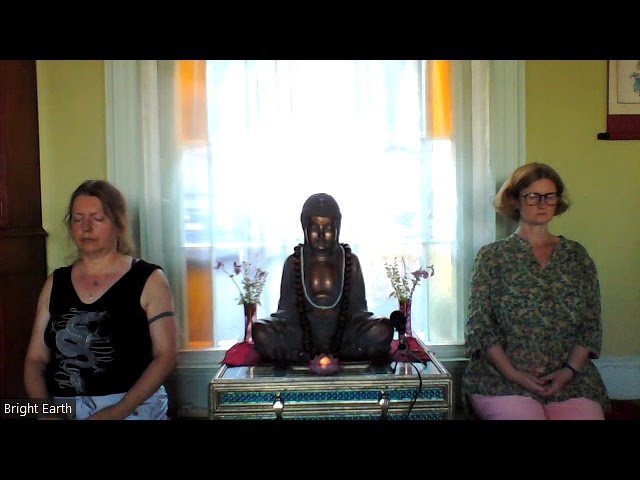
Satya Robyn leads a guided Buddhist practice session with meditation, group chanting of Amitabha and Nam-myoho-renge-kyo, and recitation of refuges and vows. A Dharma reflection touches on email anxiety and mindfulness.
Chapters
Extra points for getting here in the heat today. Welcome to Blame the Slime Room and to Frankie. Thank you, and Martin, a warm welcome. Can you hear me okay? Yeah. So we will begin with a Dharma glimpse from Sonya, which will be read out by me, Satya Robyn. Dharma glimpse by Sonya. Sonia. At night I'm plagued by emails, ones I've received, ones I need to send, ones I need to reply to.
The words fly around in a mounting frenzy and I just want to let go and go to sleep. I'm finding it increasingly hard to switch off these days, and I'm especially annoyed because I regard this as one of the things I'm good at. So throw in some feelings of failure there too. Why do emails do this? I notice it happens when some part has been activated. It's always the same thing— not good enough feelings triggered by being condescended to. One email is really bothering me. Finding the right words to reply takes More than anything, a pause. Their intentions, my intentions, a lot of this is flying under the surface, not visible to us. I notice in myself and in others a feeling of self-righteousness. The intention is to correct the other person, and woe if you get into that spiral, and woe if you are both insistent on having the last word. I've worked in lots of roles where diffusing conflict has been an important skill, where all parties leave feeling heard and perhaps with more understanding. I notice now that what made that easier was being in a position of recognized authority. It's a bit different when you either don't have power or you're taking power out of the equation entirely. It gets to the end of the day and the pause hasn't been long enough. I don't reply to the email. At night, the words keep coming back to me, little stings. I get angry. I remember to say the Nembutsu and ask for clear seeing. The words fly back, amplified. I get upset. I remember Satya Robyn to say the Nembutsu. The spiral again. I say the Nembutsu. In the morning, I'm grateful to wake with the knowledge that I have managed to get some restful sleep. Later, I log on and the email doesn't seem so bad now. I think about the person receiving my response, their complicated reactions, the daily irritations of life they are juggling, the space in which they are receiving my words. I try to understand the ripple effect. This is not just an email, but a person's heart I am speaking to, however mundane the subject might be. I picture the Buddha's smile, type the words, and hit send.
Namaste. Thank you. So we will do some quiet sitting all together, and you can either just pay attention to your breath as you sit quietly, or if you prefer spend some time with the Buddha, just hanging out with the Buddha quietly. You might need to lean on the Buddha. You might need to hand something over. You might want to draw strength or peace or hope from the Buddha. Whatever you need, just allow yourself to receive it over the next 10-15 minutes as we sit quietly together. And then after a while, we'll start chanting, and tonight we will chant Amitabha. So do join in when you get the hang of it.
Amitabh. Amitabh. Amitabh. Amitabh. Amitabh. Amitabh. Amitabh. Amitabha. Amitabha. Amitabha. Amitabha. Amitabha. Amitabha. Ameen. Ame taba. Ame taba.
Ame. Amitabha.
Amitabha. Amitabha. Amitabha.
Amitabha. Ciao! Ciao! Now recite the refuges, vows, and precepts together, so please repeat after me. For refuge I go to the Buddha. For refuge I go to the Buddha, the one who is awake and full of love.
The one who is awake and full of love.
Namo Buddha.
Namo Buddha.
For refuge I go to the Dharma.
For refuge I go to the Dharma.
All that guides us to wisdom and compassion.
All that guides us to wisdom and compassion.
Namo Dhamma. Namo Dhamma. For refuge I go to the Sangha.
For refuge I go to Sangha—
those who live in the Buddha's light. Those who live in the Buddha's light. Namo sanghaya! With faith in the Three Jewels, with faith in the Three Jewels, I pray that I may not take life. I pray that I may not take life. With faith in the Three Jewels, with faith in the Three Jewels, I pray that I may not steal. I pray that I may not With faith in the Three Jewels— I pray that I may not fall into sexual misconduct. With faith in the Three Jewels— I pray that I may not fall into wrong speech. With faith in the Three Jewels— I pray that I may avoid intoxication. No blame, no blame. Be kind, be kind. Love, love. Innumerable are sentient beings.
We vow to save them all.
Inexhaustible are deluded passions.
We vow to transform them all.
Immeasurable are the Dharma teachings.
We vow to master them all.
Infinite is the Buddha's way.
We vow to fulfill it completely.
So the past couple of weeks I've been reading a couple of books. Visions of Mahayana, I think it's called, by Nagarjuna, and A Very Short Introduction to Buddhism by Damien Kean. I'm not sure pronounce his surname, sorry. And I'm reading these books because, um, there's a couple of syllabuses and I need to find suitable books to put on the syllabuses. And what I'm looking for is a book that gives a kind of summary or paints a sketch of Buddhism. And so far, reading the books have had the effect of, um, showing me more and more things that I don't know. Just impossible to comprehend the complexity and the vastness of the Buddhist canon. Since the Buddha was teaching 2,500 years ago, his teachings have spread through many countries over the centuries. Different philosophies and positions and ideas have come and gone. Some of these ideas have crystallized into more permanent, uh, schools or, uh, particular sets of doctrines. Um, but really it's mind-blowing. It's mind-boggling, the scope and the diversity within the Dharma, within the ways that the Dharma is practiced. And as I start to read the second book, the very short introduction, which isn't that short, it's quite quite short. It's talking about all the teachings of the Buddha, hardly even mentioned him in the first book. There was so much else that was written about. And already in this short period of practice, we have touched into lots of different traditions. We did the Nembutsu together, which is a Pure Land practice. You might have done a bit of visualizing the Buddha in the silence, which is a very traditional practice. Might have done a bit of bowing already. We'll certainly be doing some in a minute. Listening to the Dharma through Sonja's Dharma Glimpse. Lots of different practices that different Buddhists have had over the centuries and that still have now. That the difference between a Tibetan temple and Tibetan practice and a Zen monastery and Zen practice, you'd hardly know that it was the same religion. In some ways I feel very lucky because we don't have a tradition here in this temple that's been passed to us, which is how it often works. This is the form, this is how you do things, this is what we believe. Um, and then sometimes I really wish that we had that, because instead we get to pick from all of this different, um, all of this universe of ways of approaching the Buddha's teachings. And then the phrase that came to me as I was sitting silently and thinking about saying this is what I suggested before meditation, which is that you might want to hang out with the Buddha. And so for me today That is Buddhism. It's hanging out with the Buddha, hanging out with what the Buddha embodied, which is love and wisdom. Perfect love, perfect wisdom. And just being in that space and letting that work away on you. One of the reasons I like Nembutsu is that it's very simple. We just say Nam-myoho-renge-kyo. You don't have to worry about anything else. Nembutsu is also a way of hanging out with the Buddha. And there he is in the shrine. And we will now hang out with the Buddha by just lying ourselves down in front of him and relaxing into the ground. And as we prostrate, we will chant Nam-myoho-renge-kyo.
Namoh Amida. Namoh Amida. Namoh Amida. Namoh Amida.
Return to stand at your seats, and then we finish by bowing to each other and to the Buddha. Into our seats and tidying our seats. And then we finish with the closing verse, um, which you'll find on your bits of paper. Sorry guys on Zoom, need a moment to type into the chat box. Bless Father, Son, and Holy Spirit, may we be there for all of you Thank you, Kaskamita.









