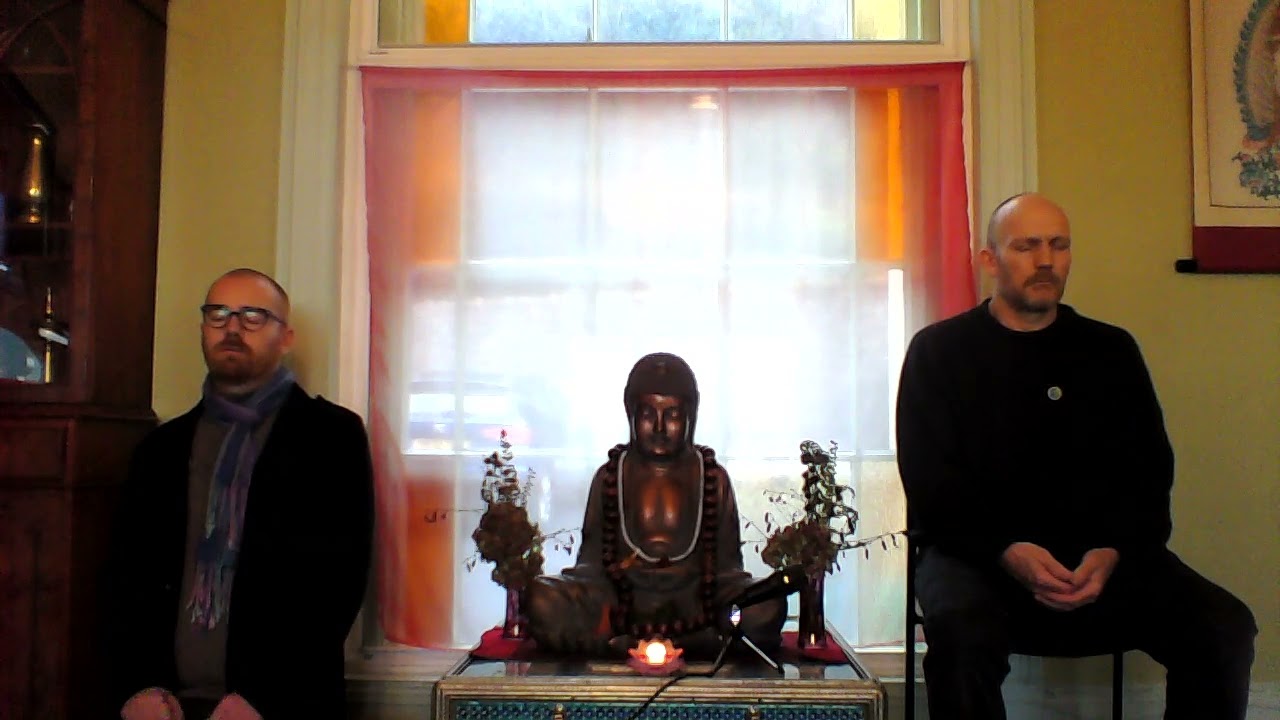
Satya Robyn leads a Buddhist New Year shrine-room practice with four people. The session includes a Dharma reading by Dave on taking a wider view, chanting of Amitabha, refuge vows, guided sitting, and closing well-wishes.
Chapters
Morning everyone. Morning if you're joining us later on YouTube. Happy New Year. No one on Zoom this morning, obviously all partying until late last night. So there's 4 of us in the shrine room this morning, and Dave is going to read a Dharma glimpse for us to get things going.
It is called A View from My Window. Nugget: Wisdom is to never stop taking a wide view of things. Our vision could widen to include the whole world. I spend much time looking out of the window of our dome home. Over the 10 years of looking, it has been teaching me to take a wide view of things that I could see out of only one window. When I look out of the large slanted window in the loft, I see only the sky and some passing clouds during the day. At night, the stars shine in and the moon, when it's out, shines through. And seems to be circling around the dome. If I just spent my time looking out of this one window, in my narrow egocentric view I would insist that the world just consisted of the sky, clouds, sun, and stars. But on the main floor of the dome we have two narrow rectangular windows that are close to the floor. Looking out of these windows gives me a view of fields of prairie grasses, From this view I could say these grasses mixed in with a few wildflowers made up the world. PBS TV has a motto: watching PBS is like having a window onto the world, i.e., their shows can give one a wider view of the world, but as demonstrated above, it can also narrow one's view and make me believe that what I see out of one window is a true picture of reality. Stepping outside, I can see how all these separate views are all connected. It's teaching me to come from a wider view in the mind. I am learning that taking a wider view is really to cultivate a beginner's mind. It also demonstrates that I really don't know on the surface what anything means, and if I think I do, I am coming from ignorance. Truth reveals itself when we take a wider view than just seeing out of one window.
Well, it's from this book, and I will put the, the, uh, I'll put the name of the person that wrote it in the video description. So we'll just have some time sitting quietly together, just noticing how you are moment to moment, what's happening in your body, what's happening in your mind, what's happening in your heart. Seeing if you can just take that step back or sideways into the observer position. And if not, just saying that the Buddha's eyes are looking kindly upon us. Amitabha.
Amitabha.
Amitabha. Amitabha. Amitabha. Amitabha. Mami, ta ba. Mami, ta ba. Mami, sa. Amitabha. Amitabha. Amitabha. Amitabha. Amitabha. Amitabha. Amitabha. Amitabha. Amitabha. Amitabha. Amitabha. Amitabha. Mami. Amitabha. Amitabha. Amitabha. Amitabh. Amitabh. Amitabh. Amitabha. Amitabha. Amitabha.
For refuge I go to the Buddha.
For refuge I go to the Buddha.
Namo Buddhaya. Namo Buddhaya. For refuge I go to Dharma.
For refuge I go to the Dharma.
Namo Dharmaya.
Namo Dharmaya.
For refuge I go to the Sangha.
For refuge I go to the Sangha.
Namah Sangaiah. Namah Sangaiah. With faith in the Three Jewels—
with faith in the three jewels—
I pray that I may not take life.
I pray that I may not take life.
With faith in the Three Jewels.
With faith in the Three Jewels I pray that I may not steal.
With faith in the Three Jewels I pray that I may not fall into sexual misconduct. With faith in the Three Jewels I pray that I may not fall into wrong speech. With faith in the Three Jewels I pray that I may avoid intoxication.
I pray that I may avoid intoxication.
No blame.
No blame.
Be kind.
Be kind.
Love everything.
Love everything. Innumerable are sentient beings.
We vow to save them all.
Inexhaustible are deluded passions.
We vow to transform them all.
Immeasurable are the Dharma teachings.
We vow to master them all.
Infinite is the Buddha's way.
We vow to forfeit it completely. In this little book from the Poetry Pharmacy, there's a quote from a Susan Coolidge poem called Every New every morning, every day is a fresh beginning. Listen, my soul, to the glad refrain, and spite of old sorrow and older sinning and puzzles forecasted and possible pain, take heart with the day and begin again. Again, probably Satya Robyn, to make it rhyme. And I like the I like the message here, and it feels particularly important at New Year, this quite arbitrary date. It's a sort of quirk of history that it's ended up here. You know, it makes much more sense for it to have been 2 weeks ago when we had the solstice, but various Roman emperors mucked around with the calendar, and here we are. And there's this impetus to turn over a new leaf, to wipe the slate clean, to begin again, especially on New Year's as the days are lengthening and we decide to take a break from Christmas gluttony. And actually, the little stanza reminds us that every day gives us that opportunity. Opportunity to begin again. It doesn't have to be this time of year, and that there will always be old sorrows, there will always be puzzles in the future, there will always be dukkha. That's the first noble truth, dukkha. The, um, one of the images in the sutras used to represent dukkha is a wonky wheel on a cart like, yeah, you're on this journey and it's always going to be a bit bumpy being born into this world. And every day presents a new opportunity to respond slightly differently. And not just every day, every hour, every minute, every second. The teaching on rebirth Between Lives talks about the different realms that one might be born into: the human realm, the animal realm, the realm of hungry ghosts, one of the hell realms, the realm of the warring gods, the heavenly realms. But many Buddhist teachers remind us that that is a cycle that we go through. Every day, every hour, we might always be being reborn into a different state of mind depending on what's just happened, how we're feeling, the rest of our lives. We're always falling into this reaction or that reaction. So every moment offers us the chance to be a little bit brave and to do things a little bit differently. And it's hard to take a big leap, and often at New Year the impulse is to take a big leap into something completely different. And I know for me there's, uh, there's not much wisdom in that because inevitably I fail and then become disappointed and don't try and do anything differently at all. But there is something to be said for being a little bit brave and trying to do things a little bit differently each day. And the reason we're not brave usually, the reason we're trapped in these cycles of falling into the hell realms or the realm of warring gods, which is you know, the realm of anger and the war. The realm of the animals, which represents greed— although I think animals get a bad rap in that analogy— is because we're scared. We're scared that we'll be revealed as vulnerable creatures, or that other people will be upset with us, or that feelings of insecurity will overwhelm us. And I suppose it might be seen as trite now, but the antidote for fear is love. The more we can trust that we are held in a web of love, that the Buddhas and bodhisattvas are smiling on us, appearing all the time, manifesting all around us, the easier it is to take that leap. Like trusting that you've got a good friend who's going to tell you it'll all be all right. So today and every day, let's hold these things in mind, that every moment there's the opportunity to begin again, and that we can, we can be brave because we know we are loved. Namaste.
We offer this incense to the Buddhas of the past, present, and the future, to all our spiritual ancestors and worldly ancestors, to the great sages of various spiritual traditions, inviting them to bless us as we move into 2024. 2022 and inviting ourselves to remember that the light is always present.
Blessed by Amitabha's light, may we care for all living things and the holy earth.
Sorry, I jumped the gun then.









