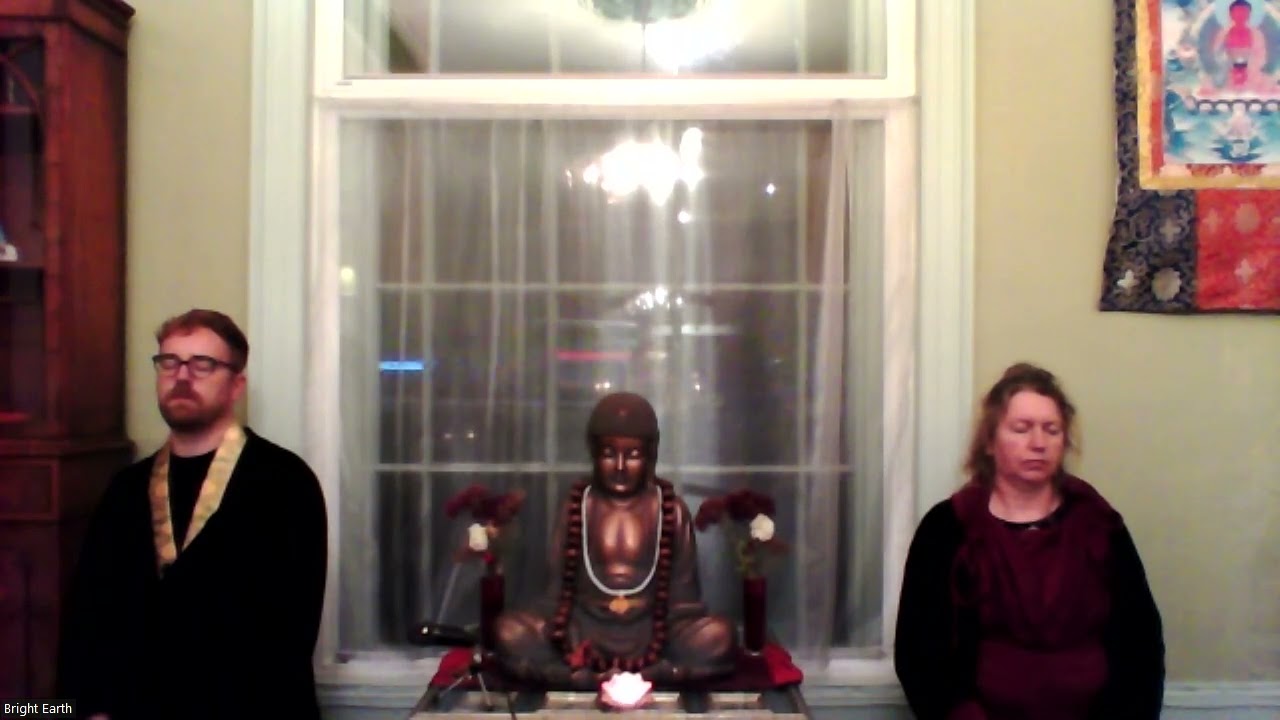
A community Buddhist practice session led by Satya Robyn featuring guided meditation, chanting of Amitābha, and recitation of refuge and vows. Bobby's Dharma glimpse explores grief, and the teaching focuses on Honen and Pure Land practice through nembutsu.
Chapters
Welcome everybody. Uh, hi to Chris who's joining us on Zoom. Nice to see you. Thank you, Angie, for doing the offerings. Let's put some time into learning the two-person choreography. Next, we'll begin practice as we always do by reading something that's been written by a member of our community about something they've learned or that's inspired them. This week we're going to hear from Bobby, who lives in the States and is part of our sister organization, cousin organization, Bright Dawn, and Fii has agreed to read for us. Thank you.
Dharma glimpse by Bobby Allander. I hope I've spelled—
said that right.
So far this year, I have experienced the death of 3 people that were fully integrated into my life in one way or another. In March, my dad passed away from natural causes just one day shy of his 80th birthday. In April, one of my closest friends died from heart failure just a few days before he and I were going to be seeing each other for the first time in several years. And two Saturdays ago, my neighbor, a young man who I've known for nearly 20 years, since he was 13 years old, took his own life. The cause of each of these deaths was vastly different, but the result was the same. For a variety of reasons that are far too numerous to name right now, over the past couple of years I have experienced a lot of grief. I have grown quite accustomed to what it feels like It has become somewhat of a constant companion. And so in some ways, these recent losses maybe haven't had quite the impact on me that they might have had in a previous season of my life. That's not to say I am numb to it. It's just that I'm keenly aware of it. And as a sort of peculiar side effect, It has made me much more aware of it in others. I have learned though that just like everything else, grief is not permanent. It ebbs and flows like the waves of the sea, in and out. If I try to push it away, the more it tends to cling to me, or I to it. The more I sit with it, examine it, and be curious about it, the less it seems to sink me under its weight. One of my teachers says there is a divine intention behind every experience. From a Buddhist perspective, I would restate this as there is a Dharma truth revealed in every experience. For me, the Dharma truth I learned from grief is that even in suffering there can be peace, and that peace comes when we loosen our grip on the suffering associated with grief, allowing it to flow in and out as it needs. Namamitabhu.
Thanks, Sarita. Thank you, Bobby. So we'll go into a period of quiet meditation together. Take a moment to notice the position of your body, aiming for a, a relaxed but upright spine with a natural curve like an elongated S, neither with the hips neither pointing too far forward, which introduces tension into the small of the back, or too far backwards, and we kind of end up slumping over and then maybe falling asleep if we're tired. Um, gently bringing awareness to the breath Noticing cooler air entering at the tip of the nose, warmer air leaving. Noticing whatever arises— thoughts, feelings, emotions— noticing them and then coming back. To the breath. We'll do this for about 12 minutes. Noticing any feelings or reactions. Oh, here's what I'm thinking about. Here's how I'm reacting to hearing noises, then coming back to the breath. So in a moment we're going to chant the name Amitābha together. Amitābha, a Sanskrit word that means infinite light, the name of a Buddha that did not exist in history but is, uh, one of the archetypal faces of enlightenment, if you like, from the Buddhist tradition. So making that connection both with enlightenment, the seed of enlightenment in ourselves, and with the enlightenment that is available in the universe. And coming away from meditation, perhaps your mind is a little quieter, perhaps you're just clearer what's in your mind, but from this place noticing, noticing that energy, noticing the Buddha. And if we're not noticing it, then trusting that it's there in the way that the sun is always behind the clouds, whether we see it or not. Amitabh. Amitabh. Amitabh. Amitabh. Amitabh. Amitabh. Amitabh. Me ta ba. Me ta ba. Ah, me ta ba. So now we recite the Refugees and Precepts and the Bodhisattva Vows together, the first part of which is repeat after me, then the Bodhisattva Vows. Our call and response, and it's all written on the A5 liturgy sheet underneath the chair or next to you. And these are words that have been said more or less this way throughout Buddhist history. They connect us to our ancestors in that sense. They point us to what's important. Refuge points us to the Buddha, the mirror of enlightenment, the spirit of enlightenment, the person, uh, who points the way, points us to the Dharma, the teachings of enlightened teachers, the Buddha particularly. And things as they are. Seeing the world clearly is enlightenment, and the world is what teaches us as much as anything. And refuge in the Sangha, the community of people putting those teachings into practice. And then the precepts, which invite us to become aware of our ethical behavior give us a direction to move in and something, a starting point to understanding our human nature. Anyway, please repeat after me: For refuge I go to the Buddha.
For refuge I go to the Buddha.
The one who is awake and full of love.
The one who is awake and full of love.
Namo Buddha.
Namo Buddha.
For refuge I go to the Dharma.
For refuge I go to the Dharma.
All that guides us to wisdom and compassion.
All that guides us to wisdom and compassion.
Namo Dhamma.
Namo Dhamma.
For refuge I go to the Sangha.
For refuge I go to the Sangha.
Those who live in the Buddha's light.
Those who live in the Buddha's light.
Namo Sangha.
Namo Sangha.
With faith in the Three Jewels.
With faith in the Three Jewels.
And in light of my human tendencies.
And in light of my human tendencies.
I pray that I may become aware.
I pray that I may become aware.
Of when I take life.
Of when I take life.
I pray that I may become aware. I pray that I may become aware.
I pray that I may become aware.
Of when I become intoxicated.
Of when I become intoxicated.
No blame.
No blame.
Be kind.
Be kind.
Love everything.
Love everything. Innumerable unsentient beings.
We vow to save them all.
Inexhaustible are deluded passions.
We vow to transform them all.
Immeasurable are the Dharma teachings.
We vow to master them all.
Infinite is the Buddha's way.
We vow to fulfill it completely. So a couple of weeks ago, whenever it was the last time I was sat here, we remembered Honen, the medieval Buddhist teacher who started the first independent Pure Land School, who taught what's called exclusive exclusive nembutsu, that the only practice you need to go to the Pure Land and then become enlightened— and some people think the Pure Land is enlightenment— the only practice you need for that is saying the name of the Buddha wholeheartedly, that that joins you to the great merit of the Buddha that will carry you to awakening. And once Honen had this revelation, maybe in his 30s, uh, he spent the rest of his life teaching this over and over again, and We have a collection of his letters, and basically whatever people ask him, he just replies and says, "Just say the Nembutsu, you'll be fine. Just say the Nembutsu. Oh yes, sorry to hear you're, you know, in these dire straits. Just say the Nembutsu." Because his own deep experience of practice told him that there was a power beyond his own thinking beyond his own willpower that was unrelated to any effort that he made, that would take him where he needed to go. And as we practice, we begin to discover that for ourselves. And when we begin practicing, perhaps we're just experimenting with that idea or trusting the people who've gone before us. I believe you can find that in meditation or through study, or as Honin did, through saying the name of the Buddha. And I'm thinking of two stories. One is of a samurai warrior who was convinced he was going to hell because he spent his whole life killing people. He lived in feudal Japan, and, uh, it was a sort of inescapable role. He was born into it, and there was no way of escaping without bringing great shame on his family and, and potentially bringing people into destitution. Institution that he cared about. So he felt very trapped in the role, and yet he would get sent out against other armies to quell rebellions. There was a lot of violence in Kamakura Japan, in medieval Japan. But he went to see Honin and said, tell me what to do. And Honin said, just say the Nembutsu. 'Even though you can't keep any of the Buddhist precepts, if you wholeheartedly keep the Buddha in mind and say these words, you'll be taken care of.' And the samurai went away comforted. And I guess on some level profoundly different. And the story goes that he died in battle with the Nembutsu on his lips and was indeed reborn in the Pure Land. And there's another story from late— a little later in Honen's life, after Honen was exiled from the capital city because people didn't like this new school of Buddhism that he was teaching, which is another story I won't tell now. Anyway, on one of these, as he was crossing the sea, he was approached by a prostitute who kind of said the same thing that this samurai said, which is why I often think of them together. I'm in this life where I'm really struggling to keep the precepts. I think I'm going to hell. This was like a lot of people worried about this in medieval Japan, whether they're going to hell or not. What can I do? And Honen, he must have seen something different in this person because he said, if you can change your life, change it. Which he didn't say to the samurai, right? But he had a sense there was a possibility here. If you can change your life, change it. If you can't, don't. Either way, say the Nembutsu. And when he came back that way, he discovered that she'd become a Buddhist nun and was very devoted in her Buddhist practice. Big change. And this is the sort of creative tension in Pure Land Buddhism. On the one hand, we are invited to trust that it doesn't matter whether we can change our lives or not. It doesn't matter if we can keep the precepts or not. It doesn't matter how much willpower we have. The Buddha is still here. Enlightenment is, is always available just next to us. As long as we can trust that, we'll be taken care of. And at the same time, we're invited to keep the precepts, to engage in spiritual training, to make progress. So we can imagine like, uh, a, uh, a cross on the floor. There's this forward motion. I'm going to make progress, I'm going to change my life, I'm going to be less of this and more of that. And that's really valuable and useful, and inevitably we will be drawn along that way. And if If we've got some energy to put effort into that, then we should do. But there's also this sideways movement that speaks to the fact that wherever we are on this line of progress, the Buddha is right here. And this is the central point of Pure Land Buddhism. Like, make that progress if you can, and, and it doesn't matter where you are on that line. The Buddha is always here. We can always rest in that loving kindness, which will naturally take us where we need to go, where we need to be. So we'll stand and place the main— main shrine for prostrations. So we bow right down to the ground. Do follow along. If you're able. And this is a way of, you know, an embodied practice that guides us into making that connection. And we chant Amitābha's name again, but this time saying slightly different version, 'Nam-myoho-renge-kyo.' Namoha Nida. Namoha Nida.
Namoha Nida. Namaste. In gratitude, we offer this incense to all Buddhas and Bodhisattvas throughout space and time. May it be fragrant as the earth herself, reflecting our carefulness, our wholehearted awareness, and the fruits of understanding. May we, in all beings, be companions of Buddha and Bodhisattvas, and be awakened from forgetfulness, and realize our true nature.
So come back to standing in our places. Each other, first to one side and then the other, and then to the main shrine and to our seats, tightening our seats and back to our seats. In a moment we'll finish with the closing verse, which is on the top of one of the sides of the liturgy sheet. But before we do, thanks for being here everybody. Please feel free to join us for a cup of tea. Donation bowl is in the hallway, and unfortunately it does cost money to run this place, so we do appreciate financial support. And, um, that's it for me. Oh, I suppose, uh, we have got a work hour after practice on Saturday if anyone wants to join. Satya Robyn will be doing some things in the garden together, uh, some pre-winter tidying. So we'll finish with the closing verse. Blessed by Amitābha's light, may we care for all living things and the holy earth. Namamitabhu. So we're experimenting with leaving the shrine room silently, still, in no particular order, but just quiet until in the hallway. Namamitabhu.









