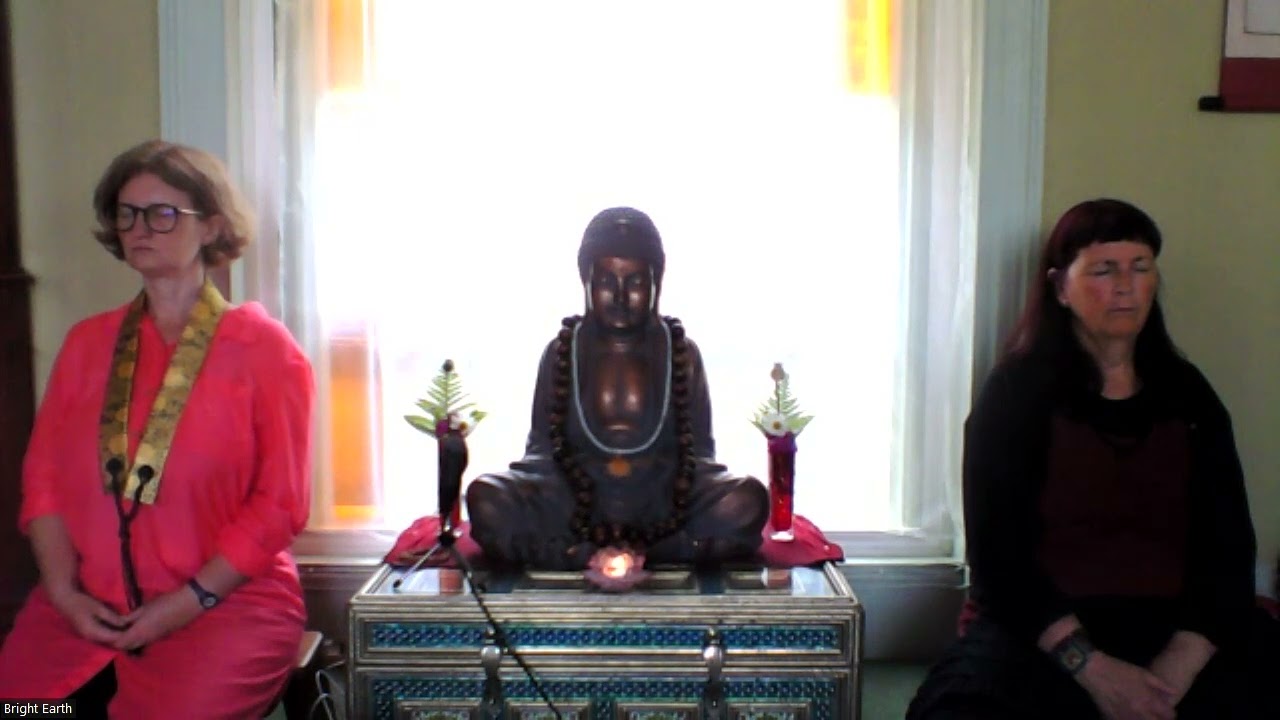
A group meditation practice in a garden shrine led by Satya Robyn and others. Keima reads a Dharma glimpse about weeding and compassion, DJAMAL leads Medicine Buddha chanting, and the facilitator uses hydrangeas as a metaphor for how conditions shape growth. The session includes recitation of refuges and precepts, announcements about a sharing circle and upcoming open day.
Chapters
Good bell, John. It's what we need to get in the mood. So welcome everybody, it's really lovely to see you all here. And today we will begin with a Dharma glimpse written by Angie and kindly read at last minute notice by Keima.
Dharma glimpse is titled Weeding, something I won't be doing today in this glorious rain. This afternoon I was weeding around my mini greenhouse that sits in the top Temple Garden. I dislike weeding for a number of reasons: it's time-consuming, tireless, endless, and any ground gained is short-lived, but mostly because I'm so deeply aware of the life I take when I weed, the lives of the plants themselves, of the miniature worlds that exist their roots, of the fungi they have, they have an inseparable relationship, and of the myriad of creatures that shelter, feed, nest, breed, live, and die around that plant. Unavoidable also is the knowledge that it was a totally selfish act, that I will put my will above that of the plants and creatures, implying that I considered my wish for a cleaner ground, a clearer ground, and and a functional greenhouse more important than their existence. I am aware that if I and others didn't weed, then the greenhouse would be taken over by plants and by the garden itself would become totally overgrown. I'm aware that most of the plants will regrow either through their fallen seeds or through the snippets of roots which remain in the ground. I'm aware that by changing the conditions I help other things to thrive, yet the harm I have intentionally caused still weighs heavy on my heart, and there is something of contrition in writing this. The nettle rash on my arms and face tingles, and I tune into it more carefully. I realize that it is showing me the intimate connection between myself and the nettles I cleared, just as the pain I feel from taking life through weeding is showing me the connection to those lives I've taken or disrupted. This realization brings a thankfulness to me which doesn't diminish the harm I've caused, but does feel like a moment of insight. Namaste.
Namaste. Thank you so much, Kema and Angie. Welcome, Satya Robyn. Satya Robyn has just joined us. Okay, so we will move on to meditation. Um, Jamye, I'm going to ask if you would mind opening the door, because I always like to take the opportunity when it's raining to do some rain meditation. So we can listen to the rain and allow the rain to offer us its blessings. On Wednesday night, Casper— Eric knows because Eric was here— Casper spoke about Dharma rain. Morning, Isi. Morning, Lena. And he's— they— sorry, they— sorry, they spoke about how the Dharma rain falls on all of us equally. And so rain is the metaphor of the week, and the The weather systems have blessed us with some actual rain this morning, which means that our brambles will also be continuing to thrive for a bit longer. We won't be doing our garden volunteer morning, but we do— we did get to walk in the rain this morning, the few of us that made it into the garden, and we do get to listen to the rain as we sit together. So as you listen to the rain, just allow the rain to bless you. Imagine the Buddha blessing every little drop, and it can just soak into you as gently. Or if you want to be under a waterfall of blessings, then that's also fine. And then we will begin chanting at a certain point. I don't know what we'll chant, but it will be on the liturgy sheet if you want to See what the words are, and then we'll have some more silence. Namaste. We will continue our theme of being blessed, and we will chant to Medicine Buddha this morning. And if you haven't done this chant before, you will definitely need to read it as we chant it because it's a bit of a tongue twister. So it's Thai, Om Begang Je Begang Je Maha Begunje Radza Samudgati Suha. So it's on the list of chants. Medicine Buddha specializes in offering medicine, so as we chant, you receive whatever medicine you need.
Mahabhagyan Jee Rasa Samudgat Te Soha. Tayatha Om Bhagyan Jee Bhagyan Jee. Mahabhagyan Jee Rasa Samudgat Te Soha. Tayatha Om Bhagyan Jee Bhagyan Jee. Om bacon jay, bacon jay, Maha Bacon jay, ratsasamudgat te soha. Satya Robyn, bacon jay, bacon jay, Maha Bacon jay, ratsasamudgat te soha. Thai Attha Om Bekken Jei, Bekken Jei Maha Bekken Jei Ratsasamudgati Soha! Thai Attha Om Bekken Jei, Bekken Jei Maha Bekken Jei Ratsasamudgati Soha! Thai, Thai, Om, bacon, jay, bacon, jay, maha bacon, jay, ratcha samut gat te soha. Thai, Thai, Om, bacon, jay, bacon, jay, maha bacon, jay, ratcha samut gat te soha. Satya Robyn, bacon, bacon, bacon, bacon.
Thai, Thai.
So we'll now recite the refuges, vows, and precepts together, and they are also written on the liturgy sheet. It's mostly call and response, but you might want to have the words in front of you. For refuge I go to the Buddha.
For refuge I go to the Buddha.
The one who is awake and full of love.
The one who is awake and full of love.
Namo Buddha.
Namo Buddha.
For refuge I go to the Dharma.
For refuge I go to the Dharma.
All that guides us to wisdom and compassion.
All that guides us to wisdom and compassion.
Namo Dhammayo. For refuge I go to the Sangha. Those who live in the Buddha's light. Namo Sangaya. With faith in the Three Jewels, and in light of my human tendencies, and invite my human tendencies.' I pray that I may become aware—
'I pray this time they've come away' —of when I take life—
of when I say bye— I pray that I may become aware—
'I pray it's on me to become aware'— of when I steal.
Of course you do! I pray that I may become aware— 'I pray that I make them aware'— but when I fall into sexual misconduct of when I fall into sexual misconduct. I pray that I may become aware. I pray that I may become aware of when I fall into wrong speech. I pray that I may become aware. I pray that I may become aware of when I become intoxicated. No blame. Be kind. Love everything.
Love everything. Innumerable sentient beings, we vow to save them all. Exhaustible ardent rooted passion, we vow to transform them all. Immeasurable are the Dharma teachings. We bow to you, Master Lao Tzu. Infinite is the Buddha's way. We bow before it completely.
So on a Saturday morning, I often receive my Dharma talk from the garden. And this morning, as we were walking around in the rain, I was really struck by the hydrangea right at the bottom near the bamboo, which is in full bloom at the moment. And it's one of the hydrangeas that was here in the hotel when we first moved in 9 years ago. It's little then, now it's pretty big. And mostly the blossoms are kind of mauve, kind of pinky, slightly purpley pink, and in places they're blue. They're like a beautiful blue. And the variety of hydrangea, the The correct colour for the blossoms is the blue, and they need to be planted in ericaceous soil, acidic soil, so the chemicals from the soil produce the kind of beautiful sky blue, purpley blue. And this bush has got kind of— in certain places it's just tending to blue, So there's obviously a difference in the soil. And it made me think about our conditions, the conditions that we all grow in. We were all planted in different locations in the country or the world, different families, different neighborhoods. We had different schools, different teachers. Different friends. Our genes are— have all sorts of conditions kind of baked into them. And that we also have very different— our blooms are very different, the expressions of our, our nature. Are very different, different to each other, different within our own lifetime at different times in our life, and different within ourselves. That within ourselves there are all sorts of different hydrangea bushes that have very different blossoms that, that come out at different times. The metaphor stretching a bit now. And what I really appreciated this morning was the pink and the blue, and there was something about the blue that was even more special because it was kind of more rare, but the pink was also very beautiful. And I'm still thinking about Kasper's Dharma talk about inclusivity and the Dharma rain and difference, and how one of our tasks as Dharma practitioners is to allow the Dharma rain to fall on us and then to facilitate the blossoming of our own blossoms, our own, um, calling, our own personality, our limitations, our, our skills and talents, our everything that we've got. It kind of goes into the pot. And sometimes we can feel like difficult conditions in our past have stunted us, and there is a reality to that. But it may also be that, that those very difficult conditions are the thing that leads you to the learning that you would never have received otherwise. My ex-partner, who's died now, was alcoholic, and I have received more gifts from him and from that really difficult time with him than I could begin to share with you that he lives on through things that I do now and the person that I am. And sometimes at the time it's really difficult to imagine that, that horrible difficult things could be one of the conditions that's necessary for our ripening. Sometimes it might be years later, decades later lifetimes later. But somehow I trust that the Buddha's reign helps us to see things in that context. It shifts our vision from the blaming of others, the blaming of our situation, the, the pain of the kind of— I don't like the word victim because I think it's very judgy word, but that sort of place that we're in when we feel like the world's just done terrible stuff to us, which I'm sure it has, but it moves us from that place. It shifts us to just wonder about what might be— what might the bigger picture be and how might we take some of that difficulty and put it into the compost and just hold space for possibility, just hold space for something new growing. So gratitude for the hydrangea, gratitude for a nice full shrine room. And gratitude for old familiar faces and new faces and all the faces in between. Namaste. Frustration, so it might be a bit more of a challenge to find some fuel in front of In gratitude, we offer this incense.
To all Buddhas and Bodhisattvas throughout space and time. May these fragrant desert flowers reflect in our careful efforts, our wholehearted awareness, and the fruits of understanding that slowly ripen. May we and all beings be companions of Buddhas and Bodhisattvas, may we awaken from forgetfulness and realize the pure land.
You like to come back to stand at your seats. Finish by bowing to each other. Find our seats, bow to our seats. So, announcements this morning: we won't be gardening. Instead, we'll meet back in this room at quarter to 11 for a sharing circle. You're welcome whether you've been to one before or not. It's just an opportunity to speak about whatever's in our hearts, or you can just listen if you prefer. And we'll have a cup of tea now. Too early for cake?
It's up to each person.
There is cake. Djamal's spoken the official line: it's never too early for cake. So there we go. And there was other things I was going to say, but I can't remember them now. Do write a Dharma Glimpse if you haven't for a while. We're down to our last one, so we've got one for Saturday and then we're in a terrible situation. Dharma Glimpses. And do write your name on the list if you haven't for a while, if you would like to. And there's also a list of volunteers for the Open Day if you're around on the 5th of August. That'd be really great. And he's got kirtan coming up. I can't remember when it is. The weekend of the Sunday. Yes, the 6th of August. 6th of August. Yes, what's the next kirtan? When I'm away. I know it's 2 weeks. 6th of August. Yeah, which is the open morning weekend. That will do. I'm ready to be. So I'll finish with the closing verse. May we care for all living things and all the holy earth. It's— this is something, it's always wine o'clock, so it's always cake o'clock. Wine o'clock, yeah, we'll have cake o'clock.









