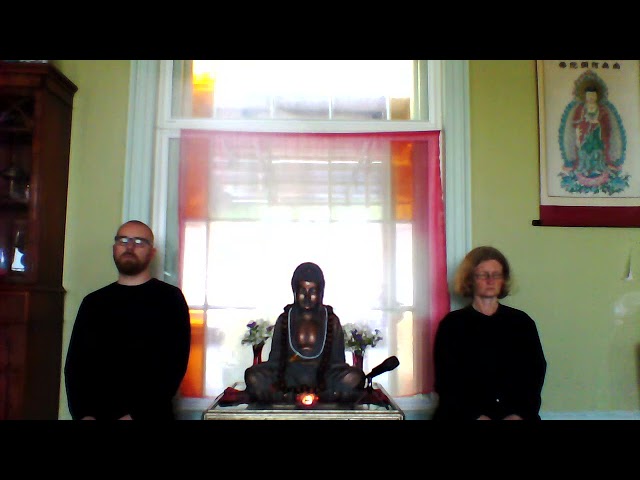
Satya Robyn leads a Pure Land Buddhist shrine practice, reflecting on the lyric "I'm only human after all" and how Buddhism teaches contrition and making amends. The session includes guided meditation, communal chanting of Om Mani Padme Hum, recitation of refuge and precepts, and community announcements.
Chapters
Good morning, welcome to the Saturday practice in the shrine. And this morning it's Satya Robyn, myself, Jahameh, and Dave. Joining us on Zoom, we've got I hope you both enjoyed the last minute on Saturday, so we may have more drop in as the practice goes on. No morning poo. No morning poo. My cousin was hoping to make it, so I'm sure she'll slide in. Morning everybody. As I was sitting here in silence, the song that was going through my mind— I don't know who it's by, someone here who's cooler might know— the song that goes, I'm only human after all. I'm only human after all, don't put the blame on me. Yes, that's right, Michael Bublé. David. Coolest man in the room. As soon as you said song, I knew you were going to say that. Did you? Maybe I got it from you earlier. Yeah, entirely possible. Anyway, that was the song that was running through my brain, so I thought, okay, thank you, Buddha, that's my Dharma talk this morning.. I think that the first part of that, "I'm only human after all," is very appropriate for Pure Land Buddhists. That really the foundation of, well, where we begin is that we are only human after all, and we're encouraged to just be honest about our limitations and the things that we, the things that we, where we reach the edge of what's possible, where we reach the edge of our patience, our competence, our courage, our discipline, our kindness, our generosity, 'And then the second part of that lyric is not quite so Buddhist, because he says, "Don't put the blame on me." I've always thought that song's just a bit, I don't know, like, I'm only human, so don't blame me, anyone.' It's a bit of a get-out. I was thinking, what would a more Buddhist version of that lyric be? And it would be something like, 'I'm only human after all, I will mess up, and when I mess up I will try to acknowledge that and make amends where I can.' And that for me, what comes along with that sense of knowing that I've messed up and seeing that something I've done hasn't been skillful, and that applies in both a consciously, a conscious way when I say something that I kind of just really want to hurt the other person in that moment or poke at them, and also the unconscious hurts that are caused when I say something that I realize later hasn't come from an entirely kind part of me. What accompanies that realization for me is a sense of contrition. And I've always liked the word contrition, there's something a bit gentler about it than guilt or fault. It's, for me, it's a sense of both taking ownership for what our actions have resulted in, and that feeling of a kind of a sadness and a regret and maybe a little bit of embarrassment, but, but it's not deep shame. It's not the kind of feeling that floods us and we just feel like we are the most terrible person in the world ever. Because blame and shame, I think, tend to go together. When we're blaming someone, what we sometimes— what we want is for them to feel shame. And then we don't have to feel that shame, because shame is a horrible thing to experience. So when he says, 'Don't put the blame on me,' my guess is he's attempting to avoid the shame he is feeling about whatever it is he's done, rather than being able to acknowledge those parts of him that feel very shamed and to find some space for genuine contrition, for a genuine sense of, yeah, I messed up and that's a sad thing, and what can I do now to do what I can to put that right? And that might be an apology, or it might be some action, or it might just be internal. It might be that that we try not to do that thing in the future, whatever it is, or we work on that thing, that part of us. So I'm only human after all. I will mess up, and when I do, I will try and recognize it and not blame other people and apologize for my part. That doesn't mean that we let the other person off the hook. The other person has probably done something wrong too, but that's their business. Karma will take care of that in the, in the long term. Maybe not this lifetime, but it'll get— it'll unfold and get there eventually. And the other part of that for me is that when we recognize how limited and human we are, It's like there's an automatic turning towards something that isn't, and we turn towards— in this tradition, we turn towards Amitābha Buddha, the Buddha of infinite light, who has infinite compassion and wisdom. And we have little intuitions little glimpses of something that isn't us, that isn't our limited fallible selves, that is available to us and that can give us more information than we have ourselves and hopefully also provide a kind of refuge for us to to go to when we're feeling especially broken. So thank you, Rag 'n' Bone Man, for your inspiration today. I hope I haven't put that earworm into all of your minds now. So during meditation, if you could try not to listen to that song over and over. So maybe to help with that, we'll do some listening meditation today. So wherever you are, as you sit quietly, just be aware of the sounds around you. And they may be human sounds from your own body or from people around you. They may be the sounds, mechanical sounds, like the cars we've got behind us on the road. They might be natural sounds like the birdsong we have at the other end of the shrine room. And just allow those sounds to be. Not— don't tune into individual sounds too much, just allow it to be like a symphony of sound and be aware of the whole lot. Just imagine that you're listening to something that's all happening outside of you together without you needing to do anything with it. And when your mind wanders, which it will inevitably do before very long, just notice that and bring it back to what you can hear. And there may be some small moments of peace or settledness. If there are, just enjoy them. And if there aren't any, then just know that the shaken up jar of muddy water is maybe taking a little bit longer to settle today, and that's okay. It's still settling even if you can't feel that it's settling. Namomi to be. So the chant that we will chant together this morning is to Kwan Yin, the Bodhisattva of Compassion, and it's the Tibetan form. So the words are Om Mani Padme Hum. Om Hri. That's Om Mani Padme Hum Hri.
Om Mani Padme Hum Hri. Om Mani Padme Hum Hri. Om Mani Padme Hum Hri. Om Mani Padme Humri! Oh mané padmé hum ri... oh mané padmé hom rii... om mané pad mé hun gri... ooh ma ne pa me hoong ree— Om Mani Padme Humri! Om Mani Padme Humri! Om Mani Padme Humri! Om Mani Padme Um— um... Om Mane Padme Humri. Om Mane Padme Humri. Om Mane Padme Humri. Om Mani Padme Hum Hri! Oh mané pa mé hum hri... oh ma né pa me hom ri— om mané pa mé ho mm riiiii. Om mani padme hum ri om mani padme hum ri—omani pa me hungri! Omani pam e hun gri? Oh ma ne pame hungry?! Omane pa me hom rii... Om mani padme hum ri om mani padme hum ri— oh! Mani Padme Hum Ri... Oh! Mane Pa Me Umri? Oohh! Mone pa me oom ree?! Om mani padme hum ri om mani padme hum ri— oh! Mané pa mé homri... Oh!
Mane pa me hooum ree...
Oom ma ne pa mem hongreee... Um mane pa me homeeeemmm... Om mani padme humbri! Oh my name Padme Humbley— oh Mané Pâmê Hungry... om namé pâmé hungreí umamne pámem hongrì Om Mani Padme Humri! Oh my name's Padminath Ramamurthy— oh mané pa mé hom ri... om mané pa mé hum riiimmmomane pa me hooum mreeeem... omané pame hoom reeeem... Om Mane Padme Humri! Om Mane Padme Hungry! Om Mane Padme Hungry! Om Mane Padme Hungry! Om Mani Padme Humri! Oh my name— oh manny pad me humry? Omani pa ma um ri... Umami pa mi om ree... Umané pame hom rii... Om Mani Padme Hum. Om Mani Padme Hum. Om Mani Padme Hum. Om Mani Padme Hum. Om Mane Padme Humri! Oh Mani Pah Me Hungry! Om Mane Pa Mehungreee— Um Mane pa me hungrie? Oomane pa me hoongreee... Om Mane pa me hoommreeeee! Om Mani Padme Humri! Oh my name— oh mané padmé humbríe... om manépame hombryée? Ooh mah ne pa me ombreeee?! Om Mane Padme Humri! Om Mane Padme Humri! Om Mane Padme Humri! Um— ma ne pa me hum ri? Oma ne Pa Me Hom Bri?! Om mani padme hum ri om mani padme hum ri—om mani Padme Hum Ri! Oh Mané Pablé Hungry? Oumane pa me hungri... Ummane Pa Me Hong Rui?! Om Mani Padme Hum. Om Mani Padme Hum.
For refuge I go to Buddha . For refuge I go to Dharma , Namo Dharmaya . Refuge— for refuge I go to Sangha . Namō sanghayai! Namo Sangha! With faith in The Three Jewels— I pray that I may not kill— —with faith in The Three Jewels—I pray that I may not steal—with faith in The Three Jewels—I pray that I may not fall into sexual misconduct—with faith in The Three Jewels— With faith in the Three Jewels, I pray that I may not fall into wrong speech. I pray that I may not fall into wrong speech. With faith in the Three Jewels, with faith in the Three Jewels, I pray that I may avoid intoxication. I pray that I may avoid intoxication.
Innumerable life sentient beings, we vow to save them all.
Inexhaustible are the Buddha's passions.
We vow to transform them all.
Immeasurable are the Dharma teachings.
We vow to master them all.
Infinite is the Buddha's way.
We vow to fulfill it completely. Namo Amitabha. Namo Amitabha. Namo Amitabha. Namo Amitabha. Namaste. Nam-myoho-renge-kyo.
Quick announcement before we do the closing verse. We will be every Saturday from 12 to 1, I sit with a group of XR in town for an hour in silence. So if anyone ever wants to join us, you'd be very welcome. Just write and ask where we will be. And this afternoon we have a mindful walk Starting at 2 in Rosebank Gardens, there's still space if anyone wants to come. Might be slightly shorter if it's raining, but it will still be lovely. And that's it. Am I muted? Oh yeah, closing verse. Sorry, unmute and we'll read the closing verse together. Blessed by our Father's light, may we care for all living things and all the earth.









