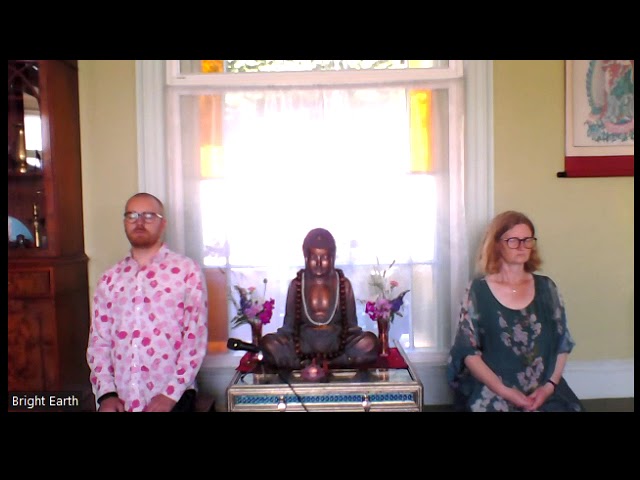
Satya Robyn leads a group meditation practice featuring Beth Hickey's essay "A Glimpse of Paradise," chanting of Namo Amitabha, and a reflection on slowness. The session includes refuges, precepts, bodhisattva vows, meditation, and prostrations.
Chapters
Good morning everybody, welcome to practice. Apologies for the slight delay. Welcome if you're joining us on Zoom. I think Tom's joining us the first time. Nice to see you. And Philip's here as well, lovely. So we'll begin as always with a Dharma glimpse. This week Satya is going to read out something that Beth has written for us.
Mummy to boo.
So this is called— it's by Beth Hickey and it's called A Glimpse of Paradise. In the distance, the silhouette of the Cretan mountains behind the twinkling lights of the little town below as the sun fades for the day. In my mind's eye, I also see the Malvern Hills silhouetted behind the twinkly lights of the little houses that hug the hills I love so much. I'm in awe of the Cretan mountains because they seem old and ancient. But so too are the Malvern Hills, and not that long ago, speaking cosmically, we were all connected as part of one landmass. So the fact that I feel connected is probably because I am. While catching up on Giame reading on the gardens and birdsong, I was lying on a sun lounger and I was simultaneously listening to both the Malvern blackbird song and the Greek birdsong. Soaking up the magnificent Greek mountains and the Malvern Hills. How amazing is that? I can do and enjoy both because I am connected to these landscapes. I can do and enjoy both. I'm made from the same material, and today I feel it acutely. The sun, the half moon, the mountains, the sea, the bougainvillea, the bluebell, bluebells, the birdsong. The soil, the cicadas, the wren and shrew, and the foolish human being. Today I embrace that I'm a foolish being. Today I let go of my craving. I don't rush to the sun lounger with my towel and hog it for the day. I don't wish I had a figure like the young bronze nymph on that lounger. I don't gobble as much or all-inclusive as I can, because today I am in touch with the Dharma and its teachings. Today I reflect on how I fit into the cosmos and appreciate how lucky I am to just be part of this truly amazing journey. And if I can just stop to appreciate instead of expecting, I can gain so much more— the beginnings of true enlightenment.
Thank you for reading, Satya Robyn. Thank you, Beth, for writing. Thank you for the Cretan Hills and the Malvern Hills. So we have some time together now in quiet meditation. Now reciting the name of Amitābha, the Buddha who accepts us just as we are.
Amitābha.
Amitabh. Amitabh. Amitabh. Amitabha. Amitabha. Amitabha. Amitabha. Amitabha.
Amitabha.
Amitabha. Amitabha. Amitabha. Amitabha. Amitabha. Mami taba, mami taba, mami taba. Amitabha. Amitabha. Amitabha. Amitabha. Amitabha. Amitabha. Amitabha. Amitabha. Amitabha. Amitabha. Amitabha. Amitabha. Amitabha. Amitabha. Amitabha. Amitabha. Amitabha. Amitabha. Amitabha. Amitabha. Amitabha. Amitabha. Amitabha. Amitabha. Amitabha. Amitabha. Amitabha. Amitabha. Amitabha. Amitabha. Amitabha. Amitabha. Amitabha.
We'll now recite the refuges, the precepts, the three remembrances, and the bodhisattva vows. Please repeat after me. For refuge I go to the Buddha. For refuge I go to the Buddha, the one who is awake and full of love. Namo Buddha. For refuge I go to the Dharma, all that guides us to compassion and wisdom. Namo Dhammaya. For refuge I go to the Sangha.
For refuge I go to the Sangha.
Those who live in the Buddha— all who live in the Buddha's light.
All who live in the Buddha's light.
Namo Sanghaya.
Namo Sanghaya.
With faith in the Three Jewels.
With faith in the Three Jewels.
I pray that I may not take life.
I pray that I may not take life.
With faith in the Three Jewels— I pray that I may not steal! With faith in the Three Jewels—I pray that I may fall into sexual misconduct! With faith in the Three Jewels—I pray that I may avoid wrong speech!
With faith in the three jewels, Three Jewels.
With faith in the Three Jewels, I pray that I may avoid intoxication.
I pray that I may avoid intoxication. No blame. No blame. Be kind.
Be kind. Love everything.
Love everything. Innumerable are sentient beings.
We vow to save them all.
Inexhaustible are deluded passions.
We vow to transform them all.
Immeasurable are the Dharma teachings.
We vow to master them all.
Infinite is the Buddha's way.
We vow to forfeit it completely.
Recently, I, um, yesterday I started rereading The Wisdom of the Wilderness by Gerald May. Which I think was written in the early 2000s, at the turn of the century, which is an odd thing to say, isn't it? When I was growing up, the turn of the century was 100 years ago, not 20 years ago. And mostly about his experiences in the early '90s. So he's writing— as he's writing, he knows that he's dying, and he's writing about experiences that happened earlier. In his life about feeling a heart pull to go into the wilderness, deep into the forest. And he describes the car journey experience starting with tension in his neck and shoulders, and as the landscape changes and the hills start to appear, the tension begins to ease. And he says, "Oh, I think this had been in my neck and shoulders for months, if not years." And he keeps driving. And a phrase comes to him. The Power of Slowness, or The Power of Slowing. I think it's The Power of Slowness, The Presence of Slowness. And it's this kind of embodied intuitive sense he has of something alongside him, guiding him. He says it often seems to show up with a more feminine energy. He doesn't— it sort of defies naming somehow, but he experiences it as this living force. And the way it appears in this drive is a kind of continual confirmation that moving towards the mountains and the forests is exactly what he needs to be doing, and that slowing down is what he needs to to be doing, and that he doesn't need to worry about making lots of lists about all the things that he needs, and this kind of anxious spiral that begins before he starts the journey. These little nudges from the outside, oh, you don't need to worry about this, but you do need to come into the woods. There's something for you to learn. Here. His career was— he was a psychiatrist. He created— not created, but he was one of the early voices in contemplative psychology, drawing on his background as a Christian and also teachings and practices from the East like Buddhism. And I really like this phrase that I can't quite remember the exact words of, the presence of slowness. I mean, I literally read it this morning before coming into the shrine room, because many of the practices that we do are about encouraging slowness, something to settle. The slow walking we did around the garden this morning, sitting quietly together in here. Because as our own busy minds quieten down, it's sometimes easier to notice that presence that holds us, that is always communicating with us and guiding us. The infinite, as John Periscopulos calls it. The Eternal, as Duke Ennick called it, and Reverend Schomburg, the Lord of the House, Duke, and he also used to call it, as steeped as she was in, in Christian liturgical training. And now we call it Amida Buddha. Or konyin, depending on how it appears. And Pure Land Buddhism invites us to experiment with the fact that that presence is always there speaking to us, whether we can hear it or not. Sometimes when we say Nembutsu, it's like this: I trust that you're out there somewhere, even if I'm too busy or too fraught or too flat or too overwhelmed to hear, hear you or sense you right now. I know that you're there somewhere, and even just reminding myself of that is meaningful. And sometimes It is more like knowing that it's there. This is the experience of shinjin, the heart opening and a felt sense of, oh, there is something beyond my small mind, beyond my ordinary processes, something that accepts me just as I am and that is offering guidance. To me if I can tune into it. And I can recognize this in my own life. And I also recognize that many times I get a message, I'm like, no, I'm not interested. In quite prosaic ways, you know, like, I'll get a sense of you've been online too much. Well, that's true, but I need to do some more scrolling. And I don't know if it's true, but you know, sometimes the connection on my phone drops and I think, oh, in that moment of quiet, I'm able to hear that or intuit that sense of slow down, let go of this, you don't need this. Even as my fingers are kind of twitching around to restore the connection. And sometimes I'm able to listen. And sometimes I'm not, because I'm after all a foolish being. And that's a very small example, but it shows up in bigger ways as well. And it can be quite frightening to trust something that doesn't come out of our rational thought processes. And there is some wisdom in checking, like, oh, does this make sense? Does this sound like good advice? Is this going to lead me more in the direction of keeping the precepts? And if the answer is yes, then maybe it's the Buddha speaking. Yes, so I just wanted to share a little bit about that flavor that spiritual practice can sometimes have this morning. I'm really hoping at some point that we might study the Gerald May book, but in the study groups. But if we do, it will be in at least a year's time because there's so many good books that we'd like to share with you. Namo Amitabha. So here in the shrine room, we're going to make prostrations to the main shrine as we chant Namo Amitabha. If you've got a Buddha at home, feel free to orient yourself in that direction.
Or you can point towards the Buddha on the TV screen.
Namoh Amida Bu. Namoh Amida Bu. Namoh Amida Bu. Namoh Amida Bu. We dedicate the merits of this incense offering to all Buddhas and Bodhisattvas throughout space and time. May it be as fragrant as Earth herself. Reflecting our careful efforts, our wholehearted awareness and the fruits of understanding slowly ripening. May we in our beings be companions of Buddhas and Bodhisattvas. May we awaken from forgetfulness and realize our true home.
So we finished practice a little bit earlier than usual this morning because Satya and I are going to join the March for Nature in town, which you're very welcome to join us for. And just to— I think everyone knows, but we're also hosting Kurt and Angie's leading this evening, which we're very much looking forward to. So you're very welcome to join us for that as well. So we finished with the Closing verse. Blessed by Amitābha's light, may we care for all living things and the holy earth. Nam-myoho-renge-kyo. Please do. Hello guys.









