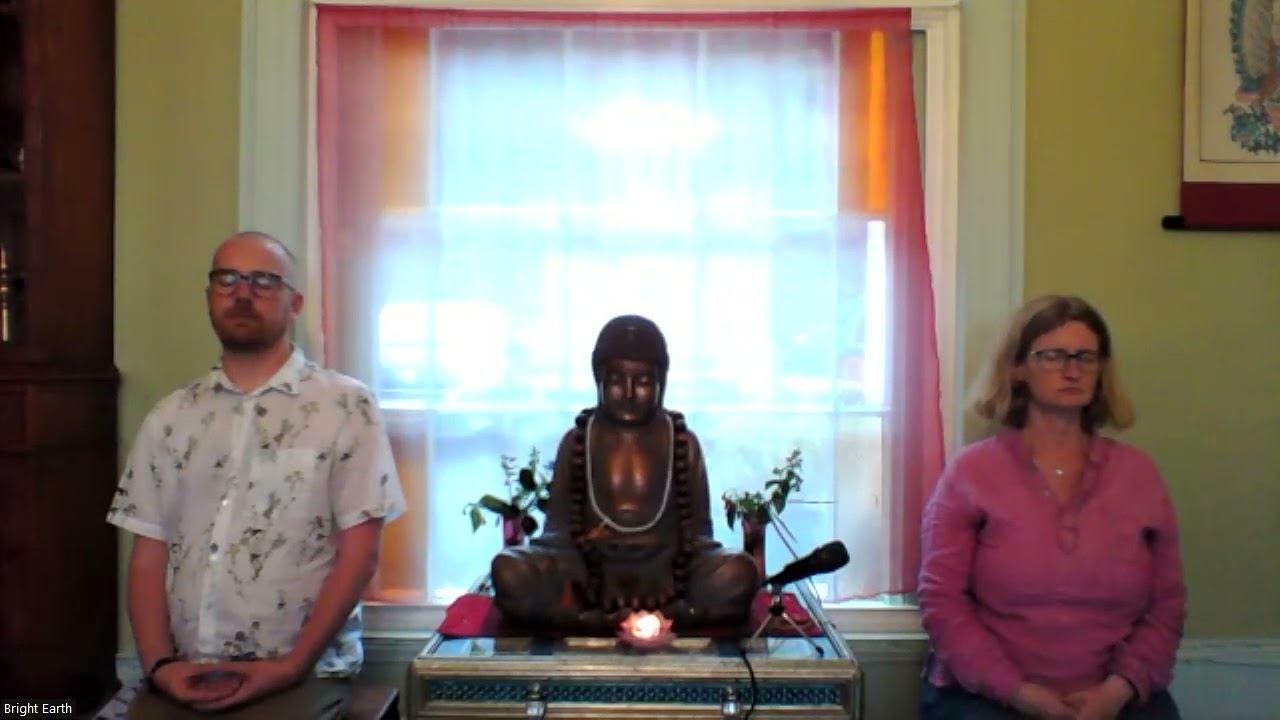
Satya Robyn leads a Buddhist group practice session featuring guided meditation, Nembutsu chanting, and a Dharma reading called "Bad Cold" by David Kakio Izumisky. The group recites the Three Refuges, makes prostrations, and emphasizes simple everyday practice: sitting with the Buddha and mindful activity.
Chapters
Good evening, everyone. Welcome to Chris, who's joining us on Zoom, and, uh, We are missing our bellmaster tonight, Fi, who has a bad cold or some kind of lurgy, so the Dharma glimpse I've chosen from the book this evening is called 'Bad Cold' in lieu of any others. Kaspa will read it for us.
Fi has written a Dharma glimpse that she was going to read for us as well, so We look forward to hearing that next time. In the meantime, Bad Cold by David Kakio Izumisky. A bad cold has been making the rounds where I work, and after all the care I had taken to protect myself, I have it. I'm taking all the moves to lessen the effects, but it will have to work its way through. This is my glimpse. I have a lot to do and I have no energy. Am I beating myself up because I cannot work, or because of the pain, or the dripping nose, or the low-grade headache, or because of the many other things that a bad cold brings? This surprises me, as I am not. I seem to have peace and acceptance. It seems that what I've learned in the last few months studying Buddhism has changed my view, or rather deepened my insight. This world can hold wonderful things as well as dreadful challenges. They are all part of life. Each only has the importance I place on it. This will not end my life, and if I worry and fret, all I will gather is suffering. I have to live through the suffering and come out on the other side as I really am. In time, the cold will be taken care of and I can do the things I need to do. I find that I'm not riding myself, telling myself that I'm a failure because I'm not working at full strength. This time, not even small echoes of fault are ringing in my mind. I find a deep sense that myself is not made true by what I experience, but by how I see and feel that experience. I do not like, nor do I hate this cold. It just is.
Namami Tobu.
So as we sit quietly today, you can either just pay attention to your breath as it comes and goes, or you might want to experiment with saying Nembutsu in silence in your head. Nembutsu is the way that we connect with the Buddha, and we use lots of different forms, but Namo Amida Butsu is the one we most commonly use. Namo— I call out to Amida Butsu, Amida Buddha, the Buddha of infinite compassion and wisdom. And the way that I like to do it is that I just allow the Namo Amida Butsu just to kind of float on my breath like a cork on waves, just following your breath in and out. Namo Amida Butsu, Namo Amida Butsu, depending on how long your breaths are. And when your mind wanders, because it will wander, just bring it back to repeating that phrase, Namo Amida Butsu. And then at a certain point I'll start chanting, and do join in. I think we'll probably do the— we don't usually do this, but we'll do the prostrations chant, which we will do later on in practice as well, which the words are Namaste.
Namoh Amida. Namoh Amida Bu. Namoh Amida Bu. Namoh Amida Bu. Namoh Amida. Namoh Amida Bu. Namoh Amida Bu. Namoh Amida Bu. Namoh Amida. Namoh Amida Bu. Namoh Amida Bu. Namoh Amida Bu. Namoh Amida. Namoh Amida Bu. Namoh Amida Bu. Namoh Amida Bu. Namoh Amida Bu. Namoh Amida Bu. Namoh Amida Bu. Namoh Amida Bu. Namoh Amida Bu. Namoh Amida Bu. Namoh Amida Bu. Namoh Amida Bu. Namoh Amida. Namoh Amida Bu. Namoh Amida Bu. Namoh Amida Bu. Namoh Amida. Namoh Amida Bu. Namoh Amida Bu. Namoh Amida Bu. Namoh Amida. Namoh Amida Bu. Namoh Amida Bu. Namoh Amida Bu. Namoh Amida. Namoh Amida Bu. Namoh Amida Bu. Namoh Amida Bu. Namoh Amida. Namoh Amida Bu. Namoh Amida Bu. Namoh Amida Bu. Namoh Amida. Namoh Amida Bu. Namoh Amida Bu. Namoh Amida Bu.
For refuge I go to the Buddha—
for Refuge I Go To The Buddha!
Namo Buddhaya— For Refuge I Go To Dharma— Namodharmaya. For refuge I go to the Sangha.
For refuge I go to sangha.
Namo Sanghaya.
Namo Sanghaya.
With faith in the Three Jewels—
With faith in three jewels—
I pray that I may not take life.
I pray time may not take my life.
With faith in the Three Jewels—
With faith in the Three Jewels—
I pray that I may not steal.
I pray that I may not steal.
With faith in The Three Jewels— With Faith In The 3 Jewels I pray that I may not fall into sexual misconduct.
I Pray That I May Not Fall Into Sexual Misconduct.
With faith in The Three Jewels—
With Faith In The 3 Jewels—I pray that I may avoid wrong-speech. I pray that I may Avoid Wrong-Speech.
With faith in The Three Jewels—with Faith In The Three Jewels—I pray that I may avoid intoxication. I pray that I may avoid Intoxication. No blame.
No blame.
Be kind. Be kind. Love everything.
Love everything. Innumerable are sentient beings.
We vow to save them all.
Inexhaustible are deluded passions.
We vow to transform them all.
Inesha bo la la dharma teaching, we vow to master them all. Infinite is the Buddha's way, we vow to fulfill it completely.
Namaste. I was wondering about what to speak to you about this evening, and there are the people here tonight haven't been coming for years and years, so I thought I could tell some of my old stories and people wouldn't have heard them.
Some people wouldn't have heard them.
Kaspar would have heard them. Or I could talk about the basics of Buddhism or something like an introduction to Buddhism. And as I started thinking about what I would say in an introduction to Buddhism, it got more and more complicated because there are many different concepts in Buddhism. And each of those concepts is very complicated in some ways. There's the story of the Buddha's enlightenment, there's the idea of impermanence, there's the Three Refuges, there's the Four Noble Truths, there's the Eightfold Path, there's the Three Marks of Existence. I could go on. I was thinking, well, which of those should I talk about? How can I encompass it all?. And I realized that I was meant to be saying the Nembutsu inside my head as I sat in the quiet. And so the thought that arrived was, well, what, what is simple and what is fundamental for me? And I thought about the Buddha. And how as Buddhists, what we are doing is sitting with the Buddha. That's all. And there he is, and he's sitting quietly, peacefully. He's got the Bodhi tree above him. It's maybe a nice sunny Indian day. There's a breeze. He's got some of his disciples and followers maybe sat around him in the forest, and he's just sitting quietly. And we can look at him, we can notice the expression on his face or his posture. Or we can just take in how it feels to sit with the Buddha, to sit with, with contentment. So I'm not going to talk about the Three Marks of Existence or the Four Noble Truths. I'm just going to encourage you to sit quietly with the Buddha, walk quietly with the Buddha, sing with the Buddha, do the washing up with the Buddha, and just see how it feels, see how it is to be alongside this enlightened being with all of that mystery, or just the, the man that lived 2,500 years ago who, who discovered this thing that he passed on to his followers, who passed on to their followers, um, and here we all are. We're still, we're still receiving that thing that he discovered, even if we don't really understand it all the time. Nam-myoho-renge-kyo. We'll now stand and use the same chant that we chanted before and make prostrations to the Buddha. Yeah, slightly different. We dedicate the merits of this incense offering to all Buddhas and Bodhisattvas throughout space and time.
May it be as fragrant as Earth herself, reflecting our careful efforts, our wholehearted awareness, and the fruit of understanding study rightly. May we and all beings be content to be companions of Buddhas and Bodhisattvas. May we awaken from forgetfulness and realize our true home.
Do you return to stand at your seats? Always finish by bowing to each other. So first of all, I'll turn to Beatrice and Casper turn to Keith. We do work it, we do work it. And then the Buddha. Tidy our seats. Bow to our seats. And then we'll finish with the verse which is on your piece of paper. Satya Robyn. Blessed by Amitabha's light, may we care for all living things and the holy area. Namaste. Time for a cup of tea. Say hello to Chris. I'll do the candles as well, love, if you want. Hello, Chris. Hello. I think you're still recording. You're just— you've got a cold drink, did you say? No, I said— no, I wish I had. I said, I think you're still recording. Oh, thank you very









