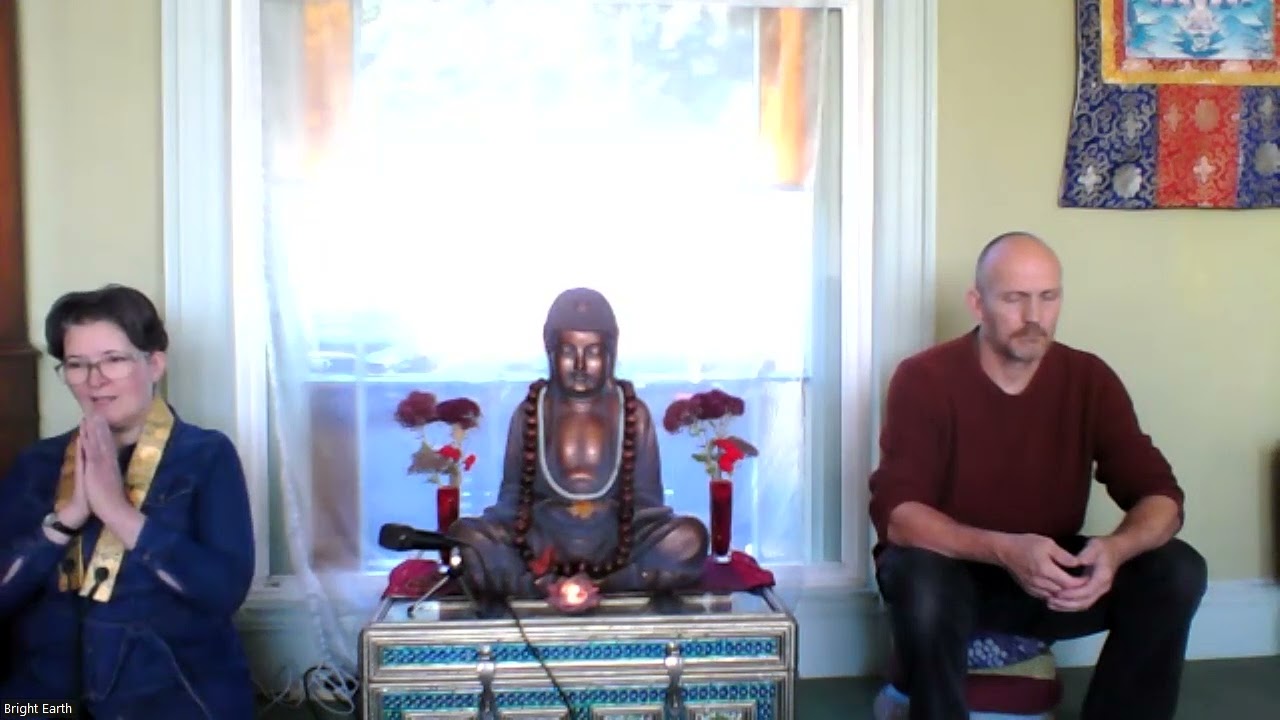
Krista Murr leads a guided Buddhist service with meditation, chanting, and a Dharma talk on suffering and letting go. The session includes a Nei Kuan Qi Kwan meditation, recitation of refuges and precepts, and a teaching that uses a pencil-case analogy to explore how we cling to things.
Chapters
There we go, action! Thank you everyone for your patience.
Good morning!
We got there in the end. Okay, so for anybody who doesn't know me, my name is Krista Murr and I'm going to lead you through the service this morning on this beautiful sunny morning, and Dave here is going to do a Dharma glimpse for us.
I am just about to start my third week of walking meditation practice in the temple garden. It's interesting to watch the seasons change and gradually as you walk the same routes over and over again. And the emphasis is most if you walk along the cotton path, which is the case in the neighbouring towns. This time of year, the newly gotten leaves start to appear on the path. They are whole, brown, and quite robust. They move around freely as we kick them to start our last walk in. As we get further into winter, they become soggy, or the rain gets squashed into the ground to walk on them. The grass can become quite slippery. When the cold sets in, they begin to break down more and blend in with the soil. In the spring and return to the drier, warmer weather, what is left of the leaves dries out again, becomes dry and powdery until there are no longer any leaves at all. Meanwhile, above us, as we walk through the leaves, the winter bugs are sat waiting on bare branches to freeze over. I learned long ago each of these buds contains the entirety of next year's growth, already fully formed in miniature, waiting to unfurl when weather conditions are just right to burst open and sprout. Leaves are not the only things falling from the trees in the autumn. Seeds fall. Three at the bottom of the town gardens are maple, and the seeds hang in pairs on short stalks, elongated wings allowing them to land further from the tree than we do fall, spiraling to the ground like tiny helicopters. Many of these seeds won't grow, and some will be eaten by skunks, some will land on the lawn and be cut down as lawn mower, and some will get weeded out by someone clearing out his nephew's space. But eventually one of these seeds might get away and grow into a full-sized tree, just like its parent tree from where it once came. Scientists believe that maple trees date back to over 100 million years ago. The tree at bottom of the garden will be a direct descendant of those trees. As you witness the impermanence of the leaves and even the individual trees, life itself carries on in one form or another, just like the light within me. Namo Amida Butsu.
Namo Amida Butsu. Thank you for that beautiful description of a maple tree. I've got one in my garden and it's doing exactly the same thing. Little tree, the little seeds. So we're going to move into a period of meditation, and today we're going to do a meditation called Nei Kuan Chi Kwan, and it's a meditation in two parts. So our first part, we inquire into our mind over some of the things across the last 24 hours or 48 hours that have maybe caused us some agitation or suffering. Things that have made us feel unsettled. And we're going to use that breath as our anchor, holding us steady and holding us with the Buddha while we think about these things, and just using our breath to let them go. And then after a period of time in Nei Kwan, um, you'll hear— uh, looking at me like, oh, so we'll have a period where a bell will sing and I will say, infinite light, be my delight. And we will move into Qigong. And Qigong is the, is the bit where you get to go like a huge breath out of relief, not physically but mentally. Um, so you just use your breath and you offer everything that you've been worrying about to the Buddha. When I do this piece, I, I think about just because I have a lot of baggage. I think about giving him sackfuls. I see the Buddha and I go, here you are, here's my sackfuls for the week. And he smiles and takes them from me, and I feel so much lighter afterwards. So first part, second part, where we offer everything up. And that's our meditation for this morning.
Satya Robyn.
So just centering ourselves in our bodies. I just want you to have an awareness of your breath at the tip of your nose, just breathing in through your nose and out through your nose, feeling for the breath moving through from your abdomen up to your collarbone. Just feeling that breath as your anchor in your body, just grounding you, holding you in the light of the Buddha. Gentle breaths in and out through the nose. Infinite light, be my delight.
Shine on me and on all that love me.
Infinite light, divine light, shine on me and on all Ari. Inspire my light, be my delight, shine on me every morning and evening. So now we move into chi kwan, maintaining our breath and trying to visualize the Buddha and offering everything that has arisen in the last few minutes to the Buddha. The uncomfortable things, the prickly things, the things that you just don't want to hold on to. We offer those to the Buddha. When you feel ready, you can open your eyes. Hopefully feel a little bit lighter. So now we're going to move into a period of chanting, a few minutes. And when we chant, we're calling out the Buddha again, offering ourselves and offering all that we are just as we are with all of our baggage. And, uh, we use that period of time just to try and connect with the infinite, to connect with Amida. And we're going to chant the word Amitabha when we're ready.
Amitabh, Amitabh. Tapa.
Ami.
Tapa. Ami. Tapa. Aah!
Aami. So we'll now move into our precepts and our refuges. And for those of you who are first time here or not used to them yet, you should have them printed out underneath your seats if you want to have a look at them as we go along. For refuge I go to the Buddha, the one who is awake and full of love. Namo Buddha. For refuge I go to the Dharma, all that guides us to wisdom and compassion. Namo Dhamma. For refuge I go to the Sangha. All who live in the Buddha's light. Namo Sanghaya. With faith in the Three Jewels, And in light of my human tendencies, I pray that I may become aware of when I take life. I pray that I may become aware of when I take what is not freely given. I pray that I may become aware of when I fall into sexual misconduct. I pray that I may become aware of when I fall into wrong speech. I pray that I may become aware of when I become intoxicated. No blame. Be kind. Love everything. We vow to save the world. We vow to transform them all. We vow to master them all. We vow to follow Sri Lankan. So now it's Dharma talk time, and mine comes from some observations over the last 2 or 3 weeks.. And, um, Sunday morning was a really bright, beautiful morning, if anybody remembers. And I had the rare luxury of being in a car on my own, so I got the choice of the radio, the CD player, which I never get because I've got a 13-year-old that dictates what's going to be on it, and it's usually some boy pop band. And, um, I put, uh, Nancy Griffiths CD in, and the very first track, if anybody knows her music, is 'From a Distance.' And within like the first line, I was feeling very hormonal and started crying because it's such a beautiful song. And if you don't know the words, she says, 'From a distance, the world looks blue and green and the snow-capped mountains white.' And it feels like such a a beautiful poetic song and a wonderful way to sort of describe distance, perspective. And it made me think about the times in my life where you can feel so close to something you can't really see it, you're so near, and that actually when you stand back from something, go, "Ah, okay, that's how I need to figure something out." And another way to look at it, I guess, really, for those of us who are lucky enough to live in Malvern, we have these huge hills, and it doesn't matter whether you're on the top looking down or on the bottom looking up. So my view is bottom looking up, and you guys that are here, it's top looking down. Is that you get to see a greater perspective on humanity, even. You know, we might be troubled and go for a walk And suddenly you can look up or down and go, actually, in the grand scheme of things, I'm tiny with my suffering. All these other people with their little houses lit up or going about their business also have their suffering, their own suffering. And it's been a few weeks with bereavements for people that I know, and a lot of people having questions. And inevitably, when you tell somebody you're a Buddhist or a Buddhist chaplain, people lean in because they want to lean into the Buddha, and they have questions. And the big question that's been circling around is, why? Why do we have to have all this suffering? And why is my suffering so painful? And I can look at other people in my life and they don't have as much 'What is that about?' And having conversations around that and trying to explain that actually it's really difficult how we perceive, you know, our perception of suffering can change so quickly, um, over the course of minutes, hours, days even, let alone, you know, it's so hard to comprehend. And certainly so hard to come up with a clear explanation. And yesterday I picked my son up from school in the pouring rain, and he said, "Oh, I had a terrible day." So he said, "Everything's gone wrong, but it's Friday the 13th, Mum, that's why." I was like, "Well, I don't think that's got anything to do with it, but what happened?" So he talked about his day, and it started by the fact that he'd forgotten his pencil case. So I want you to think about the pencil case analogy for a minute. And how, you know, we've all got this pencil case. You know, half his life is in this pencil case for school, and he didn't have it, so he had to borrow one from the learning centre. But it was the start of a difficult day and caused him suffering. And so where I'm trying to go with this is that, you know, we've all got a pencil case of different little things that cause suffering. It's not just the big stuff, it's not just the bereavements, It can be a really bad commute to school or to work. It can be a difficult boss. It can be all sorts of different things. Not having the food you want in the fridge. Yeah, lots of things cause us suffering. And we've all got different things. You know, my little finger really hurts me at the moment. And that might be really painful for me, but somebody else might not understand that that's painful. Yeah, yeah, you understand. Yeah, but to somebody else, that isn't— they can, they can live with that, they can move through that. And so when we— the Buddha says in the First Noble Truth, we all suffer. That was his thing. He went off and tried to work out what it all was. And then the second one, he says, well, there's a reason we suffer. It's our cravings, our desire for something to be different. When we encounter anything painful, we want to immediately run away from it. We absolutely desire to do something else differently. And I can give an example from my own life that comes up lots of times, and some people will have heard me talk about this before, but you know, my children were born premature. I had a really difficult childbirth, and I didn't get to be the mom that I wanted to be. And within the first few weeks, I was thrown into being pretty much a full-time nurse. I did the job of a nurse. I used to show student nurses how to do a certain treatment on my daughter. That's how clinical it was. So I never got to do the mom I thought I would be. And I remember when my kids were like 3, 4, really being in a dark place and really feeling like, this isn't fair, why is my suffering so great? And then, you know, I spent a lot of time processing it within my Buddhist faith and thought, hang on a minute, I can't sit in this space, I can't sit with this suffering as it is, or I am not going to live. I'm not going to be able to move forward and be happy. And so many Buddhist teachers will tell you, any book that you pick up around Buddhism will say you have to learn to sit with the suffering in order to find the happiness. We can't just run away from it. And so I went, right, okay, I can't have what I desire. I can't crave a life that I can never have. It's never going to be mine, so it's time to let it go. And as soon as I did that, life became fuller, life became happier. And that's the sort of lesson in it all, is that we have to not be caught up in it. And if, you know, sometimes that suffering feels too great, we find a way to let it go and entrust it to the Buddha. So my choice of Nei Kuan Qi Kwan this morning was to help you understand one way that you can let go of your suffering. So we can sift through it, we can find the uncomfortable parts in us. You know, all of our bodies react react to our suffering, even if we're consciously, you know, not consciously aware of it. Our bodies will have reacted to something in a certain way. And they'll say when we use our breath, when we use meditation, when we visualize the Buddha, that's our process of being able to let go. So when we look at the Four Noble Truths, the Buddha says, well, when we've got past this craving When we realize that that's not going to help us in any way, we then draw on this set of tools. We then go on the Eightfold Path. We find this noble route where we go, right, okay, what can we use? We can use the Dharma. We can focus on the Buddha. We can use meditation. We can use each other, because one of the beautiful things about being part of the sangha is that we can lean into each other. You know, we have this enlightenment, we've got this little bit of knowledge that allows us to hold ourselves together in this shrine, in this space. It's a real privilege to sit here together with understanding, even if it's not talked about. There's an understanding that we all know how this feels, how difficult difficult life can be. But we've all lent in. We're here leaning into the Buddha and to the Dharma and saying, okay, we've got this now. We can move forward. We can be happier. We can find a place of happiness within that suffering. And it's about this being present but also creating a different perspective And, um, sometimes we have to just remind ourselves to look at something from a distance, to step out of what feels closed in and difficult, to stand back and find a way to work through it all. Um, and the acceptance and the offering You know, that acceptance and offering brings about a self-compassion. You know, we, we learn to be gentler with ourselves, and in turn we learn to be gentler with other people too. Um, there we go. Now I'm hungry to eat. So now we are going to stand and do our prostrations. For anyone who doesn't feel comfortable, uh, bending down, do a sort of half prostration in your chair if that is more comfortable.
We dedicate the merits of this incense offering to all Buddhas and Bodhisattvas through space and time. May it be free from desert itself, reflecting our careful efforts, our wholehearted awareness, and the fruit of understanding slowly ripened.
May we and all beings be compassionate Buddhists Okay, so now it's time for our bowing to each other, and we do a bow to the Buddha, and we bow to our seats and tidy our seats. And then our final blessing— unless do we need to transfer merit to Anyone today?
Israel, Palestine.
Yeah, yeah, shall we? Yeah, okay. Blessed by Amma Sharada's light, may we care for all living things and the Holy Earth. Namaste. Does anybody have any announcements today? We have a little announcement. At quarter to 11, we will be going into the garden to do some reading in this beautiful sunshine. Anyone would like to join us for an hour max, then please do.
Next Sunday evening is the Kirtan, 22nd, so devotional singing led by Archie in this space. Details online.
And just an announcement for the ministry team who are all here this morning, I wondered if in 5 minutes, once we've had a cup of tea, if we could come back here for 10 minutes and do the check-out rechanting. Yeah, okay, that's good. Now we're ready for, yeah, cup of tea time. Do stay for a drink, everyone. I'll just quickly say hello to online. It is Claire. Good morning, Claire.
Satya Robyn.
All right, thank you. I had really bad tech problems at the beginning. Oh, okay, I'm just gonna stop









