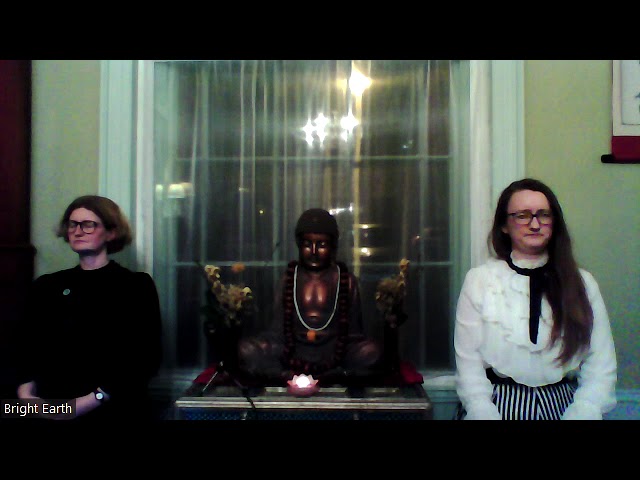
Satya Robyn leads a Buddhist practice session with guided meditation, chanting, and a talk about lightness and purpose. The group recites refuges and precepts, chants Amitabha, and makes prostrations together. Satya reflects on activism and why they practice Pure Land Buddhism.
Chapters
Gave me a bit of a shock because I was on mute last time. I wasn't expecting her to shout at me in American. Welcome everybody, really lovely to have you here and a special evening this evening because we we have 4 brand new people.
Hooray!
Special welcome to you. Hi to Chris, who's joining us on Zoom. She looks like she's got the moon behind her. And I'm Satya, and I'll talk us through what we're doing a little bit, but you may still have questions. We have a cup of tea afterwards if you're free to stay, and you can ask any questions then. So we will begin as we always do with something called a Dharma glimpse. Dharma is the truth, so a Dharma glimpse is a little bit of writing that describes a moment of revelation or inspiration. And this evening we have a Dharma glimpse read by the author, Helen, thank you very much. Over to you. Um, lightness.
At the end of 2022, lots of messages were being shared and discussed around finding a word to focus on for 2023. I took some time to consider this, as I've done this exercise before in years past, but somehow it seemed particularly poignant in 2023 for me. During practice on New Year's Eve, we were challenged to listen to our wisdom, or listen out for wisdom from the Divine around what would help us in 2023, rather than trying to control our way— in my case, through a list of material achievements that we could try and set for ourselves. Very quickly, a strong sense came to me in my meditation that my word could be lightness. So this is my challenge: to hold all impending truths lightly. This will be a significant work in progress as it doesn't come naturally to me. I often unburden— I often overburden and overwhelm myself with fight or flight, black or white, life or death thinking. My nervous system has been shot to a cinder in 2022, and this year it's a challenge not to push so hard. I think the reason that this temple has been such— has such an ingratiating effect on me is because it feels light inside. The shrine room feels safe, not in a protectionist loaded way, but rather in a freeing grounding way. In 2023, I want more of this. More light, more grounding, more space, less fear response, less white-knuckle death grip, less absolutes. Impermanence is, after all, a gift.
Now, now, I made a boo.
Thank you so much.
Nice little advert for the temple in there as well. So we, uh, next we move into silence together, and we will sit quietly for 10 minutes or so, which, uh, if you're not used to doing it, it's a very long time indeed. Um, and there are different instructions I could give you about what to do in that silence. The idea is that, like a jar full of muddy water that's been shaken and shaken and is all cloudy, as we sit quietly that mud very slowly starts to sink to the bottom and the water becomes clear. What you'll probably find is that you will either shake the jar yourself every few seconds, or the universe will shake your jar, and that's okay. Just notice when the jar is getting shaken. And again, return to allowing the mud to settle. It may be that you get some little moments where you feel a bit of clarity or a bit of peace. If so, you can just enjoy them. But if you don't, just trust that if you keep sitting still, that something is working on you, and that over time settling is happening even if you can't feel it. Sometimes it feels worse to start with because we do things to take our minds away from the turmoil. Sometimes it feels like it's getting worse before it gets better. And if it gets too tumultuous, just take some steps back and allow the— allow all the, the stirring up to be there, but trust that you don't need to do anything about it or, or, um, or be inside it. Hopefully that makes some sense. And after some silence, we will start to chant together. Um, there are lots of different Buddhas. Buddha just means awakened one, anyone who has woken up to truth. And the Buddha that we are mostly in relationship with here is called Amitabha, which means the Buddha of infinite light. So we will chant Amitabha, and when you get the hang of the tune, do join in. If you're not used to chanting, it might feel strange to start with, and my advice is to just do it anyway. And, and then the quicker you do it, the quicker the kind of the feeling— it feeling strange wears off.
Amitabh. Amitabh. Amitabh. Amitabha. Amitabha. Amitabha. Amitabh. Amitabh. Amitabh. Amitabha. Amitabha. Amitabha. Amitabha. Amitabha. Amitabha. Amitabh. Amitabh. Amitabh. Amitabh. Amitabha. Amitabha. Amitabha. Amitabh. Amitabh. Amitabh. Amitabha. Amitabha. Amitabha. Amitabh. Amitabh. Amitabh. Aami. Itaaba. Aami. Itaaba. Aami. Itaaba.
So next we will recite some words together which are on your bit of paper that's underneath your table, your chair, or next to you. First we recite the refuges, which is what all Buddhists lean into. There are 3 things that all Buddhists lean into, so please repeat after me. For refuge I go to the Buddha—
for refuge I go to the one who is awake and full of love— the one who's awake and full of love.
Namo Buddhaya! For refuge I go to the Dharma—
for refuge I get the Dharma—
all that guides us to wisdom and compassion—
all that guides us to wisdom and passion.
Namodhammāyā! For refuge I go to the Sangha.
For refuge I go to the Sangha.
Those who live in the Buddha's light.
Those who live in the Buddha's light.
Namo Sanghaya.
Namo Sanghaya.
Then we recite the precepts, which are the ethical guidelines for our behavior that we aim towards, because it's impossible to keep any of them fully. With faith in the Three Jewels— I pray that I may not take life. With faith in the Three Jewels— I pray that I may not steal. With faith in the Three Jewels— I pray that I may not fall into sexual misconduct.
I pray that I may not fall into sexual misconduct—
With faith in The Three Jewels—
Faith in The Three Jewels—
I pray that I may not fall into wrong speech—
Wrong speech—
With faith in The Three Jewels—
In The Three Jewels—
I pray that time they avoid intoxication—
Intoxication—
And then the three remembrances, what were they called? Active virtues. That my friend Terry wrote, and we have been experimenting by reading them all together. Forget that, everyone, we're going to go back to how we did it before. No blame.
No blame.
Be kind.
Be kind.
Love everything.
Love everything.
And then Fi will lead us in the Bodhisattva vows, which again are guidelines for how we might live if we were Buddhists.
Innumerable sentient beings, we vow to save them all. Inexhaustible deluded passions, we vow to transform them all.
Immeasurable are the Dharma teachings.
We vow to master them all.
Infinite is the Buddha's way.
We vow to perfect completely.
So now this is the bit where I say some things. I quite enjoyed being a jar of muddy water, but I had some bits of mud that really didn't want to stick to the bottom, and they were like, 'We want to play!' So they just did this kind of— they all clumped together and did some like spiraling over up there. Um, so I really enjoy having these special extra welcoming practice sessions for people that haven't been before because it gives me an excuse to revisit the question of why I am here. Um, you're all here, so you've all got some reason for being here. I can't guess what they are, It may be that you saw that Fi's made some banana muffins, um, but there were lots of other things I could be doing. I could be watching Netflix, um, I could be sleeping, I could be doing various other kinds of work. Um, why am I here? And yes, I run the temple. Casper, so it's not a choice I make week by week, but, um, still I am here. And it's a good question, and it's an especially good question, it feels, over the past few years since I've been more involved with activism. It's, it's, um, it's become an even more important question because I'm very aware of how, how limited my lifespan is, how, how, how few hours I have in a day and how many different callings there are on my time and energy. Um, and over the past few years At some points I've had the thought, you know, maybe I should just do what many of the people I know have done and hand myself over to activism, to protesting, to going to jail. My friend Anna, who's been in and out of prison twice, I think now, sent me a beautiful kind of work of art this week on cardboard, which is on the piano when we go next door. And that's what she does. She goes to court and she prepares for court and, uh, that's, that's her life. And during these times, it feels harder and harder to not do that in some ways. Um, and this year Kasper and I decided to, to really sort of even offer even more of our time to the temple and to the work of the temple. And I hope that what we do here is just as important as the people who are going to jail. That we are connecting— we are helping to connect people up to love, to infinite love, and to something that is steady, to something that holds us steady. And from that place, it becomes more possible to live in the way that is described by the precepts, to live in a way that is more kind, more forgiving, more patient. And all of those things are really hard. And thank goodness we're Pure Land Buddhists here, and Pure Land Buddhists begin from a point of a position of acknowledging the extreme foolishness of human beings. That we are all filled with greed, hate, and delusion that kind of shakes the jar. And Pure Land Buddhism also offers us some kind of— solution is the wrong word— but some kind of something that we can do with that, which is put ourselves as foolish beings in relationship with infinite light, with love, and allow ourselves to be held and accepted and forgiven and seen and appreciated and encouraged. And then very slowly, bit by bit, that rubs off on us and we become more able to offer that to the people around us. So I hope that what we're doing in this room tonight is a kind of activism, and that the Earth is smiling at us. So next we will finish by making prostrations to the Buddha. There are lots of different ways of looking at bowing. It's a way of offering our respect or putting ourselves in a kind of a humble place. But tonight my invitation is, if there is anything that you're carrying that you're tired of carrying, as you bow down to the floor, just let it go into the floor, offer it to the Buddha, and trust that the Buddha will take it for you and look after it. Nam-myoho-renge-kyo. Oh, and sorry, the words we chant are Nam-myoho-renge-kyo, but you probably won't be able to do the bowing and the chanting, so don't worry about that too much.
Namoh Amida. Namoh Amida. Namoh Amida.
In gratitude, we offer this incense offering to all Buddhas and Bodhisattvas throughout space and time.
May it be as fragrant as earth herself, reflecting our careful efforts, our wholehearted attention, and the fruits of understanding slowly ripening.
May we and all beings be companions of Buddhas and Bodhisattvas. May we awaken from forgetfulness and realize how truly— so if everyone would like to come back to their standing at their seat, we always finish by first of all bowing to each other to express gratitude. Gratitude for people to practice with. I will start by bowing to Phoebe, and Helen will bow to Jhame. Rest of you work it out amongst yourself, and then do the opposite, turn around. Pretty good. And then we bow to the Buddha. Tidy our seats. Bow to our seats. So, announcements. We will have a cup of tea now if you're free. There's a golden bowl on the hallway desk if you've got a donation, or you can go online and do it online. We've got a new sheet to sign up if you're willing to make the tea or read a Dharma glimpse. So that's in the dining room before— until we get the thingamajig on the wall.
That's enough for now.
So we finish with the closing verse, which is also on your bit of paper, and it starts, 'Blessed.' If you want to read it with us, wait for it. Blessed by Anatar's light, may we care for all living things on the Holy Earth. Namaste. So there's no one on the sheet to make the tea tonight. Somebody will have to. Yay, well done, J.









