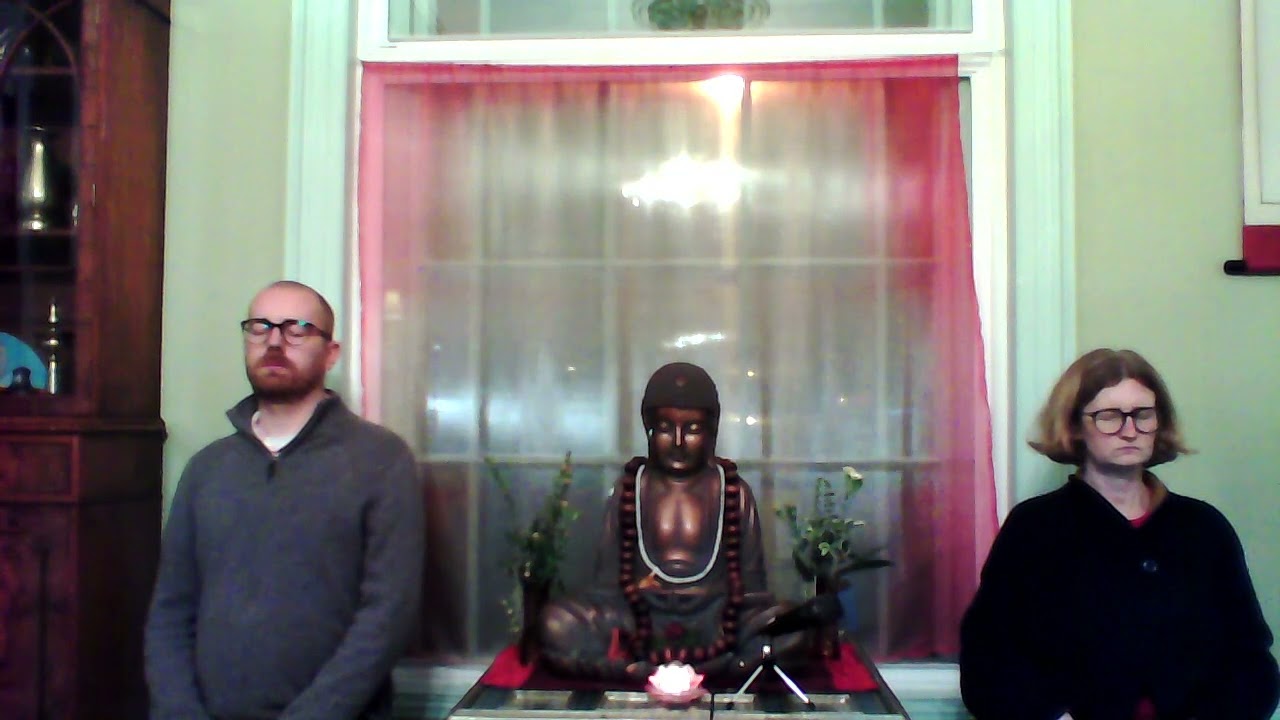
Satya Robyn leads a guided Medicine Buddha practice with group chanting of the Sanskrit mantra, refuge vows, and ethical precepts. The session includes a Dharma reading from Jeff Wael Ward about noticing life's simple joys and a teaching on relating to different Buddhas as supportive figures.
Chapters
Good evening everyone. More healthy shrine room this week than last week, and nobody joining us on Zoom at the moment, and I will pass over to Kasper. For tonight's Dharma glimpse. As long as one of us remembers, it's okay.
We could get two mics and then you just have to change it on Zoom. Maybe that's more complicated. Reading a Dharma glimpse from the book Bright Dawn Dharma Glimpses. This one is by Jeff Wael Ward and it's called Life is. The other day was a typical Tuesday. I finished work, picked up the kids from daycare, and came home. As we settled in, my son went off to gather up toys and crayons and everything else he needs for his afternoon. He began to play, and I sat on the couch with my daughter, who is 2 months old now. I propped her up on my legs so we could see eye to eye. I began really talking to her, not just baby sounds, but real conversation, albeit simple. She suddenly got a crooked little grin on her face and made a cooing noise that sounded quite like a giggle. It was just a brief moment, but it was really a moment of clarity for me. It was as if for those few seconds the whole universe came into focus for me. I saw the beauty of life. We speak so much of suffering and attachments and the vile poisons. I think we cloud out the simple joy in drawing breath each day. Life is truly amazing if we allow it to be. The very process of the wheel of life is miraculous. From the chemical reaction of photosynthesis to the complexity of the food chain which sustains us all, to birth itself, it can all be seen as a wonderful occurrence of oneness. Life is a complete cosmic organism breathing deeply with each breath we draw. As we live, we give vitality to life. We are creation, creation is us, all of us with no separation. I encourage everyone to be the breath and blood of life itself, to live authentically in this unity of wholeness. I guess it was a powerful giggle, but what should one expect from a 2-year-old? 'Laugh and the world laughs with you.' Namo Amitabha.
Namo Amitabha. Was she 2 months old or 3 years old?
2 months old. Apologies.
It's been a long day.
Yeah, as we all are.
Thank you, Kaspa. So together in the quiet And an invitation to follow the Nembutsu on our breath. You can either imagine the words Namo Amida Butsu on the in-breath and then out-breath, or I quite like just Ami Tabha.
Amitabha.
Just allow those words to arise as your breath arises. Don't change the length of your breath. When you get distracted, just come back to those words again. Namomi dabu, or Amitabha. So a couple of weeks ago we were talking about Medicine Buddha, and I said that we could chant a Medicine Buddha chant and then forgot to write it down. So I'm gonna just rely on you to hear the words as I chant them and pick it up. But I thought I'd maybe just play you a tiny bit of the chant first so you can get a hang of it. I will, I will. I'm going I'm going to look for them right now. This is 3 hours long, so I won't play it all. This is still the introduction, I think. This is actually different, isn't it?
This is it.
You got the hang of it yet? I'm still looking for the English translation of the words, which is in the comments somewhere. Here we go. Okay, now how do I stop it without getting— oh no, the English translation's really far down and I had it but now I've lost it again. Just give me 2 seconds. Yeah, this— I'm in the Sanskrit. Maybe like not in Japanese? No, no, it's definitely Sanskrit.
It.
Okay.
Taya ta om began jay. Began jay means Medicine Buddha. Began jay, Maha Began J, which is Great Medicine Buddha. Radza samudgate so ha. So, taya ta om began jay, began jay Maha Bekanjeh Radza Samudgati Soha. That's probably a bit low. Okay, so let's give it a go. Don't worry if you don't want to join in today, or if you've just got some alternative words which will work just as well.
Thaiyatha Om Bekam Cheh—Bekam Cheh Maha Bekam Cheh Ratsasamu Gathe Soha! Taiyattha Ohm Bekan Jeh Behkan Je Mahabhekhanje ratsa samu gath sooha Thailand Thao Bikanchee Bakanchihi wekang che hata lamung yin tu gamukka de soka thaiat tha ohum bekanshee bekkantsheee... Maha Bekamchee Ratsasamudgathe Soha. Thai Aton. Bekamchee, Bekamchee. Maha Bekamchee Ratsasamudgathe Soha. Thai Aton. Bekamchee, Bekamchee. Maha Bekamche Ratsha Samutgati Soha! Thai Attha Om Bekamchee Bekamchee Vatthappekamche Ratha Samutgati Soha! Thai Attha Om Bekamchee Bekamchee Maha Bekamche Ratsha Samutgati Soha! Thaiyatha om bekam che, bekam che, ahasikam che, ratsasamundati soha. Thaiyatha om bekam che, bekam che, maha bekam che, ratsasamundati soha. Thaiyatha om bekam che, bekam che, Maha Bekhanché Ratso Samudratis Soha. Tayatha Om Bekhanché Bekhanché Maha Bekhanché Ratso Samudratis Soha. Tayatha Om Bekhanché Bekhanché Maha Bekhanché Ratsasamudgatisoha. Tayatha Om Bekanjeh Bekanjeh Maha Bekanjeh Ratsasamudgatisoha. Tayatha Om Bekanjeh Bekanjeh Maha Bekanjeh Ratsasamudgatisoha.
For refuge I go to the Buddha—
for refuge Namo Buddhaya!
For refuge I go to the Dharma— or Refuge? Namodarmaya? No more than that. For refuge I go to the Sangha— namo sanghaya!
Lama Tsongkhapa—
With faith in the Three Jewels I pray that I may not take life. With faith in the Three Jewels I pray that I may not steal. With faith in the Three Jewels I pray that I may not fall into sexual misconduct. With faith in the Three Jewels With faith in the Three Jewels, I pray that I may not fall into wrong speech.
I pray that I may not fall into wrong speech.
With faith in the Three Jewels, with faith in the Three Jewels, I pray that I may avoid intoxication.
I pray that I may avoid intoxication.
No blame, no blame. Be kind, be kind. Love everything, love everything.
In you, my beloved sentient beings, we vow to save them all.
In exhaustible or deluded passions, we vow to transform them all.
Immeasurable are the Dharma teachings. We vow to master them all. Infinite is the Buddha's way.
We vow to follow it completely.
So it seems we have just the right people in the shrine room tonight for a new complicated mantra with no words. That was beautifully done. So Medicine Buddha, if we have Shakyamuni Buddha, the Buddha that appeared as a human being in India 2,500 years ago, Why do we need Medicine Buddha? Why do we need Akshobhya or Amitabha or the bodhisattvas? A few years ago now, I found a rupa, a Buddha statue, in a secondhand shop, and I didn't know what it was, but I really liked, I liked the look of it, so I bought it and it turned out to be Medicine Buddha. I didn't really know anything about Medicine Buddha, but at that time in my life I was having a really difficult time with a close colleague. That this person had started to behave in a way that was very unpredictable and Um, I felt very attacked by them and it was just bringing up loads of stuff in me. I couldn't bear the idea of this person not liking me. I couldn't work out why they were so upset with me. Um, and I didn't feel safe. And I tried lots of different things to try and handle this. I had lots of conversations with my mentor, and I actually learned about nonviolent communication, which was really helpful. But one of the things that helped me the most was talking to Medicine Buddha. And I didn't know Medicine Buddha, but I talked to them about it. And I had this communication just from the way that this statue was sitting, the way that this, this Buddha was kind of holding themselves. That was something about holding onto my own sense of what was happening or who I was. Or what was going on and not giving that away to the other person, not allowing the other person to, to have an experience that then became true for me by default. And there was some powerful stuff going on inside me, but, but this, um, this kind of offering from Medicine Buddha just started to give me a little bit of space, started to allow me to work out what was going on inside me and then help myself, help those bits of me, and then be able to see the other person as an individual who was suffering rather than somebody who had power over me. And I guess that Medicine Buddha was the right Buddha for that situation because of the qualities that Medicine Buddha holds. There was something about being healed that I really needed, but, but also strength. And so for me, the advantage of having different Buddhas to connect with is the same as having different friends to connect with. Some of my friends are really good at just letting me complain when that's what I want to do. Some of my friends would kind of start wanting to fix it or, or not liking it when I'm complaining. Sometimes when I'm feeling vulnerable, I have to remember that this person is probably going to be more helpful than this person, not through any fault of their own, but from their own kind of their own histories and their own karma. And, and also some friends are particularly good at certain things. That I've got a friend that's really good at being happy for me, so it's really nice to talk to that person about things that I'm pleased about. I've got another friend who's particularly skilled in spiritual matters, so I talk to them about, about certain things when I want to find an answer or talk something through. And it's the same with different Buddhas. Even if we don't really believe that there is such a thing, we can, we can imagine them as different characters in books that we become fond of, that we form relationships with, that coming into relationship with different qualities has a different effect on us. And we can just experiment with it. If we feel like we need some healing, we can just do a little bit of Medicine Buddha chanting and see what happens. And it's a very personal relationship. We might read about the qualities of a particular Buddha, and there's a long history of, um, stories or experiences that surround those different Buddhas. But again, like different people, you know, if we've got a mutual friend, I will see that friend as different to how you will see them, because different things stand out for us. And as time goes on, our relationship with these deities, with these whatever they are, deepens. And now when I think of Medicine Buddha, I think of that time however many years ago, that they were really present for me. And so as I chanted the chant this evening, it was like kind of checking in with an old friend. So maybe that's your homework for this week, is to, is to choose a Buddha or a bodhisattva or a spiritual figure to investigate a little bit, to come into relationship with, to include in your daily practice, to talk to, to ask for help, to say thank you to, and just see how the relationship develops, see what comes that you might not be expecting. Namaste.
Namoh Amida Butsu. Namoh Amida.
Namoh Amida. Namoh Amida.
We dedicate the merits of this incense offering to all Buddhas and Bodhisattvas throughout space and time. May it be as fragrant as Earth herself, reflecting our careful efforts, our wholehearted awareness, and the fruit of understanding slowly ripening. May we and all beings be companions of Buddhas and Bodhisattvas. May we awaken from forgetfulness and realize our true home.
Blessed by Amitabha's light, may we care for all living things and Mother Earth. Namomi tabu. Namobu.









