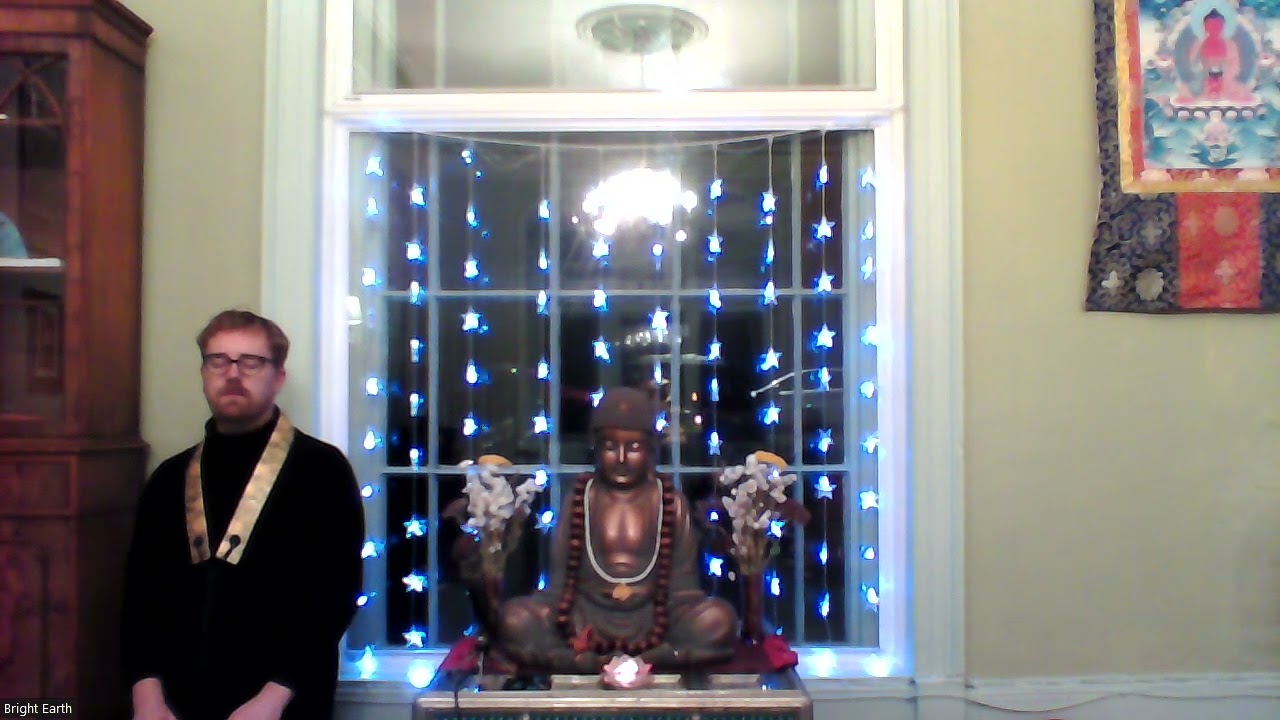
A Buddhist group practice led by Satya Robyn featuring a reading of the Heart Sutra, chanting of the Kwan Yin mantra, and a teaching on emptiness as medicine. The reflection includes a personal story about preparing a book and explores how letting go of fixed ideas can heal.
Chapters
Welcome everybody.
I really wanted to read the Heart Sutra together this evening because it sort of fits with what I was thinking about saying, and I got up and there weren't many copies here. Oh, I think of something different, it's fine. And then it became clear that there weren't going to be many people here, and actually we've got the same number of people as we do copies of the text, so maybe it was meant to be. So if you'd like to join, we'll read the Heart Sutra.
The Sutra on the Heart of Realizing Wisdom Beyond Wisdom.
Avokiteshvara, who helps all to awaken, moves in the deep course of realizing wisdom beyond wisdom. Sees that all five streams of body, heart, and mind are without boundary and frees all from anguish. Oh Shariputra, form is not separate from boundlessness. Boundlessness is not separate from form. Form is boundlessness. Boundlessness is form. Feelings, perceptions, inclinations, and discernment are also like this. Oh Shariputra, boundlessness is the nature of things. It neither arises nor perishes, neither stains nor purifies, neither increases nor decreases. Boundlessness is not limited by form nor by feelings, perceptions, inclinations, or discernment. It is free of the eyes, ears, nose, tongue, body, and mind. Free of sight, sound, smell, taste, touch, and any object of mind. Free of sensory realms, including the realm of the mind. It is free of ignorance and the end of ignorance. Boundlessness is free of old age and death and free of the end of old age and death. It is free of suffering, arising, cessation, and path, and free of wisdom and attainment. Being free of attainment Those who help all to awaken abide in the realization of wisdom beyond wisdom and live with an unhindered mind. Without hindrance, the mind has no fear. Free from confusion, those who lead all to liberation embody profound serenity. All those in the past, present, and future Who realize wisdom beyond wisdom manifest unsurpassable and thorough awakening. Know that realizing wisdom beyond wisdom is no other than this wondrous mantra, luminous, unequaled, and supreme. It relieves all suffering. It is genuine, not illusory. Set forth this mantra of realizing wisdom beyond wisdom. Set forth this mantra that says, 'Gate, gate, paragate, parasamgate, bodhi swaha.' Moving into silent meditation. Perhaps beginning resting awareness on the breath, but then just noticing what you notice. Oh, here's the breath. Oh, here's a distraction. Oh, here's an ache in my foot. Oh, here's the breath again, coming and going like clouds in an empty sky. Sutra says that Lo Kitaśvara moves in the deep courses of wisdom beyond wisdom. And in China, Avalokiteshvara is called Kwan Shin. So we'll recite the Kwan Shin mantra together, invoking boundlessness and wisdom beyond wisdom.
Namah Kwan Chi in Bosat. Namah Kwan Chi in Bosat. Namah Kwan Chi in Bosat. Na kwan sheen bo Satya Robyn. Na kwan sheen bo Satya Robyn. Na kwan sheen bo Satya Robyn. Namah Shivaya. Satya Robyn. Namah Shivaya. Satya Robyn. Namah Shivaya. Namah Shivaya. Satya Robyn. Namah Shivaya. Satya Robyn. Namah Shivaya. Namah Shivaya. Namah Shivaya. Namah Shivaya. Namah Shivaya. Namah Shivaya. Namah Shivaya. Namah Shivaya. Namah Shivaya. Namah Shivaya. Namah Shivaya. Satya Robyn. Namah Shivaya. Satya Robyn. Namah Shivaya. Namah Kwan Chi Ingo Sat. Namah Kwan Chi Ingo Sat. Namah Kwan Chi Ingo Sat.
Namaste.
For refuge I go to the Buddha.
For refuge I go to the Buddha.
The one who is awake and full of love.
The one who is awake and full of love.
Namo Buddha.
Namo Buddha.
For refuge I go to the Dharma.
For refuge I go to the Dharma.
All that guides us to wisdom and compassion.
All that guides us to wisdom and compassion.
Namo Dharmaya.
Namo Dharmaya.
For refuge I go to the Sangha.
For refuge I go to the Sangha.
Those who live in the Buddha's light.
Those who live in the Buddha's light.
Namo Sangaya.
Namo Sangaya.
With faith in the Three Jewels.
With faith in the Three Jewels.
And in light of my human tendencies, I pray that I may become aware of when I take life. I pray that I may become aware of when I take what is not freely given. I pray that I may become aware I pray that I may become aware of when I fall into sexual misconduct—of when I fall into sexual misconduct—I pray that I may become aware—I pray that I make it come away—of when I fall into wrong speech—when I call you on stage—I pray that time might become aware—I prayed to me coming here—of when I become intoxicated—no blame, no judgment for my actions at this moment.
No shame or guilt because we're all human beings who have fallen short from God's standards.—No pain!
Be kind. Be kind. Love everything.
Love everything. Innumerable are sentient beings.
We vow to save them all.
Inexhaustible are devoted passion.
We vow to transform them all. Immeasurable of Dharma teachings, we vow to master them all. Infinite is the Buddha's way, we vow to fulfill it completely.
This week I was listening to a lovely teaching called The Medicine of Emptiness by Domyo Burke, who is a grand disciple of Roshi Ji Kenneth, whose name will be familiar to some of you. And, um, emptiness, boundlessness, it's translated in the version that we read today, is the same as emptiness. And I, I don't want to misrepresent what she said, so I'll say that I'm perhaps being inspired by her rather than passing it on. She was inviting us to notice the stories we hold about the world, particularly some of the things that can get very polarized. And one of the things she was talking about was the climate crisis. And I noticed, like, oh, but my story about the climate crisis is the right one. I don't want to be too— I don't want to hold this too lightly. It's really important. And I was beginning to feel like, oh, where are you, where are you taking me with this, uh, teaching? And then she said, some of these stories may be the most accurate ways we've got of describing what is happening. I was like, okay, I can relax. And yet real— even those stories, reality is bigger than even those stories. And this, I think, is what she meant by the medicine of emptiness, to notice the limitations of the stories that we tell ourselves about ourselves and the world, and how even the most accurate of stories is always limited. We are more complex beings. Reality is more complex and vast. There is always a piece of meaning that we miss. Whatever words we use obscure things as well as reveal them. And to dwell in the experience of the space just around the stories brings a sense of ease and is a balm to the mind. And when this medicine is applied correctly, we, we continue to be moved towards compassion rather than to disassociation, which is how you can apply it incorrectly. Of course. And this week I was really noticing, uh, a couple of different stories in relation to something much smaller than the climate crisis, in relation to being in the last phase of getting our revised book ready for the printers. And it's been a nightmare I prepared the file in LibreOffice because I don't have Word installed on my computer, and for various reasons, and it's a good, it's a good word processing platform, but the printer's pre-flight checks kept rejecting the PDF and saying there's this specific error, there's this specific error. Only one other person I could find in the world had had this specific error, and the way they fixed it didn't work for me. And I was just spending what felt like hours trying to sort it out. And in the end, uh, resorted to opening it in Word on Satya's computer, which of course meant then having to reformat the whole thing. And, and that in fact, it meant more than that because the file transfer didn't work. So I had, I spent an hour fixing that and then having to reformat it, and then and it seemed to all be going smoothly, and it went away for the printers, and I felt relieved. And I'd been telling myself the story about how I'd really made a bad decision and I was getting it wrong and all these things. And then the proof copy arrived a couple of days ago, and we opened the parcel and it looked really good. And then we opened the book, and mostly it looked good, but the, um, the font was a bit big for the size of the book, and the line spacing was a bit big, which I don't mind. My Kindle is set to like a big font with lots of line spacing. But as Satya said, it looked a little like a children's book, which wasn't the vibe we were going for. And it had looked fine on the screen. And then back into this process again, because The impression I'd got was that in Word it hadn't saved any of the styles, so I'd have to select all the text to make it smaller and then redo all of the formatting. And I just, I felt awful. I felt like a real idiot for having used this software in the first place. And like I was, this is the sort of thing that I knew that I should have to be doing. And my sort of, my whole, felt like my whole identity was a a competent person was crumbling around me. 20 years ago I worked in IT, so I should be able to do this. Anyway, it turns out you can buy Word 2010 for less than £30 now because it's very old software, which I didn't realize, so I've now got that installed. And it turned out it had preserved the styles, which made my job this morning much easier. And within an hour I'd done everything that I wanted to do. And by the end of that hour, I felt competent and confident and like my identity was intact. And both versions, both versions of those stories had some truth in them. There were good reasons that I, you know, chose that piece of— chose to use LibreOffice and made those decisions. And also somebody else may have anticipated those problems. Um, so these stories were sort of more or less accurate versions of what had happened, even though they were completely disparate and, uh, the emotions that came with those stories completely different, feeling so much better an hour later than I had earlier. And yet all through this really quite painful at times experience, which, you know, seems, seems almost embarrassing, that I had this teaching of the Medicine of Emptiness in mind, which just brought a little sense of ease and spaciousness and meant that every now and again I could just catch myself telling these stories and remember, oh, even though you're convinced right now that you're the worst idiot in the world, right, that is just a story. There is a space There is space beyond that which is more complex and more spacious, and in that space compassion grows. That is the medicine of emptiness.
Namaste. In gratitude, we offer this incense to all Buddhas and Bodhisattvas throughout space and time. May it be fragrant as the Earth herself, reflecting our careful efforts, our wholehearted awareness, and the fruits of understanding. May we awaken and realize our true home.
So we'll come to stand in our places, back to each other.
I'm trying.
We'll finish with the closing verse. Blessed by Amitabha's light, may we care for all living things and the holy earth.









