Practice: Our own Dharma, and a nature Dharma Glimpse
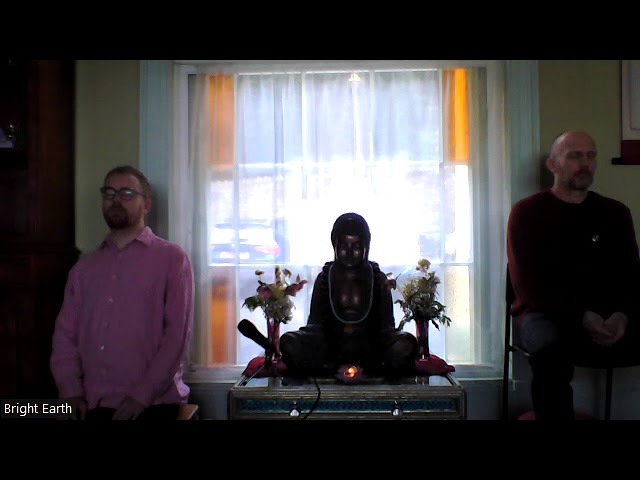
Satya Robyn leads a Buddhist practice session with a nature-inspired Dharma reflection from Dave, guided meditation, chanting of the Nembutsu, recitation of refuges and precepts, and prostrations. The community gathers to dedicate merits together.
Chapters
Good morning, welcome everybody. Welcome to Ian joining us live on Zoom. We'll start this morning's practice as we always do with a Dharma glimpse this morning by Dave. A Dharma glimpse is a sharing from a member of our community on some encounter with the Dharma that they've had. So I will hand you the microphone, Dave. And then it's over to you.
In the past, I really struggled in my own company at times. I used to sleep with the radio on and always had music on in the car when I was driving. I'm much more at ease with myself these days and can sleep and drive in silence. If my thoughts become stressful or negative when I'm driving, I now chant something I've adopted since living at the temple. The other morning on my way to work, my mind began wandering towards negative thoughts and I started chanting. As I chant, I look about me and focus on all the natural beauty that we are surrounded by and can sometimes easily take for granted. As I began chanting on this occasion, I looked up and said to myself, 'Look to the horizon.' These words are followed by other words, and before I knew it, a poem had begun to form in my mind. A kind of Dharma glimpse from nature. Look to the horizon, see the beauty in its outline, sharp black silhouettes of ancient ash and oak above soft rounded hills. Look to the ground beneath you, see the beauty in its complexity, each blade of grass and wildflower petal repeating patterns of nature's symmetry, a myriad colours contrasting and blending in equal measure. Look to the still pool, see the beauty in its perfection. Subtle ripples slipping across its surface, fleeing gentle breezes. Silent creatures gliding beneath in quiet shadows. Listen to the wind, hear it approaching through the trees. Listen to the birds, hear their song with delight and love in your heart. Listen to your heart and know that you are alive. Listen to your heart and know that you are blessed.
So now we'll have a period, a short period of meditation together before moving into chanting Nembutsu. An invitation in the meditation to notice your breath, not trying to change it, just observing how it is moment to moment. The inhale, the exhale, the pause between.
Breath.
And anything that comes to interrupt your attention, noticing what that is— oh, here's a thought, here's a feeling— before gently returning awareness to the breath. In a moment, we'll recite some Nembutsu together. Nembutsu, the practice of saying the name of Amida Buddha. We will use Amitabha, the Sanskrit, this morning. Amitabha, or Amida, is the Buddha of infinite light. And what is the light? It is wisdom and compassion that reaches out from Amitabha in their Pure Land and touches all beings without discrimination, bringing them ease, bringing them enlightenment ultimately. So as we say the name Amitābha, as we chant the name Amitābha, we're connecting with those qualities, trusting that that light is touching us. Sometimes we're able to notice that, sometimes we're not, but we can experiment with the idea. That the light is reaching us wherever we are.
Amitabh. Amitabh. Amitabh. Amitabh. Amitabh. Amitabh. Amitabh. Amitabh. Amitabh. Amitabh. Amitabh.
Amitabh.
Amitabh. Mita. Mita. Mita. Amitabh. Amitabh. Amitabh. Amitabh. Amitabh. Amitabh. Amitabh. Amitabh.
We'll now recite the refuges and precepts and the Bodhisattva vows. The refuges and precepts, repeat after me. The Bodhisattva vows are called And response and the words are on a liturgy sheet next to you or under a chair. For refuge I go to the Buddha, the one who is awake and full of love. Namo Buddhaya. For refuge I go to the Dharma.
For refuge I go to the Dharma.
All that guides us to wisdom and compassion.
All that guides us to wisdom and compassion.
Namo Dhamma.
Namo Dhamma.
For refuge I go to the Sangha.
For refuge I go to the Sangha.
Those who live in the Buddha's light.
Those who live in the Buddha's light.
Namo Sangha. Nam-myoho-renge-kyo! With faith in the Three Jewels— I pray that I may not take life. —with faith in the Three Jewels—I pray that I may not steal. —with faith in the Three Jewels— I pray that I may not fall into sexual misconduct— —with faith in the Three Jewels. With faith in the Three Jewels.
I pray that I may not fall into wrong speech—
—with faith in the Three Jewels. Faithful to you all. I pray that I may avoid intoxication—
I pray, don't win the world's intoxication.
No blame. No blame. Be kind. Be kind. Love everything.
Love everything. Innumerable are sentient beings.
We vow to save them all. Inexhaustible are deluded passions. We vow to transform them all. Immeasurable are the Dharma teachings. We vow to master them all.
Infinite is the Buddha's way.
We vow to fulfill it completely. I am convinced that the Buddha discovered something timeless, that we can find Dharma in any moment. As Dave hinted at in his Dharma Gants, perhaps particularly when we're outside in the natural world. The Buddha spent most of his career outside, and maybe some of us had a hint of that in the garden.
This morning.
The Buddha was describing something that is true, that he discovered, not something he made up. Of course, he was conditioned by the time he lived in, although I trust that mostly he was able to shed that conditioning. He once said it was like discovering an overgrown path through the forest, a path that had got lost, that he rediscovered. The path already existed. He just happened to spot it again and walk down it in a way that other people could follow. A path to a hidden city, I think, is the analogy from the Sutta. In Mahayana Buddhism particularly, there's a tradition of pratyeka Buddhas. These are Buddhas who become enlightened without a teacher. Perhaps they naturally discover meditation as they're sitting quietly, or have a curiosity about the human condition or the universe, and following that curiosity, enlightenment blossoms. For most of us, we are too— our vision is too clouded, our ears are too plugged up to have that kind of experience without the support of people who have gone before us, without coming to places like this. I've been, um, reading recently about the different disciples of Honen. Honen was the Japanese medieval monk who reinvigorated Pure Land practice in Japan and kind of made it his own and created a new tradition. And he had several key disciples that went on to make their own new traditions. Each one having a slightly different version of the teaching, some emphasizing lots and lots of practice, some emphasizing faith in the Buddha, some saying you don't need faith in the Buddha because that's the whole point. The Buddha is present and sending merit towards you. That happens whether you have faith or not. All these different glosses on the same practice. And ultimately, uh, we all do that. We all come to our own particular understanding of the Dharma, of our practice. Even the very deepest understandings are also— can also be very personal. I think it's, uh, in the Sundaikaya where enlightenment is described like a, a box with its lid. And we're all different shaped boxes, and somehow enlightenment, the Dharma, is the right size lid for the box that we are, where we discover what we need to know to awaken us. And in the modern world, we're very used to this because, uh, it's a kind of individualistic society. So it's, it's a kind of normal impulse to make something mine, my particular understanding, my take on things. What's my view on this? So we have to be careful, particularly at the beginning of our Buddhist journeys, but also in the middle and at the end as well, because we bring all of our biases with us to spiritual practice. We bring all of our conditioning. We bring ways of thinking and seeing and feeling that we don't even know about. You see, if we attempt to make something mine too early, often what happens is we create something that includes those biases, that wonky thinking. This is why I'm grateful for the teachers that have gone before us, for the guide rails that the Buddhist tradition presents, something to, uh, act as a mirror for our own practice. It's helpful to have those edges when there's something that has gone before. We can check our own practice against it. Is this really wisdom and compassion, or is it something assuming that guise that is really, uh, self-protective, that is really a judgment about myself?
Others.
So I suppose this is an invitation to hold both of these things in balance, to pay— to, to respect and pay attention to those who have gone before us, to our spiritual elders, but also to trust that through that process, ultimately, uh, our awakening, uh, will be unique. It will also be universal. Of course, both of these things are true at the same time. We awaken to what is eternally true, and that connects us to Buddhas throughout space and time. We share something of their nature. We enter into that oneness, that non-duality, and we also remain in this body, in this time, with our own ins particular insights. So we try and keep an eye on all of these things. Namaste. In a moment we'll stand and make prostrations, and as we bow we'll recite Namo Amitabha, another form of Nembutsu connecting us to those qualities of wisdom and compassion.
In gratitude, we dedicate the merits of this incense offering to all Buddhas and Bodhisattvas throughout space and time. May it be fragrant as the Earth herself, reflecting our careful efforts, our wholehearted awareness and the fruit of understanding slowly ripening. May we and all beings be companions of Buddhas and bodhisattvas. May we awaken from forgetfulness and realize our true home.
So we'll finish by bowing to each other, to one side and then the other. So Angie and I will bow to each other, Dave and Katie, and then Kusuma. Grant, you just wait, and then when we all turn the other way, okay, you'll bow to Katie, Dave and I will bow to each other, and Gian and Kusuma will wait, and then there'll be two bells and we'll bow to the main shrine. Okay, but don't, don't worry too much. Something will happen that allows us to express our gratitude for being here with each other.
Satya Robyn.
We'll tidy our seats and go to our seats. Before we finish with the closing verse, just a reminder that Anji is hosting a kirtan here tomorrow evening. You'll be very welcome to come and join us. Lots of beautiful chanting. That's from 7:30. Great, looking forward to it. Yeah, so we'll finish with the closing verse, which is on the liturgy sheet if you want to join in. Blessed by Amitabha's light, may we care for all living things and the holy land. Nam-myoho-renge-kyo. Thank you everyone. Please feel free to stay for a cup of tea if you'd like to. Nam-myoho-renge-kyo. No, as long as you've got it electronically, then I can put it online if Satya hasn't done that.









