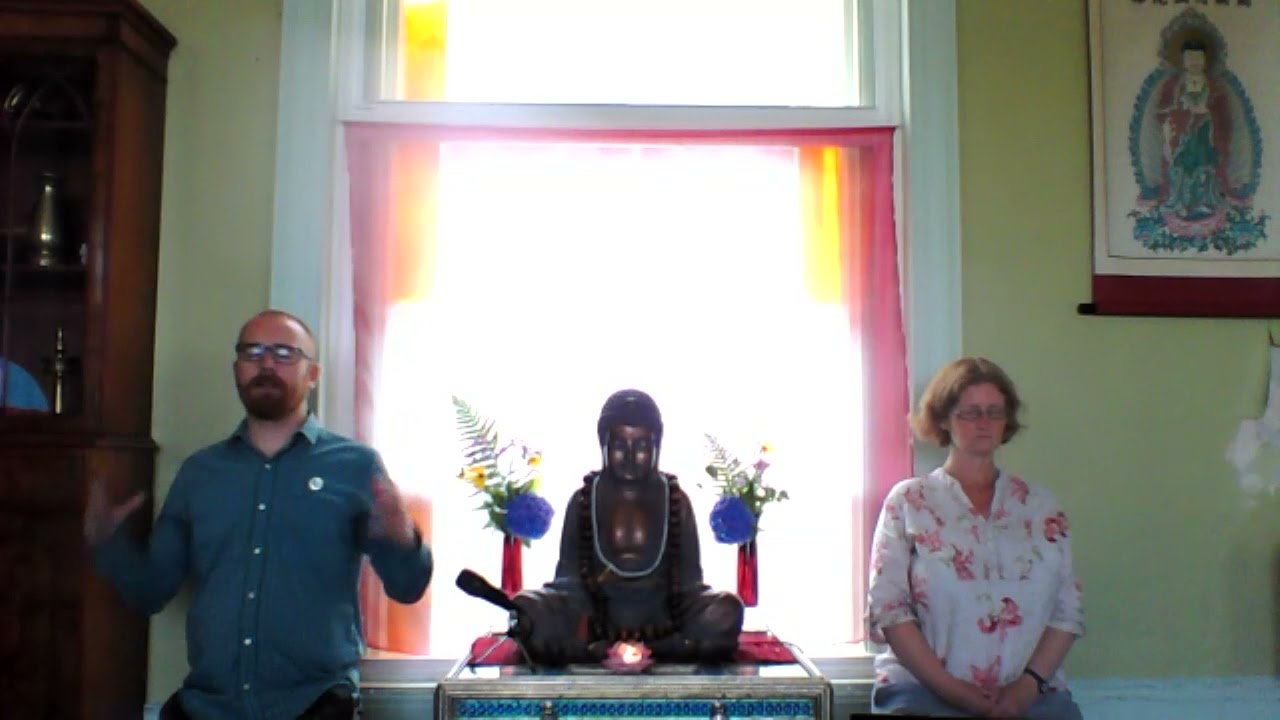
Satya Robyn and Casper lead a Buddhist practice session with sitting meditation, chanting, and a dharma talk on pleasure and pain. The group recites refuges, precepts, and Bodhisattva vows, with participants joining in person and on Zoom from places like Greece.
Chapters
Good morning everybody, welcome to our Saturday practice. We've just come in from the garden so we're a little bit damp, especially those of us who've had dogs sitting on our laps. In the shrine room this morning we have— last week was really busy and today it's a very select few, very high quality people. So we have Dave and Gyame and Sarinda and Casper, who's leading practice, and I'm Satya Robyn. And also very, very fine quality but small number of people joining us on Zoom. Welcome to Manthi. I'm not sure I've pronounced that right, so I'll check with you afterwards. Welcome to our Saturday practice, and I'll hand over to Caspar.
Thank you, Satya. Welcome, everybody. Recently, somebody asked me if I use many pop culture references in my talks, and I don't. And most of the pop culture references I know are very old and all very niche. I could give a lot of dharma talks about Star Trek, but I don't know how appealing that would be. But this morning, something brought a television advert from years ago into my mind, and it's— there's a— it was a series of adverts for, I think, for Ambrosia rice pudding or yogurt or something, with Vic Reeves and Bob Mortimer. If I remember rightly. And it was the, um, they talked about the pleasure-pain principle. So every time one of them had a scoop of the rice pudding, say, the other one would come over and like hit them with a spoon or something silly. And there were a whole series of adverts like this. And whenever you have pleasure, you must have pain. Reminds me of when I was lighting the candles about an hour ago in the shrine and the head of the match flew off and blew, burned the middle of my hand. There's the pain. And then I really enjoyed the walking meditation. There's the pleasure. And it's not, it's not formulaic in that way, but life is always a mix of these two things, pleasure and pain. And it is inevitable that one will follow the other. And what the Buddha suggested is that there is something off to the side that isn't to do with this cycle of pleasure and pain at all. There is a place you can stand outside of that cycle. As a young man, the Buddha glimpsed it a couple of times, once very famously, spontaneously falling into a state of concentration and contentment while sitting quietly under a tree at the Plowing Festival, rediscovering it again many years later under the Bodhi tree on the night of his enlightenment. And then going on to teach about it for many years. It's echoed in the Wheel of Life, the idea that we're reborn countless times into these different realms, some more pleasant than others. And the Buddha's teaching was not about trying to get into the best one of these realms, but in getting off the wheel altogether. So that's true throughout one lifetime as well as throughout many lifetimes. He called this place nirvana sometimes, or we could say it's the same as the Pure Land in this Pure Land tradition. This is the experience of being met by loving kindness, by unconditional love, by joy. It's an experience of spaciousness, an experience of not needing anything in particular. Rumi seems to be hinting at the same thing when he says, 'There's a field beyond right and wrong, and I'll see you there.' Because pleasure and pain, as we normally understand them, are the are the response of the small mind, of the calculating mind, of the reactive mind. We encounter something and we're drawn towards engaging with it deeper and really getting lots of sense pleasure out of it, or we push it away because it's ugly or horrible or distasteful. We judge it somehow. As the small mind relaxes and space appears, occasionally we also get a glimpse of nirvana or the pure land. This place in our own sense of being where there is no judgment. There's just things happening in the world and we're able to sit with them without being particularly disturbed one way or the other, fairly content, fairly peaceful. Remembering that that place exists then changes how we behave when we come away from that experience, being received into that place of loving kindness. Means that even once we're back in our small minds, we're, we're more likely to be kind to others and we're less likely to be judging. So I guess there are two kinds of practice. One, like the sitting meditation that we're going to do in a moment, allowing the small mind to relax, allowing thoughts and reactions and judgments to settle, and maybe they settle and clear, and we have a sense of that spaciousness. Within ourselves. And sometimes we do and sometimes we don't. Or the other kind of practice that we also do here, which we'll do when we're chanting a little bit later on, trusting that that place exists outside of us and all around us. That Buddha manifests from that place, that we can be in relationship to it regardless of the state of our own mind. In the same way, like whether I notice the view outside— there's not much of a view today because it's very misty— but whether I notice the view or not, if my mind is really busy or I'm really frustrated with something or thinking about work, I might walk through the house and not see the view. But the view is still there. The beautiful world is still there. The chanting practice is about remembering that nirvana, the pure land, this energy of loving kindness is still there, whether we can feel it inside of us or not. And not only that it is still there, but that it is all around us and receiving us in every moment. So now we'll move into a period of practice. So we'll begin with quiet sitting, potentially allowing the mind to settle and clear, and then we'll move into some chanting. And we'll chant— I'll say it again when we're going to begin chanting. I'll ask Satya to type it into the chat box, but we'll chant Namo Amitabha this morning, which is a Chinese chant meaning I take refuge in the infinite light. So reminding us of that quality of spaciousness and love that's all around us. Namo Amitabha. So as we sit quietly together An invitation to notice your breath, the cooler air entering at the tip of the nose, the warmer air leaving. Not trying to change the breath, just noticing how it is moment to moment. And if, when perhaps thoughts, feelings, reactions, sensations appear, you notice yourself getting into storytelling, just noticing that that's happening, perhaps naming what it is to yourself. Oh, there I go thinking about this thing again. Oh, I've just— my back's really letting me know it's sore this morning. Okay, I've noticed that. And then bringing awareness back to the breath. In a moment, we'll begin chanting together. As I said, we'll chant Nam-myoho-renge-kyo, Chinese for I take refuge in the infinite light. The tune also comes from Chinese Buddhist temples, and it's a little bit complicated, but do join in when you catch on. To what we're doing. So reminding ourselves that that spaciousness, that loving kindness, is always available, even with whether we can feel it or not.
Om for Namami Swarupa Yamomi. Na ma mi to o ko na ma me. Namoh Mitto Ahovala Omi! Oh, oh, oh. Oh! Namaste. To— Oh! Namo Amma Ji.
Me.
In a moment, we'll recite the refuges and precepts and the Bodhisattva vows. We'll take refuge in the Buddha, which is to say awakened teachers, and the spirit of those teachers and Buddhas that is available to us today. We take refuge in the Dharma, the teachings of those teachers, and also things as they are, recognizing that we can learn from every moment if we give the right kind of awareness to it. And we take refuge in the Sangha, the community of people following those teachings. Then we'll recite the 5 lay precepts, our aspiration for good behavior, if you like, and then the Bodhisattva vows. They are written on the piece of paper behind, under the chairs, if you want to read them. The first couple, I will recite them and then ask you to repeat, and the Bodhisattva vows are call and response, so Dziamay will chant the first line and then we will reply with the response. So please repeat after me. For refuge I go to the Buddha. For refuge I go to the Buddha. Namo Buddha. Namo Buddha. For refuge I go to the Dharma. For refuge I go to the Dharma. Namo Dhammaya. Namo Dhammaya. For refuge I go to the Sangha. For refuge I go to the Sangha. Namo sangha. With faith in the Three Jewels, I pray that I may not take life. With faith in the Three Jewels, I pray that I may not steal. With faith in the Three Jewels, I pray that I may not fall into sexual misconduct. I pray that I may not fall into sexual misconduct— With faith in the Three Jewels. —I pray that I may not fall into wrong speech. —With faith in the Three Jewels. —I pray that I may avoid intoxication. Innumerable are sentient beings. We vow to save them all. Inexhaustible are the Buddha's passions. We vow to transform them all. Immeasurable are the Dharma teachings. We vow to master them all. Infinity is the Buddha's way. We vow to fulfill it completely. So now there's an invitation to make prostrations. If your body allows, we go right down to kneeling on the floor. This is a way of, with our whole bodies, putting that aspiration for loving kindness above our own small minds. As we do this, we chant Namo Amida Butsu, which is just another version of what we were saying earlier. I take refuge in the Buddha, the Dharma, and the life. In gratitude, we offer this incense to Buddhas and Bodhisattvas throughout space and time. May it be as fragrant as Earth herself, reflecting our careful efforts, our wholehearted awareness, and the fruits of understanding slowly ripening. May we and all beings be companions of Buddhas and Bodhisattvas. May we awaken from forgetfulness and realize our true— so we bow to each other. Come to the main shrine. Yeah, tidy our seats and back to our seats. So, uh, listening circle at 6 o'clock for anybody that wants to join us. This evening, and next week and next Saturday at 2, meeting in the garden for a mindful walk on the hills.
And we have a cup of tea afterwards if you want to join us. Toilets up the top of the stairs. And do unmute because we do a closing verse together.
Yeah, and the donation bowl's in the hallway.
Did I say anything myself? No.
All right, so we'll just read a closing verse together, which is on the bottom of the piece of paper, if you want to join in. Blessed by Amitabha's light, may we care for all living things and the holy earth. Nam-myoho-renge-kyo. Thanks everybody.
Hi, hi. Say that again.
Hi, I am Manthy.
Where are you, Manthy?
I am from Greece. And are you in Greece? I am in Detroit now. Hello, Michael! You had lots of fires. Fires, fires, and many things, but it was very interesting. Very, very interesting.
And Desha's got twins. Yeah, good. Did you, did you, um, understand some of what we did?
Uh, I, I didn't understand the Namo Amitofu, what means.
Yeah, so Namo, it's, um, it's, it's Chinese. Chinese. Ah, so Namo means I call out to I take refuge in. And then Omido is the Chinese word for Amida, and Amida Buddha is the Buddha of infinite light.
It's my first time, but it was very interesting. Incredible, incredible. Good. Oh, that's nice to hear. Yes, incredible, really, indeed. Good, well, that's lovely. You're very welcome. Where, where are you exactly?
So we're in the UK. Do you know where Birmingham is?
We're kind of like near Birmingham, an hour away from Birmingham. One hour away from Birmingham.
Small town, it's quite green. We're lucky, it's quite green around here. We have hills. It's called Molden, this town. We have We have this quite flat, and then there's some hills, the Malvern Hills.
You are in— I thought you are in Worcester Road. That's right, Worcester. In Malvern. Yeah, yeah.
Andesh lives on the Isle of Wight.
Very, very, very, very interesting.
Yeah, if you have any questions, you're welcome to email me.
Yes, I can email you in the mail that it is in the Meetup.
That's right, yeah. Or have you seen our website?
Uh, no, yet, but I will have a look.
Yes, there's lots of information on the website. There's a free, um, course, email course if you want to learn a bit more about, um, more about Buddha.
Yeah, practice. And you, you are a Buddhist teacher? Yes, so me and my husband, we run the temple here. Ah, very interesting, very interesting.
Yeah, well, it's good to have you.
I liked, I liked very much. Good, good.
Well, it's lovely to have a visitor from Greece. Yeah.
It's a good thing, isn't it, Zoom? Yeah, yeah. So see you in the next meeting.
We meet Wednesday nights and Saturday morning every week.
Wednesday morning and Saturday morning?
Wednesday night, Wednesday evening.
Wednesday night and Saturday morning, this time?
Yeah, same time, 9:30. It's all on the website as well. If you have a look on the website website. It's all there on the website.
Okay, okay. Nice, very nice to meet you. Very nice to meet you. Bye-bye. Bye-bye.
Take care, Ander. Lovely to see you. See you soon. Bye-bye.









