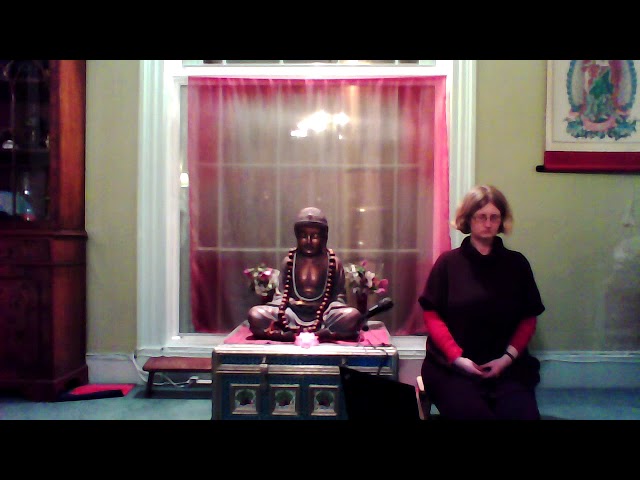
Satya Robyn leads a Buddhist practice session featuring a dharma talk on care and attention, anchored by a Natalie Goldberg story about Katagiri Roshi. The group chants Amitabha, takes refuge vows, recites ethical precepts, and bows together.
Chapters
Ame tabu.
We have Jahmay, Philip, and Dave in the shrine room. We have Beth and Paul joining us online. Casper read me a quote yesterday from a book he was reading by Natalie Goldberg, who is a Zen practitioner, also writes about writing, and she was writing about her teacher Katagiri Roshi in an interview with a Zen student, and the Zen student came in and asked Katagiri Roshi, 'What is Zen? What is Buddhist practice all about?' Katsugiri Roshi took a book and he said, "You can either put a book down like this," and it just kind of fell on the table and all its pages everywhere, "or you can put a book down like this." And that was all he said, which is a very Zen teaching. Apparently the student who was talking to Natalie Goldberg about this had no idea what it meant, and she was completely perplexed. And Natalie Goldberg said that Katsugiri Roshi didn't waste much time on people who didn't get it, so there weren't any more explanations because she kind of got it or she didn't. So I could leave my dharma talk there. I guess it led me to think about the care that we pay to our environment when we are living a spiritual life, when we are guided by spirituality, that there's something about not having to think too hard about how we put the book down because we have an innate respect for the book as an object, and we want to be gentle with it. And that when we walk into the garden and we see weeds, we just kind of innately tidy the flower beds or help the plants in whatever way they need helping., and that this kind of attention and care flows very naturally from us. One of the difficult paradoxes about living a spiritual life is that it is difficult to fake it. We can fake it, we can think, "Oh, my teacher told me that if I'm kind to objects, then I'm a better Buddhist," or it means I'm a better person, or it will get me enlightened quicker. And we can do that. Sometimes faking it to make it is, is a good, a good thing to do. But unless these acts of care and attention spring naturally from us, we'll find that there are kickbacks, that we might become exhausted because of all the hard work our brain's having to do to think of what the good thing to do is. We might become resentful because we're always having to be careful with objects and other people aren't, and we might become kind of despairing if we're doing this because we think it will get us something and it doesn't. That there's some sort of consequence that we're not in control of. I think Pure Land Buddhism addresses this very well when it talks about the bamboo paradigm, that our motives are often unknown to us. And we can't just change ourselves by our own efforts. And here we are in the shrine room, and so there is something that we can change. We can bring ourselves into relationship with the Buddha. We can bring ourselves into relationship with something infinitely loving and wise, whatever name we give that thing, that is not in us but is outside us, and hang out in that place. And that might affect us in two ways. One is that we witness the care and attention that the Buddha, or the people who we see the Buddha through, pay to their environment and other people around them. Something very inspiring about watching people unselfconsciously look after things. And as we soak in some of that care and attention, there's something infectious about it. That we're more able to be kind to ourselves, and that somehow transforms us in a way that we, we do have more to offer in a natural way. And that Katagiri Roshi's Dharma teaching to that student was his way of taking care of her, that he was trying to transmit something, to show her something, and that she would get it or she wouldn't get it. And the student passed it on to Natalie, Natalie passed it on to Casper, Casper passed it on to me, and I'm now passing it on to you. And that, that's also how dharma works, is that The care and attention doesn't always hit home, but it, it bounces around in the world doing good. We never really know how much good our own actions lead to. And maybe when you're next putting down a book, you'll think of Katagiri Roshi, who's dead now, and imagine him placing the book on the desk in front of him and the students' bewilderment. Nam-myoho-renge-kyo.
Amitabha. Amitabha. Amitabh. Amitabh.
Amitabh.
Amitabha. Amitabha. Amitabha. Amitabha. Amitabha. Amitabha. Ame taba. Ame taba. Amitabha. Amitabha. Amitabha. Amitabha. Amitabha. Amitabha. Amitabha. Amitabha. Amitabha. Amitabha. Amitabha. Amitabha. Amitabha. Amitabha.
Amitabha.
Amitabha. Amitabha. Amitabha. Amitabha. Amitabha. Amitabha. Amitabha. Amitabha. Amitabha. Amitabha. Amitabha. Ameetabha. Ameetabha. Ameetabha. Amitabh. Amitabh. Amitabh. Ameetabh. Ameetabh.
For refuge I go to the Buddha.
For refuge I go to the Buddha.
Namo Buddhaya. Namo Buddhaya. For refuge I go to the Dharma.
For refuge I go to the Dharma.
Namo Dharmaya. For refuge I go to the Sangha. Namo Sanghaya. With faith in the Three Jewels, I pray that I may not take life. With faith in the Three Jewels, With faith in the Three Jewels I pray that I may not steal. With faith in the Three Jewels I pray that I may avoid sexual misconduct. With faith in the Three Jewels I pray that I may not fall into wrong speech. With faith in the Three Jewels, I pray that I may avoid intoxication. I pray that I may avoid intoxication.
Innumerable are sentient beings. We vow to save them all. We vow to transform them all. We vow to master them all. We vow to fulfill it completely. Amor Amida. Namoh Amida. Namoh Amida. Amor Amida. Namoh Amida. Namoh Amida Butsu. Namoh Amida Butsu. Namoh Amida Butsu. Namoh Amida Butsu.
Now we will bow to each other. And then if people want to unmute, we'll all recite the closing verse together, which I still haven't printed out.
Sorry, guys.
Blessed by Amitābha's light, may we care for all living things and the holy earth. Namō Amida Butsu. Yeah, nice and peaceful. Feels peaceful tonight.
It does. It feels strangely serene. Yeah.









