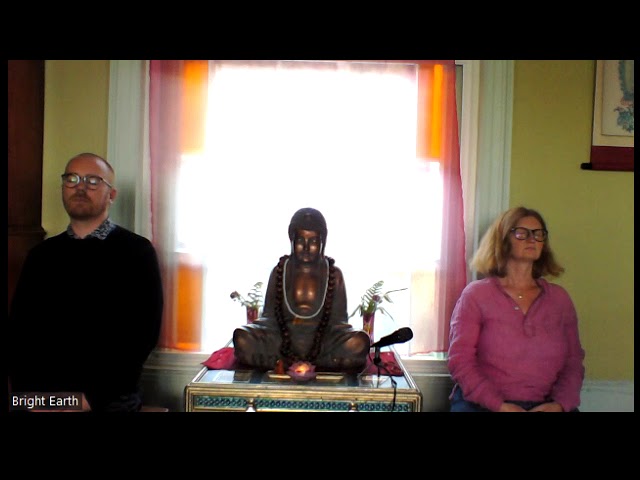
Satya Robyn leads a Pure Land Buddhist group practice with temple leaders Caspar and others. The session includes meditation, chanting of Amitābha, recitation of refuges and precepts, and a Dharma reading by Djalme Dunsby about dating.
Chapters
Good evening everybody, lovely to see new faces and joining us on Zoom today we have Chris and Seth, welcome and somebody who's just dropped an iPhone. That's probably not their real name, so welcome to that person too, whoever they are. We record, me and Casper, so don't worry, nobody else is getting recorded, so people can join us from further away, and we upload it all onto YouTube afterwards.
So this evening, the first couple of practices every month are extra extra user-friendly if you haven't been before. So I'll tell you what we're doing as we're doing it. Having said that, there's something about Buddhist practice that you can't really explain. You just have to sort of do it for a while. So if there are things that you're not sure about or questions you have, I'd encourage you to just keep coming and seeing how it feels. We do various things, but we will begin with something called a Dharma glimpse, which is a little piece of writing by different members of our community which describes a moment of seeing some truth, saying some new truth. And Casper, who is my husband and who runs the temple with me, will be reading a Dharma glimpse today. By a colleague of ours who lives here. Namaste bhin.
Yes, so Djalme, who wrote this, lives here in the temple with us, but he can't be here this evening, so I'm going to read it on his behalf. And this is called Hopes and Fears by Djalme Dunsby. I'm beginning to explore the possibility of dating again after a long period of celibacy and recovery from compulsive patterns, some of which are related to relationships, both platonic and romantic. This effort to consciously engage with prospective partners has opened up a whole new dimension in my encounters with women. A once dormant part of me has apparently reawoken. It's partly exciting and fun, yet also overwhelming and confusing. It's brought me face to face with some of my conditioned behaviors that have developed from a very early age and helped me to see how they've contributed to chaotic and painful outcomes in my attempts to have healthy and fulfilling relationships. The matter of relationships has always been loaded for me. My internal complexities have often dominated and overpowered my good intentions in one way or another, creating a kind of feedback effect that can be excruciating if you don't know what's happening. There can be confusion on both sides of the relationship as unseen and unconscious impulses dictate the direction and tone of the union, leaving you both bitter and confused when it goes wrong for no apparent reason. Buddhism has helped me to see and understand that I have an innate tendency to either grasp at things because I like them or push them away because they pose some kind of threat. Relationships with other humans have the potential to activate both of these behaviors in me. I crave the attention and stimulation of being around nice people, yet my psychological wounding can prevent me from getting— letting them get too close, which can cause all sorts of confusion and misunderstanding. As a different— as a devotional practitioner and recovering compulsive, my primary relationship has to be with Amida Buddha. Everything else has to grow out of it or in conjunction with it. I am, after all, a foolish being of wayward passions. I think I know what I want, but when I get it, it can feel like too much and trigger me into destructive ways. And my foolishness is in some ways integral to my faith, in that it is the basis for me seeking a power greater than myself, the catalyst which transforms my karmic mess into dharmic grace. Of course, it's never as neat as that and often includes deep suffering, but the lesson is proceeding in a conscious way while paying attention to the currents of synchronicity that weave themselves around our hopes, fears, and desires. Namomi tabu. Thank you, Jahmay.
So we will now sit quietly together. Welcome, Beth.. And as I was listening to Kaspar, I was also struck by the joyous birdsong coming from outside. I don't know if it's because it's near the end of the day, they really seem to be going for it. So while we sit quietly, you might just want to listen to the birds. Put your attention on the sounds, and when your attention wanders, just bring it back to the sounds that are around you. Or if you prefer, you could just pay attention to your breath as it comes and goes without changing it, just noticing when it comes in and when it goes out. After 10 minutes or so, we'll begin to chant together.. And it's really lovely to sit quietly with other people, and I also feel that it's really lovely to join our voices, and there's something different in quality to that. And the word that we'll chant tonight is Amitābha. Amitābha is the same Buddha as Amida, which was mentioned in Jamy's Dharma glimpse, and I'll say a little bit about Amitābha afterwards. So the tune is quite simple, and when you roughly get the tune, do join in with us. Don't worry too much about whether you're getting it right or about whether you're tuneful. Just, just let your voice join with ours. So, Namo Amitabha.
Amitabha.
Amitabha.
Amitabha.
Amitabha. Amitabha. Amitabha.
Amitabha.
Amitabha. Amitabha. Amitabha.
Amitabha.
Amitabha. Amitabha.
Amitabha.
Amitabha.
Amitabha. Amitabha. Amitabha.
Amitabha.
Amitabha. Amitabha. Amitabha.
Amitabha.
Amitabha. Amitabha.
Amitabha.
Amitabha.
Amitabha. Amitabha.
Amitabha.
Amitabha.
Amitabha.
Amitabha.
Amitabha.
Amitabha.
Amitabha.
Amitabha. Amitabha.
Amitabha.
Amitabha.
Amitabha. Amitabh. Amitabh. Amitabh.
So next we will recite some things together which are on a little bit of paper. Underneath you don't need to have it because it's a repeat after me, but you might just want to look at the words. And if you don't want to say the words for yourself, you can say them to support other people here who try to abide by what the words point towards. First of all, we have the refuges. All Buddhists take refuge in three things, 3 jewels they're called, and they are the things that remain reliable in this world of impermanence. So please repeat after me: For refuge I go to the Buddha.
For refuge I go to the Buddha.
The one who is awake and full of love.
The one who is awake and full of love.
Namo Buddha.
Namo Buddha.
For refuge I go to the Dharma.
For refuge I go to the Dharma.
All that guides us to wisdom and compassion.
All that guides us to wisdom and compassion.
Namo Dharmaya.
Namo Dharmaya.
For refuge I go to the Sangha.
For refuge I go to the Sangha, those who live in the Buddha's light. Those who live in the Buddha's light.
Namo Sanghaya.
Namo Sanghaya.
Next we recite the precepts for lay people, which is us, unless there are any monks in the room. And these are 5 things that we try to adhere to and fail. So there's like, it's like a direction that we're pointing in. And they also give us a chance to just reflect on our lives and look at where we are doing things that are unskillful and be curious about why that might be. With faith in the Three Jewels, with faith in the Three Jewels, I pray that I may not take life I pray that I may not take life— With faith in The Three Jewels!
—The three jewels...
"Kokoro" ...with my mind? Avec foi dans les trois bijoux?
Je prie que je ne prenne pas la vie avec ma tête?
J'espère qu'en gardant confiance en Les Trois Bijoux ????? ??.
Je prions pour éviter de voler ou commettre des abus sexuels.
Je le demande à Bouddha et aux esprits protecteurs du monde entier! .....avec Foi En Les Trois Joules ??? With faith in The 3 jeweled gemstones??? Je suis honête...]: Avec Faiteen Le Trejewls ???...) I pray that I might fall into wrong-speech.....
...
«Faux-parole» .
With faith in the Three Jewels, with faith in the Three Jewels, I pray that I may avoid intoxication.
I pray that I may avoid intoxication.
And then the words of my friend Terry: no blame, no blame, be kind, be kind, love everything, love everything. And then Phoebe will lead us in the Bodhisattva vows. Which again are descriptions of how an enlightened being might behave, and they're set up to be impossible. So we again, we hold them in front of us as a direction to travel towards.
In your blossomed humaneness, we vow to save them all. Inexhaustible are deluded passions.
We vow to transform them all.
Immeasurable are the Dharma teachings.
We vow to master them all.
Infinite is the Buddha's way.
We bow to Prophet completely.
So, um, what are we doing here? You all have your different reasons for being here. But I am here because, first of all, because I run the temple, so I kind of have to be here. But why am I running the temple? Because practicing Buddhism has allowed me to connect with a source of infinite love and infinite wisdom.. And in the precepts, we spoke of the Buddha as being the one who is awake and full of love. When we speak of the Buddha, most people are thinking of the man who lived in India 2,500 years ago, Shakyamuni Buddha. But the idea is that Buddha means enlightened one, so any being that is awake and full of love is known as a Buddha.. And there are many, many Buddhas. We just have to look around the shrine room. We've got Amida Buddha here, we've got Shakyamuni Buddha here, we've got Vajrapala, we've got Kuan Yin and Tai Chi Chi who are bodhisattvas. And they all have their different qualities and their different personalities. Whether we believe they exist or not doesn't really matter, because if we connect with them, we can, we can allow those qualities to rub off on us. And as Pure Land Buddhists, which is what we are here, the Buddha that we kind of put in the center of our shrine or our practice is Amitabha, or Amida. Amitabha is the Buddha of infinite light. So Amitābha personifies a kind of a shining compassion that penetrates, that is, that goes on and on and on. And when we speak of Amitābha, of Amida Buddha, we often say that they accept us just as we are. There's a really beautiful little poem by a Japanese poet called Inagaki that goes, "Just as you are, really just as you are." And for me, that really is necessary because there's something about the idea of being acceptable and lovable just as I am that's quite difficult to really comprehend or believe. And that's okay. We don't have to comprehend it or believe it. All we have to do is come into relationship with that source of love and trust that something is beginning to work away on us. Every time we step into the shrine room, every time we make an intention to follow a precept or be grateful or be humble or to ask for help, especially to ask for help from the Buddha, then that, that influence is working away on us. And we can try and talk about it, which we try to do twice a week, but it is difficult to speak of. Really what I hope is that you might just begin to feel a little bit of something in your heart as we sit here together in this beautiful room with each other. So that's all I'll say today. And we finish practice with prostrations. So prostrations are another way of connecting with the love of the Buddha, and they used to be my least favorite thing to do, and now they're my most favorite thing to do. I find that prostrating just allows me to to just relax and let it all go and let the Buddha take care of it. So we do something that's quite difficult if it's your first time. We chant, which you can't— you won't know— and do prostrations at the same time. So don't worry about doing both. And we're in the minute when Phoebe rings the bell, we'll all stand up and face the main shrine and with a bit of floor in front of you. If your body is willing for you to go all the way to the floor and back up again, then do copy me. If not, just stay standing and bow, or seated and bow, whatever, whatever feels comfortable. And in your mind, you can go as low to the floor as you like. And then after that, I will do a little offering to the shrine. When we make offerings, it's really another way of connecting, and it's like you'd offer food to someone that came to your house. That's how it is to make offerings to the Buddha. Philip, maybe you could slide over and get the reading to read when I do this, the incense, over there on the chair after we do prostrations. Yeah, or whenever. Nam-myoho-renge-kyo.
Namoh Amida. Namoh Amida.
Namoh Amida. Namoh Amida. Namaste. Namoh Amida Butsu. Namoh Amida Butsu. Namoh Amida Butsu.
Namoh Amida Butsu.
We dedicate the merits of this incense offering to all Buddhas and Bodhisattvas throughout space and time. May be fragrant as Earth herself, reflecting our careful efforts, our wholehearted awareness, understanding slowly ripening. May we and all beings be companions of Buddhas, May we awaken from forgetfulness and realize our true home.
Thank you, Philip. So if you'd like to return and stand at your seats, we always finish by bowing to each other to thank each other for being here and practicing with each other. So when Fi rings the bell, Caspar will turn to bow to Fi, and I will bow to Philip. So you can work it out amongst yourselves, and then we'll turn, and then we'll turn and bow in the opposite direction. It's hard when there's an odd number, I know. And then we will bow to the Buddha. And then we tidy our seats and bow to our seats, opening back where it was. So announcements before we finish: there is a golden bowl in the hallway for donations, which will be gratefully received. The toilets at the top of the stairs. We always have a cup of tea after practice You've come on a good night because there are chocolate brownies tonight, which doesn't always happen. Some of them have, some of them haven't.
But if you've got an allergy, you'll need to tell them.
True, they're vegan. Sorry if you're on Zoom, we'll send you a virtual chocolate brownie. We've also just launched today some book study groups which will take place both in the temple and hopefully online. So if you're not on our mailing list and you haven't got details about that, then ask us afterwards. Have I forgot? Oh, we have a retreat day on the 11th of June, which is next week on Saturday. So that will be a whole day of different things you can kind of drop into. That's it. So we always finish, the final thing we do is chant, recite the closing verse, which is on one of the sides of the bit of paper. We need to sort out that for there as well. And so do join in with me.
Blessed by Amitābha's light, may we care for all living things and the home of the earth.
Namō Amitabha. I will say hello to Zoom people and do follow Satya Robyn. Oh yeah, yeah, yeah, come and say hi to— let me stop the thing.









