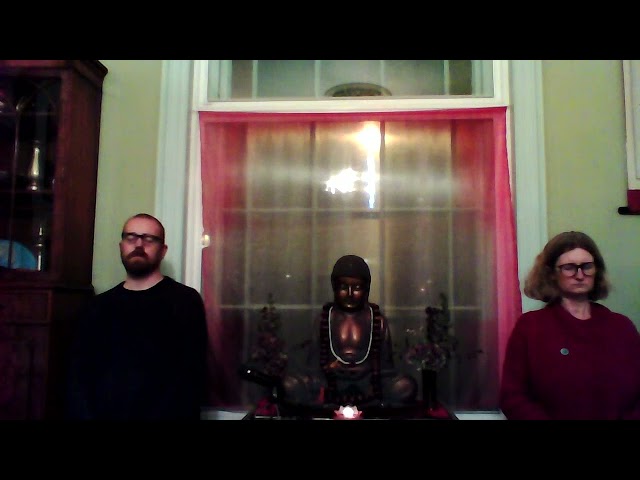
A Buddhist practice session led by Satya Robyn honoring Beckie, a longtime attendee who recently died. The group meditates, chants to Kwan Yin, and reflects on Pure Land themes and transfer of merit in remembrance of her.
Chapters
Good evening. Welcome everybody. There's 5 of us here in the shrine room this evening, and we're joined by Philip and Beth. On Zoom, welcome. As we have started to do recently, we will begin with reading a Dharma glimpse. And of course, a reminder, there's an open invitation that anyone can write one of these and let us know, and we can have it read out at this time. Also, you can do that if you're on Zoom. You can even do it if you're watching later on YouTube. Drop us an email and maybe we will read it out or put it in the newsletter. Yeah, I mean, unless it's offensive, we'll definitely read it out. I haven't asked anyone in advance, but I wonder if anyone would like to volunteer to read about half a page this evening. Do you mind coming up and sitting where Satya Robyn is, just so you can be on the mic? Thanks. Oh, and at the end we're all going to bow and say namo amitabha. It's a way of receiving the wisdom.
Fruit of Meditation. I got ready for meditation. As always, I prepared my spot by lighting incense and candles. I'm sure we're all familiar with the phenomenon of a light source burning an image on the back of our eyes as we close them. We get the silhouette of the last image we saw. For me, as I sat there on my zafu, that image was a statue of Shakyamuni Buddha that I have as the centerpiece of my altar. The black silhouette of the Buddha was surrounded by the glow of the candles burning beyond my closed eyelids, which appeared in the shape of a pair of hands in gassho on my retina. The image of the Buddha seemed to reach out, and the black of his silhouette extinguished the red glow, and my inner vision went completely black. No image remained burned on my retina. In religions as a whole, we often attribute the deity prophet, etc., as a guiding light. But this image made me see it in a different way. The Buddha and his law can be seen as the gentle shade comforting and protecting us from the harsh burning light of our illusions. Just as we take refuge under the shade of a tree on a hot summer's day, sunny day, we take refuge in the Buddha. His law comforts us and lessens the burning of our ego-fueled selves so that our true self can enjoy the gentle ephemeral— ephemeral, thank you— breeze of universal oneness. Now, I'm not implying that this was in any way a mystical event. It was mere physics and biology acting accordingly to nature. But that such an image resulted from natural processes and the circumstances of the moment serves to remind us that the Dharma is present everywhere. We just have to open our eyes to see it. Now, Mamie Dabou.
Thank you very much. Thank you. So now we'll go into a period of quiet sitting together. If you notice any stillness or peace in your practice, allowing your attention to dwell there. Any thoughts, feelings, sensations that come to distract you, inviting them to step back so you can continue to place your awareness with that sense of peace or stillness, trusting that that will be good for the parts of your mind that are distracting you, as well as for you. This evening we'll chant A mantra to Kwan Yin, the bodhisattva of compassion, who is associated with moonlight. Namo Kwan Shin Bosat. I call out to the one who hears the cries of the world. Both connecting with our own sense of compassion, if that's available, but also understanding that we can call on this compassionate energy from outside of us, that we can be held in and moved by.
Namah Kwan Chim Bosat. Namah Kwan Chim Bosat. Namah Kwan Chim Bosat. Namah Kwan Jin Bosats. Namah Kwan Jin Bosats. Namah Kwan Jin Bosats. Namah Kwan Shin Bosat. Namah Kwan Shin Bosat. Namah Kwan Shin Bosat. Namah Kwan Shin Bosats. Namah Kwan Shin Bosats. Namah Kwan Shin Bosats. Namah Kwan Shin Bosat. Namah Kwan Shin Bosat. Namah Kwan Shin Bosat. Namah Kwan Chim Bosat. Namah Kwan Chim Bosat. Namah Kwan Chim Bosat. Namah Kwan Shin Bosat. Namah Kwan Shin Bosat. Namah Kwan Shin Bosat.
For refuge I go to the Buddha— for Refuge I Go To The Dharma— Namo Buddhaya! For refuge I go to the dhamma— for Refugiah Goh Chah Dahmah— Namu Dharmayah! For refuge I go to the Sangha.
For refuge I go to the Sangha.
Namo sanghaya. With faith in the Three Jewels—
with faith in three jewels—
I pray that I may not take life.
I pray that I may not take life.
With faith in the Three Jewels—
with faith in the Three Jewels—
I pray that I may not steal. I pray that I may avoid intoxication. No blame.
No blame.
Be kind.
Be kind.
Love everything. Love everything.
Innumerable sentient beings, we vow to save them all.
Inexhaustible are deluded passions.
We vow to transform them all.
Immeasurable are the Dharma teachings.
We vow to master them all.
Infinite is the Buddha's way.
We vow to forfeit completely.
Namamit Bhut. Some of you know, some of you don't know that Rekhi, who came to the temple for a long time, passed away yesterday. We heard from her sister. She hadn't been here in person since the pandemic, but she was on Zoom quite often, so you might have seen her face on Zoom if you're joining us through Zoom. We don't know any details, but she'd been ill with poor lungs for quite some time. So I'm just remembering her and remembering her spirit. She was in some ways quite quiet, but she had a good sense of humor, and she was always very reassuring when we were talking about the struggles we were having with our dogs, which I really appreciated. Um, she had a history of— she worked as a dog groomer for a long time, and her I think it was her uncle who first imported a particular breed of dogs into the country. And something she said when we were training Aiko, I think, is equally true about Buddhist practice: just trust that it's all going in there, and you'll start to see the results at some point. And it turned out to be true. Yeah, so missing her. The, um, some of the classical ideas around what happens at the point of death in Buddhism is that, that we're sort of presented with all these different things that we might be drawn to, different places that we might be drawn to be reborn. And depending on our karma, depending on the, the kind of active habit patterns through our life, and particularly at the moment of death, they take us to particular places. And many of those places contain suffering. Even if we want to be reborn close to our hometown, you know, as a human being, that life is one that will be mixed. Pure land— well, all of Buddhism suggests that if we can face the light in that moment and receive the invitation to be accepted into the light, then we will be lifted into the pure land or into nirvana. But that is It's usually understood that that's something that takes a lot of training to do, to get ready for that opportunity. Pure Land Buddhism suggests that taking a leap of faith is enough, making the choice to step into the light is enough, and that we can make that choice at any time. And I, I really trust that, knowing Becky well, that she will have made that choice, that the Buddha will have met her and welcomed her into the Pure Land. Jia Kenneth, writing about this process— Jia Kenneth was an English woman who trained in the Zen monastery in Japan just after the Second World War, she had this idea that these habit patterns, these parts of us that were greedy or contained ill will or ignorance, that they would be— that they would end up in the world somewhere, but that the parts of us that were enlightened would automatically be reborn in the Pure Land. A little bit— this isn't the perfect analogy, but like sometimes the image of a wave at sea, waves at sea, is described to get across this sense of how we are all connected and one very deep down where the ocean is still, as this shared sense of stillness. But how on the top of the ocean every wave is unique and different, and when the wave breaks and crashes down, the energy of that goes across the surface of the water into other waves, forming other ripples. But that stillness remains. I quite like that idea that, that we can do training, we can do spiritual practice to find that place of stillness, to heal some of the wounds that create that greed, hate, and delusion. Leaves less stormy waves on the surface to be transmitted. But I also like the idea that however much is left, we can hand that over. We can keep handing it over, trusting that there is something else running alongside our training. That you can— it called the eternal or the cosmic Buddha— that will take care of that. And maybe that's our job mostly, just to trust that the eternal will take care of it. The thing that Becky said that touched me the most over all the years that I knew her was that she was grateful for having a glimpse of the divine in the shared practice here. She never expected to know that. So I'm remembering her. I'm trusting that she's already received by the light or the shade, and I'm trusting that we can all hand ourselves over to the eternal and be carried forwards to the Pure Land. Together, even if we don't quite know exactly what that means, that we can trust there is something good we can rely on. Nam-myoho-renge-kyo. So before we move into prostrations, we'll transfer the merit of our practice together to Becky, trusting that she's been reborn in the pure land, and to her family, that they also can be held by the light in whatever way is right for them during this grieving process.
By your vows and through your grace, a pure land I've been.
In gratitude, we offer this incense to Buddhas and Bodhisattvas throughout space and time. May it be as fragrant as Earth herself reflecting a careful effort our whole heart to learn, and the fruits of understanding slowly ripening. May we and all beings be companions of Buddhas and Bodhisattvas. May we awaken from forgetfulness and realize our true home. Now we'll finish with the closing verse. Do unmute if you're on Zoom. Blessed by Amitābha's light, may we care for all living things and the holy earth.









